On this page
Gen3 Marketing Review 2026: The Biggest Agency, Assembled From Four
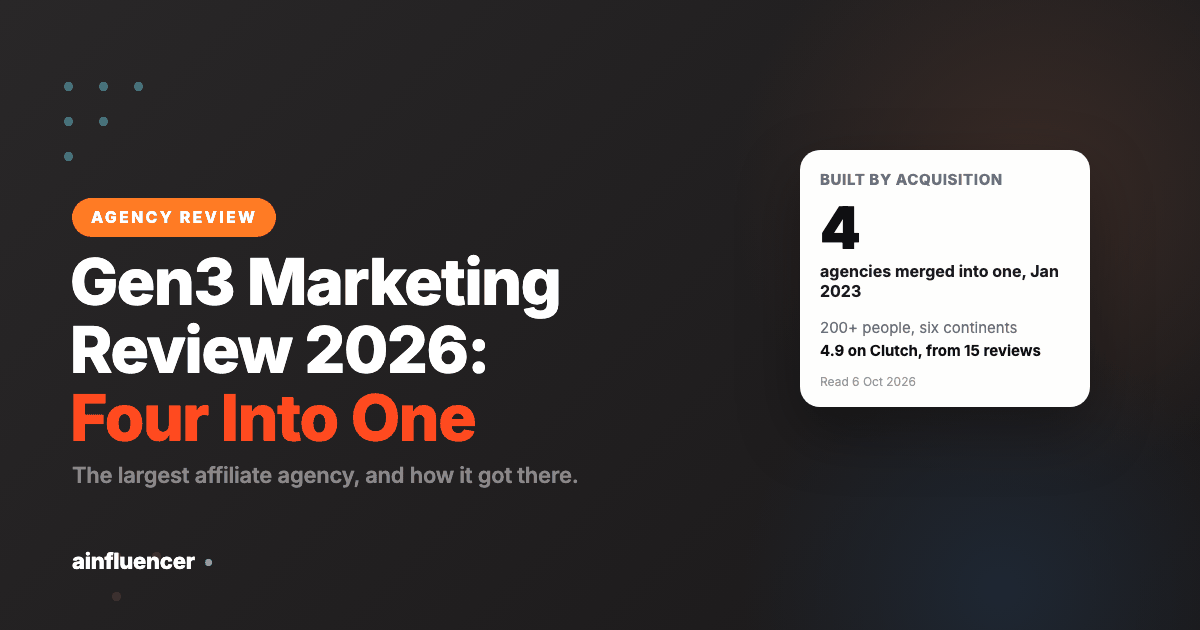
Gen3 Marketing is the largest affiliate marketing agency in the world by headcount, with more than 200 people across six continents driving a reported $2 billion in annual client revenue. It holds 4.9 out of 5 on Clutch, the highest score of any agency in this comparison.
It is also not one company. It is four, bought between 2019 and 2022 and merged into a single entity in January 2023. That fact explains both the scale and the question you should ask before hiring them.
The scale, in numbers
| Measure | Figure |
|---|---|
| Founded | 2007, headquartered in Blue Bell, Pennsylvania |
| People | 200+ across six continents, with hubs in the USA, Canada and Europe |
| Agencies acquired | Four since 2019, unified under one brand in January 2023 |
| Client revenue managed | Reported $2 billion a year |
| Average reported ROAS | 10:1 |
| Minimum project | $5,000+, as Clutch lists it |
| Hourly rate | $150 to $199, as Clutch lists it |
| Reported client spend | $10,000 to over $1,000,000 a year |
That spread of client spend, from $10,000 to over $1 million, is the widest of any agency here and it is the most useful number on the page. It tells you Gen3 will take a mid-market brand, which several of its peers will not.
What being four companies means
Consolidation is how this agency got its scale, and it is worth understanding what you inherit from it.
The upside is coverage. Buying four established agencies buys four publisher networks, four sets of network relationships and four regional footprints. That is why Gen3 can credibly cover six continents when a comparable organic agency would be strong in one region and thin elsewhere.
The risk is consistency. Merged agencies carry merged ways of working for years. Two clients of the same brand can have materially different experiences depending on which legacy team they came from or sit with. The January 2023 unification was three years ago at the time of writing, which is long enough for that to have settled and not long enough to assume it has.
The question to ask in the pitch. Which of the acquired teams will run my account, and how long have they worked together in their current structure? A good answer is specific. A vague one tells you the integration is still in progress, which is worth knowing before you sign rather than after.
What clients say
Gen3 Marketing, as Clutch reports it
Read 6 October 2026. The highest agency score in this comparison, from the second smallest sample. Fifteen verified client interviews is meaningful evidence and it is not a large dataset, so read it as fifteen clients who were happy rather than as a ranking against agencies with more reviews.
Reviewers consistently highlight value for cost, strategy quality, communication and substantial return improvements in affiliate specifically. The value-for-cost theme is notable at an agency with a $5,000 minimum, and it is consistent with the wide client spend range: Gen3 appears to price proportionally rather than applying an enterprise floor to everyone.
When scale is the right purchase, and when it is not
All of the above can read as scepticism about size. It is not. Large agencies win specific situations decisively, and the situations are identifiable in advance.
Scale is the right buy when:
- Your programme spans several markets. Different territories mean different publisher networks, different compliance and often different languages. A small agency covers one well and the rest by improvisation
- You cannot afford a gap. If your programme stopping for three weeks would be a genuine commercial problem, bench depth is worth paying for and a boutique cannot offer it honestly
- Your own team is small. A large agency brings process you do not have to build. If nobody internally owns this channel, that process is most of the value
- You are large enough to be a priority. At or above their median client, you get the version of the agency they advertise
Scale is the wrong buy when: your spend sits well below their median, you need one channel done exceptionally rather than four done competently, or your decisions need to be fast and a committee is not a feature.
The useful reframing is that you are not choosing between a good agency and a bad one. You are choosing which failure mode you can live with. A boutique fails by being fragile. A large agency fails by being indifferent. Decide which of those two you would rather manage, because you will be managing one of them.
One last practical note on a merged agency specifically, because it changes how you should run the first six months. Ask at the start which legacy team your account sits with and who their lead is, then write those names down. Integration work continues in the background for years after the announcement, and the single most useful early-warning signal you have is a change in those two answers. If your named lead moves or your account is reassigned to a different legacy team, that is the moment to ask what happened, rather than six months later when the reporting has quietly changed shape and nobody can tell you why.
What four merged agencies means in practice
A merger of four companies is reported as a single event and experienced as a multi-year process. Where an agency sits in that process matters more to you than the fact of it, and the stages are predictable.
- Systems take longest. Four firms arrive with four reporting stacks, four ways of structuring an account and four definitions of the same metric. Until those converge, a cross-agency report is assembled by hand, and “we are migrating platforms” is a sentence clients hear for longer than anyone intends
- Cultures resolve slowly. Teams keep working the way they worked, which is fine for your account and awkward for consistency. Two clients at the same agency can genuinely have different experiences because they sit with different legacy teams
- Leadership consolidates, and people leave. Four firms had four leadership teams and the merged entity needs one. The people who do not get those roles usually move on, typically eighteen months to three years in
- Client overlap gets resolved. Competing brands who were clients of different firms are now clients of the same one, which has to be handled and is not always handled early. If you compete with anyone obvious, ask about this directly rather than assuming somebody has already thought about it on your behalf
The question worth asking is not whether the merger is complete. It is which of the four original firms your account would sit with, and what has actually changed for them since. That is a question a straight answer exists for, and the ease of the answer tells you how far along the integration really is.
Headcount is not attention
Largest by headcount is a real fact and an easily misread one. The number that affects your results is not how many people work at the agency, it is how many hours of competent attention your account receives each month, and those two numbers are only loosely related.
A large agency gives you things a small one cannot:
- Continuity through staff changes. Your programme does not pause because one person left
- Specialists on tap. A technical tracking problem goes to someone who has solved it before rather than to whoever is free
- Procurement-grade infrastructure. Insurance, security review, references at your scale, payment terms. Routine at scale and sometimes impossible below it
And it introduces one specific risk, which is that attention follows revenue. At a small agency a mid-size client is important by arithmetic. At a large one, a mid-size client is a mid-size client, and the senior people are on the accounts that pay for the building.
So the useful question is where you would sit in their client list. Ask directly what the average and median client spend is. If your budget is well below the median, you are a small account at a large agency, which is the configuration that most often disappoints. That is worth knowing before you sign rather than discovering in month five.
What you can ask a large agency that a small one cannot answer
Scale creates obligations as well as capabilities, and a large agency should be able to answer all four of these immediately. A small one usually cannot, which is precisely why these are the questions worth asking here.
- “What is your client retention rate, and how do you calculate it?” At this size the number exists. The calculation method matters as much as the figure, because retention measured by revenue and by client count can differ enormously
- “What is your staff turnover on client-facing roles?” This is the number behind every continuity promise, and an agency built from four mergers has a specific reason to be asked it
- “How do you handle competing clients?” With a merged client base this is not hypothetical. You want to hear a policy, not reassurance
- “Which of your reporting is automated and which is assembled by hand?” Hand-assembled reporting is slower, more error-prone and the first thing to slip when the team is busy
One structural point worth holding on to about affiliate programmes specifically. The agency recruits and manages publishers who are endorsing your brand, and the FTC’s position is that an advertiser is responsible for what others do on its behalf, and expects reasonable programmes to train and monitor the network it pays. Delegating the work does not delegate the responsibility. An agency that raises monitoring and disclosure before you do has run programmes that were examined. One that treats it as your problem is describing how an audit would go.
What the score does not tell you
| Complaint | What reviewers describe | What to do about it |
|---|---|---|
| Fifteen reviews | The highest score here comes from the second smallest public sample. There is no large independent dataset on an agency of 200+ people. | Ask for references from clients at your own spend level, not their largest. An agency spanning $10,000 to $1,000,000 clients delivers those two very differently. |
| Integration of four acquisitions | Unified in January 2023 after four acquisitions. Merged agencies take years to standardise process, tooling and culture. | Ask which legacy team will service you and how long that team has operated in its current form. Specific answers are a good sign. |
| Wide client spread | Clients range from $10,000 to over $1 million a year. A $10,000 client at an agency whose largest accounts are a hundred times bigger is not the priority account. | Ask what the median client spends, not the range, and where you would sit in it. That single question reorders most agency shortlists. |
| No published pricing | Clutch lists a $5,000 minimum and a $150 to $199 hourly rate, but there is no rate card for retained work. | Ask whether you are being quoted a retainer, an hourly arrangement or a performance override, and get the basis in writing. Agencies at this size use all three. |
| ROAS figures are self-reported | The 10:1 average ROAS and $2 billion managed revenue are the agency’s own figures, not audited numbers. | Treat them as a claim about capability rather than a forecast, and ask how ROAS is calculated, specifically whether it counts incremental sales only. |
Gen3 Marketing pros and cons
Pros
- 4.9 out of 5 on Clutch, the highest agency score in this comparison
- Largest affiliate agency by headcount, 200+ people across six continents
- Four acquired agencies’ publisher networks and regional relationships under one roof
- Takes clients from $10,000 a year, which several enterprise peers will not
- Reported $2 billion in annual client revenue managed
- Clutch lists a transparent $150 to $199 hourly rate, which is more than most peers publish
- Reviewers repeatedly cite value for cost, unusual at this tier
- Covers affiliate, performance PR, influencer and Amazon affiliate
Cons
- Only 15 public reviews for an agency of more than 200 people
- Built from four acquisitions unified in January 2023, so consistency across legacy teams is a fair question
- Client spend ranges from $10,000 to over $1 million, so a small account sits a long way from the top
- $5,000 minimum project puts it out of reach for early-stage programmes
- No published retainer pricing
- The headline ROAS and revenue figures are self-reported rather than audited
Who Gen3 Marketing suits
A good fit if you want enterprise-grade capability without an enterprise-only price, you value publisher network depth, or you need coverage across several regions. The willingness to take mid-market clients at a $5,000 minimum is its most practical advantage over Acceleration Partners.
A poor fit if your programme is too small to clear the minimum, or if you want a boutique where you are the biggest client in the building. At this scale you will not be.
Gen3 Marketing alternatives
| Option | Entry | Choose it when |
|---|---|---|
| PartnerCentric | Reported $3,000+/mo plus override | You want incrementality measurement and 30 verified reviews |
| Acceleration Partners | Custom enterprise | You need 40+ country coverage above all else |
| Advertise Purple | From a reported $2,500/mo | Budget is the binding constraint |
| Ainfluencer | Free, managed from $1,500/mo | You want creator campaigns and managed affiliate below agency minimums |
The verdict
Gen3 is the most broadly useful agency on this list. It has the scale of the enterprise players, the highest client score, and a floor low enough that a mid-market brand can actually hire it.
Ask the two questions the 4.9 does not answer: what does the median client spend, and which of the four legacy teams will run your account. If both answers are specific, this is a strong choice.
How much does Gen3 Marketing cost?
Clutch lists a $5,000 minimum project size and an hourly rate of $150 to $199. Reported client spend runs from $10,000 to over $1,000,000 a year. There is no published retainer rate card, so ask whether you are being quoted a retainer, hourly work or a performance override.
How big is Gen3 Marketing?
More than 200 people across six continents, with hubs in the USA, Canada and Europe, and a reported $2 billion in annual client revenue under management. It is the largest affiliate marketing agency by headcount.
Is Gen3 Marketing one company?
Now, yes. It acquired four established affiliate agencies between 2019 and 2022 and unified them into a single entity in January 2023. That is where its publisher networks and regional coverage came from, and it is worth asking which legacy team would service your account.
Is a 4.9 Clutch rating reliable?
It is real but it comes from 15 verified client interviews, which is a small sample for a 200-person agency. Treat it as fifteen clients who were genuinely happy rather than as proof it outranks agencies with more reviews and slightly lower scores.