PartnerCentric Review 2026: The Retainer Is Not the Price
PartnerCentric is the largest independent partnership marketing agency in the United States and the largest woman-owned and woman-led agency in the category. It is also the one whose pricing is most often quoted wrongly, because almost every write-up gives you the retainer and stops there.
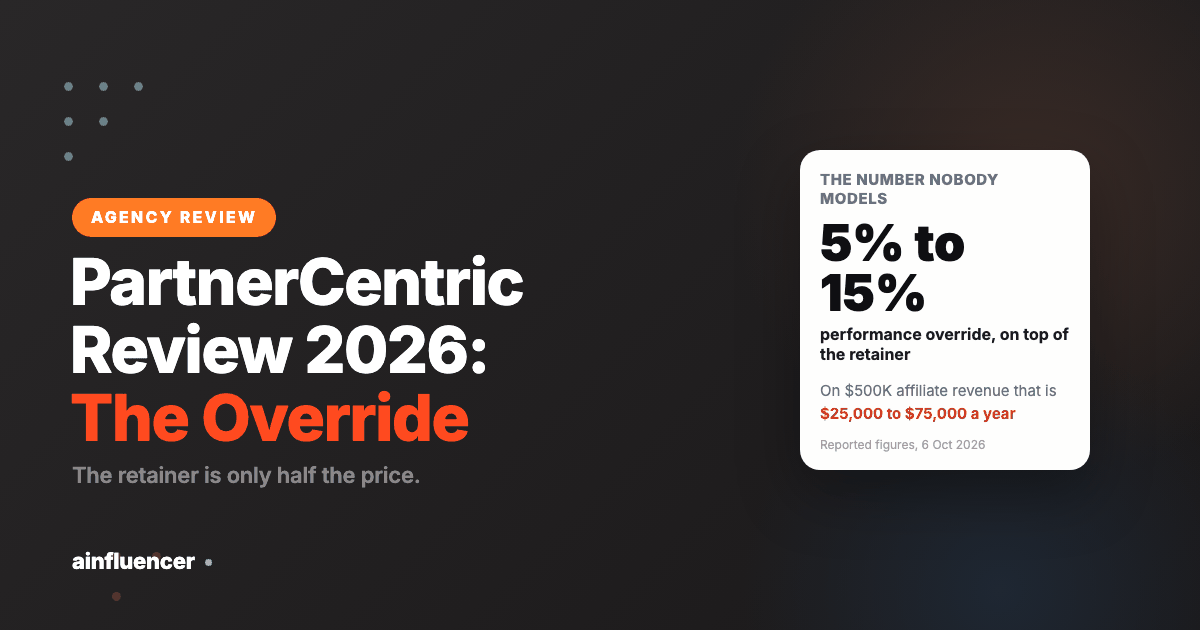
The retainer is reported at $3,000 to $25,000 a month. The part that decides your actual bill is the performance override of a reported 5% to 15% that usually sits on top of it. This review is organised around that number.
Who PartnerCentric is
The company’s history explains its positioning. Stephanie Harris joined Schaaf Consulting as its first employee in 2006, became chief executive in 2015, and in 2017 led a buyout that created PartnerCentric. That is why you will see both 2004 and 2017 given as founding dates: the business traces back to the predecessor agency, the brand does not.
It is fully remote, WBE-certified, and works with brands including Lemonade, VSP Vision Plans, DTLR and HIMS/HERS. Its differentiator is technical rather than operational: a patented platform called FUSE Precision and a measurement tool called FUSE Incrementality.
That second tool is the one worth understanding, because incrementality is the hardest honest question in affiliate marketing: how many of these sales would have happened anyway? An agency that builds its own tooling to answer that is making a specific bet about what clients should be paying for, and it is the right bet.
PartnerCentric pricing, with the override included
Two components, and the second is the one that moves.
| Component | Reported figure | What it depends on |
|---|---|---|
| Monthly retainer | $3,000 to $25,000+ | Scope, markets, number of programmes |
| Performance override | 5% to 15% of affiliate revenue | Negotiated, and the number that scales |
| Clutch minimum project | $5,000+ | As Clutch lists it |
| Reported client spend | $3,500 a month to $400,000+ total | Engagement length and size |
What the override adds, annual cost on a $5,000 monthly retainer
Twelve months at a $5,000 retainer, plus a 5%, 10% or 15% override on $500,000 of affiliate-driven revenue. Retainer range and override range are reported figures rather than published rates, so treat this as the shape of the deal. The point stands at any retainer: the override is not a rounding error, and at 15% it more than doubles the cost of the engagement.
Negotiate the override before the retainer. A thousand dollars a month off the retainer is $12,000 a year. Five percentage points off the override, on a programme doing $500,000, is $25,000. Most buyers spend their negotiating effort on the smaller number.
The override is also, in fairness, the reason agency incentives line up with yours. An agency paid only a flat retainer earns the same whether your programme grows or stalls. Ask for a lower override with a growth trigger rather than for no override at all; the second ask usually buys you a less motivated team.
What clients say
PartnerCentric, as Clutch reports it
Read 6 October 2026. Thirty reviews is small in absolute terms and large for an enterprise affiliate agency, where a Clutch review requires a verified client interview rather than a two-click rating. Around 95% of reviewers specifically mention strong communication.
That communication theme matters more than it sounds. In agency reviews, praise for communication usually means the client always knew what was happening, which is the thing most commonly missing in a retained relationship and the most common reason they end.
Reported results in client reviews include affiliate programme growth above 100%. Those are self-selected successes, as all agency case evidence is, and should be read as proof the agency can do the job rather than as a forecast.
What to press on before signing
PartnerCentric has few public complaints, which is normal at thirty reviews and is not evidence of perfection. These are the questions a 4.8 does not answer.
| Complaint | What reviewers describe | What to do about it |
|---|---|---|
| The override is not published | No public rate card. The 5% to 15% range comes from reported engagements, so the number you are quoted is the only one that applies to you. | Ask for the override in the first conversation, not the third, and ask what it is calculated on: gross affiliate revenue, net of returns, or margin. Those three produce very different invoices. |
| Minimum commitment | Clutch lists a $5,000 minimum project size and reported retainers start at $3,000 a month, so this is not a channel you test cheaply here. | If your affiliate revenue is below roughly $250,000 a year, the combined cost is a large share of the channel. Build the programme on software first and bring in an agency when there is something to manage. |
| Incrementality cuts both ways | FUSE Incrementality is a genuine strength and it exists to tell you which affiliate sales were not incremental. That is a tool that can shrink your reported numbers. | Treat that as the reason to hire them. Ask in the pitch what proportion of a typical client’s affiliate revenue turns out to be non-incremental, and judge the answer’s honesty. |
| Small public sample | Thirty verified reviews is the best in this category and still thirty. There is no large independent dataset on this agency. | Ask for two references in your own vertical and talk to them without the agency on the call. That is the only way to get evidence the review sites do not have. |
PartnerCentric pros and cons
Pros
- 4.8 out of 5 on Clutch from 30 verified reviews, the largest sample among the agencies we compared
- Around 95% of reviewers single out communication, the usual failure point in retained relationships
- Patented FUSE Precision platform and a dedicated FUSE Incrementality tool
- Measures whether affiliate sales were actually incremental, which most agencies avoid
- Largest independent partnership marketing agency in the US, and the largest woman-owned and woman-led
- Works across affiliate, influencer and partner channels rather than affiliate alone
- Named enterprise clients including Lemonade, VSP Vision Plans, DTLR and HIMS/HERS
- Fully remote, which widens the talent pool behind your account
Cons
- A reported 5% to 15% performance override on top of the retainer, and no published rate
- Reported retainers from $3,000 a month, with a $5,000 minimum project on Clutch
- Too expensive to use as a test of whether affiliate marketing suits you
- Thirty public reviews is a thin evidence base for a commitment this size
- No public pricing of any kind, so every evaluation starts with a sales process
- Incrementality reporting may show a smaller programme than your current attribution does
Who PartnerCentric suits
A good fit if your affiliate programme is already producing meaningful revenue, you have been burned by attribution you did not trust, and you want an agency that will tell you which of your affiliate sales were not incremental. That last point is the real reason to choose them over a larger competitor.
A poor fit if you are testing the channel, where the combined retainer and override is out of proportion to the revenue; or if you want a flat predictable fee, because the override exists precisely to be variable.
PartnerCentric alternatives
| Option | Entry | Choose it when |
|---|---|---|
| Ainfluencer | Free, managed from $1,500/mo | You want creator campaigns and managed affiliate without an enterprise retainer |
| Gen3 Marketing | $5,000+ minimum | You need the largest team and multi-continent coverage |
| Advertise Purple | From a reported $2,500/mo | Budget is the binding constraint |
| Refersion | $39/mo plus 3% | You want software and will run the programme yourself |
The verdict
PartnerCentric is the agency to shortlist when you care whether the numbers are real. The incrementality tooling is a genuine differentiator in a category where most reporting flatters the channel, and the Clutch record is the strongest here.
Price it properly before you decide. On a $5,000 retainer and $500,000 of affiliate revenue, the difference between a 5% and a 15% override is $50,000 a year, which is larger than the entire retainer. Settle that number first and the rest of the negotiation is detail.
How much does PartnerCentric cost?
Reported retainers run from $3,000 to $25,000 a month, usually plus a performance override of a reported 5% to 15% of affiliate revenue. Clutch lists a $5,000 minimum project size. There is no public rate card, so the quote you receive is the only figure that applies.
What is a performance override?
A percentage of the revenue the agency generates, charged on top of the monthly retainer. On a $5,000 retainer and $500,000 of annual affiliate revenue, a 5% override adds $25,000 a year and a 15% override adds $75,000. It is usually the larger half of the bill and the more important half to negotiate.
When was PartnerCentric founded?
Both 2004 and 2017 appear in sources and both are defensible. The business traces to Schaaf Consulting, which Stephanie Harris joined as its first employee in 2006 and led as chief executive from 2015. She completed a buyout in 2017 that created PartnerCentric as it exists now.
What is FUSE Incrementality?
PartnerCentric’s own measurement tool for working out how many affiliate-driven sales were genuinely incremental rather than sales that would have happened anyway. It is the agency’s main differentiator, and it is unusual because it can make a client’s affiliate numbers look smaller than their existing attribution shows.