Influencer marketing can be powerful, but it’s also where brands lose thousands. Every year, many brands waste money on influencer campaigns because they pick the wrong influencers or use the wrong marketing strategies. All these problems have led to a new solution: Performance based influencer marketing.
In this new strategy, brands are much less likely to lose money. In fact, brands only pay for what they get. If you want to learn what performance-based marketing is and how to collaborate with influencers using this strategy, this blog is for you.
What Is Performance Based Influencer Marketing?
Performance-based influencer marketing is a strategy where brands pay influencers based on measurable outcomes, like sales or conversions, instead of flat fees. In other words, brands reward influencers based on how well their content performs, not paying a fixed fee.
This strategy helps brands reduce risk and improve ROI, since they only pay for real results. Performance-based marketing is especially popular in e-commerce, apps, and direct-to-consumer brands. This is because in these niches, tracking is easy and conversions are clear. So it’s easier to calculate the results to pay the influencer fees.
Performance-Based Influencer Marketing Vs. Traditional Influencer Marketing
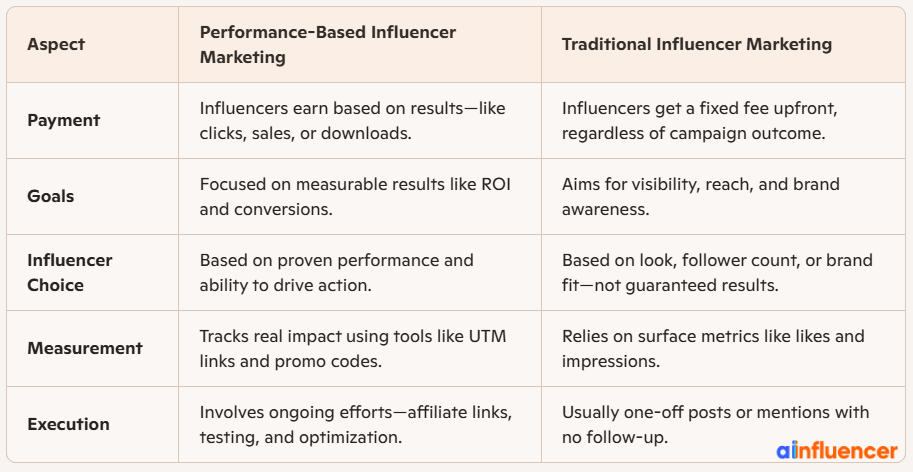
Performance influencer marketing differs from traditional marketing in its goals, execution, payment, and more. Let’s break down each of these factors and explore them:
1. Difference in Payment
In performance-based influencer marketing, payment is tied to measurable outcomes, like conversions, sales, app downloads, etc. Therefore, instead of a flat fee, influencers earn through things like affiliate links, commissions, or revenue sharing. In other words, their income depends on their performance.
In traditional Influencer marketing, payments are usually a fixed amount upfront, no matter what happens. This means brands have to pay the influencer the negotiated price, even if the campaign has zero ROI for them.
2. Difference In Goals
In performance-based influencer marketing, the main goal is income or measurable results for the brand. It’s more about results you can measure, like ROI and conversion rates.
In traditional influencer Marketing, the goal is more about getting seen and gaining brand visibility, not direct results. It uses metrics like impressions or estimated reach, but it’s harder to link those numbers to actual sales.
3. Difference in Influencer Selection
In traditional campaigns, brands usually pick influencers based on appearance, follower count, or how well their style fits the brand’s image. This can help with visibility, but it doesn’t guarantee results. Just because someone looks the part doesn’t mean their audience will take action.
Performance-based influencer campaigns take a different approach. Brands choose influencers who’ve proven they can drive real outcomes, like clicks or sales. They look at past performance, audience behavior, and conversions to find creators who influence decisions, not just attract attention.
4. Difference in Measurement
To accurately measure performance, brands often rely on more than just tracking links and promo codes. Many performance-driven teams also automate how they collect and submit influencer inquiries across multiple platforms. A contact form automation tool allows brands to streamline outreach, ensure consistent data submission, and connect attribution data more effectively with conversion tracking systems.
5. Difference in Execution
Traditional marketing usually involves one-off posts, sponsored content, or brand mentions. The influencer creates and publishes the content, and the campaign ends there.
Performance-based marketing is more dynamic. It includes affiliate links, promo codes, or ongoing partnerships. Influencers are encouraged to optimize their content, test formats, and keep driving results over time.
Why Shift Toward Performance Based Influencer Marketing?
There are multiple reasons why brands are shifting towards performance-based marketing. In short, the most important reason is making more income and having efficient campaigns. Let’s explain more:
1. Revenue Over Reach
A 2025 report from NetInfluencer shows that 31.5% of brands now measure influencer campaign success based on revenue and sales. Additionally, currently, only 20% of brands care about old metrics that matter in traditional marketing, like engagement or earned media value (EMV)
2. Growth of the Influencer Marketing Industry
Moreover, the influencer marketing industry grew from $24 billion in 2024 to $32.55 billion in 2025. With more money being spent, brands want to make sure they’re getting value. That’s why performance-based models (which focus on results) are becoming more popular.
3. Smarter Partnerships
Performance-based influencer marketing lets brands:
- Pay influencers based on results,
- Test and improve campaigns while they’re running,
- Build long-term relationships with influencers who consistently deliver good results.
This model also helps smaller brands compete, because they can focus on cost-per-action instead of paying big fees based on follower count.
4. Responding to Market Shifts
As consumer behavior changes and economic conditions become less predictable, brands are rethinking how they spend their marketing budgets. Traditional advertising, like flat-fee influencer posts or broad awareness campaigns, usually lacks clear performance data. That’s risky when budgets are tight or ROI is under pressure.
Performance-based influencer marketing, on the other hand, offers a smarter alternative. This model gives brands lower CPA (Cost Per Acquisition), more control, and better campaign tracking. According to Acceleration Partners, this shift is important during uncertain market conditions. It allows brands to:
- Focus on measurable outcomes,
- Reduce wasted spend,
- Build scalable partnerships with influencers who consistently deliver results.
Key KPIs and Metrics for Performance Based Influencer Marketing
Just like any marketing strategy, performance influencer marketing focuses on certain KPIs.
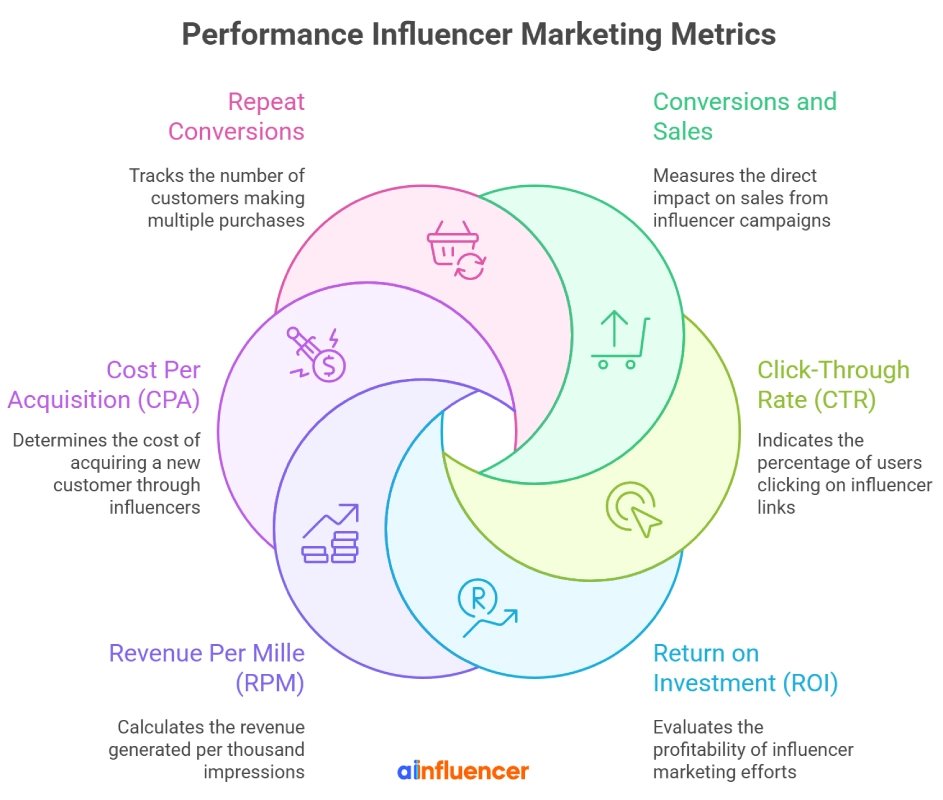
These metrics measure real business outcomes, like sales, conversions, and ROI. The most important metrics brands track in performance-based campaigns include:
1. Conversions and Sales
This is the most important metric. It shows how many people actually bought something, signed up, or downloaded an app because of the influencer’s content.
For example, if 100 people click a link and 10 make a purchase, the conversion rate is 10%. It helps brands understand how persuasive the influencer’s content really was.
Brands track this metric using tools like affiliate links, promo codes, or UTM tags, so they know exactly which influencer drove which result.
2. Click-Through Rate (CTR)
CTR measures how many people clicked on a link in the influencer’s post or story. It shows how effective the content was at getting attention and encouraging action. A high CTR means the audience was interested enough to take the next step.
Currently, there is no universally published benchmark specifically for a “good” CTR in influencer marketing across platforms. However, average click-through rates (CTR) usually fall between 0.5% and 3%. If a campaign gets 3–5% or more, it’s considered strong and performing.
3. Return on Investment (ROI)
How much money can a brand make compared to what it spent on a campaign? This is ROI. Let’s say a brand pays an influencer $500 and earns $2,000 in sales from that campaign. So, the ROI will be 300%. That means the brand made four times what it spent.
In performance-based marketing, ROI is one of the most important metrics because it ties every dollar spent to real business outcomes. Also, it helps brands decide which influencers to keep working with and which strategies are worth repeating.
4. Revenue Per Mille (RPM)
“Revenue Per Mille”. This is what RPM stands for. This KPI means revenue per 1,000 impressions. It shows how much money a brand earns for every 1,000 views of the influencer’s content. Imagine an influencer’s post gets 100,000 views and generates $2,000 in sales. To calculate RPM, we need to use this formula:

So the RPM is $20. In other words, the brand earned $20 for every 1,000 views, which is a pretty good result.
RPM helps brands understand the financial efficiency of influencer content.
- A high RPM means the content is converting well and generating strong revenue per view.
- A low RPM might mean the content isn’t driving enough sales, even if it gets lots of views.
5. Cost Per Acquisition (CPA)
Looking to learn how much it costs to get one customer or conversion through the influencer’s content? You need to track CPA.
For example, if a brand spends $500 on a campaign and gets 25 purchases, the CPA is $20. This means each sale costs the brand $20.
This metric helps brands understand how efficient the campaign is. A lower CPA means the influencer is driving results at a better cost. A high CPA might signal that the campaign isn’t performing well or that the audience isn’t converting.
In influencer marketing, a low CPA is typically under $10–$20 per conversion. On the other hand, a high CPA can exceed $50–$100 depending on the industry, product price, and campaign goals.
6. Repeat Conversions
Last but not least, we have Repeat Conversions. This metric tracks whether the influencer’s audience keeps buying or engaging over time.
Think this: if someone buys a skincare product after seeing an influencer’s post, and then returns to buy it again a month later (without needing another promo).
That’s a repeat conversion.
Repeat Conversions is useful for long-term partnerships. If an influencer can drive repeat customers, they’re a good partner.
Now that you know the key performance-based influencer marketing KPIs, let’s check out some practical strategies:
11 Powerful Performance Based Influencer Marketing Strategies
The KPIs are essential, but you need to put them into action. How can you create a performance-based campaign?
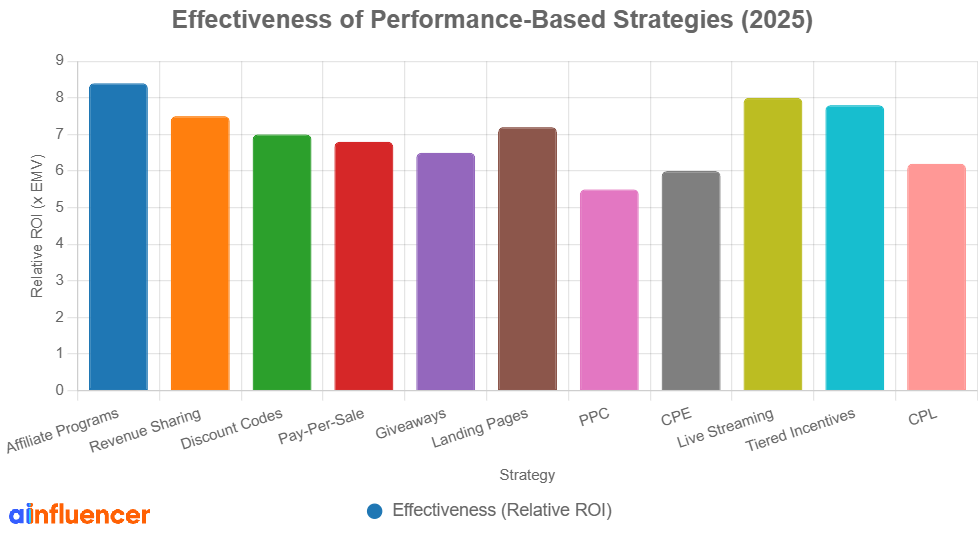
There are different strategies. As you can see, affiliate programs and live stream sales are the top two among the best strategies for performance influencer marketing. Here’s how each strategy works:
1. Affiliate Programs
Let’s begin with a popular strategy in performance-based influencer marketing. In affiliate programs, influencers promote products or services using special affiliate links or discount codes. When someone purchases through that link, the influencer earns a commission, typically between 5% to 20%.
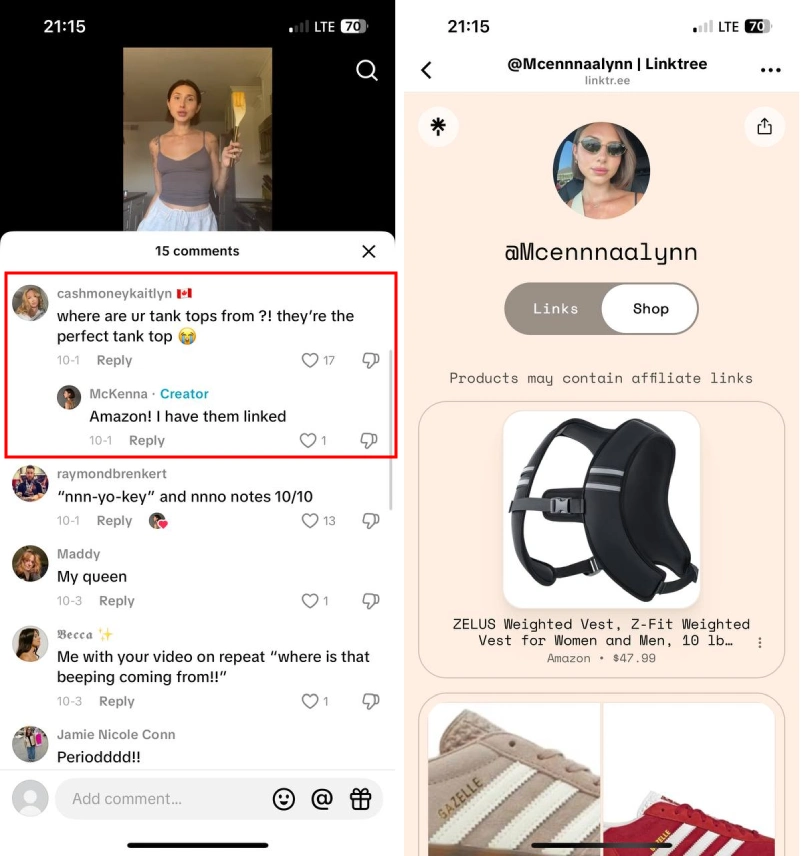
Basically, in this strategy, brands give influencers special, trackable links to their products on their website or other platforms like Amazon. Then influencers create content that encourages their audience to click on that link and buy the product. When users make purchases, influencers earn commissions.
For example, take a look at a post from this influencer on TikTok. She shares her favorite things on her videos and shares her affiliate link with her followers.
Note: Based on influencer marketing benchmarks of 2025, affiliate programs are used by nearly half of marketers (49.6%). Also, nano-influencers perform especially well in this setup thanks to their strong engagement rate of 1.73%.
However, there are some challenges. For instance, brands need reliable tracking systems to monitor performance accurately. Also, some influencers may be hesitant to work on commission-only terms.
2. Revenue Sharing Partnerships
When brands and influencers agree to split the money earned from sales, revenue-sharing partnerships appear as a performance-based strategy.
Instead of paying a flat fee, the influencer gets a fixed percentage of the final sales they help generate. This amount is usually around 30%.
Usually, when the product is expensive, influencers are willing to join this strategy. It’s a common strategy in e-commerce and SaaS, where the products have higher prices and longer customer lifecycles.
Premium brands benefit the most from revenue sharing because it can give them much bigger returns. In some cases, they earn up to 8.4 times more than what they would get from regular paid ads. This is because of the earned media value (EMV) that the brand gains after each campaign.
However, this strategy isn’t for everyone. The agreements can be complex, and the higher payouts may not suit smaller influencers. It also needs clear and honest reporting to make sure both sides are fairly paid.
3. Performance-Based Discount Codes
Another simple and effective way for influencers to help brands make sales? Performance-based discount codes. They are similar to affiliate programs.
In this strategy, influencers share special discount codes (like “GROK20” for 20% off) with their followers. Every time someone uses the code to make a purchase, the influencer earns a commission. Sometimes, they also get a bonus if they reach certain sales goals.
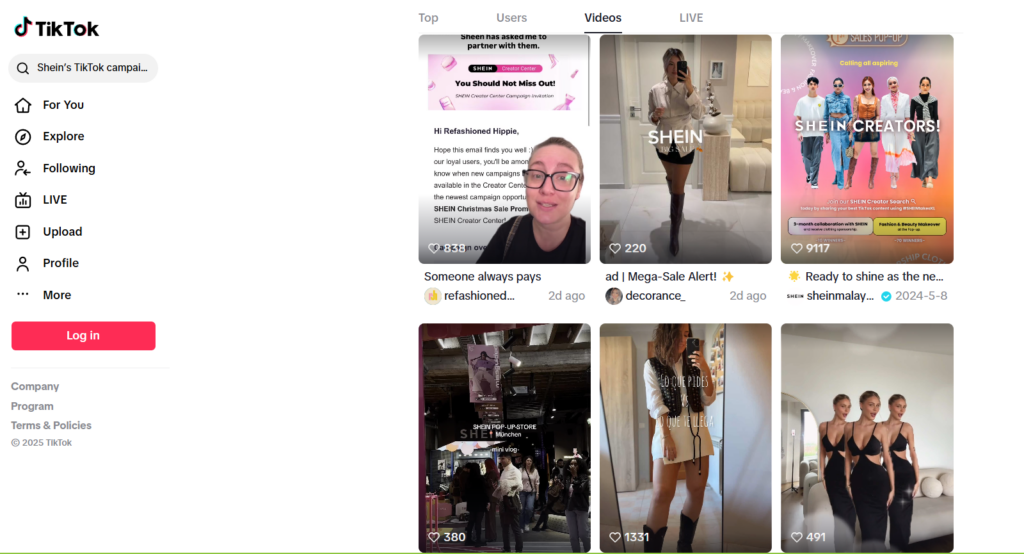
A strong example is Shein’s TikTok campaign, where discount codes helped generate 3.3 billion views and led directly to sales.
That said, there are some challenges. If too many codes are used, it can weaken the brand’s image and make discounts feel less special. Also, brands need accurate tracking systems to make sure influencers are paid fairly and performance is measured correctly.
4. Pay-Per-Sale
Pay-per-sale is a performance-based strategy where influencers earn money for each sale they directly generate. They’re paid either a fixed amount or a percentage of the sale price.
This strategy is similar to affiliate programs, but usually simpler and focused on specific products or campaigns. Let’s dive into the differences between PPS and affiliate programs:
Pay-per-sale (PPS) is a type of affiliate marketing where influencers earn money only when someone they refer makes a purchase. It only focuses on confirmed sales. On the other hand, affiliate programs are broader. They also include models like pay-per-click (PPC) and pay-per-lead (PPL), which include clicks or sign-ups.
PPS works well on high-conversion platforms like Instagram Reels, which 57.1% of marketers are actively using. However, there are some downsides. Influencers may feel pressured to focus only on selling, which can limit their creativity. Also, brands need strong tracking systems to make sure everything is correct.
5. Conversion-Based Giveaways
Have you ever heard of conversion-based giveaways? These are giveaways with purchase incentives where influencers run contests or promotions. The prizes for these contests can be free products, exclusive perks, or other rewards that make the offer more exciting.
However, to enter these giveaways, followers need to make a purchase or take an action, like signing up using a discount code.
Here’s how these campaigns work: Influencers promote these giveaways through their content and send traffic to the brand’s website or store.
Then brands track how many people enter, buy, or sign up using special links or codes. And finally, they pay influencers based on how many entries or sales the giveaway generates.
However, there are a few challenges with influencer giveaways. Brands must follow FTC rules and clearly disclose the giveaway terms. Also, if the campaign isn’t well-targeted, it can attract low-quality leads who aren’t interested in the product.
6. Influencer Specific Landing Pages
You can also establish a performance-based influencer campaign using influencer-specific landing pages. These are actually custom web pages that brands create just for an influencer marketing campaign.
Landing pages help track exactly how much traffic and how many sales come from that influencer’s content. Here’s how they work:
The influencer shares a link or code in their post, story, or video. When followers click through, they land on a page designed to encourage purchases or sign-ups. Brands measure how well the page performs and pay the influencer based on the results.
A strong example is Warby Parker eyewear. They partnered with Emma Chamberlain and created specific landing pages for their collaboration. And as you might guess, due to Emma’s influence, their campaign was very successful.

The downside of this method? These pages can be expensive to set up and need technical tools to track performance properly.
7. Livestream Selling
One of the most effective strategies for performance marketing is live-streaming sales campaigns. Live Streams are when influencers go live on platforms like Instagram or YouTube to show off products for sale. During these live sessions, influencers demo the product, answer questions, and share links or discount codes that viewers can use to buy.
Lastly, influencers earn money based on how many sales or sign-ups happen during the stream.
In 2025, live shopping is a very popular strategy; in fact, it’s one of the top influencer marketing trends.
About 52.4% of marketers prefer live streaming because it feels immediate and often leads to quick sales. That said, this approach takes planning. It only works well if the influencer is engaging and their audience trusts them. Plus, everything has to run smoothly in real time.
8. Pay-Per-Click (PPC)
Our next popular strategy is Pay Per Click. In these campaigns, brands pay influencers a set fee for each time someone clicks on their link, no matter if that click leads to a purchase or not. It’s similar to how Google Ads work, but instead of ads, the traffic comes from influencers sharing the link with their loyal followers.
Here’s how this strategy works:
Brands give influencers trackable links, and the creators share those links with their content on social media. Then, influencers earn money per click, it’s usually between $0.30 and $1.00, depending on their niche and audience size.
Brands that want to manage these campaigns use analytics tools to count clicks in real time. Some of them might set limits (like 1,000 clicks per influencer) to manage costs.
The downside of this strategy is that brands pay for clicks that might not turn into leads or results.
9. Pay-Per-Engagement
Another strategy for performance-based campaigns is Pay Per Engagement.
In PPE campaigns, influencers get paid based on how people interact with their content. Influencers are paid for likes, comments, shares, or saves, not sales. This strategy works well for boosting visibility, especially with micro-influencers.
Here’s how it works:
Brands decide how much each type of engagement is worth (e.g., $0.05 per like, $0.10 per comment) and set minimum goals like 500 likes. Tools like WeArisma help track this accurately. Then, influencers get paid based on total engagement.
For example, 5,000 interactions could earn $500. Brands may set limits or use tiered pricing to manage costs.
One of the main challenges with PPE campaigns is that high engagement doesn’t always lead to sales, and some influencers may use fake likes. Also, focusing only on numbers can reduce meaningful interactions.
10. Tiered Incentives
Tiered Incentive Programs are performance-based reward systems where influencers earn more as they hit higher goals, like more sales, clicks, or leads.
In other words, instead of getting paid a flat rate, creators unlock bigger payouts by reaching specific milestones. For example, a brand might offer $100 for 50 sales, $300 for 100 sales, and $500 for 200 sales.
This structure motivates influencers to keep promoting over time, because the more results they deliver, the more they earn. It’s like leveling up in a game, and it’s especially useful for long-term campaigns where consistent effort leads to better rewards.
Now moving to the downsides of this strategy, tiered incentive programs can be tricky to manage without clear tracking. Also, only a small number of marketers use advanced tools to help.
They also cost more to monitor and may confuse smaller influencers who aren’t familiar with performance-based setups.
11. Pay-Per-Lead
Last but not least, pay-per-lead campaigns pay influencers for each qualified lead they generate, like email sign-ups, registrations, or form submissions. This model works best for B2B, SaaS, or service-based brands that want to build a customer pipeline instead of driving immediate sales.
Just like the previous strategies, brands give influencers trackable links. Then, creators share those links on their social media and earn a set fee per lead (usually $5–$50). Also, leads are vetted for quality.
PPL campaigns are great for targeting valuable leads, controlling budgets, and increasing customer lifetime value. But they come with challenges: lead quality can vary, tracking needs advanced CRM tools, and some influencers might not have the right audience.
How To Set Up a Performance-Based Deal With an Influencer?
To organize a strong campaign, you need to plan everything step by step. It’s beyond handing out a promo code. Here, we’ll teach you how to set up a performance-based influencer deal:
1. Start With Clear Goals
Before reaching out to any influencer, define what success looks like for your campaign. Are you trying to drive sales, generate leads, or simply increase traffic? Your goal will determine the payment model:
- CPS (Cost Per Sale): You pay a percentage or flat fee for each sale the influencer drives.
- CPA (Cost Per Action): You reward actions like sign-ups, downloads, or app installs.
- Commission-based: Often used in affiliate-style deals, where influencers earn a cut of each transaction.
- CPL (Cost Per Lead): Good for B2B or service-based brands that want qualified leads.
Each model has its pros and cons, but the key is to match it to your business objective and product type.
2. Set Up Tracking Infrastructure
Performance-based deals live or die by attribution. You need to know exactly which influencer drove which result. That means setting up:
- Unique tracking links (e.g., UTM parameters),
- Promo codes tied to each influencer,
- Custom landing pages for better conversion and attribution,
- Affiliate or influencer platforms like GRIN, Impact, or Upfluence to automate tracking and payouts.
Without this infrastructure, you risk underpaying or overpaying and losing trust with your partners.
3. Create a Transparent Agreement
Once the structure is ready, create a clear agreement. It should outline:
- The payment terms (e.g., 10% per sale, $5 per lead)
- How performance will be tracked and verified
- When payments will be made (weekly, monthly, post-campaign)
- Disclosure requirements, especially for FTC compliance
- Any bonus tiers or performance incentives
Lack of transparency can ruin your whole campaign. Influencers need to know exactly how they’ll be rewarded and what’s expected of them. Also, you don’t want the risk of an influencer cancelling your brand on social media.
4. Launch and Monitor in Real Time
Once your campaign goes live, keep an eye on how things are going in progress, not just at the end. You need to check how many people are clicking, signing up, or buying through the influencer’s content. Most brands use dashboards or tracking tools to see this in real time. This can have multiple advantages for you.
First of all, if something isn’t working, like a landing page or a discount code, you can catch it early and make changes before the campaign loses momentum.
Also, monitoring things in progress helps to stay in touch with the influencer during the campaign. They might suggest something isn’t working and change their content or messaging to get better results.
This kind of back-and-forth makes the campaign feel more like a partnership, and usually leads to better performance.
5. Pay Fairly and Build Long-Term Trust
After the campaign, verify the results and pay the influencer based on the agreed terms. If they performed well, consider offering a longer-term partnership or tiered bonuses. Influencers who feel valued are more likely to go the extra mile in future campaigns.
Also, when you work with an influencer for a second time, you’re exposing your brand to their audience for a second time, which means more brand visibility for you.
Now that you know how to set up a campaign, let’s check some useful tools and platforms that you’ll definitely need for your campaign:
Tools and Platforms to Manage Performance Based Influencer Marketing
Setting up a performance-based campaign is impossible without tools and platforms. The best platforms include GRIN, Ainfluencer, Upfluence, Linqia, Aspire, and Impact.
They all offer tracking, payouts, and campaign automation tailored to CPA, CPS, and commission models. Let’s review each tool and platform:
All-in-One Influencer Platforms
- GRIN: Popular with e-commerce brands. Offers affiliate-style tracking, custom landing pages, and real-time ROI dashboards.
- Ainfluencer: A fast-growing platform that connects brands with influencers for performance-based campaigns. Offers free access, built-in marketplace tools, and supports CPA and CPS tracking without needing a full agency setup.
- Upfluence: Strong for managing discount codes, UTM links, and influencer-specific landing pages. Integrates with Shopify and WooCommerce.
- Aspire: Great for scaling campaigns with micro and nano influencers. Includes tiered incentive tracking and automated reporting.
- Impact: Ideal for affiliate-style performance deals. Offers deep analytics, fraud detection, and flexible commission structures.
Affiliate & ROI-Focused Platforms
These are best for commission-based or CPS campaigns:
- Refersion: Built for affiliate-style influencer deals. Tracks sales, clicks, and payouts with customizable commission tiers.
- ShareASale: A classic affiliate platform now used by influencers. Good for long-term partnerships and tiered bonuses.
- Checkout Links: Designed for tracking influencer-driven conversions across platforms. Useful for CPL and PPC campaigns
Discovery & CRM Tools
These tools help find the right influencers and manage relationships:
- Ainfluencer: Has a strong influencer discovery ability (over 5M vetted influencers on TikTok, Instagram, and YouTube), uses AI for matching, covers multiple search filters, and offers analytics.
- CreatorIQ: Combines influencer discovery with performance analytics. Useful for large-scale campaigns across multiple platforms.
- Later Influence: Lightweight tool for managing campaigns on Instagram and TikTok. Includes engagement tracking and link attribution
E-commerce & CRM Integrations
If your brand already uses Shopify, HubSpot, or other CRM platforms, you can use their built-in features to run influencer campaigns:
- Shopify Collabs: Built-in influencer tools for Shopify stores. Supports discount codes, affiliate links, and payout automation.
- HubSpot CRM: Useful for CPL campaigns. Tracks lead quality and integrates with influencer landing pages and forms.
These were all the tips you needed to know about performance-based influencer marketing. All that’s left is to review a few examples:
Best Examples of Performance-Based Influencer Marketing
As our last section, let’s review some of the successful performance-based influencer marketing campaigns that you can get inspiration from:
1. Branch Basics
Brand Basics, a direct-to-consumer cleaning brand, decided to change its influencer strategy and collaborate with nano and micro-influencers.
Instead of paying them up front, the brand used influencer seeding so that influencers would promote the brand.
Additionally, Branch Basics gave each influencer a special link that earned them commission when someone purchased with their promotion. These links were used in ongoing promotions, so creators could keep earning over time.
Performance Metrics: Branch Basics grew its influencer program into a large group of loyal creators, almost like an “army” of brand advocates. As a result, their engagement rate increased by 39%.
Moreover, because each influencer used trackable affiliate links, the brand could see exactly how many sales came from each person. This made it easy to measure return on investment (ROI) and led to steady monthly revenue growth.
Why It Exemplifies Performance-Based Marketing: The campaign used a mix of product seeding and affiliate links. Influencers were only paid when their followers made verified purchases. This setup helped the brand focus on long-term customer value (LTV), since many of those buyers came back and bought again.
2. Topicals’ #TopicalsTakesBermuda Launch
The skincare brand Topicals ran a Bermuda-themed campaign on TikTok and Instagram by teaming up with a group of micro-influencers. These creators used affiliate links and branded hashtags like #TopicalsTakesBermuda and #TopicalsTurns3 to promote the products and drive direct sales.
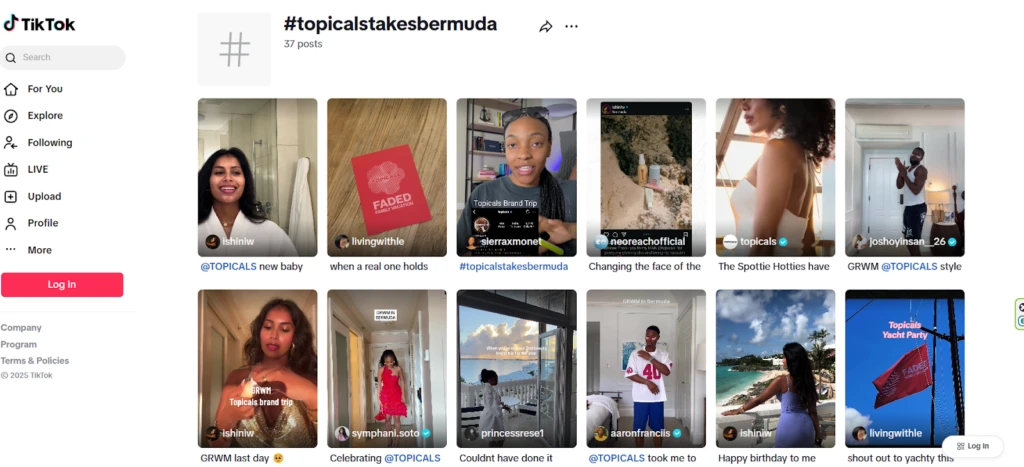
Performance Metrics: The campaign delivered 3 million impressions and brought in 5,000 new followers across TikTok and Instagram. Also, Topical used smart tracking tools to monitor how engagement, such as views, likes, and clicks, converted into actual sales.
This way, they optimized their strategy even more and achieved a high return on investment.
Why It Exemplifies Performance-Based Marketing: The brand tracked impressions, engagement, and conversions in real time. So they could adjust the campaign halfway to boost sales results.
3. Air Wick’s Scented Home Content Series
Another great example of performance campaigns is Air Wick’s Scented Home Content Series. This campaign focused on real results, like engagement and sales. It also used trackable tools to measure success.
Air Wick partnered with lifestyle influencers to promote its scented products through content on Instagram and TikTok.
To make the campaign measurable, it gave each influencer a unique affiliate discount code. When followers used those codes to buy products, the brand could track exactly which influencer drove the sale. This made it easy to see which content was working and which creators were most effective.
Performance Metrics: The campaign led to a 39% increase in engagement. It also helped grow Air Wick’s social media presence, as followers began posting their own photos and videos using the products. Also, the track of affiliate sales showed a high conversion rate.
Why It Exemplifies Performance-Based Marketing: The campaign actually focused on CPA metrics. This means it tracked how many people who engaged with the content ended up making a purchase. Air Wick also boosted influencer posts with paid ads to reach more people and increase sales.
Wrapping Up
In conclusion, until a few years ago, influencer marketing aimed for more brand awareness and exposure. However, due to the market saturation and high competition, brands are changing their strategy towards performance based campaigns.
As we mentioned, performance based influencer marketing is more about saving budget and getting results. It’s a safe, risk-free strategy that can be especially helpful for small to mid-sized brands that can’t endure a failure in a campaign.
FAQs
Q1. What Metrics Or KPIs Should I Track In A Performance-Based Influencer Campaign?
Track metrics that directly show performance and ROI. Focus on conversions, sales, and cost per acquisition (CPA) as primary KPIs. Also monitor click-through rates, engagement, and coupon code usage to understand which influencers drive real results.
Q2. Is Performance-Based Influencer Marketing Suitable For Every Brand/Industry?
It works best for e-commerce, app installs, and direct-to-consumer brands that can easily track conversions. However, other industries can benefit if measurable actions like lead generation or downloads exist.
Q3. What Are The Benefits Of Performance-Based Influencer Marketing (Vs Paying Flat Fees Upfront)?
Brands pay only for measurable results, which makes this model cost-efficient. It reduces upfront risk and encourages influencers to create content that converts. Influencers also gain opportunities to earn more through strong performance. Overall, it builds a mutually accountable, ROI-driven partnership between brands and creators.
Q4. What Are The Risks Or Common Mistakes In Performance-Based Influencer Marketing?
A major risk is poor tracking or attribution, which can misrepresent influencer impact. Some brands set unrealistic performance expectations, leading to low participation. Influencers might also focus too heavily on sales and compromise authenticity. Clear terms, fair payouts, and transparent analytics reduce these issues significantly.
Q5. How Do You Find The Right Influencers For Performance-Based Campaigns?
Look for influencers whose audience matches your target market and whose content feels trustworthy and conversion-oriented. Review their past engagement, link clicks, and sales performance if available. Tools that track affiliate metrics can help you identify strong performers. Authenticity and niche alignment matter more than follower count in this model.