On this page
SalesDuo Review 2026: An Ex-Amazon Team, and No Price List
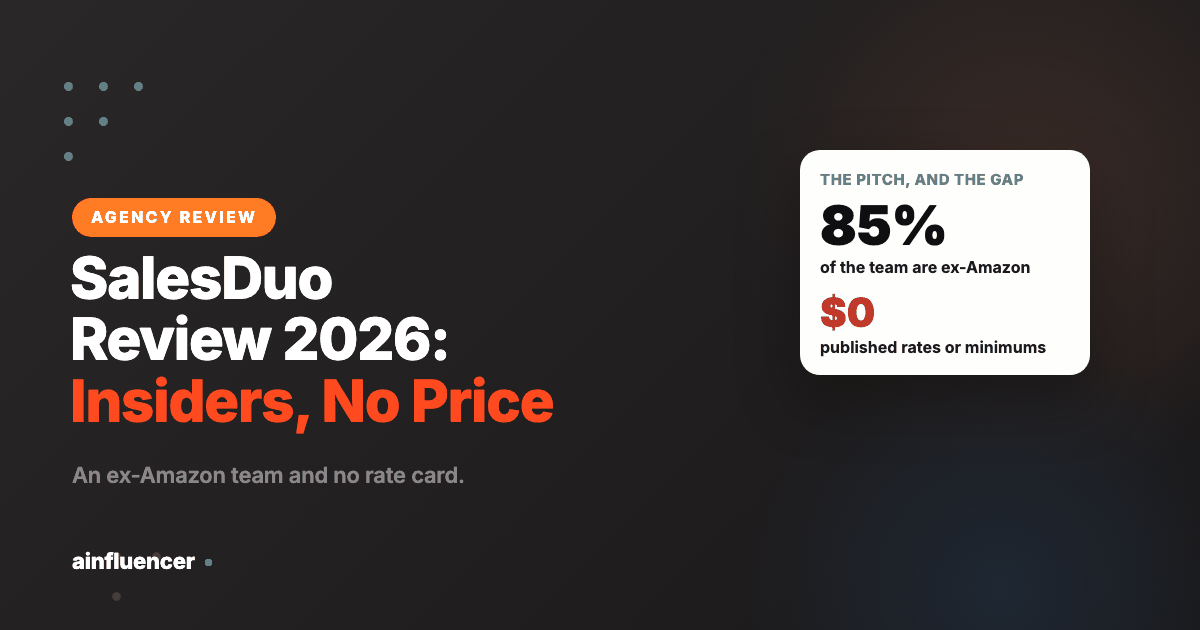
SalesDuo’s pitch is one line and it is a good one: 85% of the team are former Amazon employees. For a channel where the rules are opaque and change without notice, hiring people who worked inside the company is a genuinely different proposition from hiring people who learned it from outside.
The gap in that pitch is equally simple. SalesDuo publishes no rates and no minimum contract, and the one pricing guidance it does publish is about the market rather than about itself.
The numbers they put forward
| Claim | Figure | Status |
|---|---|---|
| Ex-Amazon staff | 85% of the team | Company claim |
| Brands served | 300+ | Company claim |
| Ad spend managed | $3 billion | Company claim |
| Average client growth | 80% year on year | Company claim |
| Amazon Verified Partner | Yes | Verifiable via Amazon |
| Proprietary AI assistant | Named Ethan | Company product |
| Published rate card | None | Confirmed absent |
Everything in the first column except the partner status is self-reported. That is normal for agencies and it is still worth labelling, because an 80% average growth figure is the kind of number that should come with a definition and does not.
What it costs, as far as anyone can tell
There is no rate card. The most useful pricing signal SalesDuo publishes is in its own content, where it puts market PPC management at $1,500 to $8,000 a month, or 10% to 20% of ad spend.
That is guidance about the industry, not a quote. It is still useful, because it tells you the band they consider normal and therefore roughly where their own proposal will land.
What a percentage-of-ad-spend model costs at different spend levels
Annual management fee at the midpoint of the 10% to 20% band SalesDuo describes as market rate. This is not a SalesDuo quote. It is shown because percentage-of-spend is the most common model at this tier, and the number grows with your advertising budget whether or not the agency’s workload does.
Ask which model you are being quoted on. A flat retainer, a percentage of ad spend and a percentage of revenue behave completely differently as you grow, and at $100,000 a month in ad spend the difference between a $5,000 retainer and 15% of spend is roughly $120,000 a year.
Why the scope matters more than the Amazon label
SalesDuo is not only an Amazon agency, and that is the part most comparisons miss. It covers Walmart, Target, TikTok Shop and more than a dozen other channels through tiered Starter, Growth and Scale programmes.
For a brand whose marketplace business has outgrown Amazon, that is the strongest reason to shortlist them. Running separate agencies for Amazon, Walmart and TikTok Shop means three sets of reporting that never reconcile, and consolidating is usually worth more than squeezing a better rate out of any one of them.
The AI assistant, Ethan, sits alongside the human team rather than replacing it. Treat that as a productivity claim to probe in the demo rather than as a differentiator in itself: ask what Ethan actually does on your account each week.
The ex-Amazon claim, and how to test it
An 85% ex-Amazon team is a real asset if those people sit on your account, and a marketing line if they sit in leadership while juniors do the work. The claim is testable in one question.
Ask who, specifically. How many people on my named account team are ex-Amazon, which teams did they work on, and how recently? Someone who left the Seller Central team eighteen months ago is enormously valuable. Someone who spent a year in an unrelated Amazon division a decade ago is a statistic. Both count toward 85%.
What the first 90 days should look like
Most of the disappointment in agency relationships is set in the first quarter, and almost all of it is avoidable by agreeing what that quarter contains before anyone signs.
A competent onboarding has a shape, and you can ask for it in advance:
- Weeks one to three, audit and access. They should be reading your account, not changing it. If optimisation starts in week one, somebody is making changes before understanding why the current setup exists
- Weeks three to six, the plan and the baseline. You should receive a written diagnosis, a prioritised list and, critically, a baseline of where the account stands today. Without that baseline, nobody can honestly claim an improvement in month six
- Weeks six to twelve, execution and the first real read. Changes land, and enough time passes for the data to mean something. Resist judging before this point, because early numbers in a restructured account are noise
Two things to insist on at the start, because they are awkward to ask for later. A written baseline, since the alternative is arguing about where you started. And a named person with a stated time commitment, because “the team” is not a commitment and cannot be held to one.
One warning sign worth watching for in the first month: if the reporting is prettier than the diagnosis, you are being managed rather than served. A good first report is frequently uncomfortable reading, because it says what is wrong with an account you have been running, and an agency that softens that to keep the relationship pleasant is storing up a harder conversation for month six.
The opposite failure is worth naming too. An agency that spends the whole first quarter auditing and planning, with nothing live, is managing its own risk rather than yours. Somewhere around week six there should be changes in the account that you can see, even if the full plan is still being built around them.
What “ex-Amazon” actually buys you, and what it does not
This is the central claim in SalesDuo’s positioning, so it deserves more than a nod. It is a real advantage and it is narrower than the phrase suggests.
What former Amazon employees genuinely bring:
- They know how the internal tooling behaves, which shortens the diagnosis when something breaks in a way the public help pages do not explain
- They know which escalation paths are real and which are dead ends, and that knowledge is worth days every time a case stalls
- They have seen the policy enforcement from the other side, which changes how they write an appeal
What it does not confer:
- Nothing privileged. Former staff have no special access, no back channel and no influence over decisions. Everything they work with is the same publicly available advertising platform any agency uses. Anyone implying otherwise is selling something that does not exist
- It ages. Someone who left four years ago knows a platform that has since changed its policies, its interface and its enforcement posture. Ask when, not just whether
- Working at Amazon is not the same as selling on Amazon. Those are different jobs with different skills, and the overlap is smaller than the phrase implies
The question that converts the claim into something checkable: which team were they on, and what year did they leave? Advertising, Seller Support, Retail and Catalogue are entirely different experiences, and only some of them are relevant to what you need.
When multi-channel scope helps, and when it dilutes
Breadth is sold as an advantage and it is one, conditionally. The condition is whether your channels genuinely share a strategy or merely share a company.
Breadth earns its keep when: the catalogue, pricing and inventory are the same across channels, so a change made once propagates everywhere. One agency holding that picture beats three agencies each holding a third of it, and the coordination overhead you avoid is real money.
Breadth costs you when: one channel is most of your revenue and the others are experiments. Then you are paying for coverage of channels that need different specialists, and the depth on the channel that matters gets thinner to fund the breadth you are not using.
Three ways to tell which situation you are in before you sign:
- Look at your revenue split. If one channel is above 70%, you are buying depth, not breadth, and should price accordingly
- Ask how the team is structured. One generalist covering four channels and four specialists under one roof are very different products sold with the same words
- Ask what happens if you drop a channel. If the fee does not move, the breadth was never priced separately and you were always paying for it
Getting a number out of an agency with no published price
No rate card is the norm in this category rather than a red flag, but it does put the burden on you to make quotes comparable. Four things make that possible.
- Write the scope yourself, by channel and by name. Send the same written scope to every agency on your shortlist. Quotes against different scopes cannot be compared, and agencies will happily scope to their own strengths if you let them
- Ask for the fee at two spend levels. Your current one and double it. This exposes whether you are being quoted a retainer, a percentage, or a retainer that quietly becomes a percentage
- Ask what is excluded. Always more revealing than what is included
- Ask for the renewal cap in year two. It costs the agency nothing today, which is exactly why it is negotiable now and almost never available later, once the switching cost of moving away has quietly become their leverage rather than yours
One framing that reliably changes the number: state your budget rather than asking what it costs. Quoted pricing is built against what the buyer will pay, and the first configuration offered is rarely the smallest one available.
A last point on comparing quotes once they arrive. Put them side by side on scope rather than on price, and the differences usually turn out to be about what each agency assumed rather than what each agency charges. One has priced for your full catalogue and another for your top hundred products. One included creative production and another did not. Resolving those assumptions typically moves the quotes closer together than the headline figures suggest, and occasionally reverses which one is cheaper.
What to press on before signing
| Complaint | What reviewers describe | What to do about it |
|---|---|---|
| No published rates or minimums | SalesDuo is not transparent about its standard rates or minimum contract obligations. Its own published guidance describes market rates rather than its own. | Get the model, the rate and the minimum term in writing in the first proposal. If any of the three is missing, ask again before the second meeting. |
| Headline figures are self-reported | The 300+ brands, $3 billion in managed spend and 80% average year-on-year growth are company claims without published methodology. | Ask how the 80% is calculated: which clients are in the sample, over what period, and whether clients who left are included. The answer tells you a lot. |
| The 85% claim needs localising | An ex-Amazon majority across the company says nothing about who is on your account. | Ask for the named team and their Amazon background, and put continuity in the contract. |
| Percentage-of-spend incentives | If the quote is a percentage of ad spend, the agency earns more when you spend more, regardless of return. | Either negotiate a flat retainer, or agree an efficiency target such as a floor ROAS alongside the percentage, so growth in spend has to come with performance. |
| Breadth versus depth | Covering Amazon plus a dozen other channels is a strength for multi-channel brands and a dilution risk for an Amazon-only seller. | If Amazon is your whole business, ask what share of their clients are Amazon-only and who specialises in it. |
SalesDuo pros and cons
Pros
- A reported 85% of the team are former Amazon employees, which is rare and relevant
- Amazon Verified Partner status, which is independently checkable
- Coverage across Walmart, Target, TikTok Shop and more than a dozen channels beyond Amazon
- Tiered Starter, Growth and Scale programmes rather than one enterprise package
- Full-service: Sponsored Ads, DSP, reporting and listing support rather than advertising alone
- A reported 300+ brands and $3 billion in managed ad spend, so operational scale is not in doubt
- A proprietary AI assistant working alongside the account team
Cons
- No published rates and no published minimum contract
- Its only public pricing guidance describes the market rather than its own fees
- Headline growth and scale figures are self-reported with no stated methodology
- The 85% ex-Amazon figure is company-wide and says nothing about your account team
- Percentage-of-spend pricing, if quoted, rewards higher spend rather than better returns
- Breadth across many channels may dilute focus for an Amazon-only seller
Who SalesDuo suits
A good fit if you sell across several marketplaces and want one agency covering Amazon, Walmart and TikTok Shop with reporting that reconciles, or if your account has genuine operational complexity where ex-Amazon knowledge pays for itself.
A poor fit if you need pricing certainty before engaging, because there is none published; or if Amazon is your entire business and you would rather have a specialist than a multi-channel operator.
SalesDuo alternatives
| Option | Pricing | Choose it when |
|---|---|---|
| Acadia | Custom, no rate card | You need Vendor Central as well as Seller Central |
| Envision Horizons | Published from around $4,000/mo | You want a published starting price |
| Levanta | $750/mo plus 3.5% | You want Amazon creator and affiliate revenue, not ad management |
| Ainfluencer | Free, managed from $1,500/mo | Creator campaigns for Amazon products below agency minimums |
The verdict
SalesDuo’s insider staffing and multi-channel coverage are real advantages, and the scale figures suggest an operation that can handle a complex account.
The evaluation is harder than it should be because the pricing is invisible. Go in with two questions written down: which pricing model am I being quoted on, and how many people on my named team are ex-Amazon and from which part of it. Good answers to both make this a strong option. Vague answers to either mean you are buying a marketing line.
How much does SalesDuo cost?
SalesDuo publishes no rate card and no minimum contract. Its own content puts market PPC management at $1,500 to $8,000 a month or 10% to 20% of ad spend, which is guidance about the industry rather than a quote. Ask which model you are being quoted on, because a flat retainer and a percentage of spend diverge sharply as budgets grow.
Is SalesDuo really staffed by ex-Amazon employees?
The company reports that 85% of its team are former Amazon employees. That is a company-wide figure, so the useful question is how many people on your named account team are ex-Amazon, which Amazon teams they worked on, and how recently.
Does SalesDuo only work on Amazon?
No. It covers Walmart, Target, TikTok Shop and more than a dozen other channels through tiered Starter, Growth and Scale programmes. That multi-channel coverage is the strongest reason to consider it over an Amazon-only specialist.
What is Ethan?
SalesDuo’s proprietary AI assistant, which works alongside the human account team rather than replacing it. Treat it as a productivity claim worth probing: ask specifically what it does on your account each week.