On this page
Acceleration Partners Review 2026: Read the Employee Reviews, Not the Client Ones
Acceleration Partners is widely treated as the global leader in enterprise affiliate management, and on capability that is fair. It runs programmes in more than 40 countries for brands including Target, Reebok and Crocs.
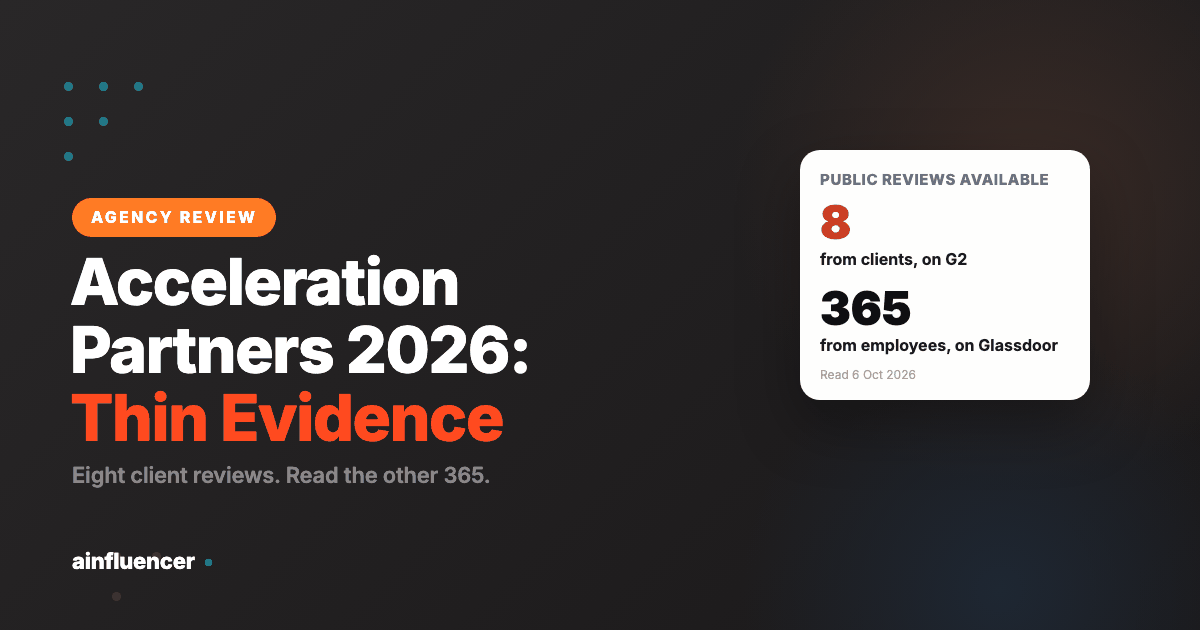
The problem for anyone evaluating it is evidence. It has eight public client reviews. Eight. You cannot responsibly judge a six-figure engagement on that, so this review does something different: it reads the 365 employee reviews instead, because at a service agency the staff turnover rate is a client risk, not an HR statistic.
The evidence problem, in one chart
Public reviews available about Acceleration Partners, by audience
As each site reports them, read 6 October 2026. The client sample is too small to draw conclusions from. The employee sample is large enough to show trends, and at an agency whose product is people, what those people say about workload and pay tells you who will be running your account next year.
This is not a gotcha. It is the only large dataset that exists about this company, and using it is more honest than treating a 4.6 from eight reviews as a verdict.
Both scores, side by side
Acceleration Partners, as each site reports it
Read 6 October 2026. The figure that matters most for a buyer is the third one. Account managers are the people who will run your programme day to day, and they rate the job well below their own company’s average.
The account manager score is the finding. 3.2 out of 5 from 43 people doing the exact job your account depends on, against a company average of 3.9 that is itself falling. The recurring themes in those reviews are workload, micromanagement and pay described repeatedly as low.
There are also reports of staff being laid off after short tenures because work moved to outsourced teams, and of infrastructure changing repeatedly between 2020 and 2026.
What that actually means for your account
Agency quality is not an abstract property of a company. It is the person who knows your brand, your margins and which of your affiliates are worth keeping. When that person leaves, you do not lose a resource, you lose the context.
This is the mechanism behind the complaint you will see in almost every list that mentions Acceleration Partners, that managers rotate across accounts. The employee data explains why, and it turns a vague warning into something you can negotiate about.
What to do with this. Put account team continuity in the contract. Ask who specifically will run the account, what happens if they leave, how long the average client keeps the same lead, and whether any part of the work is outsourced. A confident agency answers all four. These are reasonable questions at any agency and necessary ones here.
What they are genuinely good at
None of the above says the work is bad. The capability case is strong and specific.
- Global reach that is hard to replicate. Programmes across 40+ countries with in-country compliance and partner recruitment, which is the single hardest thing to buy in this category.
- Proprietary analytics in APVision, used for reporting and benchmarking across a large client base.
- Breadth beyond affiliate, covering influencer, content and B2B partner programmes under one contract.
- Recognition from the industry, including multiple Global Performance Marketing Awards.
- Scale of client, with brands such as Target, Reebok and Crocs, which tells you the operation survives enterprise procurement and enterprise expectations.
If you genuinely need one agency to run partner programmes across many markets, the list of companies that can do it is short and this is at the top of it.
Whether you are the client this agency is built for
Agencies at this size are shaped around a particular client profile, and most of the disappointment in reviews anywhere in this category comes from a brand that was never that profile signing anyway.
You are probably the right fit if:
- Your programme spans several markets or regions. This is where large agencies earn their premium, because the alternative is coordinating several small suppliers yourself
- You need process more than you need speed. Documented handovers, consistent reporting, somebody to call when your contact is away. Real value, and a different product from a fast small team
- Your procurement has requirements. Insurance levels, security review, payment terms and references at scale are routine here and sometimes impossible elsewhere
- Your spend sits at or above their median client. This is the one people skip and it decides more than the rest combined
You are probably the wrong fit if your budget is well below that median, if you need decisions in hours rather than days, or if what you actually want is one exceptional person rather than a team with a process. None of those is a criticism of the agency. They are a description of what a large organisation can and cannot be, and pretending otherwise is how both sides end up disappointed a year in.
The way to settle it in one question: ask what their median client spends. If they will not say, ask what the smallest account they currently serve looks like and who runs it. Where you sit relative to that answer predicts your experience better than any review on either side of the ledger.
What employee reviews tell you that client reviews cannot
The evidence here is unusually lopsided, and rather than treat that as a gap it is worth using. Employee reviews answer questions clients are never asked, and several of them predict your experience better than a client testimonial does.
Four things to read for, none of which appear in a client review:
- Workload per person. Repeated mentions of account managers holding too many clients is the single most useful signal available about how much attention yours will get. Nobody writes a client review saying “my manager had eleven other accounts”, because clients cannot see it. Employees say it constantly
- Turnover and why. Continuity promises in a pitch are only as good as the retention behind them, and employees describe that retention directly
- Whether juniors are supervised. Large agencies run on junior execution with senior oversight, which works when the oversight is real. Employee reviews are candid about whether it is
- What the agency rewards. If reviews describe pressure on new business rather than on retention, that tells you where attention goes after you sign
Two cautions on reading them. Employee review bases skew toward people who left, so expect a negative tilt and read for recurring specifics rather than tone. And a complaint about pay or hours tells you about the employer, not about your campaign. Filter for the four items above and ignore the rest.
How to read a thin client base at a large agency
Eight public client reviews is thin for an agency of this size, and the reason matters more than the number. There are three explanations and they are not equally reassuring.
- They never built a review collection process. The most common and least alarming. Enterprise agencies frequently win work through referrals and RFPs rather than through directories, so nobody ever asked. Review count is then a fact about their marketing, not their delivery
- Their clients cannot review them publicly. Large brands often have policies against endorsing suppliers by name. If an agency’s client list skews enterprise, a thin public base is close to inevitable
- They stopped asking. The one worth ruling out. An agency that collected reviews and then stopped is a different story from one that never started, and the dates on the existing reviews tell you which
So check the dates first. Eight reviews spread evenly across six years reads very differently from eight clustered in one quarter three years ago and nothing since.
And then stop relying on public reviews entirely, because at this size they were never going to be the evidence. Ask for two references from clients at your spend level and in your category, and ask to speak to them without the agency on the call. That is worth more than eighty reviews.
What to ask when the evidence is lopsided
Four questions turn the asymmetry above into something you can act on, and all four are fair to ask of any agency.
- “How many accounts does my account manager hold?” The question the employee reviews have already raised for you. Ask it plainly and watch whether the answer is a number or a reassurance
- “What is your client-facing staff turnover?” At this size the figure exists. An agency that tracks it will tell you
- “Who is your longest-standing client on this service, and has the same team run it throughout?” One question testing continuity, capability and candour at once
- “May I speak to a client who left?” Almost nobody asks this and the reaction is informative regardless of the answer
One structural point to keep in view when assessing any affiliate agency. They recruit and manage publishers who endorse your brand, and the FTC’s position is that a company is responsible for what others do on its behalf, with an expectation that advertisers train and monitor the network they pay. An agency that raises monitoring before you do has been examined on it. One that treats it as your concern is describing how an audit would go.
The recurring concerns
| Complaint | What reviewers describe | What to do about it |
|---|---|---|
| Account team turnover | Account managers rate the role 3.2 out of 5 across 43 Glassdoor reviews, against a 3.9 company average that has fallen 6% in twelve months. Themes are workload, micromanagement and low pay. | Negotiate named continuity into the contract and ask what the average client tenure of an account lead is. This is the single highest-value question to ask them. |
| Outsourcing | Employee reviews report layoffs following work moving to outsourced teams. | Ask directly which parts of your programme would be delivered by the named team and which by a third party, and get the answer in writing. |
| Only eight client reviews | An enterprise agency of this size with eight public client reviews leaves you almost nothing to check before committing. | Ask for three references in your own vertical and speak to them without the agency present. At this price that request is entirely normal. |
| No published pricing | Custom enterprise retainers with no public floor, which is standard at this tier but means the evaluation starts with a sales process. | Set your ceiling before the first call and state it early, so the proposal is built to your budget rather than to their tiers. |
| Overkill for mid-market | The operation is built for multi-market enterprise programmes. A single-market brand is buying capability it will not use. | If you sell in one country, a smaller agency or software plus an in-house owner will almost certainly cost less and move faster. |
Acceleration Partners pros and cons
Pros
- Genuine multi-market capability across 40+ countries, including in-country compliance
- Proprietary APVision analytics and benchmarking across a large client base
- Covers affiliate, influencer, content and B2B partner programmes in one engagement
- Enterprise clients including Target, Reebok and Crocs
- Multiple Global Performance Marketing Award wins
- 4.6 out of 5 on G2, the highest client score among the agencies we checked
- 72% of employees would recommend it as a workplace, which is above average for agencies
Cons
- Only 8 public client reviews, far too few to judge a six-figure engagement
- Account managers rate the role 3.2 out of 5 across 43 reviews, below the company average
- Company Glassdoor rating of 3.9 has fallen 6% in the last twelve months
- Employee reports of layoffs after work moved to outsourced teams
- Recurring themes of low pay and heavy workload in the roles that service clients
- No published pricing at any level
- More capability than a single-market brand needs, at a price to match
Who Acceleration Partners suits
A good fit if you run partner programmes in several countries and need one agency that can handle local compliance and recruitment in each. That capability is rare and it is what you are paying for.
A poor fit if you sell in one market, where you are buying unused global infrastructure; or if you are not in a position to negotiate account team continuity, because the employee data suggests that is the risk you are carrying.
Acceleration Partners alternatives
| Option | Entry | Choose it when |
|---|---|---|
| Gen3 Marketing | $5,000+ minimum | You want comparable scale with a larger public review record, 4.9 from 15 |
| PartnerCentric | Reported $3,000+/mo plus override | You want incrementality measurement and 30 verified reviews |
| Ainfluencer | Free, managed from $1,500/mo | Single market, and you want creator campaigns alongside affiliate |
| Advertise Purple | From a reported $2,500/mo | Budget is the constraint and the programme is domestic |
The verdict
Acceleration Partners can do things almost nobody else can, and if multi-market partner management is your problem it belongs on a shortlist of about three companies.
Go in with your eyes open about what you cannot verify. Eight client reviews is not an evidence base, and the 365 employee reviews point at one specific risk: the person running your account may not be there next year. That is a solvable problem if you raise it during the contract negotiation, and an expensive one if you discover it in month nine.
Is Acceleration Partners worth it?
For multi-market enterprise programmes, yes: very few agencies can run partner programmes across 40+ countries with in-country compliance, and it holds 4.6 out of 5 on G2. For a single-market brand it is more capability than you will use, at enterprise prices.
Why does this review use Glassdoor data?
Because it is the only large public dataset about the company. Acceleration Partners has 8 client reviews on G2 and more than 365 employee reviews on Glassdoor. At a service agency the people are the product, so what account managers say about workload, pay and turnover is directly relevant to who will run your programme.
How much does Acceleration Partners cost?
There is no published pricing. Engagements are custom enterprise retainers negotiated per client, which is standard at this tier. Set your budget ceiling before the first call so the proposal is built around it.
What should I negotiate with them?
Account team continuity. Ask who will run the account by name, what happens if they leave, how long the average client keeps the same lead, and which parts of the work are outsourced. The employee reviews make all four reasonable questions.