On this page
Advertise Purple Review 2026: The Cheapest Way In, and the Widest Quality Spread
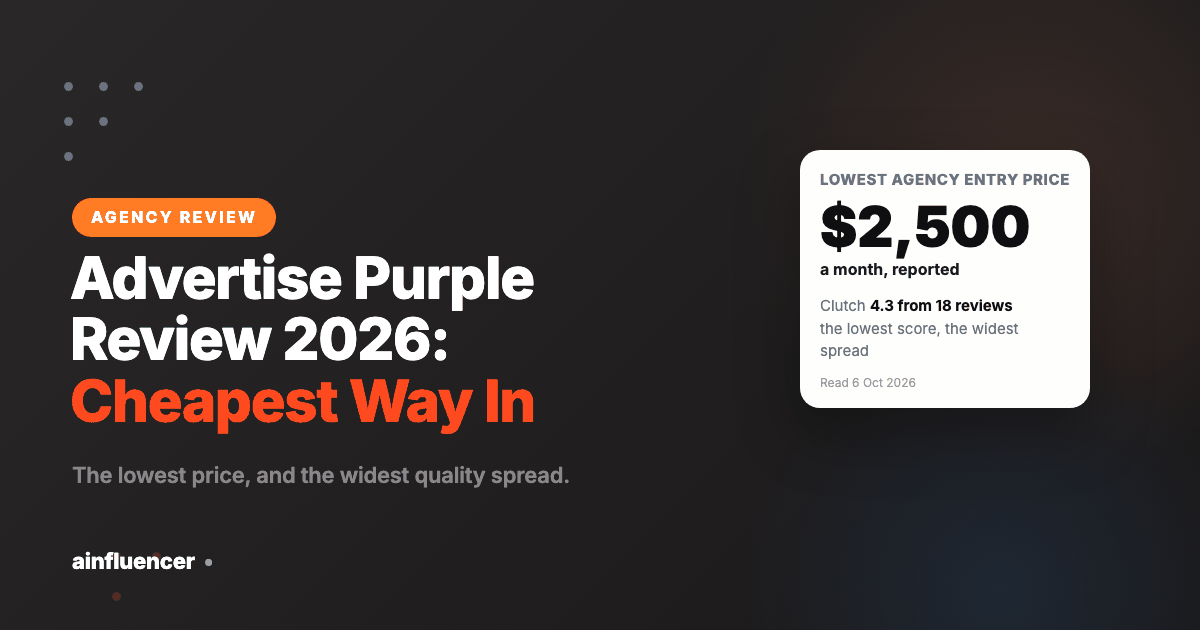
Advertise Purple has the lowest entry price of any established affiliate agency, at a reported $2,500 a month. That is roughly half what PartnerCentric’s retainer starts at and a fraction of what the enterprise agencies quote.
It also has the lowest rating here, 4.3 out of 5 on Clutch from 18 reviews, and the most polarised client reports. Those two facts are connected, and understanding how is the point of this review.
What it costs
| Item | Reported figure |
|---|---|
| Entry retainer | From a reported $2,500 a month, with some clients reporting around $2,000 |
| 2026 change | Pricing reported to have moved upward, attributed to added compliance tooling |
| Clutch rating | 4.3 out of 5 from 18 reviews |
| Published rate card | None |
At $2,500 a month, $30,000 a year buys managed affiliate from an agency with a real track record. For a brand doing $200,000 to $500,000 in affiliate revenue that is a defensible number, and it is the main reason this agency keeps appearing on shortlists.
The quality spread, and why it exists
The reviews do not disagree slightly. They disagree completely.
On one side, clients describe a team that took time to understand the business and delivered strong affiliate results. On the other, one reviewer says the agency was “excellent at sales talk, but they weren’t good at delivering their promises”, and another reports being given only coupon sites and no real value.
Reporting on the agency attributes this to account team variance: quality differs noticeably by who you get, and the gap between the best and worst client experience is wider than at more selective agencies.
That is what a low price buys and what it costs. An agency charging $2,500 cannot staff every account the way one charging $10,000 does, so outcomes depend more on the individual team assigned to you. The average is decent. The variance is the risk.
The coupon site complaint, and why it matters more than it sounds
Of all the criticism here, the one worth understanding properly is the client who said they received only coupon sites.
Coupon and deal sites are the easiest affiliates in the world to recruit. They will join almost any programme within days, and they generate volume immediately, so a programme stuffed with them looks like it is working from month one.
The problem is incrementality. A customer who was already on your checkout page, opens a new tab, searches your brand plus the word “coupon” and clicks a discount site has just cost you a commission plus a discount on a sale you were going to make anyway. Scale that and you have a channel that reports growth while reducing margin.
How to check for this in month two. Ask for affiliate revenue split by partner type: coupon and deal, content and review, loyalty and cashback, influencer. If coupon and loyalty dominate, ask what the plan is to recruit content partners, and set a target date. This single question separates agencies that are building a programme from agencies that are filling one.
What the rating actually says
Advertise Purple, as Clutch reports it
Read 6 October 2026. The lowest of the four agencies we compared, where the others sit at 4.9, 4.8 and 4.6. A 4.3 is still a good score in absolute terms, and the gap is consistent with variance between accounts rather than with poor work overall. We could not verify a Trustpilot score for this company, so none is given.
Set against that, it has 18 reviews, more than Acceleration Partners and DMi Partners have between them. A slightly lower score on a larger sample is often better evidence than a perfect score on a tiny one.
What a $2,500 floor buys at this size
An entry price tells you who an agency wants and roughly what you get for being at the bottom of its range. Both are worth translating before you decide.
At a floor price you are, almost always, getting a smaller share of a more junior person’s week. That is not a criticism and it is not hidden. It is arithmetic: the fee has to cover the hours, and at the bottom of a range the hours are fewer and cheaper. Agencies rarely volunteer this and will answer honestly if asked.
What that means practically:
- Response times stretch. Not because anyone is neglecting you, but because your account is one of more accounts held by that person
- Strategy happens less often. Execution continues; the stepping back to ask whether the structure is still right happens quarterly rather than monthly, if at all
- Escalation is slower. The senior people exist and are not on your account, so reaching them takes a reason
The honest test of whether a floor price is right for you: take your monthly programme revenue, assume an agency improves it by fifteen or twenty percent, and see whether that improvement clears the fee with room to spare. If it only just clears it, you are buying a coin flip. If it clears it several times over, the floor is cheap and you should be asking for more attention rather than a lower price.
What an average rating hides
A 4.3 is a good score and an average, and averages are the least informative way to read a review base this size. Two agencies can both average 4.3 and be completely different purchases.
One might have thirty reviews clustered tightly between 4 and 4.6, which describes consistency: most clients get a similar experience and you can predict yours. The other might have a stack of fives and a handful of ones, which describes a lottery: some clients get excellent work and some get something they were angry enough to write about. The average is identical and the decision is not.
So read the distribution rather than the headline:
- Open the lowest-scored reviews first. They are the most informative text on the page. You are not looking for whether complaints exist, you are looking for whether the same complaint recurs
- Check whether the low scores cluster by client size. If every unhappy review is from a small account, you have learned exactly where this agency’s attention goes
- Check the dates. Problems from three years ago under different leadership are different evidence from problems from last quarter
- Read the agency’s replies. A specific, non-defensive reply to a bad review tells you more about how they will handle your problem than any five-star review does
Worth knowing when weighing any public rating: the FTC’s guidance for marketers on soliciting and paying for online reviews is explicit that businesses may ask customers for reviews but may not condition an incentive on the review being positive, and that suppressing or selectively surfacing reviews can itself be deceptive. Review collection is a process every agency runs differently, which is one more reason the shape of the distribution matters more than the number on top of it.
The coupon publisher complaint, and whose problem it is
This complaint recurs across affiliate agencies generally rather than attaching to one, and understanding the mechanism tells you whether it is a real failure or a misread.
Coupon, deal and loyalty publishers sit at the very end of the purchase journey. A shopper who has already decided to buy opens a new tab, searches for a discount code, clicks a coupon site and completes the purchase. The affiliate link fires, the publisher is credited, and the agency’s reported revenue goes up.
The uncomfortable question is whether that sale would have happened anyway. Frequently it would. The publisher intercepted a conversion rather than creating one, and you paid commission on revenue you already had.
Two things follow, and they point in opposite directions:
- It is not automatically waste. A coupon publisher can prevent an abandoned basket, and recovering a sale that was about to be lost is worth paying for. The failure is not having coupon publishers, it is not knowing which of the two is happening
- It is not purely the agency’s fault either. Programmes drift this way because coupon partners are easy to recruit and produce immediate reported revenue, which looks like performance in a monthly report. An agency judged monthly is being rewarded for exactly this
The fix is a conversation rather than a different agency: agree up front how publisher types are weighted, whether commission differs between content publishers and deal sites, and what evidence you will both accept that revenue is genuinely new.
Questions that surface the spread before you sign
Everything above is readable from the outside. These four questions get you the part that is not public, and the quality of the answers is itself the signal.
- “Which account most like mine have you run, and may I speak to them?” Not a reference from their best client. The closest one to your situation
- “Who would be on my account day to day, and how many others do they hold?” The pitch team is rarely the delivery team, and this gap causes more disappointment than pricing ever does
- “What does a client at my spend level typically get in hours per month?” Vague answers here usually mean the honest answer is not many
- “Tell me about an account that did not work out.” The most useful question on the list. An agency with a real answer has reflected on it. One that claims none has either not been going long or is not being straight with you
A practical way to reduce the risk whatever the answers: ask for a short initial term with a defined review rather than a twelve month commitment. An agency confident in its own onboarding will usually accept three months. Reluctance to discuss it at all tells you something about their retention that no rating will.
What the negative reviews actually say
| Complaint | What reviewers describe | What to do about it |
|---|---|---|
| Sales exceeded delivery | One reviewer states the agency was excellent at sales talk but not good at delivering its promises. This is the most direct criticism in its public reviews. | Ask the pitch team which of them will still be on the account in month three, and get specific deliverables with dates into the contract rather than into the proposal deck. |
| Coupon-heavy partner mix | A client reports receiving only coupon sites and no real value. Coupon partners are the quickest to recruit and the least likely to be incremental. | Require a partner mix target in writing, and review revenue by partner type monthly from month two. |
| Variance between account teams | Reporting describes quality differing noticeably by team, with a wider gap between best and worst experience than at more selective agencies. | Meet your actual account lead before signing, not the new business team, and ask how many other accounts that person carries. |
| Pricing flexibility | Some clients ask for more flexibility in the pricing structure, which suggests the packages are less negotiable than at larger agencies. | If the standard package does not fit, test early whether they will shape it. The answer tells you how they will handle other exceptions. |
| Price rising | Pricing is reported to have moved upward in 2026, attributed to added compliance tooling. | Ask what the renewal price will be, in writing, during the first negotiation. The cheapest agency is only cheap until renewal. |
Advertise Purple pros and cons
Pros
- Lowest entry price of any established affiliate agency, from a reported $2,500 a month
- 4.3 out of 5 on Clutch from 18 reviews, a larger sample than several higher-rated peers
- Genuinely accessible to mid-market brands that enterprise agencies will not take
- Clients report strong results and a team that invested time in understanding the business
- Reported to have added compliance tooling in 2026
- A practical option for testing whether managed affiliate beats running it in house
Cons
- Lowest rating of the four agencies compared, at 4.3 against 4.9, 4.8 and 4.6
- Quality reported to vary noticeably by account team, the widest spread in this group
- One reviewer reports strong sales and weak delivery
- One reviewer reports a partner mix of coupon sites only, which is the least incremental kind of affiliate
- Pricing reported to be rising, and less flexible than at larger agencies
- No published rate card
- No verifiable Trustpilot presence we could confirm
Who Advertise Purple suits
A good fit if budget is the binding constraint, your programme is domestic, and you want managed affiliate without an enterprise retainer. At a reported $2,500 a month it is the realistic entry point into agency management, and plenty of clients report good outcomes.
A poor fit if you cannot afford variance. If this is your one attempt at proving the channel internally, pay more for an agency with a narrower spread, because the downside case here is a year of coupon traffic and a programme you then have to rebuild.
Advertise Purple alternatives
| Option | Entry | Choose it when |
|---|---|---|
| Ainfluencer | Free, managed from $1,500/mo | You want lower cost again, plus creator campaigns alongside affiliate |
| Gen3 Marketing | $5,000+ minimum | You can double the budget for a 4.9 rating and far more scale |
| PartnerCentric | Reported $3,000+/mo plus override | You want incrementality measurement, which directly addresses the coupon problem |
| Refersion | $39/mo plus 3% | You would rather buy software and hire one person in house |
The verdict
Advertise Purple is the honest budget option. The price is real, the track record is real, and 18 reviews at 4.3 describes an agency that usually does a decent job.
Manage the two risks and it is a reasonable bet. Meet your actual account team before you sign, and demand a partner mix report from month two. Both cost nothing, and between them they cover the two things its unhappy clients complained about.
How much does Advertise Purple cost?
A reported $2,500 a month at entry, with some clients reporting around $2,000, and pricing reported to have moved upward in 2026 for added compliance tooling. There is no published rate card. It is the lowest entry price among established affiliate agencies.
Is Advertise Purple any good?
On balance yes, with caveats. It holds 4.3 out of 5 on Clutch from 18 reviews, which is a good score from a reasonable sample, and it is the lowest rated of the four agencies we compared. Reporting describes quality varying noticeably by account team, so who you get matters more here than at pricier agencies.
What is the coupon site complaint about?
One client reported receiving only coupon sites as affiliates. Coupon and deal partners are the easiest to recruit and generate volume fast, but much of that volume is not incremental: the customer was already buying and the discount site captured a commission plus a discount. Ask for affiliate revenue split by partner type from month two.
Advertise Purple or a bigger agency?
If budget is the constraint and your programme is domestic, Advertise Purple is the realistic entry point. If this is your one chance to prove the channel internally, pay more for an agency with a narrower quality spread, because the downside case costs you a year.