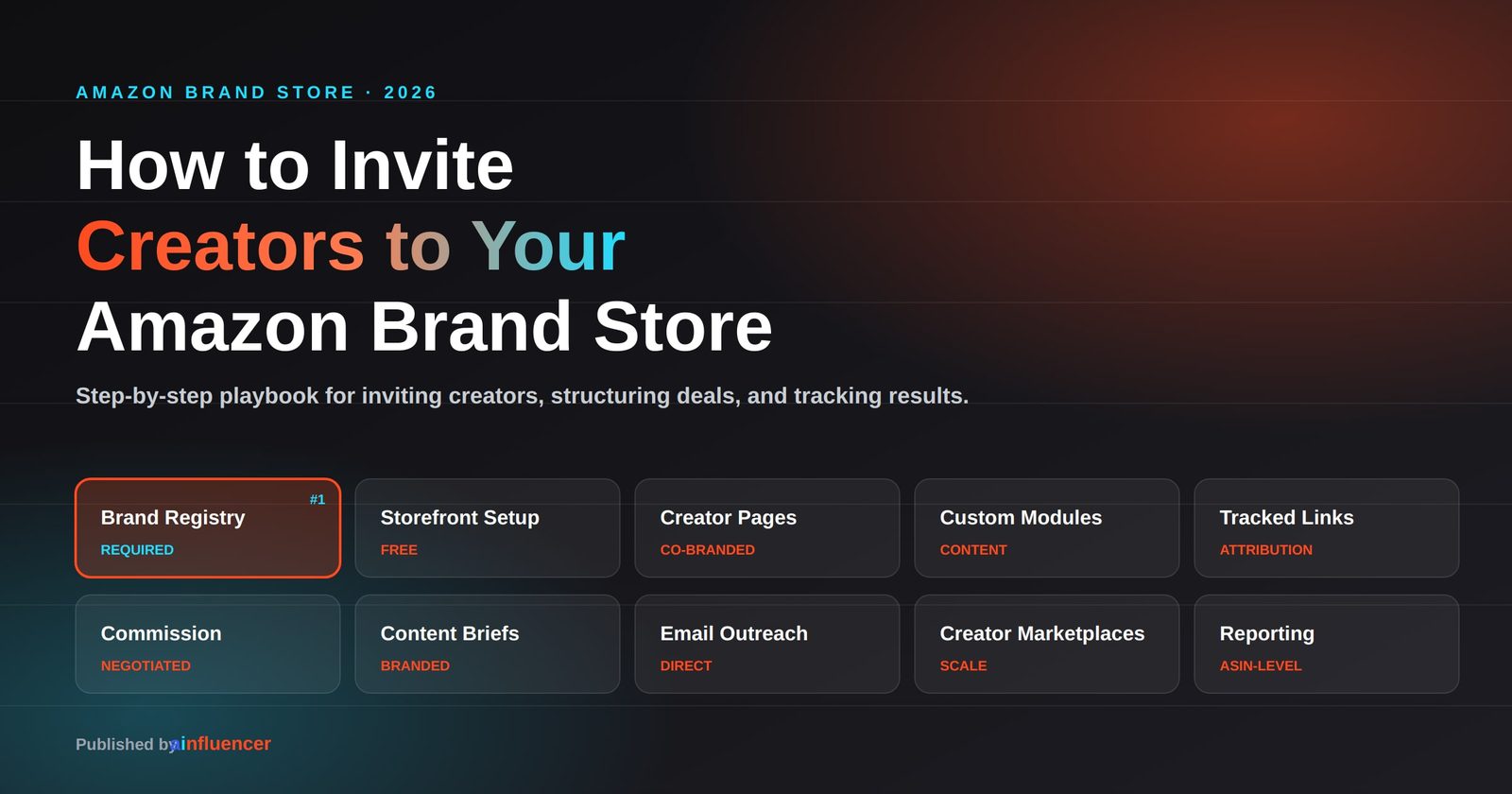
The Amazon Brand Store is one of the most underused assets in the Amazon Marketplace stack. Brand-registered sellers get a free, customizable mini-website inside Amazon, complete with product modules, lifestyle imagery, and trackable subpages. In 2026, the brands winning on Amazon are the ones using their Brand Store as a creator collaboration hub, not just a static product showcase. Knowing how to invite creators to Amazon Brand Store partnerships is the missing skill that separates mid-tier sellers from market leaders.
This guide is the complete 2026 playbook for using your Amazon Brand Store to attract, recruit, and activate creators. We cover the setup work that makes your Brand Store creator-ready, the four channels for finding creators, outreach templates that get responses, the deal structures creators expect, and how to measure the lift creator partnerships produce.
What is an Amazon Brand Store?
An Amazon Brand Store is a free, customizable storefront on Amazon for brand-registered sellers. It functions as a mini-website with multiple pages, drag-and-drop modules (product grids, lifestyle imagery, video embeds, comparison tables), and its own URL like amazon.com/[brand]. Customers landing on your Brand Store see your full catalog organized the way you want it, without competing product listings or distracting recommendations.
For sellers building a long-term Amazon brand, the Brand Store solves three problems at once. It creates a destination for paid traffic that doesn’t compete against your own ASINs. It hosts A+ Content and lifestyle imagery in a coherent brand environment. And — most importantly for this guide — it provides the structural foundation for inviting creators into an influencer ambassador collaboration that goes beyond a single sponsored post.
Step 1: Prepare Your Brand Store for Creator Collaboration
Before you can effectively invite creators to Amazon Brand Store partnerships, your Brand Store needs to be creator-ready. Four prerequisites apply.
Confirm Brand Registry enrollment
Brand Registry is required to build a Brand Store. If you have a trademark, enrollment is free and takes 2-4 weeks. Without it, no Brand Store, no Amazon Attribution, and no Brand Referral Bonus. Start here if you haven’t already.
Build the core Brand Store structure
Build out at least three pages: a homepage, a category page (collection), and a story page (about the brand). Make sure every page has lifestyle imagery, not just product shots. Creators evaluating your brand will land on this content first; weak presentation rules you out before the conversation even starts.
Add tracking infrastructure
Set up Amazon Attribution for every product you want creators to drive traffic to. Each creator partnership will get a unique tracked link tied to a specific landing page on your Brand Store. Without Attribution, you cannot measure creator-specific ROI or capture the Brand Referral Bonus.
Plan for co-branded creator subpages
The best Brand Stores in 2026 have dedicated subpages for top creator partnerships, with the creator’s image, content, and a curated selection of products they recommend. Sketch this layout before you start outreach so you can show creators exactly what they’ll get.
Step 2: Find Creators Worth Inviting
Not every creator is worth inviting to a long-term Brand Store collaboration. Brand Store partnerships involve deeper commitment than a single TikTok post, so the vetting bar is higher. Four channels produce candidates worth pursuing.
Existing customer-creators. If a customer has already left a positive review and has a relevant social following, they are the warmest possible lead. Search your review database for verified purchasers, cross-reference with Instagram or TikTok handles, and prioritize those with engaged audiences in your niche.
Creator marketplaces with Amazon Attribution integration. Platforms with influencer discovery tools like Ainfluencer let you filter 5M+ creators by niche, follower count, engagement, and Amazon-program participation. This is the fastest route to scale, and the marketplace handles outreach, contracting, payment, and reporting in one workflow.
Competitor mention mining. Search Instagram and TikTok for mentions of your top competitors. Creators who already promote category-adjacent products will be receptive to your offer if the terms are competitive.
Amazon Live and Amazon Influencer Program directories. Creators in Amazon’s own programs are pre-vetted for Amazon-specific content fit, which makes them strong candidates for Brand Store partnerships. See our companion guide on Amazon Live influencer outreach strategy for more on this channel.
Step 3: How to Invite Creators to Amazon Brand Store Partnerships
The outreach message is where most Brand Store partnership conversations die. Generic “we’d love to partner with you” messages get ignored. Specific, structured invitations with clear deliverables get responses. Below are three templates calibrated for 2026 response rates.
Template 1: Cold outreach via DM
Template 2: Warm email to existing customer-creators
Hi [Creator Name],
We saw your recent review of [Product] and your Instagram presence in [niche]. Would you be open to a paid partnership with our Brand Store on Amazon? Here’s the offer:
• Dedicated featured-creator page on our Amazon Brand Store
• Free product samples (any 3 ASINs from our catalog — see our product gifting vs seeding guide)
• 15% commission on attributed sales for 12 months
• $300 flat fee for the launch content piece
Available for a quick call this week?
[Name]
Template 3: Marketplace direct invite via Ainfluencer
The key in any outreach template is to invite creators to Amazon Brand Store partnerships with specific, named deliverables. “Featured partner” sounds prestigious but is meaningless unless you describe what it actually is. The co-branded subpage, the commission rate, the time commitment, the deliverable, all of these belong in the first message.
Step 4: Structure the Partnership Deal
Brand Store creator partnerships in 2026 typically use a three-component structure: a flat fee at launch, a commission on attributed sales, and a 12-month engagement term. The components flex based on creator tier, but the structure stays consistent because it aligns incentives well for both sides.
- Launch flat fee. Pays for the initial content piece and the time investment to set up the creator subpage. Typical ranges: $100-$300 for nano-creators (under 10K followers), $300-$1,000 for mid-tier (10K-100K), $1,000-$5,000 for macro (100K+).
- Commission on attributed sales. Aligns long-term creator behavior with sales outcomes. Typical rate: 10-15% of attributed revenue, tracked via Amazon Attribution. Capture the Brand Referral Bonus to offset ~67% of this cost.
- 12-month engagement term. Creator commits to keep the original content live, refresh once at 6 months, and maintain the co-branded subpage. Most creators are open to longer terms than sellers realize because long-term partnerships produce recurring revenue.
Add a milestone bonus structure for top performers. A $500 bonus paid when a creator drives $5,000 in attributed revenue creates strong upside-alignment without exposing the seller to runaway cost.
Step 5: Build Co-Branded Creator Pages
The co-branded subpage is what makes the Brand Store partnership feel different from a one-off sponsored post. Done well, the subpage serves as a credible recommendation environment that drives both immediate conversion and long-term brand-creator association. Five elements belong on every co-branded creator page.
- Creator hero image and intro. A high-quality photo of the creator with your product, and 2-3 sentences in the creator’s voice about why they chose your brand.
- Curated product selection. 3-6 ASINs the creator personally recommends, not your entire catalog. Curation reads as authentic; comprehensive product dumps read as paid placement.
- Embedded video or quote. A 30-second video from the creator (uploaded to your Brand Store) or a pull-quote with creator attribution.
- Discount code or commission attribution. A creator-specific discount code that doubles as attribution. Customers feel like they’re getting a creator-specific deal; the seller can attribute the sale.
- Cross-promotion to creator’s social channels. Buttons or links to the creator’s Instagram, TikTok, or YouTube, signaling that this is a real ongoing collaboration, not a paid endorsement.
Step 6: Track Performance with Amazon Attribution
Performance tracking on Brand Store creator partnerships uses Amazon Attribution, the same tool that powers all off-Amazon traffic measurement. Each creator gets a unique Amazon Attribution link to the Brand Store creator subpage. That link captures clicks, detail page views, add-to-carts, and purchases within a 14-day window.
Three reports deserve weekly review. Creator-attributed revenue per partnership over the trailing 30 days. Top-of-funnel signal like Brand Store sessions and product detail page views, which precede revenue by 7-14 days. And Brand Referral Bonus capture, which arrives roughly 60 days after the qualifying sales. Sellers who do not check the BRB report typically discover their Attribution is misconfigured weeks too late.
How to Scale Brand Store Creator Outreach
Running 25-100+ Brand Store creator partnerships manually is operationally infeasible. The work of discovery, outreach, contracting, brief writing, content review, payment, and reporting compounds fast. Most sellers hit a ceiling around 10-15 creators before adding tools or service.
Ainfluencer is built for the scaling problem. The 5M+ creator marketplace handles discovery and outreach at scale. Each invited creator can be wired to a specific Brand Store subpage with Amazon Attribution links generated automatically. Escrow-secured payments and 1099 tax-form collection are handled inside the platform. Reporting unifies Brand Store creator performance with off-Amazon creator campaigns in a single dashboard. Free tier to start, paid plans from $49/month. For sellers who want the entire workflow handled, the Fully Managed Affiliate Marketing service runs end-to-end from $1,500/month.
Ready to invite creators to your Amazon Brand Store?
Start free on Ainfluencer to access 5M+ creators across Instagram, TikTok, and YouTube. Amazon Attribution integration built in. Free-forever tier. Paid plans from $49/month.
Start free → Book a demoFrequently Asked Questions
How do I invite creators to my Amazon Brand Store?
The cleanest way to invite creators to Amazon Brand Store partnerships is to use a structured outreach process: identify candidates via existing customer reviews, creator marketplaces like Ainfluencer, competitor mention mining, and Amazon Live directories. Send specific outreach with named deliverables (co-branded subpage, commission rate, time commitment). Structure the deal as a flat fee + commission + 12-month term. Build a co-branded subpage on your Brand Store. Track performance with Amazon Attribution.
Do I need Brand Registry to build an Amazon Brand Store?
Yes. Amazon Brand Stores are only available to sellers enrolled in Amazon Brand Registry. Brand Registry requires a registered trademark and takes 2-4 weeks to process. Once enrolled, you can build a Brand Store for free. Without Brand Registry, you cannot build a Brand Store, use Amazon Attribution, or capture the Brand Referral Bonus, so registry is foundational for any serious creator collaboration strategy.
How much should I pay creators for Amazon Brand Store partnerships?
Compensation depends on creator tier and partnership scope. The standard 2026 structure is: $100-$300 flat fee (nano), $300-$1,000 (mid-tier), $1,000-$5,000 (macro), plus 10-15% commission on attributed sales for 12 months. The Brand Referral Bonus (10% rebate from Amazon on off-Amazon traffic) typically offsets a meaningful portion of the commission cost, so the real net cost to the seller is lower than the headline numbers suggest.
Can I track sales from each creator separately on my Brand Store?
Yes, using Amazon Attribution. Each creator gets a unique Amazon Attribution link that tracks clicks, detail-page views, and purchases attributed to that creator over a 14-day window. Sellers see this data in the Amazon Attribution dashboard. Third-party platforms like Ainfluencer consolidate this data with creator metadata, payment status, and Brand Referral Bonus capture in a single dashboard for sellers running multiple partnerships.