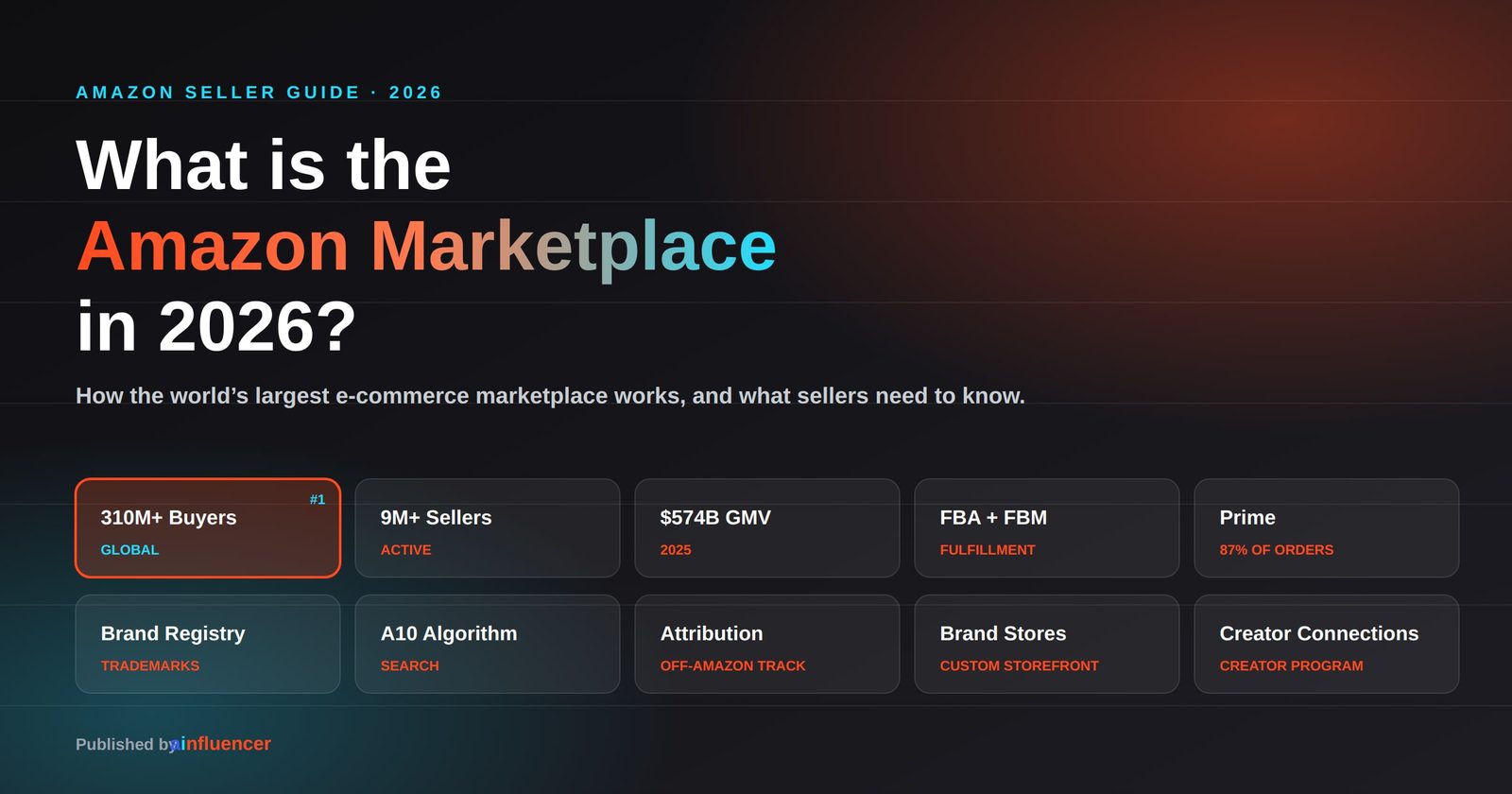
The Amazon Marketplace is the world’s largest online retail platform, hosting more than 310 million buyers and 9 million active sellers globally, with total marketplace GMV exceeding $574 billion in 2025. For new and existing sellers, understanding how the Amazon Marketplace works is the single most important business decision they will make, because almost every operational, financial, and marketing choice flows downstream from where and how they sell on the platform.
This guide is the definitive 2026 reference on what the Amazon Marketplace is, how it functions, who participates, and what it takes to win. We cover the marketplace structure, the seller categories, the fulfillment models, the fees, the algorithm that decides who ranks, and the creator-marketing layer that has become essential for new launches in competitive categories. By the end, you’ll have a clear picture of the entire system and where your business fits inside it.
What is the Amazon Marketplace?
The Amazon Marketplace is a third-party selling platform operated by Amazon.com, where independent businesses and individuals can list and sell their products alongside Amazon’s own retail offerings. Unlike Amazon Retail (where Amazon buys inventory and sells it to customers directly), the Amazon Marketplace lets external sellers maintain ownership of their inventory while leveraging Amazon’s customer base, search engine, payment infrastructure, and fulfillment network.
In practical terms, when you search for a product on Amazon.com and see multiple sellers offering the same item, those sellers are participating in the Amazon Marketplace. Today, third-party marketplace sellers account for approximately 60% of all units sold on Amazon, making the marketplace the dominant force in the platform’s growth story since 2015.
The Amazon Marketplace operates in 20+ country-specific stores including the United States, United Kingdom, Germany, Japan, India, and Brazil. Sellers can list products in one marketplace or expand into multiple via Amazon Global Selling. Each country marketplace has its own currency, language, regulatory requirements, and customer base, but the core platform mechanics work the same way globally.
A Brief History of the Amazon Marketplace
Amazon launched as an online bookstore in 1995. The Amazon Marketplace as we know it today opened in 2000, originally as a way for sellers to list used books alongside Amazon’s new inventory. The model expanded steadily through the 2000s: first to all categories, then internationally, then with the introduction of Fulfillment by Amazon (FBA) in 2006, which let sellers ship inventory to Amazon’s warehouses and let Amazon handle storage, packing, shipping, and customer service.
FBA fundamentally changed who could sell on Amazon. Before FBA, marketplace selling favored sellers with warehouse capacity and shipping infrastructure. After FBA, anyone with a viable product and a credit card could start a global business. By 2024, FBA-fulfilled units accounted for the majority of marketplace orders, and FBA sellers comprised the bulk of the platform’s small-business growth.
The 2020s have added two further evolutions. Amazon Brand Registry (formalized in 2017 but matured significantly in 2022-2024) gave trademark-holding brands new tools, including Amazon Attribution for affiliate marketing, the Brand Referral Bonus rebate, and customizable Brand Stores. And the 2025-2026 emergence of creator-led launches (where new ASINs are launched with coordinated TikTok and Instagram content) has changed the playbook for how the most successful Amazon Marketplace sellers operate.
How the Amazon Marketplace Works
From the seller’s perspective, the Amazon Marketplace works in five stages. First, a seller registers for an Amazon seller account (Individual or Professional plan) and is assigned a Seller Central dashboard. Second, the seller lists products by creating new listings (for unique products) or matching to existing listings (for products already in Amazon’s catalog). Third, the seller ships inventory to Amazon’s fulfillment centers (FBA) or fulfills orders from their own warehouse (FBM). Fourth, customers find and purchase the products, and Amazon handles payment processing, customer service, and (for FBA) delivery. Fifth, Amazon deducts fees from the sale price and pays out the remainder to the seller every 14 days.
From the buyer’s perspective, the experience is almost identical to buying from Amazon Retail. The Amazon Marketplace is intentionally invisible to most consumers: same checkout, same Prime shipping, same returns policy, same customer service. This invisibility is by design and is part of why Amazon Marketplace sellers can compete effectively, customers trust the experience whether the product comes from Amazon or a third-party seller.
Who Sells on the Amazon Marketplace?
The Amazon Marketplace hosts five broad seller categories. Private-label brands create their own branded products (often sourced from manufacturers in China or India) and sell them exclusively on Amazon. Wholesale sellers buy branded products from authorized distributors and resell them. Retail arbitrage sellers buy clearance or discounted products from retail stores and resell them on Amazon. Online arbitrage sellers do the same but source from other online retailers. Handmade and artisan sellers create unique items and list them via Amazon Handmade, the platform’s craft-focused subcategory.
By volume, private-label brands and wholesale sellers dominate the Amazon Marketplace, accounting for roughly 70% of total third-party GMV. The private-label segment is where the most successful new entrants now build because it offers the highest margins, brand control, and the ability to leverage Amazon-specific advantages like Brand Registry and the Brand Referral Bonus.
Fulfillment Models: FBA vs FBM
Every Amazon Marketplace seller must choose a fulfillment model. The two primary options are FBA (Fulfillment by Amazon) and FBM (Fulfillment by Merchant), with a third hybrid option (Seller Fulfilled Prime) available to qualified merchants.
- FBA (Fulfillment by Amazon): Seller ships inventory to Amazon’s warehouses. Amazon handles storage, packing, shipping, customer service, and returns. Products are Prime-eligible by default. Fees range from $3 to $15+ per unit depending on size and weight. Best for most sellers, particularly newcomers.
- FBM (Fulfillment by Merchant): Seller fulfills orders from their own warehouse or via a third-party logistics provider. No FBA fees, but products are not Prime-eligible by default, which hurts conversion. Best for large, heavy, or low-margin products where FBA fees eat too much margin.
- SFP (Seller Fulfilled Prime): Seller fulfills orders from their own facility while maintaining Prime eligibility. Requires meeting strict performance metrics. Best for established mid-market sellers with logistics infrastructure.
For new sellers, FBA is the default recommendation in 2026. The conversion premium from Prime eligibility usually outweighs the additional fees, and the operational simplicity (no warehouse, no shipping logistics, no customer service) lets sellers focus on product selection and marketing.
Amazon Marketplace Fees and Pricing
The Amazon Marketplace fee structure has three components. Subscription fees cover account access: $0.99 per item sold (Individual plan) or $39.99/month flat (Professional plan). Most sellers above 40 sales per month use the Professional plan. Referral fees are Amazon’s commission per sale, typically 8% to 15% depending on category, with electronics on the low end and luxury beauty on the high end. Fulfillment fees apply only to FBA sellers and cover storage, picking, packing, shipping, and customer service.
For a typical $30 private-label product sold via FBA, the fee breakdown looks roughly like this: $4.50 referral fee (15%), $5.50 FBA fulfillment fee, $0.30 monthly storage fee allocation, $39.99 / total monthly sales for the Professional plan share. Net to the seller after fees is approximately $19, before cost of goods, advertising, and overhead. Sellers who structure their pricing without accounting for the full fee stack typically discover the math problem after their first 30 days on the platform.
The A10 Algorithm and Search Ranking
The Amazon search algorithm (sometimes called A9 historically, now widely referred to as A10) decides which products appear in search results and in what order. Unlike Google search, which optimizes for relevance broadly, the Amazon algorithm optimizes specifically for the metric Amazon cares most about: probability of purchase. Products that convert browsers into buyers at high rates rank higher. Products that don’t get demoted.
The factors that move A10 ranking are reasonably well understood. Sales velocity is the single biggest input. Conversion rate (the percentage of visitors who buy) is a close second. Keyword relevance in title, bullets, and backend search terms matters. Reviews matter, both quantity and average rating. Time on listing matters. Off-Amazon traffic (driven through Amazon Attribution links) is increasingly weighted because Amazon rewards sellers who bring outside customers to the platform. This last factor is what makes creator-led launches so effective: they generate exactly the off-Amazon traffic signal Amazon values most.
Seller Tools and Infrastructure on the Amazon Marketplace
Amazon provides a substantial native tool stack for marketplace sellers. Seller Central is the dashboard where sellers manage everything. Brand Registry unlocks brand-specific tools for trademark holders. A+ Content lets brand-registered sellers add rich product page modules with images and comparison tables. Brand Stores are customizable mini-websites within Amazon for individual brands. Amazon Attribution tracks off-Amazon traffic and unlocks the Brand Referral Bonus rebate. Product Opportunity Explorer surfaces niche opportunities based on shopping behavior data. Amazon Creator Connections is the platform’s native creator outreach program (see our Amazon influencer tools guide for the third-party alternatives).
Beyond Amazon’s native tools, an entire third-party ecosystem has grown around the Amazon Marketplace. Research tools like Helium 10, Jungle Scout, and AMZScout help with product discovery and competitive analysis. Repricing tools automate price competition. PPC management tools optimize advertising spend. And creator marketing platforms like Ainfluencer combine creator discovery with Amazon Attribution link generation in one workflow.
Why Creators Matter on the Amazon Marketplace in 2026
The single biggest change in how successful sellers operate on the Amazon Marketplace over the past two years is the rise of creator-led affiliate launches. The data is now clear: ASINs that launch with coordinated TikTok and Instagram creator content reach Amazon page 1 of search approximately 3.6x faster than ASINs that rely on paid ads alone. This is not a marginal improvement, it is a structural shift in the launch playbook.
The reason creator content works so well on the Amazon Marketplace comes down to three factors. First, creator videos generate the off-Amazon traffic signal that the A10 algorithm rewards. Second, when that traffic flows through Amazon Attribution links, the seller captures the Brand Referral Bonus (a 10% rebate from Amazon on off-Amazon-driven sales), which effectively offsets a meaningful portion of the commission paid to the creator. Third, social proof from TikTok and Instagram drives secondary search demand on Amazon itself, which compounds organic ranking.
For sellers asking how to take advantage of this shift, the answer is to combine three things: a creator marketplace with depth at scale, native Amazon Attribution link generation, and an operational workflow that can manage 25-100+ creator partnerships without crushing the team. Ainfluencer is built for exactly this motion, with 5M+ creators across Instagram, TikTok, and YouTube and Amazon Attribution integration baked into every campaign. Free tier to start, paid plans from $49/month, and an optional Fully Managed service when you want execution off your plate.
How to Start Selling on the Amazon Marketplace
Register your seller account
Choose between Individual ($0.99/item) and Professional ($39.99/month). Most serious sellers go Professional. You’ll need a business address, tax ID, bank account, and government-issued ID. Approval is typically same-day.
Enroll in Brand Registry
If you have a trademarked brand, enroll in Amazon Brand Registry. This unlocks A+ Content, Brand Stores, Amazon Attribution, and the Brand Referral Bonus. Enrollment is free but requires a registered trademark and takes 2-4 weeks to process.
Validate your product and source inventory
Use the 5-step validation framework (demand, margin, competition, reorder, creator fit) before committing to inventory. Run an initial order of 300-500 units for a new ASIN, not 5,000. You’ll know more after 30 days of real data than any pre-launch research will tell you.
Create your listing and ship to FBA
Build the listing with keyword-optimized title, bullets, A+ Content, and Brand Store. Ship inventory to Amazon’s fulfillment centers. Inventory is typically receivable in 3-7 days.
Launch with creator content and ads in parallel
The launch playbook is creator content (TikTok, Instagram, YouTube) plus sponsored ads on top keywords for the first 30 days. Tag every creator link with Amazon Attribution to capture the Brand Referral Bonus. Most sellers underestimate how much velocity matters in the first 30 days, this is when Amazon decides whether your listing is worth ranking organically.
Launching on the Amazon Marketplace in 2026?
Start free on Ainfluencer to access 5M+ creators with Amazon Attribution link generation built in. Free-forever tier. Paid plans from $49/month. Optional Fully Managed service from $1,500/month.
Start free → Book a demoFrequently Asked Questions
What exactly is the Amazon Marketplace?
The Amazon Marketplace is Amazon’s third-party selling platform, where 9+ million independent businesses list and sell products alongside Amazon’s own retail inventory. When you see multiple sellers offering the same product on Amazon, those sellers are participating in the Amazon Marketplace. Third-party sellers now account for approximately 60% of all units sold on Amazon.
How much does it cost to sell on the Amazon Marketplace?
Costs depend on plan, category, and fulfillment model. The Professional seller plan is $39.99/month flat. Referral fees range from 8-15% of sale price depending on category. FBA fulfillment fees range from $3 to $15+ per unit depending on size and weight. For a typical $30 product sold via FBA, Amazon Marketplace fees total approximately $10-12, leaving $18-20 to cover cost of goods, advertising, and overhead.
What is the difference between Amazon Marketplace and Amazon Retail?
Amazon Retail is where Amazon itself buys inventory wholesale and sells it directly to customers. Amazon Marketplace is where third-party sellers list and sell their own inventory, using Amazon’s platform but maintaining ownership of the products. Buyers see both in the same search results, but the seller of record differs. Marketplace sellers pay fees to Amazon; Retail products are sold by Amazon directly.
Is Amazon Marketplace still profitable in 2026?
Yes, with the right strategy. The Amazon Marketplace remains the single largest online retail opportunity globally, with $574B+ GMV in 2025. However, the playbook has changed. Generic me-too products competing only on price rarely succeed in 2026. Successful sellers combine validated product selection (using a 5-gate validation framework), creator-led Amazon launches, Brand Referral Bonus capture, and operational discipline. Margins of 35%+ after all fees are achievable in beauty, health, pet, and home categories.
Do I need a trademark to sell on the Amazon Marketplace?
No, you can sell on the Amazon Marketplace without a trademark. However, a trademark unlocks Amazon Brand Registry, which provides materially better tools: A+ Content, Brand Stores, Amazon Attribution for affiliate marketing, and the 10% Brand Referral Bonus rebate. For any seller building a long-term brand on Amazon, filing a trademark and enrolling in Brand Registry is one of the highest-ROI decisions available.