Amazon Live is Amazon’s native live-shopping platform, where vetted creators stream product demonstrations directly on Amazon storefronts and product pages. For Amazon sellers, it has quietly become one of the highest-converting traffic sources on the platform, often outperforming standalone TikTok and Instagram content by 2-3x on add-to-cart rate. The challenge is that Amazon Live influencer outreach is operationally heavier than standard creator outreach, with a smaller creator pool and different commercial structures.
This guide is the definitive 2026 reference on building an Amazon Live influencer outreach strategy that actually converts. We cover the creator landscape, the four channels that produce results, outreach templates that get responses, the commercial structures Amazon Live creators expect, and how to measure success once partnerships are live. By the end, you will have a complete operational playbook for the channel that increasingly separates mid-tier Amazon sellers from market leaders.
What is Amazon Live?
Amazon Live is Amazon’s live-streaming shopping platform, launched in 2019 and substantially expanded between 2022 and 2026. It lets approved creators stream product demonstrations live, with clickable product carousels embedded in the stream. Viewers can buy without leaving the stream, which makes Amazon Live one of the few channels where the path from discovery to purchase is genuinely friction-free.
Creators access Amazon Live through the Amazon Influencer Program, which is separate from Amazon Associates. Amazon Influencer Program members get their own Amazon storefront, can stream live shopping shows, and earn commission on attributed sales. The program is curated, with admission requirements based on follower count, engagement, and niche fit, which means the creator pool is smaller and more vetted than the broader Amazon Associates ecosystem.
For Amazon sellers, partnering with Amazon Live influencers is fundamentally different from partnering with TikTok or Instagram creators. The traffic happens on Amazon itself, the commerce mechanics are native, and the attribution is automatic via Amazon’s own tracking. The tradeoff is a smaller, more competitive creator pool that requires more thoughtful outreach.
Why Amazon Live Influencer Outreach Matters in 2026
Three forces make Amazon Live influencer outreach a strategic priority in 2026. First, Amazon Live viewership has grown approximately 60% year-over-year as the format crosses from early-adopter to mainstream. Second, conversion rates on Amazon Live streams routinely run 8-12%, compared to 1-3% for standard Amazon product pages, because viewers arrive with explicit purchase intent. Third, Amazon’s algorithm appears to reward products that get featured on Amazon Live with stronger organic ranking lift, possibly because the velocity signal feeds the same A10 inputs as Brand Referral Bonus traffic.
For sellers building a comprehensive Amazon influencer strategy, Amazon Live should sit alongside TikTok, Instagram Reels, and YouTube as one of four creator channels. The skill is matching creators to channels. Some creators have huge TikTok followings but no Amazon Live presence. Others are Amazon Live powerhouses with modest social-channel reach. Smart sellers maintain partnerships across both because the audiences barely overlap.
Where to Find Amazon Live Influencers
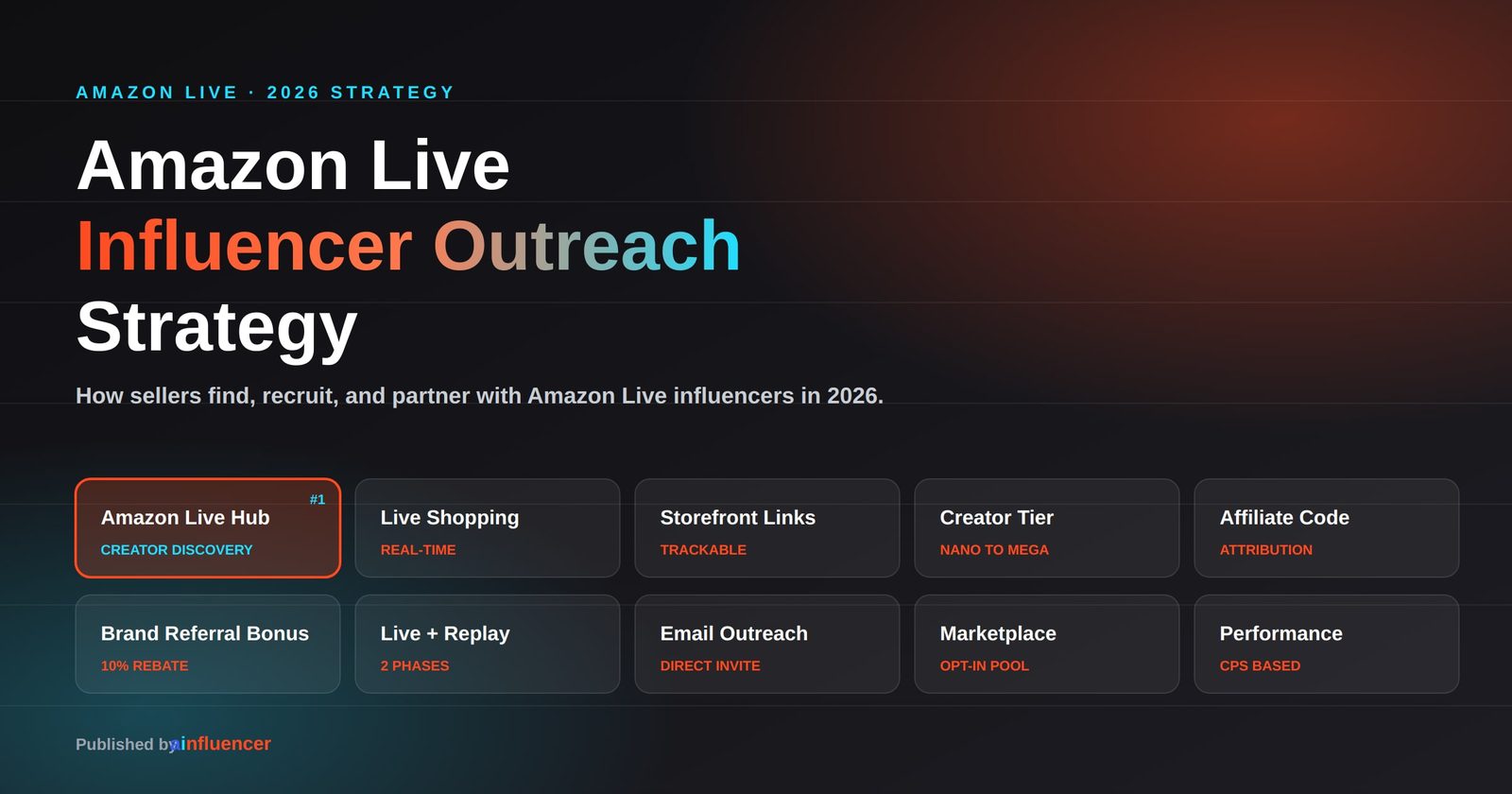
There are four channels for finding Amazon Live creators, each with different signal quality and operational cost.
1. The Amazon Live discovery page
Amazon’s own Amazon Live hub at amazon.com/live shows currently streaming creators, upcoming shows, and creator profiles. Browsing by category surfaces the most active creators in your niche. The advantage is direct, free access to the public-facing creator catalog. The disadvantage is that contact information is not exposed; you can see who is streaming but not how to reach them.
2. Amazon Influencer Program storefronts
Every Amazon Live creator has an Amazon Influencer storefront at amazon.com/shop/[username]. Browsing these storefronts reveals each creator’s product mix, content cadence, and stylistic approach. For sellers researching Amazon Live influencer outreach targets, this is the deepest signal of fit before you reach out.
3. Creator marketplaces with Amazon Live segments
Third-party influencer discovery tools have started building dedicated Amazon Live segments. Ainfluencer’s creator marketplace includes filterable segments for Amazon Influencer Program members across Instagram, TikTok, YouTube, and Amazon Live, with attribution and outreach handled in one workflow. This is the fastest path to scale for sellers who want to partner with 20+ Amazon Live creators in a quarter without spending weeks on manual outreach.
4. Direct social-channel outreach
Most Amazon Live creators are also active on Instagram, TikTok, or YouTube. Searching for “Amazon Live” or “Amazon Influencer” in TikTok bios, Instagram bios, or YouTube About sections surfaces creators who actively promote both their social presence and their Amazon Live shows. The advantage is direct contact via DM or email. The disadvantage is that this channel is operationally heavy at scale.
How to Vet Amazon Live Creators
Not every Amazon Live creator is worth partnering with. The vetting criteria for Amazon Live influencer outreach differs from standard creator vetting because the Amazon Live mechanic itself selects for certain creator characteristics.
- Streaming frequency. Active Amazon Live creators stream 3+ times per week. Less frequent creators tend to have weaker viewer retention.
- Niche alignment. Amazon Live audiences are extremely niche-loyal. A beauty creator’s audience expects beauty content. Cross-category attempts rarely work. Vet for category fit aggressively.
- Storefront curation. Look at the creator’s Amazon storefront. Disorganized or thinly populated storefronts signal lower commitment. Curated, themed, regularly updated storefronts signal strong fit.
- Engagement velocity. Comments per stream, products sold per stream, and follower growth rate on the Amazon Influencer page. Amazon doesn’t publish these publicly, but creator marketplaces and direct conversations with creators typically reveal them.
- Cross-channel presence. Top Amazon Live creators usually have meaningful TikTok or Instagram followings. The cross-channel lift compounds if both can be activated together.
Amazon Live Influencer Outreach Templates
The outreach templates below are calibrated to actual response rates. The shorter, more specific message outperforms the long pitch every time. Always include the ASIN, the commission offer, and a tracked link in the first message.
Template 1: Direct DM outreach (Instagram, TikTok)
Template 2: Email outreach to managed creators
Hi [Creator Name],
I’ve been following your Amazon Live shows in the [niche] category and would like to propose a partnership. We’re launching [Product] (ASIN: [number]) and looking for 5 Amazon Live creators to feature it across the next 30 days.
Offer: 15% commission on attributed sales + $250 flat fee per stream featuring the product. Product samples shipped within 48 hours of agreement.
Available to discuss this week?
[Name]
Template 3: Marketplace direct invite
Across all three templates, three rules consistently outperform alternatives. State the offer in the first message, including specific numbers. Include the actual Amazon link, not a generic landing page. Set a clear next step (reply, click, schedule) so the creator knows what action you want.
Commercial Structures: Commission, Flat Fee, or Hybrid
Amazon Live influencer compensation typically uses one of three structures. Each has different incentive properties and different risk profiles for the seller.
- Pure commission (CPS). Creator earns a percentage of attributed sales, typically 10-20%. Lowest seller risk, but Amazon Live creators with strong audiences usually decline pure CPS offers because they prefer guaranteed compensation for stream time.
- Flat fee. Creator earns a fixed payment per stream, typically $100-$2,500 depending on creator tier. Predictable cost for the seller, but no upside-aligned incentive for the creator to drive higher conversion.
- Hybrid (flat + commission). The most common structure in 2026. Creator earns a smaller flat fee ($100-$500) plus a commission on attributed sales (10-15%). Balances guaranteed compensation against performance upside.
For most sellers running Amazon Live influencer outreach at scale, the hybrid model produces the best long-term economics. Creators respond to it because they get paid even if the stream underperforms. Sellers benefit because the commission component aligns creator behavior with sales outcomes. Brand Referral Bonus capture (10% rebate from Amazon on off-Amazon traffic) helps offset the cost, though Amazon Live traffic is on-Amazon and does not qualify.
Building Creator Briefs for Amazon Live
The creator brief is the document that turns an outreach acceptance into a working partnership. Brief quality is the single largest determinant of whether the resulting stream content actually drives sales. Five elements belong in every Amazon Live creator brief.
- Product context. ASIN, retail price, key features, two or three competitor products. The creator needs enough context to talk about the product credibly without scripting.
- Brand voice and do/don’t list. Tone of voice, claims that are approved (e.g., “clinically tested”), claims that are not approved (e.g., specific health outcomes), and any FDA or platform-specific language requirements.
- Stream structure suggestion. Not a script. A high-level structure: 30-second intro, 3-5 minute demo, 1-minute “why I love it” segment, clear CTA to the product carousel. Creators perform best when they have structure but their own voice.
- Hashtags, mentions, and tracking links. Specific hashtags to include, social handles to tag, and the unique tracked link (typically the Amazon product URL with a creator-specific identifier appended).
- Payment and timing terms. Confirmed payment schedule, payment method (PayPal, Wise, ACH), and stream date confirmation. Ambiguity here is the single most common source of post-partnership disputes.
Measuring Amazon Live Influencer ROI
Amazon Live attribution is largely native, which makes ROI measurement cleaner than off-Amazon creator partnerships. Five metrics deserve weekly attention.
Stream-level conversion rate. Units sold during the stream window divided by stream viewers. Healthy ranges are 8-12%. Below 4% suggests creator-product misfit. Above 15% suggests an exceptional creator worth re-engaging.
Attributed revenue per stream. Total revenue tagged to the creator’s tracked link, including post-stream conversion within the attribution window. This is the headline ROI number, and creators expect to see it in their report.
Cost per acquired customer. Total cost (flat fee + commissions paid) divided by new customers acquired. Compare against your blended CAC across all channels. Amazon Live should typically be 30-50% below your Amazon PPC CAC.
Listing rank lift. Pre-stream and post-stream organic rank on your top 5 keywords. Streams that drive 20+ unit velocity within a 24-hour window typically produce rank lift, which compounds value beyond the immediate stream revenue.
Review velocity. Reviews generated within 14 days post-stream. Amazon Live viewers convert and review at higher rates than standard buyers, which compounds the launch-velocity effect.
How to Scale Amazon Live Outreach with Ainfluencer
For sellers running Amazon Live influencer outreach strategy at scale, the operational load grows fast. Managing 25 creators manually across discovery, contracts, briefs, content review, payment, and reporting consumes 10+ hours per week. Most sellers eventually hit a ceiling where adding more creators requires adding tools or service.
Ainfluencer is built specifically for this scaling challenge. The platform combines a 5M+ creator marketplace (with filterable Amazon Influencer Program segments), automated outreach workflows, escrow-secured payment, and unified reporting across Amazon Live and other creator channels. Sellers can run 25-100+ Amazon Live partnerships from a single campaign management dashboard, with each partnership wired to Amazon Attribution for off-Amazon campaign extensions if the creator also has Instagram or TikTok presence.
The free-forever tier covers basic discovery and outreach. Paid plans from $49/month add advanced filtering and unlimited campaigns. For sellers who want execution off their plate entirely, the Fully Managed Affiliate Marketing service handles end-to-end Amazon Live influencer outreach including discovery, contracting, briefing, content review, payment, and reporting, from $1,500/month with a 3-month minimum.
Ready to launch your Amazon Live outreach strategy?
Start free on Ainfluencer to access creators across Amazon Live, Instagram, TikTok, and YouTube. Amazon Attribution integration built in. Free tier to start.
Start free → Book a demoFrequently Asked Questions
What is an Amazon Live influencer outreach strategy?
An Amazon Live influencer outreach strategy is the structured approach Amazon sellers use to find, recruit, and partner with creators in the Amazon Influencer Program to stream live shopping shows featuring their products. A good strategy covers four channels for finding creators (Amazon Live discovery, Influencer storefronts, creator marketplaces, social outreach), five vetting criteria, three commercial structures, and a measurement framework to evaluate ROI.
How much do Amazon Live influencers charge?
Compensation varies by creator tier and commercial structure. Nano-creators (under 10K followers) accept $50-$200 per stream + 10-15% commission. Mid-tier creators (10K-100K) typically charge $200-$800 per stream + 10-15% commission. Macro creators (100K+) can charge $1,000-$2,500+ per stream. The hybrid structure (flat fee + commission) is now the most common in 2026.
Where can I find Amazon Live influencers?
Four channels: (1) Amazon Live’s public discovery page at amazon.com/live, (2) Amazon Influencer storefronts at amazon.com/shop/[username], (3) creator marketplaces like Ainfluencer that include Amazon Influencer Program members in their database, and (4) direct outreach to creators on Instagram and TikTok who mention Amazon Live in their bios. Most sellers combine two of these channels for both volume and quality.
How do I track sales from Amazon Live influencers?
Amazon Live attribution is largely native via Amazon’s own tracking infrastructure. Creator earnings appear in their Amazon Influencer dashboard, and sellers can see stream-attributed sales in Seller Central reporting. For unified attribution across Amazon Live and off-Amazon creator partnerships, third-party platforms like Ainfluencer combine native Amazon data with Amazon Attribution links for cross-channel campaigns.
How is Amazon Live influencer outreach different from TikTok or Instagram outreach?
Three differences. First, Amazon Live creators are curated (Amazon Influencer Program admission required), so the pool is smaller but more vetted. Second, commerce is native (purchases happen on Amazon during the stream), so conversion rates run 8-12% vs 1-3% for off-Amazon channels. Third, attribution is automatic via Amazon’s tracking, so reporting is cleaner. The tradeoff is that the pool is smaller and creator competition is higher per opportunity.