TikTok has become the single most important off-Amazon traffic source for sellers in 2026. The #AmazonFinds hashtag alone has surpassed 100 billion views, and Amazon’s own data confirms that TikTok-driven Attribution traffic produces higher add-to-cart rates than any other social channel. The challenge is no longer whether to work with TikTok creators; it is how to find TikTok influencers for Amazon products at the scale, niche match, and content quality your launch needs.
This guide is the complete 2026 playbook for finding, vetting, and recruiting TikTok creators who can move Amazon product sales. We cover six channels for creator discovery, the vetting criteria that separate productive partnerships from time-wasters, outreach templates that get responses, compensation structures that actually work, and how to track every dollar through Amazon Attribution.
This covers sourcing TikTok creators yourself. For the managed version, Amazon influencer marketing agencies compares the firms that recruit creators across channels and route the traffic back to your listings.
Why TikTok Matters for Amazon Sellers in 2026
Three statistics frame the TikTok-Amazon opportunity. First, the #AmazonFinds hashtag has surpassed 100 billion cumulative views, with new product mentions adding roughly 500 million views per month. Second, TikTok-driven Amazon Attribution traffic produces conversion rates approximately 2.4x higher than Instagram-driven traffic and 3.1x higher than YouTube-driven traffic, because TikTok viewers arrive with higher purchase intent. Third, ASINs that launch with TikTok creator content reach Amazon page 1 of search approximately 3.6x faster than ASINs that rely on paid ads alone.
The combination of audience scale, conversion intent, and algorithmic responsiveness makes TikTok the single highest-leverage off-Amazon channel for new Amazon affiliate launches. The corollary is that finding the right TikTok influencers has become a core competency for serious Amazon sellers, not a nice-to-have.
Six Channels to Find TikTok Influencers for Amazon Products
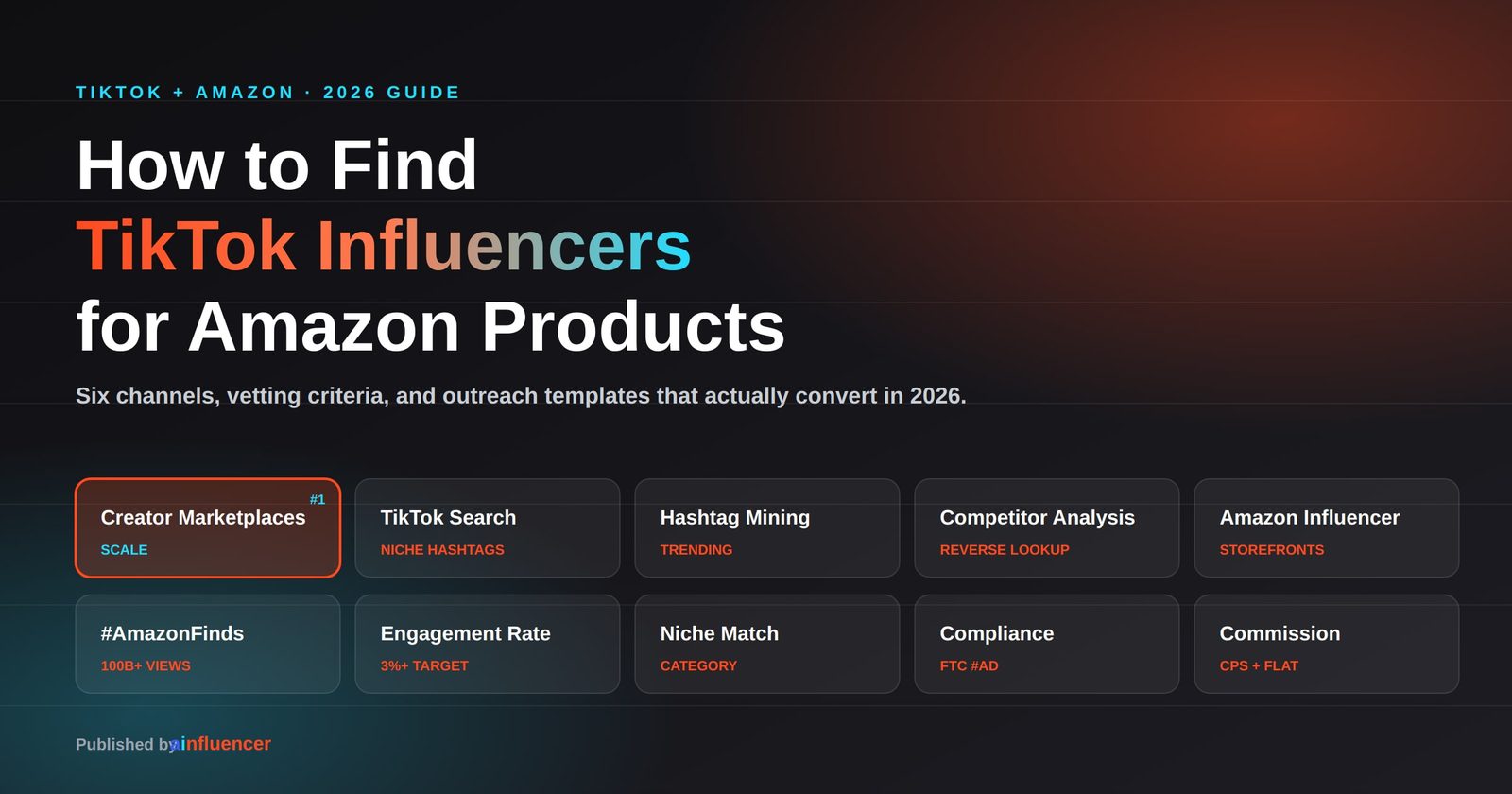
There are six channels that produce usable creator candidates. Most sellers should combine two or three rather than relying on any single source.
1. Creator marketplaces with Amazon-specific filtering
The fastest channel by far. Platforms like Ainfluencer (5M+ creators) and other influencer discovery tools let sellers filter creators by niche, follower count, engagement rate, geography, and Amazon Influencer Program participation, then run opt-in offers or direct invites from inside the platform. For sellers asking how to find TikTok influencers for Amazon products at scale, this is the cleanest answer. Time-to-first-partnership is typically 3-5 days versus 4-6 weeks for manual outreach.
2. TikTok search and hashtag mining
TikTok’s native search now surfaces creators directly, not just videos. Searching for niche-specific terms (#skincare, #petproducts, #kitchenfinds) and filtering by Users reveals creators producing content in your category. Mining trending hashtags like #AmazonMustHaves, #AmazonFinds, and #TikTokMadeMeBuyIt surfaces creators already promoting Amazon products, who are warm leads for new partnerships.
3. Competitor mention analysis
Search TikTok for direct mentions of your top competitors. Creators who promote category-adjacent products will be receptive to offers if the terms are competitive. This channel produces particularly high response rates because the creator has already demonstrated category fit and Amazon-promotion capability.
4. Amazon Influencer Program storefronts
Every Amazon Influencer Program member has a storefront at amazon.com/shop/[username]. Many of these creators are also active on TikTok. Cross-referencing Amazon Influencer storefronts with TikTok presence surfaces creators with proven Amazon expertise and existing TikTok audiences, the highest-quality combination for product launches.
5. TikTok Creator Marketplace (TCM)
TikTok’s own native creator marketplace for brand collaborations. Free to join for brands and provides filtering by creator demographics, audience demographics, and content performance. Direct competitor to third-party marketplaces but limited to TikTok-only creators. Useful as a complement to cross-channel marketplaces.
6. Direct DM outreach
For top targets identified through other channels, direct DM outreach still produces results. Conversion rates on cold DMs run 5-15%, which sounds low but produces meaningful volume at scale. Most sellers eventually centralize this in a marketplace platform because manual DM management at scale is operationally unsustainable.
How to Vet TikTok Creators
Not every TikTok creator is worth partnering with. Six vetting criteria separate productive partnerships from wasted effort.
- Niche alignment. TikTok audiences are extremely niche-loyal. A beauty creator’s audience expects beauty content. Cross-category attempts rarely work. Vet for category fit aggressively.
- Engagement rate. Target 3% or higher (likes + comments + shares divided by followers, per post). Lower suggests either bot followers or stagnant audience.
- Content cadence. Active creators post 3-7 times per week. Less frequent posting hurts algorithmic reach and reduces the value of any single sponsored post.
- Comments-to-likes ratio. A healthy ratio is 1:50 to 1:100 (one comment per 50-100 likes). Lower means the audience consumes but doesn’t engage, a red flag for purchase intent.
- Amazon track record. Has the creator promoted Amazon products before? If yes, has their content driven attributable sales? Past Amazon performance is the single strongest predictor of future Amazon performance.
- Authenticity signal. Watch 5-10 of the creator’s recent videos. Are they on-brand? Does the audience feel real? Is the production quality consistent? Trust your gut here; if something feels off, it usually is.
TikTok Influencer Outreach Templates
Short, specific outreach outperforms long pitches every time. Always include the product, the offer, and a clear next step in the first message.
Template 1: Direct DM
Template 2: Email (where bio shows email)
Hi [Creator Name],
Reaching out because your TikTok content on [niche] is exactly the audience for our new Amazon launch. We’re seeking 10 TikTok creators to feature [Product] (ASIN: [number]) over the next 30 days.
Offer: $250 flat fee + 15% commission on Amazon-attributed sales for 60 days post-publication. Brand Referral Bonus offsets a meaningful portion of our cost, so we can offer competitive rates.
Available to chat this week?
[Name]
Template 3: Marketplace direct invite
Compensation Structures That Work
TikTok creator compensation in 2026 typically uses one of three structures.
- Pure commission (CPS). 10-20% of attributed Amazon sales, no upfront fee. Lowest seller risk, but most established TikTok creators decline pure CPS because their reach justifies guaranteed compensation.
- Flat fee. $100-$5,000+ per video depending on creator tier. Predictable cost but no upside alignment.
- Hybrid (flat + commission, plus optional seeding). Most common in 2026. Flat fee in the $150-$500 range plus commission of 10-15% on attributed sales for 60-90 days. Balances guaranteed comp against performance upside.
The hybrid structure works best because Brand Referral Bonus capture (the 10% rebate from Amazon on off-Amazon traffic) effectively subsidizes the commission portion. A seller paying 15% commission with 10% BRB capture pays a net 5% on the back end, which leaves room for a generous flat fee on the front end without breaking unit economics.
Tracking TikTok Traffic with Amazon Attribution
Every TikTok creator partnership needs an Amazon Attribution link. The creator places the tagged link in their bio (TikTok does not allow clickable links in video descriptions for non-business accounts), and viewers click through to your Amazon product or Brand Store. Attribution then tracks the 14-day conversion window for each unique link.
Five attribution best practices apply to TikTok specifically. First, every creator gets a unique link — no sharing. Second, the destination URL should be a specific ASIN or a Brand Store creator subpage, not a generic search page. Third, watch the click-to-detail-page-view ratio in the Attribution dashboard; below 80% suggests TikTok is stripping the link. Fourth, account for the 14-day window when measuring ROI; a creator video posted on day 1 may still drive attributed sales on day 14. Fifth, reconcile the Brand Referral Bonus monthly — it lands roughly 60 days after qualifying sales.
For the full Attribution playbook, see our companion guide on Amazon Attribution for affiliate marketing.
FTC Compliance and Platform Rules
Three compliance rules apply to every TikTok-Amazon creator partnership in 2026.
FTC paid-partnership disclosure. Any sponsored content must be clearly labeled as such. TikTok provides a native “Paid partnership” tag that satisfies most FTC requirements, plus standard #ad or #sponsored hashtags as backup. Briefs to creators should explicitly require both.
TikTok platform rules. TikTok prohibits certain claims (medical, weight-loss without substantiation), platforms (some financial products), and ad formats. Review TikTok’s current branded content policy before launching campaigns. Violations can result in content takedowns and creator account flagging.
Amazon content guidelines. Amazon allows creator promotion of Amazon products but prohibits incentivized reviews. Creator videos can drive customers to Amazon but cannot promise rewards in exchange for reviews. Misclassified incentives can trigger Amazon account suspensions.
How to Scale TikTok Creator Outreach
Running 25-100+ TikTok creator partnerships manually is operationally unsustainable. Discovery, outreach, contracting, brief writing, content review, payment, and reporting compound fast. Most sellers hit a ceiling around 10-15 creators before adding tools or service.
Ainfluencer is built for this scaling problem. The 5M+ creator marketplace (with deep TikTok creator coverage) handles discovery and outreach. Amazon Attribution-tagged URLs are generated automatically per creator. Escrow-secured payments protect against creator no-shows. Reporting unifies TikTok performance with Instagram, YouTube, and Amazon Live in one dashboard. Free tier covers basic discovery. Paid plans from $49/month add unlimited campaigns and advanced filtering. For sellers who want execution off their plate entirely, the Fully Managed Affiliate Marketing service runs end-to-end from $1,500/month with a 3-month minimum.
Ready to launch your TikTok-Amazon strategy?
Start free on Ainfluencer to access 5M+ creators with TikTok-specific filtering and Amazon Attribution integration. Free-forever tier. Paid plans from $49/month.
Start free → Book a demoFrequently Asked Questions
How do I find TikTok influencers for Amazon products?
Six channels reliably produce TikTok creator candidates for Amazon partnerships: (1) creator marketplaces with Amazon-specific filtering like Ainfluencer, (2) TikTok search and hashtag mining, (3) competitor mention analysis, (4) Amazon Influencer Program storefronts cross-referenced with TikTok handles, (5) TikTok’s own Creator Marketplace, and (6) direct DM outreach. Most sellers combine two or three channels.
How much do TikTok creators charge to promote Amazon products?
Compensation varies by creator tier and structure. Nano-creators (under 10K followers): $50-$200 flat + 10-15% commission. Mid-tier (10K-100K): $200-$800 flat + 10-15% commission. Macro (100K-1M): $800-$5,000 flat + 10-15% commission. Mega (1M+): $5,000-$50,000+ flat + commission. The hybrid model (flat fee + commission) is the most common 2026 structure because Brand Referral Bonus capture offsets a meaningful portion of the commission cost.
How do I track TikTok-driven Amazon sales?
Track TikTok-driven Amazon sales using Amazon Attribution. Generate a unique Attribution link per creator, have the creator place it in their TikTok bio (links are not clickable in video captions for non-business accounts), and review the Attribution dashboard for clicks, detail-page views, and attributed purchases within the 14-day window. Third-party platforms like Ainfluencer automate Attribution link generation and reporting at scale.
What engagement rate should I look for when vetting TikTok creators?
Target 3% or higher (likes + comments + shares divided by followers, per post). Engagement rate below 1.5% usually signals either bot followers or stagnant audience. Comments-to-likes ratio is a secondary check: 1:50 to 1:100 (one comment per 50-100 likes) is healthy. Lower ratios mean the audience consumes but doesn’t engage, which is a red flag for purchase intent.
Can TikTok creators link directly to Amazon products?
Clickable links are only allowed in TikTok bio fields, not in video captions, for non-business accounts. Most sellers structure partnerships so the creator places the Amazon Attribution link in their bio for the duration of the campaign, and references it verbally in the video (“link in bio”). TikTok business accounts have additional link options, but the bio-link model still produces the strongest conversion in 2026.
Is TikTok or Instagram better for Amazon product launches?
TikTok produces approximately 2.4x higher conversion rates on Amazon Attribution traffic compared to Instagram in 2026, largely because TikTok viewers arrive with higher purchase intent. However, Instagram remains valuable for brand-building, lifestyle context, and audience demographics that skew slightly older. The optimal strategy is to use both: TikTok for direct conversion velocity, Instagram for brand depth and longer-form content reuse.