On this page
Envision Horizons Review 2026: A Published Price and Four Reviews
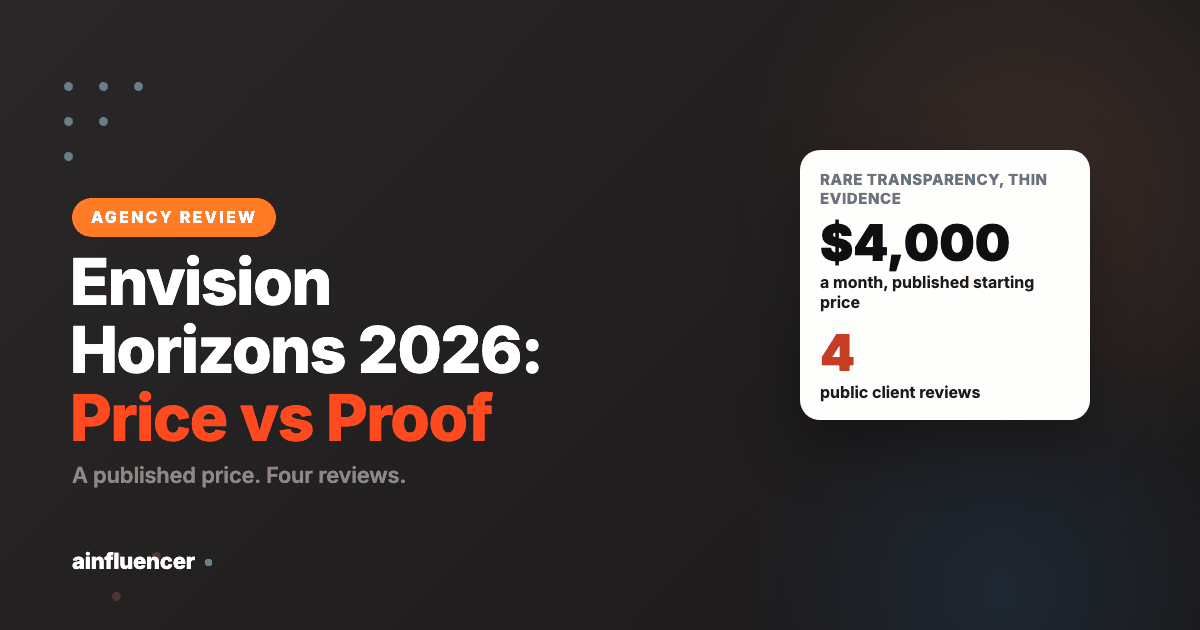
Envision Horizons does something almost no agency in this category does: it publishes a starting price, from around $4,000 a month. After reviewing a dozen agencies that all answer “custom”, that alone is worth noting.
It also has four public reviews. Four. This review is about how to evaluate an agency when the price is unusually clear and the evidence is unusually thin, which is the opposite problem from most of this category.
What it costs, which you can actually find out
| Item | Figure |
|---|---|
| Published starting price | From around $4,000 a month |
| Minimum project size | $5,000+, as Clutch lists it |
| Reported client investment | $25,000 to $130,000 per engagement |
| Clutch rating | Listed with 4 verified reviews |
$4,000 a month is $48,000 a year, which sits between Advertise Purple’s reported $2,500 entry and the enterprise agencies that start at $5,000 and climb. The reported engagement range of $25,000 to $130,000 tells you most clients are spending between roughly six months and two years at that rate, or more per month over a shorter term.
Why the transparency matters. An agency willing to publish a floor has decided which clients it does not want, which saves everyone a sales call. It also means you can benchmark it before you talk to anyone, which you cannot do with Acadia, SalesDuo or Acceleration Partners.
Four reviews, and what to do about it
Public client reviews, Amazon and affiliate agencies compared
Verified client reviews as each platform reports them, read 6 October 2026. Four is the smallest sample of any agency we have reviewed. That is not evidence of poor work, it is an absence of evidence, and the two need treating differently.
Four reviews cannot tell you whether an agency is good. What it can tell you is that you will have to do the verification yourself, and at $48,000 a year that is a reasonable amount of work to take on.
Fortunately there are things here you can check without reviews at all.
What can be verified independently
- Amazon Advanced Ads Partner, reported as top 5% globally. Partner tier is awarded by Amazon against performance criteria, not bought, so this is the single most useful signal on the page. Ask them to show you the current status.
- Rising Stars Program participant. Again Amazon-awarded.
- Named clients including ELEMIS, Kopari Beauty and bareMinerals, with Grupo Boticário beginning a US partnership in February 2026. Beauty and personal care is clearly the vertical.
- myHorizons, a proprietary platform connecting retail readiness with ad performance and operations, given to every client as part of the engagement.
- A brand protection software acquisition, which indicates investment in the unglamorous side of marketplace work.
That is a stronger evidence base than four reviews suggests. An Amazon-awarded partner tier and a named client list in one vertical is worth more than a dozen generic five-star ratings.
The vertical concentration, read two ways
ELEMIS, Kopari Beauty, bareMinerals and Grupo Boticário are all beauty and personal care. If you sell beauty, this is a specialist who already knows your category’s compliance rules, review dynamics and seasonality. If you sell anything else, you are hiring a beauty agency, and the right question is what their experience looks like in your category specifically.
If you are below the floor, what are the options
A published minimum is useful precisely because it tells some readers to stop reading. If $4,000 a month is more than your whole marketing budget, that is worth knowing in ten seconds rather than after two calls, and it does not leave you without options.
Four routes, roughly in order of how much of your own time they take:
- A smaller agency or an independent consultant. The work does not require a thirty person firm. What you give up is bench depth and continuity if your contact disappears, which is a real risk and a survivable one at smaller spend
- A project rather than a retainer. Many agencies that will not take a small retainer will take a defined piece of work: an account audit, a catalogue clean-up, a campaign rebuild. You get the expertise once and run it yourself afterwards, which is frequently the better value at low spend
- Hire part time. A freelancer two days a week is often cheaper than any agency floor and gives you someone who learns your catalogue properly
- Do it yourself for another quarter. Unglamorous and frequently correct. Agency fees make sense when the spend they manage is large enough that a few percent of improvement exceeds the fee. Below that threshold you are paying for help with a number too small for the help to pay for itself
The arithmetic worth running before any of this: take your monthly ad spend, assume an agency improves your return by twenty percent, and see whether that improvement exceeds the fee. If it does not, no agency on any shortlist is the right answer yet, and the honest move is to grow the spend first.
Worth saying plainly, because agencies will not: there is a spend level below which this entire category is the wrong purchase, and plenty of brands arrive at a shortlist before they arrive at that level. Nobody loses money by waiting a quarter and spending the fee on inventory or creative instead. Several lose a year by signing early, seeing no movement, and concluding the channel does not work for them when what did not work was the timing.
Why a published price is rarer than it should be
Most agencies in this space will not put a number on a page, and the fact that this one does is worth more than it first appears. It is also worth understanding why the rest refuse, because that tells you what happens on the call you would otherwise be taking.
An agency that publishes a floor is making three admissions at once:
- It has decided who it is not for. A published $4,000 floor turns away every prospect with a smaller budget before anyone spends an hour on a call. Agencies that hide pricing are keeping that door open deliberately
- It prices from a model rather than from the buyer. When the number is public it cannot flex with how large your brand looks or how urgently you need help. Quoted pricing can and does
- It expects to be compared. Publishing invites exactly the side-by-side you are doing now, which is a confident position and a commercially inconvenient one
The practical value to you is time. With a floor on the page you can rule the agency in or out in ten seconds rather than after two meetings. That is the whole benefit, and it is larger than it sounds when you are shortlisting six agencies.
What it does not tell you is the real number. A floor is the cheapest configuration, and the gap between a floor and a working engagement is frequently substantial. Treat it as the start of the range rather than the price.
What a concentrated vertical means for you
Deep experience in one category is sold as a strength, and it genuinely is one, right up to the point where it is not. Both halves are worth stating plainly before you sign.
Where concentration helps: an agency that has run twenty brands in your category already knows the seasonality, the compliance traps, which creative angles are exhausted and roughly what a good cost per acquisition looks like. You are buying pattern recognition that would otherwise take you two years to build.
Where it costs you:
- Your competitors may be clients. Ask directly whether they work with anyone you compete with, and what the separation looks like if they do. Many agencies handle this well. The ones that get defensive about the question are telling you something
- Playbooks get reused. The pattern recognition that helps you also produces sameness, and if three brands in a category run the same structure the advantage cancels out
- Outside the vertical, you are a first. If your product sits at the edge of their category, you are funding the learning curve
One question settles most of this: ask for the closest client to your situation they have run, and listen for how close it actually is. “Similar category” and “same problem” are different answers.
What a $4,000 floor should make you ask
A number on a page invites a specific set of follow-ups, and the answers decide whether the floor is relevant to you at all.
- What is in the floor, and what is the first thing that leaves it? Ask for the list of what is not included rather than what is. That list is where the real price lives
- Does it include media spend, or sit on top? A retainer plus spend and a percentage of spend diverge the moment your budget moves, so ask for the figure at your current level and at double it
- What does the floor assume about your catalogue? Thirty products and three thousand are different amounts of work, and the floor was priced for one of them
- Who works on a floor-level account? The honest answer is usually a more junior team with less of a named lead’s time, which may be perfectly fine. You just want to know before rather than after
Worth knowing for context: Amazon DSP is a programmatic buying platform rather than a service, so an agency fee here is buying people and process on top of media you are paying for separately. Any quote that blurs those two lines is a quote you cannot compare with anyone else’s.
What to press on
| Complaint | What reviewers describe | What to do about it |
|---|---|---|
| Four public reviews | The thinnest evidence base of any agency in this comparison, for an engagement starting at a published $4,000 a month. | Ask for three references in your own category and speak to them without the agency present. At this commitment level that request is entirely normal and a confident agency will not hesitate. |
| Heavy beauty concentration | Every named client is beauty or personal care. That is depth in one vertical and a question mark everywhere else. | If you are outside beauty, ask how many current clients are in your category and to speak to one. If the answer is none, you are their learning curve. |
| Published price is a floor, not a quote | The roughly $4,000 a month figure is a starting point. Reported engagements run from $25,000 to $130,000 in total value. | Ask what a client at your size and scope typically pays, and what drives movement above the floor. |
| myHorizons is proprietary | Every client gets the platform, which means reporting and some operational workflow live in a system you do not own. | Ask what happens to your data and dashboards if the engagement ends, and get the answer in writing before you start. |
| Smaller than the enterprise alternatives | This is not a 250-person agency. Capacity and continuity are fair questions at any smaller firm. | Ask who covers your account during holidays and departures. The answer is more revealing at a small agency than at a large one. |
Envision Horizons pros and cons
Pros
- Publishes a starting price from around $4,000 a month, almost unique in this category
- Amazon Advanced Ads Partner, reported in the top 5% globally, which Amazon awards rather than sells
- Rising Stars Program participant, another independently awarded status
- Named enterprise clients including ELEMIS, Kopari Beauty and bareMinerals
- Grupo Boticário began a US partnership in February 2026, with reported immediate impact
- Proprietary myHorizons platform included for every client
- Multi-marketplace across Amazon, Walmart, Target and emerging platforms
- Acquired a brand protection software company, so compliance is taken seriously
- Covers affiliate marketing alongside advertising and operations
Cons
- Only four public verified reviews, the thinnest evidence base in this comparison
- Every named client is beauty or personal care, so other categories are unproven
- The published $4,000 is a floor, with reported engagements from $25,000 to $130,000
- Reporting and workflow live in a proprietary platform you will not own
- Smaller than the enterprise agencies, so capacity and continuity are fair questions
Who Envision Horizons suits
A good fit if you are a beauty or personal care brand on Amazon. The client list, the vertical depth and the Amazon partner tier line up, and the published price means you can decide whether to talk to them without a sales call.
A poor fit if you need a large body of independent evidence before committing $48,000 a year, or if you sell outside beauty and cannot get a reference in your own category.
Envision Horizons alternatives
| Option | Entry | Choose it when |
|---|---|---|
| Acadia | Custom | You need Vendor Central, and want 26 reviews rather than 4 |
| SalesDuo | Custom | You want an ex-Amazon team across a dozen marketplaces |
| Levanta | $750/mo plus 3.5% | You want Amazon creator and affiliate revenue rather than ad management |
| Ainfluencer | Free, managed from $1,500/mo | Creator campaigns below agency minimums |
The verdict
Envision Horizons is easier to evaluate on paper than almost any agency here, and harder to verify through other people’s experiences. The published price, the Amazon-awarded partner tier and the named beauty clients are all real signals, and together they outweigh the thin review count.
If you sell beauty on Amazon, this belongs on the shortlist and the $4,000 floor tells you immediately whether it is worth a call. If you sell anything else, get a reference in your own category first, because four reviews will not answer that question for you.
How much does Envision Horizons cost?
Published pricing starts at around $4,000 a month, and Clutch lists a $5,000 minimum project size. Reported client investments run from $25,000 to $130,000 per engagement. Publishing a floor at all is unusual in this category and lets you benchmark before contacting them.
Is Envision Horizons only for beauty brands?
Not formally, but every named client is beauty or personal care: ELEMIS, Kopari Beauty, bareMinerals and Grupo Boticário. If you sell beauty that concentration is an advantage. If you do not, ask how many current clients are in your category and to speak to one.
What is myHorizons?
Envision Horizons’ proprietary platform, connecting retail readiness with advertising performance and operations. Every client gets access as part of the engagement. Ask what happens to your data and dashboards if the relationship ends.
Should four reviews put me off?
It should change how you verify rather than whether you consider them. Four reviews is an absence of evidence, not evidence of poor work. The checkable signals here are stronger than the review count: Amazon Advanced Ads Partner status is awarded by Amazon on performance, and the named client list is specific. Ask for three references in your own category as well.