Facebook Ads for Amazon Products: The 2026 Playbook
The creative rule that separates 2x from 24x, margin-safe setup, honest cost expectations, and the route where the Meta budget isn’t yours.
Facebook ads for Amazon products are one of the highest-leverage external channels a seller can run, and one of the easiest to burn money on. The difference between 2x and 24x returns comes down to three choices: what creative you run, whose handle it runs from, and how you track it. This playbook covers why Meta traffic compounds on Amazon, the creator-handle creative rule that decides performance, margin-safe campaign setup, honest cost expectations, and the funded route where the Meta budget isn’t yours at all.
Why Meta Traffic Works So Well for Amazon
Targeting Amazon can’t sell you
Meta targets by interest, behavior, and lookalike affinity, reaching shoppers before they ever type a keyword. Inside Amazon you compete in an auction for expressed demand; on Meta you manufacture demand your competitors’ PPC campaigns will never see.
Amazon rewards the resulting sales twice
External sales add rank-lifting velocity, and enrolled brands collect the ~10% Brand Referral Bonus on attributed purchases. A Meta campaign that looks break-even on last-click ROAS is frequently profitable once the rebate and the organic-rank lift are priced in. The full channel landscape sits in our guide to driving external traffic to Amazon listings.
The Creative Rule That Decides Everything
The single biggest performance gap in Meta-to-Amazon campaigns is not audience, budget, or bid strategy. It’s creative framing:
| Creative type | How it reads | Typical outcome |
|---|---|---|
| Brand-page product ads | A promotion | Scroll-past, weak CTR, thin margins |
| UGC-style video from brand page | Better, still branded | Moderate lift |
| Creator content from the creator’s own handle | A recommendation | Highest CTR and conversion of the three |
Why creator-handle ads win
Shoppers have trained themselves to scroll past brand promotions and stop for faces they trust. The identical product, price, and offer converts materially better when the ad arrives under a creator’s name, because the format inherits the trust of a recommendation. Running ads this way is called whitelisting (Meta’s Partnership Ads), and it’s the format behind every standout Amazon-external number we’ve verified.
Getting the permissions
Whitelisting requires the creator to grant ad permissions on their handle, a negotiation with rate, usage, and duration terms that trips up many first attempts. The full setup, permission scripts, and pitfalls are in our influencer whitelisting playbook; sourcing the creators themselves is covered in how to find influencers on Amazon.
Campaign Setup That Protects Your Margin
Tag before you spend
Create a unique Amazon Attribution link per ad set. It’s your conversion tracking, your true-ROAS source, and your Brand Referral Bonus claim in one step. Untagged Meta spend is unmeasurable and rebate-forfeiting simultaneously.
Send warm traffic direct, cold traffic through a filter
Creator-audience and retargeting traffic converts direct-to-listing, which also maximizes velocity and the rebate. Broad cold prospecting often earns a landing page that pre-sells, captures the email, and passes only warmed clicks to Amazon. The colder the click, the more a filter step earns its keep.
Structure for creative testing, not audience micro-slicing
In 2026, Meta’s delivery system does the audience work. Your job is feeding it creator creatives to test: multiple hooks, multiple creators, one product per campaign. Kill losers weekly, scale winners, and resist the urge to fragment budgets across a dozen hand-built audiences.
Judge on blended impact, not last-click alone
Watch Attribution ROAS alongside organic-rank movement and total sales lift. External pushes routinely lift organic sales that last-click reports never credit; judging Meta on last-click alone systematically undervalues the channel and starves it of budget.
Costs and ROAS: Honest Expectations
| Approach | Typical outcome | Risk profile |
|---|---|---|
| Self-run, brand-page creative | Often below breakeven after fees | Your budget, high creative risk |
| Self-run, whitelisted creator creative | Materially better CTR and conversion | Your budget, testing costs are yours |
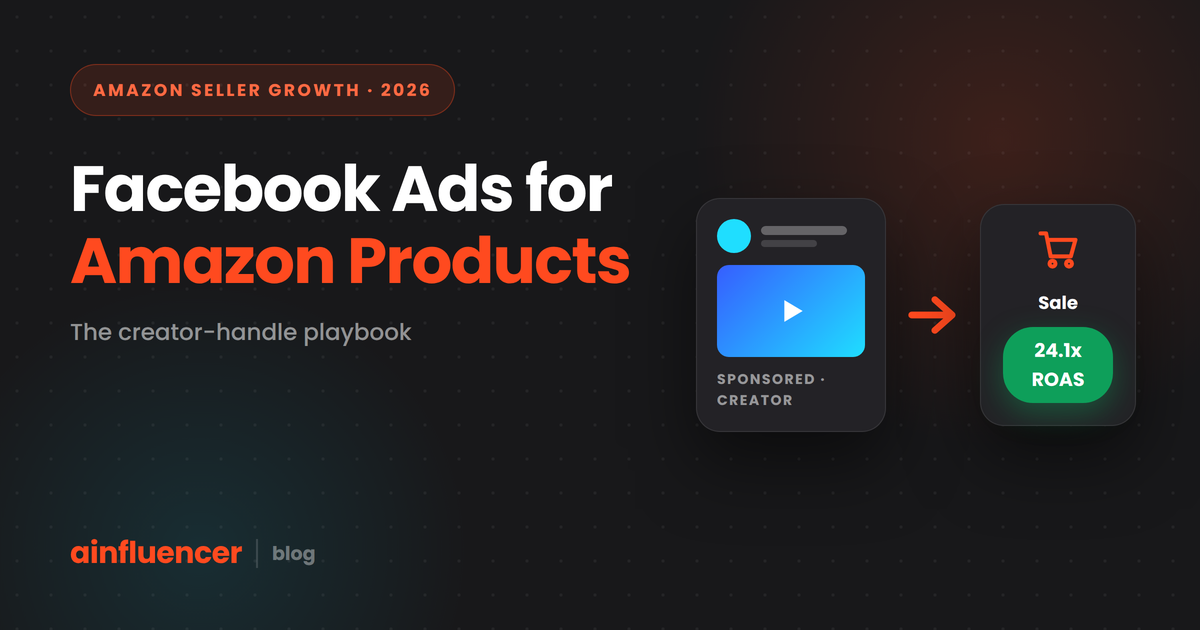
| Funded program, creator-handle ads | Dec 2025: 16.8x blended, 24.1x top | Zero brand budget, losses absorbed |
The honest middle row deserves emphasis: even done well, self-funded testing has a tuition cost. Expect to burn budget on losing hooks before winners emerge, and price that tuition into your plan. The gap between the second and third rows isn’t performance methodology, it’s who pays the tuition.
⚡ Budget reality check
Self-funded Meta campaigns to Amazon typically need patient testing budgets before creative winners emerge, and every losing test is your money. That risk profile is exactly what the funded model below removes.
The Funded Route: We Run the Meta Ads, You Keep the Sales
On Ainfluencer’s Ultimate plan, the Amazon Creator Boost Program runs this entire playbook for you, with Ainfluencer’s budget. Up to $500,000 in ad spend across Meta and TikTok goes behind the posts you create with influencers on the platform: whitelisted creator-handle ads, professional hook testing and scaling, Attribution-friendly tracking throughout, and $0 added to your media budget. Wasted spend on underperforming posts is Ainfluencer’s loss, never yours. December’s campaigns: $800K of program spend, $13.4M in product sales, 16.8x blended ROAS with the top account at 24.1x.
Meta ads for your Amazon products, on our budget
Creator-handle campaigns, tested and scaled by our team, up to $500K funded. You approve content and watch the sales dashboard.
See the $500K Boost Program →Creative Production: Feeding the Testing Machine
Creative testing only works with creative volume, and this is where most self-run programs stall: two assets is not a test, it’s a coin flip. Plan for six to ten distinct creator assets per product entering testing, varying the hook, the opening frame, and the creator persona while holding the product constant. Whitelisting agreements should anticipate this, securing multiple cuts and usage windows per collaboration rather than a single post.
The sustainable way to generate that volume is a standing creator pipeline instead of one-off deals: several creators per product, each producing native content on their own handles, each whitelistable. Marketplaces compress this from months of outreach into weeks, and it’s exactly the structure the funded program industrializes: more collabs means more testable assets, which is why boost budget allocation scales with collaboration volume. Creative supply, not media budget, is the real bottleneck in Meta-to-Amazon performance.
Scaling Rules: When a Winner Deserves More Budget
Scale on stability, not spikes. A creative earning above your blended threshold for two to three consecutive weeks, with the rebate and rank lift priced in, earns a budget increase; a one-day ROAS spike earns patience. Increase budgets in steps rather than leaps so Meta’s delivery can re-stabilize, and expect efficiency to soften slightly as spend grows, which is normal and fine as long as blended returns hold above threshold.
Retire creatives on fatigue signals: climbing frequency, sagging CTR, rising cost per attributed sale. The rotation cadence is why the production pipeline in the previous section matters more than any bidding trick. And know your ceiling honestly: self-funded scaling is capped by your tolerance for tuition on new tests, while the funded route’s December campaigns scaled winners toward six-figure monthly spend precisely because the testing losses weren’t the brand’s to absorb.
The Mistakes That Burn Meta Budgets
Five failure modes account for most losses in this channel. Brand-page creative to cold audiences, surrendering the entire trust advantage. No Attribution tagging, which blinds optimization and forfeits the rebate at once. Ice-cold traffic sent direct to listings, depressing conversion and wasting velocity. Audience micro-slicing that fragments learning budgets Meta’s delivery would have spent better. And quitting after the first losing week of what is structurally a creative-testing game. Each one is avoidable with the setup sequence above, and if you’d rather skip the tuition entirely, that’s what the funded route exists for. For the broader paid-media picture beyond Meta, see our Amazon DSP guide.
Beyond Facebook: Extending the Playbook to TikTok and Instagram
Everything in this guide transfers with small dialect changes. Instagram runs inside the same Meta auction, so Partnership Ads, tagging discipline, and the creative rule apply untouched; Reels placements simply reward faster hooks. TikTok’s equivalent of whitelisting is Spark Ads, boosting a creator’s organic post from their own handle, and it shines for visual, impulse-priced products where the platform’s discovery engine does the prospecting for you.
The portfolio logic is the strategic upgrade: the same creator asset, tested across Meta and TikTok with separate Attribution tags, frequently performs very differently by platform, and the spread itself is information worth paying for. Brands running the funded program get this multi-platform testing by default, since boost campaigns deploy across Meta and TikTok with budget flowing to whichever placement converts. Self-funded sellers should stage it instead: prove the creative on one platform, then port winners to the second with fresh tags rather than splitting an unproven budget across both.
The through-line of this entire playbook is simple: creative framing first, measurement second, budget third. Get those priorities in order and Meta becomes a compounding Amazon channel instead of an expensive experiment.
Meta Ads or Amazon PPC: Where the Next Dollar Goes
These are not competing answers to the same question, which is why “which is better” has no useful answer. They buy different things, and the right split changes with what you are trying to fix.
| Amazon PPC | Meta ads | |
|---|---|---|
| Captures | Demand that already exists, at the moment of search | Demand that does not exist yet, by interrupting |
| Best at | Taking share from competitors on known keywords | Reaching people who do not know the product category |
| Ceiling | Hard. You cannot buy more searches than happen | Soft. Audience size is rarely the constraint |
| Attribution | Native and immediate | Needs Amazon Attribution tags or you are flying blind |
| Side effect | Sales count toward rank | Sales count toward rank and qualify for the Brand Referral Bonus |
The practical rule
If your keywords are not fully covered, spend on Amazon PPC first. Buying a click from someone already searching for your product is the cheapest conversion available, and leaving those impressions to a competitor while you fund Meta discovery is the most common sequencing mistake.
Once search demand is saturated, Meta is where growth comes from. When you own your keywords and spending more on them only raises your cost per click, the constraint is that not enough people are searching. Meta is the lever that creates those searches, and the Brand Referral Bonus means Amazon effectively rebates part of the cost of bringing them.
If the product needs explaining, Meta goes first. Anything genuinely new has no search volume to capture, because nobody knows the words for it yet. Search advertising cannot create a category; video demonstration can.
One measurement warning. Meta traffic lifts Amazon PPC performance by raising conversion rate and rank, so judging the two channels separately on last-click will consistently flatter PPC and understate Meta. Compare total sales and blended spend across a period with Meta on against one with it off, which is the only comparison that answers the question honestly.
Frequently Asked Questions
Can you run Facebook ads directly to an Amazon listing?
Yes, and with warm or creator-based traffic it’s often the best-converting setup. Always route through an Amazon Attribution link so ROAS is measurable and sales qualify for the Brand Referral Bonus.
What ROAS should I expect from Facebook ads to Amazon?
Self-run campaigns vary widely with creative and price point, and brand-page creative frequently lands below breakeven after fees. Whitelisted creator-handle campaigns perform materially better; December’s funded program campaigns blended 16.8x with a top account at 24.1x.
Why do my Facebook ads for Amazon products lose money?
The usual culprits: brand-page creative that reads as an ad, missing Attribution tags, ice-cold traffic sent direct to a listing, and judging the channel on last-click ROAS while ignoring rank lift. Fix creative first; it’s the biggest lever.
Do I need the creator’s permission to run their content as ads?
Yes. Whitelisting runs through Meta’s Partnership Ads with explicit creator authorization, and usage terms belong in the collaboration agreement. Our whitelisting playbook covers the exact permission flow.
Is there a way to run Meta ads for Amazon without paying for them?
On the Ultimate plan, yes: the Creator Boost Program funds up to $500,000 in ad spend behind your influencer collab posts, Ainfluencer’s team runs the campaigns end to end, and underperformance losses are absorbed by Ainfluencer.
Published on the Ainfluencer Blog. Related reading: influencer whitelisting playbook, Amazon DSP, and best Amazon PPC tools.