How to Drive External Traffic to Amazon Listings: The 2026 Playbook
Ranked channels, the tracking setup that claims your ~10% rebate, the direct-vs-landing decision, and the funded route where up to $500K of the budget isn’t yours.
Every serious seller eventually learns the same lesson: the listings that dominate page one aren’t winning inside Amazon, they’re winning outside it. Mastering how to drive external traffic to Amazon listings compounds three ways at once: sales velocity that lifts organic rank, a roughly 10% rebate through the Brand Referral Bonus, and audiences your competitors’ PPC budgets can’t touch. This playbook ranks the channels, walks the tracking setup that makes every dollar measurable, settles the direct-link versus landing-page question, and covers the funded route where up to $500,000 of the ad budget isn’t yours.
Why External Traffic Beats Another PPC Dollar
The velocity flywheel
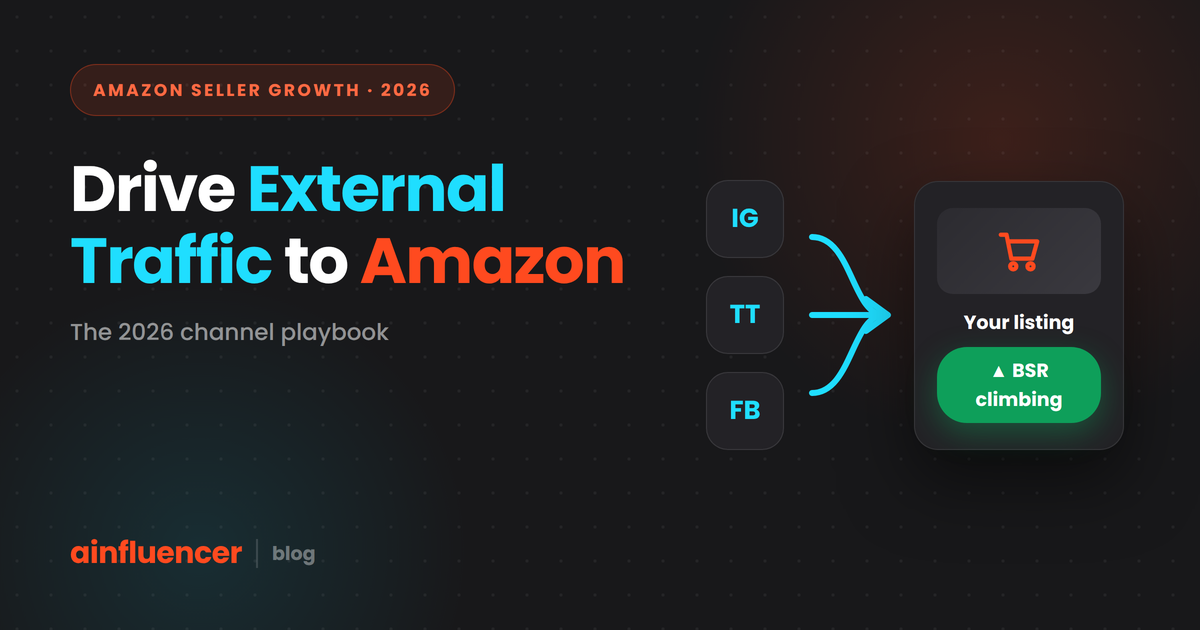
Amazon’s algorithm rewards sales velocity from any source, but it especially values net-new demand it didn’t have to auction off. External sales lift Best Sellers Rank and organic position exactly like internal ones, while skipping the knife-fight CPCs of Amazon PPC, where every competitor bids on the same keywords. The flywheel: external sale → velocity spike → rank climbs → organic sales rise → the listing strengthens permanently.
Amazon pays you to do it
Through the Brand Referral Bonus, Amazon rebates enrolled brands an average of roughly 10% of external-traffic sales, credited against referral fees. External revenue is therefore structurally cheaper revenue: the same sale sourced externally carries a materially lower effective fee than one sourced internally.
You escape the auction entirely
Off-Amazon audiences are targeted by interest, behavior, and creator affinity rather than keyword bids. Your competitors can outbid you inside Amazon; they cannot outbid you for an audience that discovered your product through a creator they trust.
The External Channels, Ranked
| Channel | Conversion quality | Cost profile | Best for |
|---|---|---|---|
| Influencer posts + whitelisted ads | Highest, recommendation-framed | Paid, or funded (see below) | Almost every consumer category |
| Facebook and Instagram ads | High with creator creative | CPMs vary by niche | Scalable, targetable volume |
| TikTok organic + Spark Ads | High for discovery products | Low to medium | Impulse and visual products |
| Google Ads to listings | High intent, exact demand | Keyword CPC | Search-driven categories |
| Email and SMS lists | Highest repeat conversion | Near zero marginal | Launches and ranking pushes |
| Pinterest and SEO content | Slow build, evergreen | Low | Durable baseline traffic |
Why creator content tops the table
The identical product converts better when the message arrives as a recommendation instead of a promotion, and running creator content as ads from the creator’s own handle (whitelisting) preserves that framing at paid scale. The mechanics, permissions, and pitfalls are in our influencer whitelisting playbook; recruiting the creators themselves is covered in how to find influencers on Amazon.
The supporting cast, in one paragraph each
Meta ads supply the scalable volume underneath creator creative; the full setup is our Facebook ads for Amazon products playbook. TikTok excels for visual, impulse-priced products, especially with Spark Ads behind organic winners. Google intercepts exact purchase intent, best for categories people search by name. Email and SMS are your launch weapon: near-zero marginal cost and the highest repeat conversion of any channel, which makes them ideal for concentrated ranking pushes. Pinterest and SEO build slowly and then refuse to die, a durable floor under everything paid.
Set Up Tracking Before You Spend a Dollar
Enroll in Brand Registry and Amazon Attribution
Amazon Attribution is the free measurement layer that ties external clicks to Amazon conversions. Without it you’re flying blind on ROAS and forfeiting the Brand Referral Bonus on every untagged sale. This is step zero, not an optimization.
Create one Attribution tag per channel and per creator
Granular tagging is what turns ‘influencers kind of work’ into ‘creator A returns 24x and creator B returns 3x, reallocate now.’ Per-creator, per-channel tags make optimization arithmetic instead of argument.
Fix the destination before buying traffic
External traffic converts on your listing’s strength: images, bullets, reviews, price position. Sending paid clicks to a weak listing subsidizes your competitors’ retargeting. Run through our guide on optimizing Amazon listings first.
Reconcile weekly against blended metrics
Watch Attribution ROAS alongside organic-rank movement and total sales lift. External pushes routinely lift organic sales that last-click reporting never credits, and judging the channel on last-click alone systematically undervalues it.
Direct to Listing or Through a Landing Page?
When direct wins
Warm audiences, creator followers, retargeting pools, and your email list convert well straight to the listing, and direct sales maximize both velocity and the referral rebate. When the traffic already trusts the messenger, every extra step is leakage.
When a landing page earns its keep
Cold prospecting traffic often benefits from a filter step: a simple page that pre-sells, captures the email, and passes only warmed clicks to Amazon. You trade some velocity for audience ownership and cleaner conversion rates on the listing itself. Rule of thumb: the colder the click, the more a filter earns.
The Funded Shortcut: $500K of External Traffic You Don’t Pay For
Everything above assumes the media budget is yours. For brands on Ainfluencer’s Ultimate plan, it isn’t. The Amazon Creator Boost Program funds up to $500,000 in ad spend behind the posts you create with influencers on the platform: whitelisted ads from the creators’ own handles, professional testing and scaling by Ainfluencer’s team, Attribution-friendly tracking throughout, and $0 added to your media budget. Budget flows to performance, so the more creator collabs you run, the more posts qualify for testing and the more of the cap your products can absorb.
External traffic, on our budget
Up to $500K in funded ad spend on your influencer collabs. You approve the content, we run the media, sales land on your listings.
See the $500K Boost Program →Your 90-Day External Traffic Plan
Days one through fifteen: complete Brand Registry, enroll in the referral bonus, build your Attribution tag taxonomy, and audit your listing’s conversion readiness. Days sixteen through forty-five: launch two channels only, one creator-based and one owned (email or retargeting), each fully tagged, and start the weekly reconciliation ritual against blended metrics. Resist launching five channels at once; attribution clarity beats coverage at this stage.
Days forty-six through ninety: read the data, kill the weaker half of your tests, and concentrate budget on the channel-creator combinations returning above your threshold. This is also the point where organic-rank movement becomes visible, so add it formally to your channel math. By day ninety you’ll know your best creators, your true blended ROAS, and your rebate run-rate, which is exactly the position from which funded amplification multiplies best: a brand that knows its winners can hand a media team a proven portfolio instead of a guess.
How Much Should You Spend on External Channels?
A workable starting allocation for a brand new to external traffic: dedicate 10 to 20% of your total advertising budget to external channels for the first quarter, weighted toward creator-based traffic where conversion quality is highest. Price the Brand Referral Bonus into the math from day one; a rebate averaging ~10% of attributed sales materially changes what “breakeven” means, and ignoring it starves profitable channels.
Scale rules are simple: any tagged channel returning above your blended threshold for three consecutive weeks earns a budget increase, and concentration beats diversification once winners emerge. And for Ultimate-plan brands, remember that the largest external budget available may not be yours at all: the boost program’s funded spend scales with your collab volume, which turns “how much should I spend” into “how many qualifying creator posts can I produce.”
The Mistakes That Burn External Budgets
Four failure modes account for most wasted external spend. Running brand-page creative to cold audiences, when creator-framed content is the whole conversion advantage. Skipping Attribution tags, which forfeits the rebate and blinds optimization simultaneously. Sending ice-cold traffic direct to listings, where unconvinced clicks bounce and depress conversion rates. And judging the channel on last-click ROAS alone, which misses the organic-rank lift that is half the reason to run external traffic at all. Every one of these is avoidable with the setup sequence above, and the deeper strategy layer is covered in our Amazon sales increase strategies guide.
Case Snapshot: What a Funded External Month Looked Like
To make the funded route concrete, here’s one account from December 2025’s program cohort, itemized. A home-and-lifestyle creator’s collab posts entered testing early in the month; winners were scaled with $65,456 of Ainfluencer’s ad spend across Meta placements running from the creator’s own handle. Attributed product sales for the month reached $1,913,005 against a pre-boost baseline of $335,767, meaning the boosted distribution drove roughly 82% of total monthly sales at a 24.1x return on the ad spend.
Every one of those incremental sales carried the external-traffic profile this whole playbook optimizes for: auction-free acquisition, Attribution tracking, rebate eligibility, and rank velocity landing on the listings throughout the month. The brand’s media contribution to that outcome was zero dollars. Results vary by product, price point, and content, but the structure of the win is repeatable, and it’s the same structure the self-funded version of this playbook builds, minus the tuition.
Frequently Asked Questions
Does external traffic really help Amazon organic ranking?
Yes. Sales velocity from any source feeds rank, and external sales add velocity without cannibalizing your ad auction. Sellers routinely watch organic positions climb during sustained external pushes, which compounds the direct revenue.
Should I send external traffic straight to my Amazon listing?
Warm audiences (creator followers, email lists, retargeting) convert well direct, and direct sales qualify for the Brand Referral Bonus. Use a landing page only when traffic is cold enough to need filtering and email capture.
What’s the best external traffic source for Amazon in 2026?
Creator content amplified through whitelisted ads leads on conversion quality because it reads as a recommendation. Meta supplies the scale underneath it, email owns launches, and Pinterest plus SEO build the durable floor.
How do I track external traffic to Amazon?
Amazon Attribution, free through Brand Registry. Create one tag per channel and per creator before spending, and reconcile weekly against organic-rank movement, not just last-click ROAS.
How can I drive external traffic without an ad budget?
Organic social, SEO, and email work but build slowly. On the Ultimate plan, the Creator Boost Program supplies the budget instead: up to $500,000 of Ainfluencer’s own ad spend behind your influencer collab posts, at zero media cost to your brand.
Published on the Ainfluencer Blog. Related reading: Amazon Brand Referral Bonus, Amazon Attribution, and Amazon DSP.