Amazon Influencer vs Amazon Associates: The 2026 Decision Guide
Same commission tables, different ceilings. The full side-by-side, three payout scenarios, and the both-programs setup that leaks nothing.
Both programmes need creators before either pays anything. Our list of Amazon influencer marketing agencies covers the firms that recruit and manage them for brands.
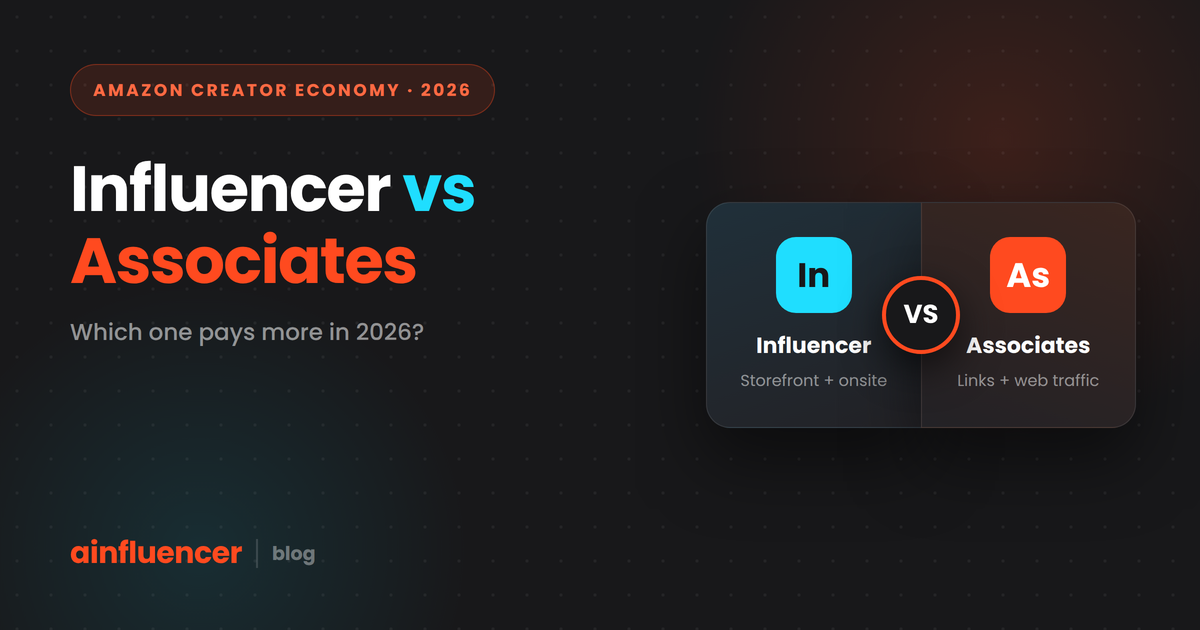
Amazon Influencer vs Amazon Associates is the first fork in the road for anyone monetizing Amazon traffic, and picking wrong costs months of misdirected effort. The short version: Associates is built for websites and link-driven content, the Influencer Program is built for social creators and adds a storefront plus onsite earning, and the programs share commission structures while differing completely in assets and entry logic. This guide walks the full comparison, runs the “which pays more” question through three realistic scenarios, and shows the both-programs setup top earners quietly run.
The Two Programs in Plain Terms
Amazon Associates: the link machine
Associates is Amazon’s original affiliate program. You generate tracked links to individual products, place them in blog posts, emails, apps, or social captions, and earn a category-based commission on qualifying purchases. Entry is nearly open, but there’s a survival rule most beginners miss: you need qualifying sales within your first 180 days or the account closes. Associates is a tool for people whose audience lives on the open web.
The Amazon Influencer Program: the storefront machine
The Influencer Program is the social-native evolution. Accepted creators get a permanent, curated storefront at amazon.com/shop/their-handle, commission on everything it sells, and a path to onsite placements where their review videos appear on Amazon product pages and earn from Amazon’s own shoppers. Entry is reviewed on engagement quality rather than being open, which we cover exhaustively in our Amazon Influencer Program requirements guide.
Side-by-Side Comparison
| Amazon Associates | Amazon Influencer Program | |
|---|---|---|
| Built for | Websites, blogs, apps | Social creators (YT, IG, TikTok, FB) |
| Entry bar | Open to nearly anyone with a platform | Application reviewed on engagement quality |
| Survival rule | Qualifying sales within 180 days | Stay active and policy-compliant |
| Your asset | Individual product links | A personal storefront at amazon.com/shop/you |
| Onsite earning | No | Yes, approved videos earn on product pages |
| Best traffic source | SEO and web content | Social audiences and short-form video |
| Link lifespan | Post by post | Evergreen, curated destination |
| Bonus programs | Creator Connections where eligible | Creator Connections plus tiered bonuses |
Requirements Compared: Different Bars, Not the Same Bar
Getting into Associates
You need a functioning platform (site, app, or qualifying social presence), accurate application details, and then sales inside 180 days. The bar is at the exit, not the entrance. Full checklist in our Amazon affiliate requirements guide, and the whole setup walked through step by step in Amazon affiliate for beginners.
Getting into the Influencer Program
Amazon reviews your social account’s engagement quality upfront: no official follower minimum exists, but roughly 1K+ engaged followers is where acceptance becomes realistic. There’s also a second approval tier for onsite commissions after you submit sample review videos, the step where the program’s biggest earning surface unlocks.
Which One Pays More? Three Scenarios
Same commission tables, very different ceilings. The honest answer depends on where your audience lives, so here are the three cases that cover almost everyone:
Scenario one: the blogger or niche-site owner
If your traffic is search-driven web traffic, Associates wins outright. Storefronts don’t help readers mid-article, and your comparison posts convert through inline links. Your growth path is more ranked content and better on-page conversion, not a storefront.
Scenario two: the social-first creator
If your audience lives on TikTok, Instagram, or YouTube, the Influencer Program wins, and it isn’t close. The storefront gives every bio one evergreen destination that compounds, and onsite placements add an income stream Associates simply doesn’t have: your videos earning from Amazon’s own shoppers around the clock. Our data guide on how much Amazon influencers make shows storefront creators clustering well above link-only affiliates at identical audience sizes, with onsite income as the separator.
Scenario three: the hybrid
Blog plus social? Run both programs (next section). Each monetizes the traffic the other wastes, and the bonus layers stack across both.
⚡ The nuance most comparisons miss
The programs’ income gap isn’t in the rates, it’s in the surfaces. Associates gives you one earning surface: your links. The Influencer Program gives you three: your links, your storefront, and Amazon’s own product pages via onsite video. More surfaces, more compounding.
How Payments, Attribution, and Sessions Differ
Both programs pay on qualifying purchases, but the attribution texture differs in ways that shape strategy. Associates earnings hinge on session behavior after a link click: the shopper’s subsequent qualifying purchases in the window credit to you, which is why high-traffic informational content can monetize surprisingly well even when readers buy something other than the linked product. Influencer storefront attribution behaves similarly for traffic you send, with the storefront acting as a persistent entry point rather than a one-shot link.
Onsite placements add a third attribution model that Associates never touches: your video earns from shoppers already on the product page, credited for influencing a purchase that was going to happen somewhere. That’s why onsite income scales with Amazon’s traffic instead of yours, and why it changes the risk profile of your whole business: platform algorithm changes can hurt your social reach, but they can’t touch commissions generated on Amazon’s own pages. Payment timing is comparable across both programs, with commissions arriving roughly two months after the earning month, so plan cash flow identically either way.
The Real Answer for Creators: Run Both
Nothing prevents holding both memberships, and top earners structure it deliberately:
- Associates handles the web: blog posts, comparison articles, email newsletters, anywhere a contextual text link converts a reader mid-decision.
- The Influencer storefront handles social: one hub every bio points to, curated idea lists doing the merchandising, onsite videos earning passively underneath.
- Bonus layers stack on both: Creator Connections campaigns and tiered bonuses apply to qualifying sales regardless of which program’s link carried them.
The operational cost of running both is nearly zero once set up; the cost of running only the wrong one is every conversion your unmonetized channel leaks. And if Amazon’s ecosystems still feel limiting, the wider landscape of programs is mapped in our roundup of Amazon Associates alternatives.
Adding the Second Program Without Breaking the First
If you’re an Associate adding the Influencer Program, nothing about your existing links changes: web content keeps earning exactly as before, and your new storefront simply becomes the destination for social bios. Migrate deliberately over a week: build three named idea lists from your best-converting Associates products, point every social bio at the storefront, and start the onsite video track immediately since it’s the asset Associates never gave you.
If you’re a storefront creator adding Associates, the trigger is usually a blog, newsletter, or any web surface where inline text links convert better than a storefront detour. Keep the streams cleanly separated in your reporting so the monthly numbers tell you where each audience actually buys. The only real mistake in running both is cross-wiring them: sending web readers to a storefront mid-article, or cluttering social bios with naked product links, puts each program’s asset in the other one’s weakest position.
Whichever You Pick, Reach Decides Your Number
Program choice sets your income’s structure; distribution sets its size. Both programs monetize exactly as much attention as you can route through them, which is why the highest verified creator earnings we’ve seen come from amplified distribution rather than bigger audiences. For storefront creators, the Amazon Creator Boost Program is the cleanest version of that lever: Ainfluencer funds paid ads behind your existing posts, your commissions and bonuses stay untouched and fully yours, you receive half the campaign profit on top, and losses are absorbed. One December creator went from $24,320 to $126,360 in monthly earnings on this model, a 419% jump in a single month, with zero of the ad budget coming from her side.
Storefront creators: your ceiling is optional
Star-badged or 5%+ commission creators qualify for funded boosting with zero cost and zero downside. See exactly how the December numbers were built.
Explore the Boost Program →Which Amazon Marketplace You Join Decides What You Earn
Both programs are tied to a single Amazon marketplace, and that fact changes the answer to every question above. An Associates account on amazon.com covers amazon.com. Earning on amazon.co.uk, amazon.de or amazon.com.br means applying to that marketplace’s own program, with its own account, its own commission schedule, its own payment threshold and its own currency.
Three consequences worth planning around:
- Rates are set per marketplace, not globally. The same product category can pay a different percentage on two Amazon sites, so there is no single answer to what Amazon pays until you name the marketplace.
- The commission comes from wherever the buyer checks out. A follower in Brazil who lands on an amazon.com link usually faces shipping and import costs that kill the purchase, so the click converts poorly, and any sale that does happen pays under the .com program rather than the Brazilian one.
- The Influencer Program reaches fewer countries than Associates. Amazon’s own Associates help page lists it as available in the US, UK, India and Canada, while Amazon’s newsroom describes a wider list. The two do not agree, availability moves, and the only reliable check is the influencers page of the marketplace you actually want.
The practical rule: join the marketplace your audience buys from, not the one with the headline commission rate. If your audience is genuinely split across countries, run an account per marketplace and point each piece of content at the one its viewers can actually check out on. That is extra admin, and it is the only version of this that pays.
The 60-Second Decision Checklist
Answer five questions and the fork resolves itself. Where does your audience live: web search or social feeds? Which asset can you maintain weekly: written content with links, or a curated storefront? Do you make video of products you own, unlocking the onsite stream only one program offers? Can you realistically drive qualifying sales inside 180 days, the Associates survival rule? And is your engagement ratio strong enough today to pass the Influencer review, or is Associates the bridge while you build it?
Score it simply: web-heavy answers point to Associates, social-heavy answers to the Influencer Program, and split answers mean run both with each program assigned to its native traffic. Whatever the result, revisit the checklist twice a year; creators’ audiences migrate, and the right structure at 2K followers is often the wrong one at 50K. The programs are free, switching costs are near zero, and the only expensive choice is leaving one audience unmonetized out of inertia.
However the checklist lands for you today, remember that this decision is reversible, and that the strongest creators revisit it as their audience mix evolves. The programs are entry points, not destinies; distribution is what writes the actual number on your monthly report.
Frequently Asked Questions
Can I join both Amazon Associates and the Influencer Program?
Yes, and top earners do exactly that. Use Associates links for web content and the Influencer storefront for social traffic; earnings track separately but bonus layers stack the same way across both.
Do Associates and Influencers earn the same commission rates?
The commission structures are aligned by category. The income gap comes from earning surfaces, not rates: storefronts and onsite placements give influencers extra surfaces Associates doesn’t have.
Which program is easier to get into?
Associates is easier to enter but requires qualifying sales within 180 days to survive. The Influencer Program reviews your social engagement upfront instead. They’re different bars, not the same bar at different heights.
I only have a small following. Which should I choose?
Under roughly 1K engaged followers, start with Associates while you grow, especially if you have any web presence. Once engagement is real, apply to the Influencer Program; the storefront advantage compounds from day one of approval.
Does the Influencer Program pay more than Associates?
For social-first creators, consistently yes, because of onsite income and storefront compounding. For web-first publishers, Associates monetizes better. Hybrids should run both and let each program catch what the other misses.
Can I use one Amazon Associates account for amazon.com and amazon.com.br?
No. Each Amazon marketplace runs its own program with its own account, commission schedule, payment threshold and currency, so selling to a Brazilian audience means applying to the Brazilian program as well. Commission is paid by the marketplace where the purchase completes, which is why sending Brazilian traffic to an amazon.com link tends to earn very little.
Published on the Ainfluencer Blog. Related reading: Amazon Influencer Program requirements, Amazon affiliate requirements, and Amazon Associates alternatives.