What is the Amazon Influencer Program?
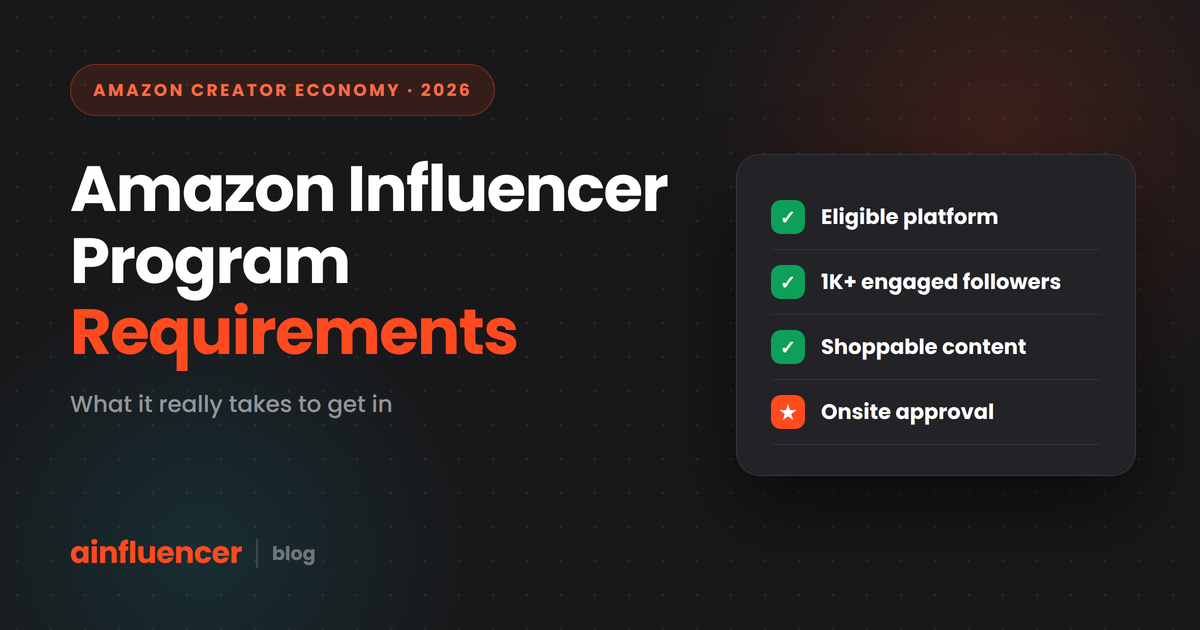
The Amazon Influencer Program lets creators build a free Amazon storefront, recommend products, and earn a commission when their audience buys. It is open to creators on YouTube, Instagram, TikTok and Facebook. Amazon publishes no follower minimum. Approval is judged on engagement and on whether your content looks shoppable, and it happens in two stages: storefront approval first, then a separate onsite approval that lets your videos appear on Amazon product pages.
- Cost to joinFree, no fees at any stage
- Follower minimumNone published, around 1,000 is realistic
- Platforms acceptedYouTube, Instagram, TikTok, Facebook
- Approval stagesTwo: storefront, then onsite
- Reapply after rejectionNo fixed limit, wait until the account has changed
Amazon Influencer Program Requirements: What It Really Takes in 2026
No, there’s no official follower minimum. Here’s what Amazon actually checks, the two-tier approval nobody explains, and the 60-day fix for a rejection.
Once you are in, the work becomes listings, pricing and ads. Amazon seller skills for Claude Code lists the Agent Skills that handle those, all free and readable before you install.
Getting accepted is the creator side of this. If you are a brand looking to work with creators who are already approved, our ranked list of Amazon influencer marketing agencies covers the firms that recruit them for you.
The Amazon Influencer Program requirements confuse almost everyone for one simple reason: Amazon never publishes a hard follower number, so the internet fills the gap with guesses. The reality after watching thousands of applications: acceptance is about engagement quality and content fit, not a magic count, and there’s a second, separate approval for onsite commissions that most guides skip entirely even though it’s where the real money lives. Here’s exactly what you need in 2026, what Amazon’s review actually weighs, and the recovery plan if you’ve already been rejected.
What the Program Is (and What It Isn’t)
The Amazon Influencer Program is the creator-focused sibling of Amazon Associates. Associates is open to almost anyone with a website or app and pays commissions on individual tracked links. The Influencer Program adds two assets on top: a personal storefront at amazon.com/shop/your-handle, and eligibility for onsite placements, where your review videos appear on Amazon product pages and earn from Amazon’s own shoppers.
That distinction matters for your application strategy, because the two programs review different things. Associates has a low entry bar but a strict rule: you need qualifying sales within 180 days to stay in. The Influencer Program reviews your social presence upfront instead. We compare them fully in Amazon Influencer vs Amazon Associates, and the classic Associates checklist lives in our Amazon affiliate requirements guide.
The Requirements, Line by Line
| Requirement | What Amazon looks for | Notes |
|---|---|---|
| Eligible platform | YouTube, Instagram, TikTok, or Facebook | You apply with one primary account |
| Follower count | No official minimum; roughly 1K+ realistic | Micro accounts with strong engagement get in |
| Engagement | Consistent likes, comments, saves relative to size | The real gatekeeper, weighted over followers |
| Content type | Product-adjacent, shoppable-friendly content | Reviews, hauls, finds, tutorials perform best |
| Account standing | Public, active, policy-compliant account | Recent, regular posting matters |
Platform: apply with your strongest, not your biggest
You connect one social account to your application, and Amazon evaluates that account. Creators consistently report smoother approvals applying with the platform where their engagement-to-follower ratio is best. YouTube and TikTok applications built on product-review content tend to sail through, because the content type maps directly onto what the program monetizes.
Followers: the myth of the magic number
Amazon’s own language says eligibility depends on “the number of followers and other engagement metrics,” deliberately vague. In practice, accounts around 1,000+ followers with genuine engagement get accepted regularly, while 50K accounts with hollow engagement get rejected. If a guide promises you an exact threshold, it’s guessing.
Engagement: the real gatekeeper
Amazon is admitting sellers into its store, so it evaluates whether your audience actually listens to you. Comments asking about products, saves on finds content, and steady interaction relative to your size are the signals that matter. This is also why bought followers actively hurt applications: they crater the ratio Amazon weighs most.
Content fit: look monetizable before you apply
An account already posting hauls, reviews, favorites, and tutorials shows Amazon exactly how it will earn. If your feed is personal-life content with no product angle, spend three or four weeks weaving in shoppable formats before applying. The review is partly a prediction of your future storefront, so make the prediction easy.
Requirements by Platform: What Reviewers Actually See
Applying with TikTok or Instagram Reels
Short-form applications live or die on comment quality. Reviewers see an account where finds-style videos draw “link?” and “where did you get this?” comments as pre-validated for commerce, because the audience is literally asking to shop. Before applying, publish two or three finds-format videos and reply actively; the engagement pattern you create is the strongest evidence a short-form account can submit.
Applying with YouTube
YouTube applications benefit from the platform’s review-native culture. A channel with even a handful of honest product reviews, unboxings, or comparison videos maps perfectly onto what the program monetizes, and watch time signals depth of trust that raw follower counts can’t. If you have both a small YouTube presence and a larger generic account elsewhere, the YouTube application frequently wins.
Applying with Facebook
Facebook applications work best from pages with active community interaction, especially in buy-sell-trade adjacent niches like deals, parenting, and home. A quiet page with a big like count reads as dormant; a smaller page with daily comment threads reads as a functioning audience. As everywhere in this program, the ratio beats the raw number.
The Two-Tier Approval Nobody Explains
Tier one: storefront approval
Passing the initial review gets you the storefront and commission eligibility on traffic you send. Some strong accounts get approved instantly at application; others enter a review window where Amazon watches early storefront activity. Either way, tier one only monetizes your audience.
Tier two: onsite approval
The second review happens after you upload product review videos. Amazon evaluates a few of them for quality and compliance, and once approved, your videos become eligible to appear on product listing pages, earning commissions from Amazon’s own shoppers. This is the highest-leverage requirement in the entire program, and the one most creators never complete. Tier one gives you a shop; tier two gives you distribution you could never buy: placement inside the world’s biggest product search engine.
How to Apply, Step by Step
Pick your strongest platform
Compare engagement rates across your accounts, not follower counts. A 4K TikTok with lively comments beats a 40K Instagram with silence. That ratio is what the reviewer sees first.
Submit through the Influencer Program page
Sign in with your Amazon account (use your main shopping account; history helps), connect the chosen social profile, and submit. Instant approvals happen for stronger accounts; everyone else gets a review period, which you should treat as an audition.
Build your storefront immediately
During any review window, activity is evidence. Add idea lists with searchable names, upload shoppable photos, and organize by niche. An active storefront strengthens full approval and starts earning the moment you’re in. Then learn how to promote your Amazon storefront so it never sits idle.
Unlock onsite commissions
Film honest reviews of products you own: good lighting, real usage, clear opinions, no exaggerated claims. Upload three or more and wait for the quality review. Once approved, keep uploading; every additional video is another earning surface on Amazon’s own pages.
Rejected? The 60-Day Recovery Plan
Why applications actually fail
The common causes, in order: engagement too thin for the audience size, content with no product angle, an account that’s been quiet for weeks, and follower quality problems from old growth hacks. Notice that raw follower count is rarely the core issue.
The fix
Post consistently for 30 to 60 days with product-focused formats. Use comment-bait structures (“which of these would you pick?”) to wake up engagement, lean into finds and review content so the account looks monetizable, and cross the 1K mark if you’re under it. Then reapply, ideally with your strongest platform if you originally applied with a weaker one. Second-attempt approvals are extremely common.
⚡ While you wait
Join Ainfluencer’s free marketplace and land brand deals in parallel. Brand collaborations grow exactly the engagement signals Amazon’s review weighs, they pay you during the waiting period, and a storefront full of products you’ve genuinely worked with converts better after approval.
How Often Can You Reapply After a Rejection?
Amazon sets no published waiting period and no cap on attempts, which is why the honest answer is not a number of days. Reapplying with the same account, the same follower count and the same content gets the same decision, because nothing the reviewer looks at has changed.
Treat the gap as a work window rather than a countdown. The accounts that get in on a second attempt usually come back after 30 to 60 days with three things different:
- More shoppable posts. Reviews, hauls and demonstrations where a product is visibly used, not lifestyle posts that happen to include one.
- Engagement that moved. Comments and saves rising relative to follower count, which is the signal Amazon weights over raw size.
- A different primary platform. If you applied with your largest account and were declined, apply with the one where people actually respond to you.
You can also apply with a different eligible account entirely. Each social account is assessed on its own, so a smaller channel with real engagement often succeeds where a bigger, quieter one failed.
Amazon Storefront Requirements
The storefront is not a separate application. It is what you receive when the Influencer Program accepts you, so the storefront requirements and the programme requirements are the same list. What differs is what Amazon expects once the storefront exists.
- It has to be populated. An empty storefront signals an inactive account, and inactivity is the most common reason a new account quietly stops progressing.
- Idea lists and shoppable photos count. You do not need video to start. Curated lists and images get the page working while you build toward onsite approval.
- Your name and profile carry across. The storefront uses the identity you applied with, so it should match the audience that already knows you.
- Traffic is your job, not Amazon’s. Until onsite approval, every visitor comes from links you place yourself.
Onsite approval is the point where that changes, and it is covered in the two-tier section above.
Approved? Your First 30 Days Decide Your Trajectory
Getting in is the easy half. Week one: structure your storefront with three to five named idea lists and your proven products. Week two: film your first batch of onsite review videos and submit for tier-two approval. Week three: point every social bio at the storefront and set a weekly content cadence. Week four: opt into every bonus program you can see, including Amazon Creator Connections when it appears in your dashboard. Our data guide on how much Amazon influencers make shows what separates tiers from there, and the pattern is blunt: top creators put distribution behind proven posts.
Once you’re in, we can fund your growth
Star-badged or 5%+ commission creators qualify for the Amazon Creator Boost Program: Ainfluencer pays for ads behind your existing posts, you keep 100% of commissions plus 50% of profit, and losses are covered.
Check if you qualify →The Pre-Application Checklist
Run this list the week before you submit, in order. Account is public and posted within the last seven days. Engagement is visible on recent posts, with real comments you’ve replied to. At least three product-adjacent posts sit in the most recent ten, so the reviewer’s first scroll sees monetizable content. Follower count has crossed roughly the four-figure line, or your engagement ratio is strong enough to argue otherwise. Bio is clean, human, and hints at your niche rather than reading like a link farm.
Then prepare for the day after approval, because momentum matters: draft three idea-list names in search-query style, shortlist the first products you’ll add, and pick the three products you own that will become your first onsite review videos. Applicants who walk in with this prepared convert the review window into an audition they’ve already rehearsed, and convert approval week into their first earning week instead of a planning week.
Frequently Asked Questions
How many followers do you need for the Amazon Influencer Program?
Amazon publishes no official minimum. Accounts around 1,000+ followers with genuine engagement get accepted regularly, while much larger accounts with weak engagement get rejected. Engagement quality relative to your size is the real requirement.
Is the Amazon Influencer Program free to join?
Yes. Applying and maintaining a storefront costs nothing, and there are no fees to Amazon at any point. You earn commissions on qualifying sales from day one of approval.
What’s the difference between storefront approval and onsite approval?
Storefront approval lets you build your shop and earn from traffic you send. Onsite approval, granted after Amazon reviews sample videos, lets your content appear on Amazon product pages and earn from Amazon’s own shoppers. The second tier is where passive income lives.
How long does Amazon Influencer Program approval take?
Some accounts are approved instantly; others enter a review window while Amazon watches early activity. Building your storefront actively during that window materially improves outcomes.
Can I be in Amazon Associates and the Influencer Program at once?
Yes, and many creators run both: Associates links for blog and web traffic, the Influencer storefront for social. See our full comparison of the two programs to structure it cleanly. If you have not joined Associates yet, start with Amazon affiliate marketing for beginners, which covers signup, approval and the three sales you need inside 180 days.
Published on the Ainfluencer Blog. Related reading: how much Amazon influencers make, Amazon affiliate requirements, and Amazon influencer tools.