Learning how to find influencers on Instagram gives you direct access to more than tens of millions of creators across every niche, country, and city, precisely where engaged audiences live and buy.
If you want high-impact reach without burning your ad budget, Instagram remains the platform marketers rely on to build authentic trust at scale. Many of these strategies reflect current influencer marketing trends that prioritize authenticity, creator credibility, and long-term partnerships.
This guide helps you learn discovery tactics and advanced tools, with real results to prove the approach, and repeatable methods to discover creators who actually move the needle for your brand.
How to Find Instagram Influencers
Ready to find influencers on Instagram for your next marketing campaign? Discovering the right creators doesn’t have to be complicated. Here are eight proven methods that top brands use to connect with influential voices on the platform.
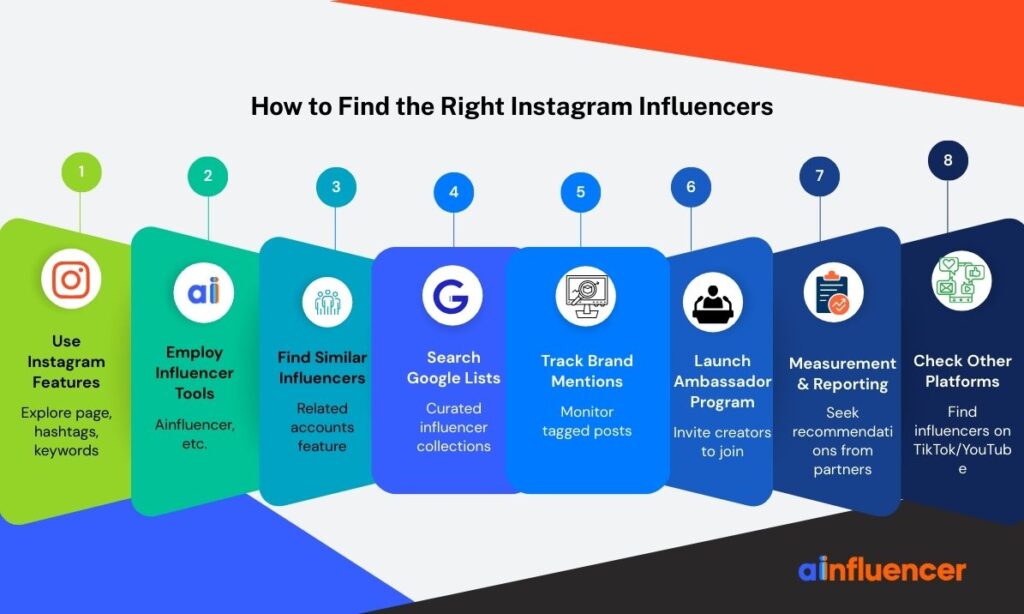
1. Use Instagram Explore, Hashtags, & Keywords
The platform’s native discovery features remain remarkably effective for finding creators in any niche. Start by using the Explore page, which shows trending Reels and posts tailored to your browsing habits. For more targeted results, search relevant hashtags like #FitnessInfluencer or #CleanBeautyRoutine.
Additionally, try Instagram’s keyword search function by switching to the Accounts tab after typing industry-specific terms such as “nutrition coach” or “book reviewer.” Look for profiles mentioning “creator” or “collaborations” in their bios to identify those open to partnerships.
2. Try Influencer Search Tools Like Ainfluencer
When manual discovery becomes inefficient, purpose-built influencer platforms speed up targeting and improve accuracy.
Ainfluencer gives brands direct access to millions of verified creators across Instagram, TikTok, and YouTube, and lets you filter by niche, location, follower size, language, and campaign objective so you can find relevant partners much faster than with manual searches.
The platform combines AI-assisted matching with detailed creator profiles that surface audience breakdowns (top cities and countries, age, and gender), engagement statistics, previous brand work, and quality indicators.
It also supports secure, in-platform payments and negotiation, plus live campaign reporting, so outreach, contracting, and performance tracking can all be handled in one place.
3. Find Similar Influencers to the Ones You Already Like
Instagram offers a built-in feature to discover related accounts. Simply visit any creator profile, click the arrow next to the ‘Contact’ button, and the platform will suggest similar accounts based on mutual followers and content style.
This tool analyzes Instagram bios, hashtags, audience demographics, and engagement patterns to find profiles with significant overlap.
4. Search Google for Niche-Specific Influencer Lists
Many websites compile and maintain specialized lists of Instagram influencers by industry, topic, or location.
A simple Google search with terms like “[your industry] Instagram influencers 2025” can reveal curated collections of relevant creators. These lists often include engagement metrics and audience insights, saving you considerable research time.
5. Track Brand Mentions & Tagged Posts
Monitoring when people talk about your brand presents a goldmine for discovering potential collaborators.
Tools like HypeAuditor help you find influencers who mention your brand or competitors, even without direct tags. This approach is particularly valuable since creators who already speak positively about your products can lead to more authentic partnerships.
6. Launch a Brand Ambassador Program
Instead of constantly searching for new influencers, create a dedicated landing page inviting creators to join your ambassador program.
This approach attracts influencers who genuinely connect with your brand values. For best results, clearly outline what ambassadors receive in return, whether free products, commissions, or exclusive opportunities.
7. Ask for Referrals from Current Influencers
Your existing influencer partners likely know other creators in similar niches. Simply asking “Do you know anyone else who might be interested in working with us?” can uncover hidden gems with minimal effort.
This approach also tends to yield better cultural fits since referred influencers often share similar values and content styles.
8. Check if your TikTok or YouTube Influencers are on Instagram
Many creators maintain presences across multiple platforms to reach different audience segments. If you’re already working with effective partners on TikTok or YouTube, check if they maintain active Instagram accounts as well.
Their handles are typically found in their bio sections on other platforms, and multi-platform collaborations often deliver better overall results.
By combining these strategies, you’ll be well-equipped to find influencers on Instagram who truly align with your brand’s vision and audience, the key to creating partnerships that deliver meaningful business results.
How to Evaluate Influencers Before Reaching Out
Once you’ve gathered a list of potential influencers to find influencers on Instagram, don’t rush into partnerships. Proper evaluation separates true brand amplifiers from those who might waste your marketing budget.
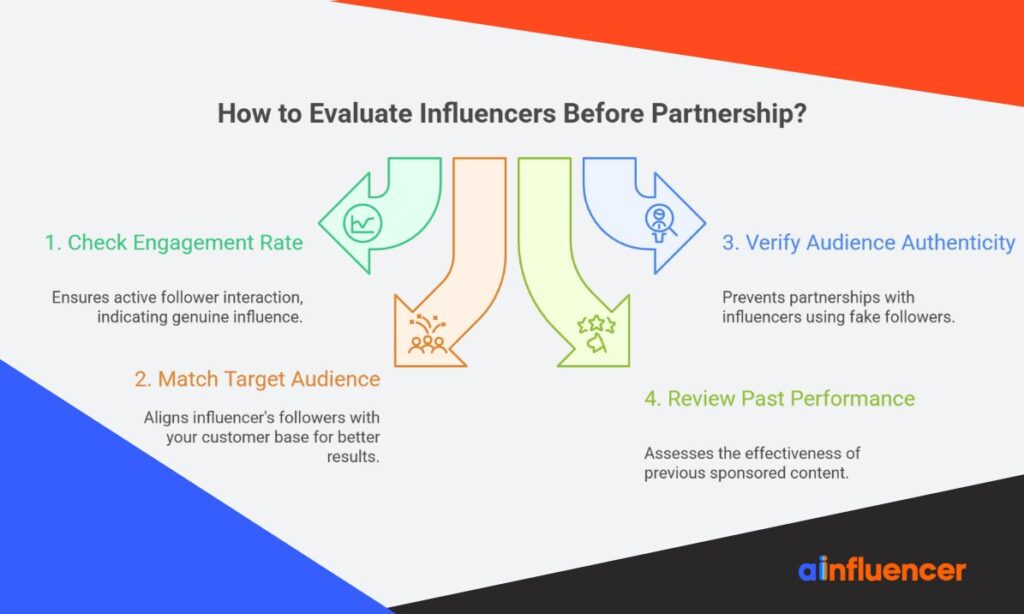
#1 Check Engagement Rate & Content Quality
Engagement rate reveals how actively followers interact with an influencer’s content, far more telling than follower count alone. To calculate it, divide total interactions (likes, comments, shares) by follower count, then multiply by 100.
Consider these engagement rate benchmarks based on follower size:
- Micro-influencers (1K-5K followers): Above 3.85% is excellent.
- Mid-tier (10K-50K followers): Above 1.27% is high.
- Macro-influencers (100K-500K followers): Above 0.93% is strong.
Furthermore, you can use the Instagram audit tool to check follower growth patterns, estimated audience quality, and engagement anomalies before paying.
#2 Look for Audience Authenticity
Before you find influencers on Instagram to promote your product, verify that their followers are real people.
Telltale signs of fake audiences include:
- Suspicious follower growth patterns, sudden spikes often indicate purchased followers.
- Additionally, examine comment authenticity; bot-generated comments typically lack substance or contain obvious grammatical errors.
- An influencer audit tool can simplify this process by analyzing audience quality scores and flagging suspicious activity.
- Legitimate influencers maintain consistent, organic growth without unusual fluctuations that might suggest manipulation.
#3 Match their Followers with Your Target Audience
The perfect partnership happens when an influencer’s audience aligns with your customer base. Beyond basic demographics like age and location, analyze whether their followers genuinely care about your product category.
Modern analytics tools reveal audience composition by age, gender, location, and interests. Request media kits from potential partners; professional influencers typically have demographic breakdowns readily available.
Above all, remember that influence isn’t universal; it’s contextual. An influencer with perfect alignment to your target audience will outperform one with twice the followers but minimal audience overlap.
#4 Review Past Sponsored Content Performance
One of the most effective ways to spot influencers who actually perform is to look closely at their previous sponsored posts. Check how those posts compare to their regular content. If engagement holds steady, it’s a good sign the partnership feels natural to their audience.
Dig into the comments, not just the numbers. Thoughtful, positive reactions usually mean followers trust the creator’s recommendations.
The strongest influencers stick to topics they genuinely know, disclose partnerships clearly, and promote products in a way that fits their usual style. Taking time to vet creators properly helps you avoid vanity metrics and build partnerships that deliver real results.
How to Attract the Right Influencers to Your Brand
Successful brands don’t just search for influencers; they create magnetic opportunities that attract the right creators naturally. After identifying potential partners, your next challenge is making your brand irresistible to those who find influencers on Instagram searching for meaningful collaborations.
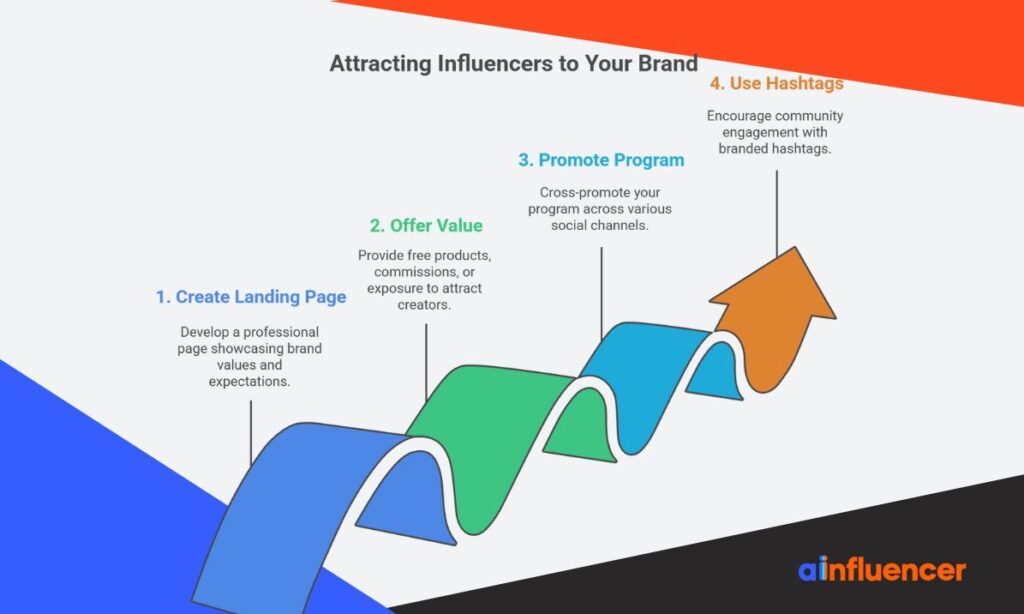
1. Create a Clear & Appealing Landing Page
A dedicated influencer landing page serves as your program’s digital storefront. Treat your influencer program like a product launch with a sleek, professional page that showcases your brand values and clearly outlines expectations. The best way to find influencers on Instagram is often letting them find you through a compelling landing page.
Your page should include:
- Clear application process steps to reduce uncertainty.
- Authentic imagery featuring current influencers using your products.
- Specific qualities you seek (beyond follower counts).
- Testimonials from existing partners.
Brands like Snif fragrance effectively use landing pages that emphasize community building with headlines like “share ideas, test out new products, and help us build a luxury scene brand. This approach appeals to creators looking for meaningful collaborations beyond one-off sponsorships.
2. Offer Value: Free Products, Commissions, or Exposure
Creators evaluate potential partnerships based on what you bring to the table. Besides monetary compensation, consider:
- Free product testing opportunities before official launch dates.
- Tiered commission structures that reward performance milestones.
- Social recognition by featuring creators on your official channels.
- Exclusive community access with other creators and brand team members.
Essentially, treat influencers as long-term collaborators rather than temporary promoters.
3. Promote Your Program Across Social Channels
Don’t limit your influencer program promotion to Instagram alone. Cross-promote your program across:
- Your website’s main navigation.
- Email newsletters to customers.
- Other social platforms where potential creators might discover you.
Remember that when you find influencers on Instagram in your area, local promotion strategies become particularly effective. Accordingly, highlight geographic connections in your outreach materials when targeting regional creators.
4. Use Branded Hashtags to Build Community
Branded hashtags function as digital gathering spaces for your brand community. These unique tags, often featuring your brand name or campaign slogan, encourage followers to share experiences with your products.
For optimal results:
- Keep hashtags short and memorable (preferably three words or fewer).
- Place them prominently in your social bios.
- Couple with clear calls-to-action like “Share your unboxing with #YourBrand”.
- Regularly engage with content posted under your hashtag.
Many successful brands use the formula “my + brand name” (like #MyAnthropologie) or add modifiers like “family,” “community,” or “team” to create belonging.
By implementing these strategies, you’ll not only find influencers on Instagram but also create relationships that deliver authentic advocacy and meaningful results.
Free vs Paid Methods: What Works Best?
As influencer marketing has grown into a $32+ billion global industry, brands are increasingly evaluating whether free discovery methods are enough or if paid influencer platforms are required to scale efficiently.
When to Use Free Methods Like Hashtags & Explore
These tactics are especially effective if you’re trying to find local influencers for region-specific or in-store campaigns.
Free methods work best during these specific scenarios:
- The initial exploration phase, when you’re testing influencer marketing as a channel.
- For brands with limited marketing budgets, especially startups and small businesses.
- When searching for just a handful of influencer partners per month.
- For local business campaigns targeting specific geographic areas.
- During short-term, one-off campaigns with simple goals.
However, these free methods demand significant manual effort and provide limited insight into fair compensation, which is why many brands eventually rely on an Influencer pricing calculator to estimate costs and scale their influencer programs more efficiently.
When to Invest in Influencer Tools
Consider upgrading to paid platforms under these circumstances:
- Once you’re managing 50+ influencer relationships monthly.
- When you need reliable audience demographics and engagement metrics.
- After your manual process becomes too time-consuming.
- For tracking campaign performance across multiple influencers.
- When avoiding fake followers becomes critical to your strategy.
Paid tools justify their cost through time savings alone. For instance, one health brand avoided a partnership with an influencer who had 70% fake followers, saving $50,000 in wasted marketing spend through a $3,000 annual tool investment, a 17X return.
Pros & Cons of Each Approach
Below we have gathered the pros and cons of each method that is free or paid.
| Approach | Pros | Cons |
| Free Methods (hashtags, Explore, manual search) | • No financial investment required• Easy to use for beginners• Good learning experience for first-time influencer campaigns | • Very time-intensive when scaling• Limited data visibility (no audience authenticity checks)• Smaller discovery pool• No campaign management or reporting tools• Minimal or no customer support |
| Paid Influencer Platforms | • Large influencer databases (up to 350+ million profiles)• Advanced filters for niche, location, and audience targeting• Instant access to engagement and demographic data• Built-in campaign tracking and performance reporting• Dedicated customer support and strategic guidance | • High subscription costs ($2,000–$100,000+ annually)• May require integration with existing marketing tools• Learning curve to fully leverage advanced features |
Best Practices from Top Brands
Top brands have mastered the art of finding and working with Instagram influencers through years of refinement. Successful brands follow a repeatable process for creating a successful influencer marketing campaign.
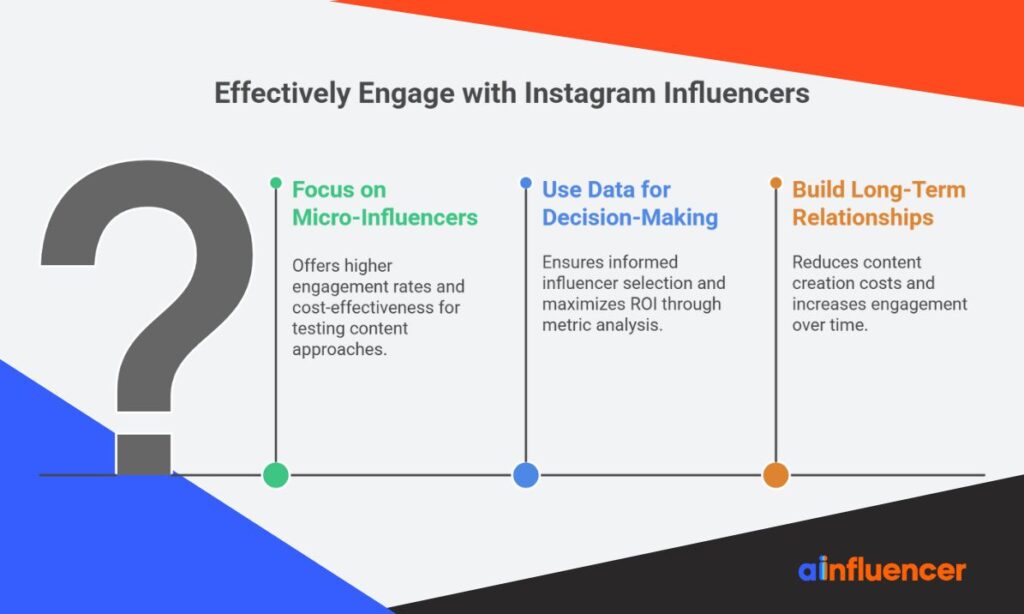
Start with Micro-Influencers for Better ROI
Micro-influencers (10,000-50,000 followers) deliver significantly higher engagement rates than celebrity counterparts.
Indeed, Instagram micro-influencers have the highest across all influencer tiers. These smaller creators typically charge just $10-$20 per 1,000 followers, making them ideal for testing different content approaches before scaling and improving influencer marketing ROI.
Use Data to Guide Decisions
Smart brands never rely on gut feelings when they find influencers on Instagram. They analyze performance metrics beyond surface-level engagement.
Clicks Talent exemplifies this approach by leveraging data to evaluate influencers based on past campaign outcomes to predict future impact.
Moreover, the most successful companies track detailed metrics like audience overlap, ensuring they’re not paying twice for the same viewers. This data-driven mindset allows for mid-campaign adjustments that maximize ROI.
Build Long-Term Relationships, Not One-Off Deals
Brands that maintain influencer partnerships for 12+ months see a remarkable increase in engagement compared to short-term collaborations. These sustained relationships ultimately reduce content creation costs over time.
Because each collaboration model performs differently, influencer marketing types such as product seeding, brand ambassadorships, and long-term partnerships require distinct discovery and evaluation strategies.
Conclusion
You need to find influencers on Instagram by prioritizing audience fit over raw follower counts: start with micro-influencers, run 4-8 week UTM-tagged pilots to measure clicks, conversions, and CPA, and scale only the partnerships that prove their impact.
Treat each collaboration as a learning experiment. Small, data-driven bets today create the playbook for larger, higher-return relationships tomorrow.
As your program matures, combine targeted manual discovery with a platform that verifies audiences, tracks campaigns, and simplifies payments. Invest in long-term creator relationships for better content, lower churn, and sustained, measurable growth.
FAQs
How can I find the right Instagram influencers for my brand?
Start by using Instagram’s native features like Explore, hashtags, and keyword searches. For more targeted results, consider using specialized influencer search tools or asking for referrals from your current partners. Focus on finding influencers whose audience aligns with your target market.
What’s the best way to evaluate potential Instagram influencers?
Look beyond follower count and examine engagement rates, content quality, and audience authenticity. Review their past sponsored content performance and ensure their followers match your target demographic. It’s also important to verify that their values align with your brand.
Should I focus on micro-influencers or larger accounts?
Micro-influencers (10,000-50,000 followers) often deliver higher engagement rates and are more cost-effective for small to medium-sized businesses. They typically charge less and can provide a great starting point for testing different content approaches before scaling up to larger influencers.
How can I attract influencers to my brand?
Create a clear and appealing landing page for your influencer program, offer valuable incentives (such as free products or commissions), and promote your program across various social channels. Use branded hashtags to build a community and make your brand more discoverable to potential influencers.
Is it better to use free methods or paid tools to find Instagram influencers?
The choice depends on your budget and campaign scale. Free methods like manual searches work well for initial exploration or small campaigns. As your influencer program grows, paid tools become more valuable, offering time savings, detailed metrics, and features to avoid fake followers. Many successful brands start with free methods before transitioning to paid tools.