Influencer marketing can drive massive awareness and sales, but many brands still struggle to answer the simple and critical question: Did this campaign actually make money? So here we walk through Influencer Marketing ROI and how to calculate it.
You’ll get clear, repeatable tasks for measuring return on investment (ROI), the exact metrics to track from engagement and conversion rates to customer lifetime value, and the simple formulas that turn messy campaign data into reliable financial numbers. By the end, you’ll know how to measure results and improve future influencer campaigns, especially if you’re focused on Influencer Marketing Strategy.
Step-by-Step: How to Calculate Influencer Marketing ROI
Calculating influencer marketing ROI requires a structured, trackable approach.
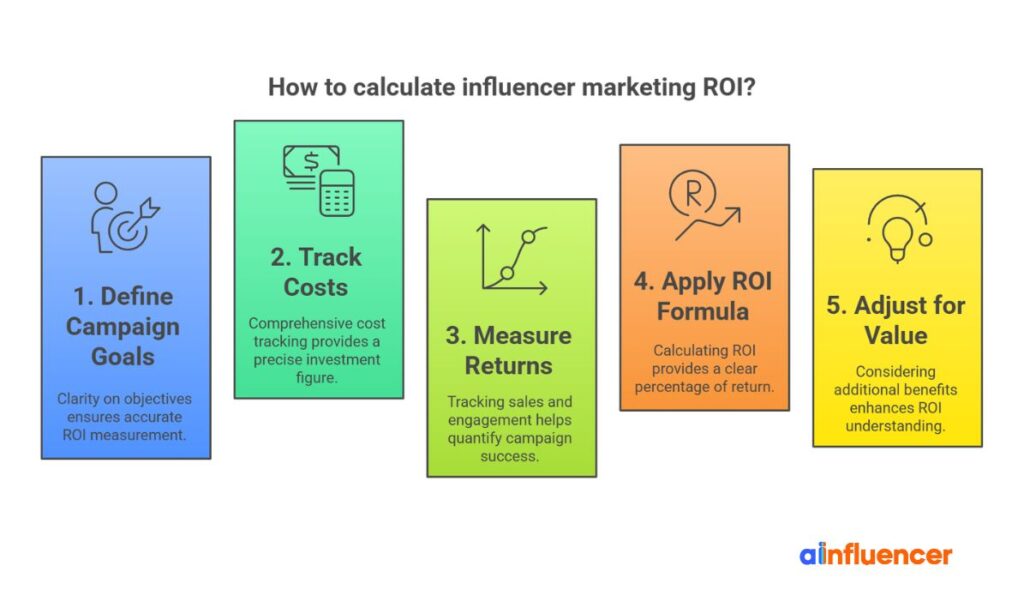
1. Define Your Campaign Goals
Start with clarity about what you want to achieve. Without defined objectives, your influencer marketing ROI becomes impossible to measure accurately. Ask yourself: Are you pursuing brand awareness, lead generation, or direct sales?
Each goal requires different metrics:
- Awareness: measured through impressions, reach, and brand mentions.
- Lead generation: tracked via new signups, subscribers, or form completions.
- Sales: monitored through conversions, tracked revenue, and affiliate code usage.
Nick Veneris, marketing manager for Refersion, notes: “The biggest mistake brands make is not knowing what they’re looking to achieve, then receiving an unexpected result.
Furthermore, your influencer marketing goals should align directly with your core business objectives, shaping the Instagram Collab Ideas you select for each campaign.
2. Track all Influencer-Related Costs
To calculate true influencer ROI, you must account for every expense. This represents the “I” in ROI – your total investment.
| Cost Category | Examples |
| Compensation | Influencer fees, affiliate commissions |
| Products | Free samples, promotional items |
| Production | Content creation, photography |
| Management | Agency retainers, tools, analytics |
| Promotion | Ad spend behind influencer content |
“One of the biggest mistakes ecommerce merchants make is not putting ad spend behind content that’s doing really well organically,” says Jason Goldberg, president of Carro. Tracking these expenses gives you a precise figure for your overall marketing cost.
3. Measure Returns from Sales & Engagement
Your returns include both direct revenue and engagement value.
For monetary returns, track:
- Sales from affiliate or tracking links.
- Revenue from discount codes.
- Value of new leads generated.
For non-monetary returns, measure:
- Engagement quality (comments, shares).
- Brand lift (increased awareness).
- User-generated content.
Consider using UTM parameters, unique discount codes, or dedicated landing pages to track traffic and conversions from each influencer.
4. Apply the ROI Formula
Once you’ve gathered all data, calculating your influencer marketing ROI becomes straightforward:
ROI = (Return − Investment) / Investment × 100
For example, if you spend $10,000 on an influencer campaign and generate $65,000 in tracked revenue: ROI = ($65,000 – $10,000) / $10,000 × 100 = 550%
This means for every dollar invested, you earned $5.50 in profit.
5. Adjust for Non-Monetary Value
The value of your influencer campaign extends beyond the initial returns. Consider these additional benefits when measuring your complete influencer ROI:
- Content reuse value: Influencer-generated content (IGC) can be repurposed across ads, landing pages, and emails.
- Production cost savings: 41% of brands report higher ROI from repurposed creator content compared to studio-produced creative.
- Engagement lift: Authentic creator content often drives higher engagement rates in paid channels.
If influencers created high-quality content you can repurpose, estimate what similar content would cost to produce internally. For instance, 15 pieces of professional content might cost approximately $4,500 to create through an agency.
Key Metrics to Track for Influencer ROI
Tracking the right metrics is fundamental to accurately measuring your influencer marketing ROI. Instead of focusing solely on vanity numbers, successful brands monitor specific indicators that reveal the true impact of their campaigns.
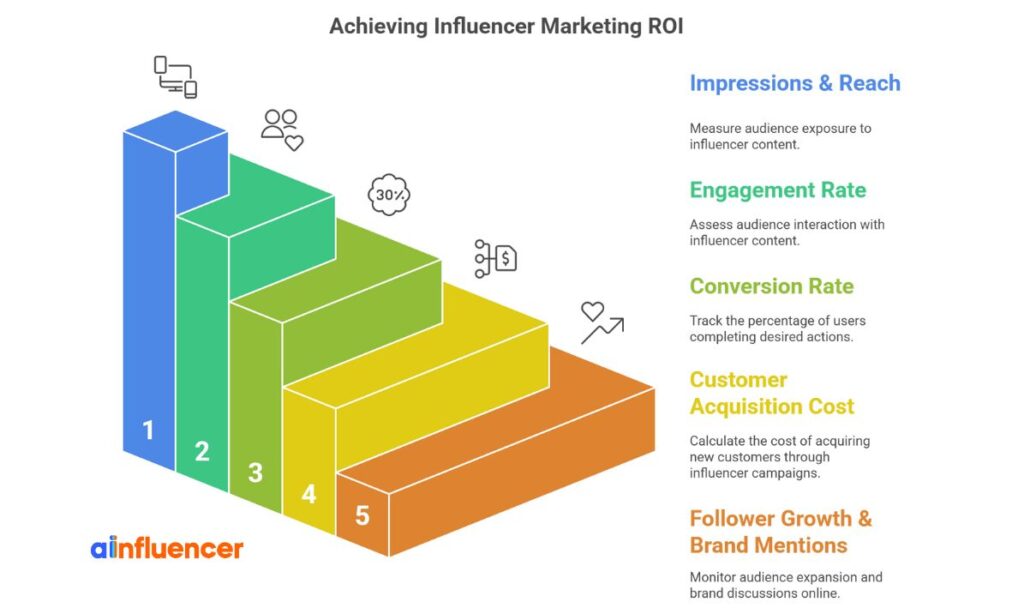
#1 Impressions & Reach
Understanding the difference between these two metrics is crucial for evaluating campaign visibility. Reach measures the number of unique users who see an influencer’s content, while impressions count the total number of times content is displayed. Although related, they tell different stories:
- Reach shows audience breadth (how many people saw your content).
- Impressions reveal frequency (how often your content appeared).
Higher reach and impressions indicate greater audience exposure, which can lead to increased brand awareness and potential conversions. This visibility matters significantly as nearly half of all consumers (49%) make purchases at least monthly because of influencer posts.
#2 Engagement Rate & Shares
Engagement rate measures how actively audiences interact with influencer content through actions like likes, comments, shares, and saves. This metric provides a clear picture of content resonance and effectiveness.
The formula is simple: Engagement Rate = (Total Interactions ÷ Followers) × 100
Platform and follower count significantly impact expected engagement:
| Platform | Creator Size | Avg. Engagement Rate |
| TikTok | Under 100K | 7.50% |
| Under 100K | 3.65% | |
| TikTok | 10M+ | 2.88% |
| 10M+ | 1.77% |
Source:
An engagement rate between 1-5% is generally considered good. Moreover, high-engagement posts can boost sales by 20% and yield 4.3x higher ROI than lower-performing content.
#3 Conversion Rate & Direct Sales
Conversion rate tracks the percentage of people who complete desired actions after seeing influencer content. According to recent findings, the average conversion rate for influencer marketing across all industries is 0.80%.
Nevertheless, brands are seeing impressive returns, earning an average of $5.78 for every dollar spent on influencer campaigns. Micro-influencers (10,000–100,000 followers) often deliver superior results, generating up to 60% more engagement than larger accounts.
To track conversions accurately, use:
- Unique discount codes assigned to each influencer.
- Trackable URLs with UTM parameters.
- Dedicated landing pages for specific campaigns.
#4 Customer Acquisition Cost
Customer acquisition cost (CAC) measures how much you spend to gain each new customer through influencer campaigns. Calculate it using this formula:
CAC = Total influencer marketing costs ÷ Number of customers acquired
Always view CAC alongside customer lifetime value (CLV)—what may seem like a high acquisition cost becomes reasonable when customers make multiple purchases over time.
CAC calculation in influencer marketing faces unique challenges due to attribution difficulties. Did that sale come directly from an influencer post, or was it the result of brand awareness they generated weeks ago? Overcome this by using:
- Promo codes and trackable links for direct measurement.
- Affiliate platforms to monitor conversions.
- Tracking pixels for website analysis.
#5 Follower Growth & Brand Mentions
Follower growth rate measures how quickly your audience expands during influencer campaigns. Beyond just numbers, the quality of new followers matters significantly—are they actively engaging with your content after discovery?
Monitoring brand mentions shows how often your brand is discussed online as a result of influencer partnerships. This conversation volume demonstrates awareness, impact, and community involvement. Social listening tools can track both mention frequency and sentiment, providing insight into how perception changes throughout campaigns.
Tracking these five key metrics gives you a comprehensive view of your influencer marketing ROI, connecting campaign activities directly to business outcomes.
Tools to Help You Measure Influencer ROI
Modern technology offers several powerful solutions for tracking your influencer marketing ROI with precision. The right tools not only save time but also provide insights that manual tracking simply cannot match.
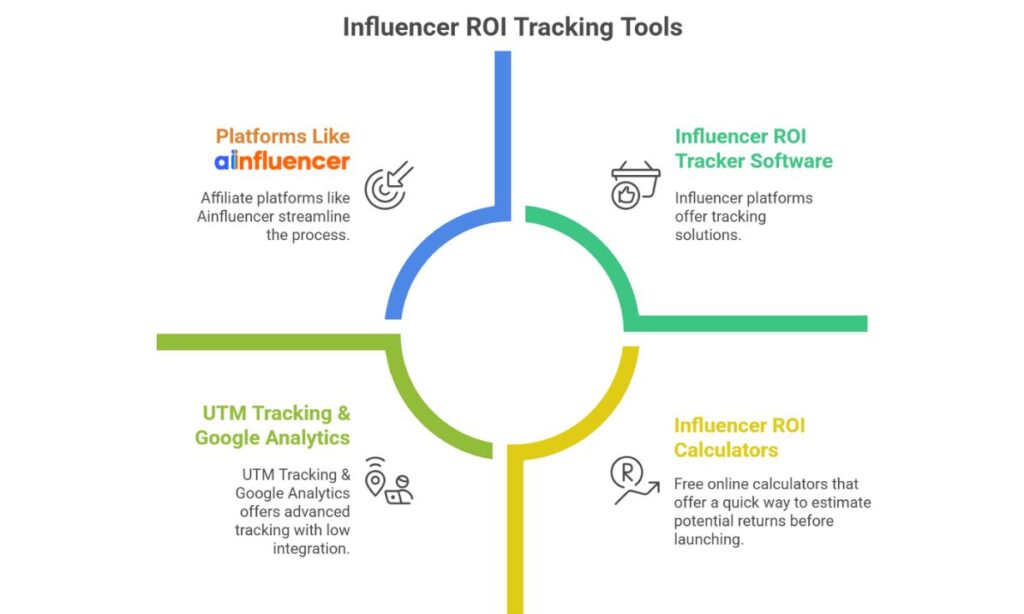
1. Influencer ROI Calculators
Free online calculators offer a quick way to estimate potential returns before launching campaigns. These tools require minimal inputs yet deliver valuable projections:
- InBeat’s ROI Calculator automatically estimates reach, engagement, and impressions based on your budget and influencer follower count.
- Traackr’s IM ROI Calculator claims to improve the performance of paid influencer programs by 15-70%, helping brands calculate their ROI and make better decisions.
- Rows.com Calculator requires just five inputs: campaign cost, audience reached, engagement rate, conversion rate, and average order value to calculate projected ROI.
2. UTM Tracking & Google Analytics
UTM parameters remain the foundation of reliable attribution, particularly when combined with Google Analytics:
UTM parameters are simple codes attached to URLs that identify traffic sources, campaign names, and content types. Each influencer receives uniquely tagged links, enabling precise tracking of:
| UTM Parameter | Purpose | Example |
| Source | Platform origin | |
| Medium | Channel category | influencer |
| Campaign | Campaign name | summer_launch |
| Content | Content variation | video_review |
In Google Analytics, these tags allow you to monitor conversions and user behavior from influencer traffic. Furthermore, GA4’s event-based tracking offers improved attribution for influencer campaigns.
3. Affiliate Platforms Like Ainfluencer
Affiliate platforms streamline both tracking and payment processes:
Ainfluencer focuses on tracking actual sales rather than engagement metrics, showing which creators drive real business growth. This platform allows brands to identify converters versus mere engagers.
4. Influencer ROI Tracker Software
Dedicated influencer platforms offer comprehensive tracking solutions:
- Ainfluencer focuses on Instagram and TikTok influencer campaigns, combining creator discovery with built-in performance tracking. Through its Shopify integration, brands can track influencer-driven clicks, orders, and revenue at the campaign level, enabling basic ROI measurement without relying on vanity metrics.
- The Cirqle stands out by connecting creator activity directly to e-commerce outcomes through integrations with Shopify, Magento, and BigCommerce. Unlike platforms that focus on vanity metrics, it maps each content piece to revenue impact.
- Sprout Social Influencer Marketing integrates paid and organic content performance tracking while automating attribution analysis.
- AspireIQ complements Google Analytics by providing social metrics visibility that GA cannot capture alone, giving brands a complete picture of campaign performance across platforms.
Common Challenges in Measuring ROI
Even with the right tools and metrics, accurately measuring influencer marketing ROI remains one of the biggest hurdles for marketers.
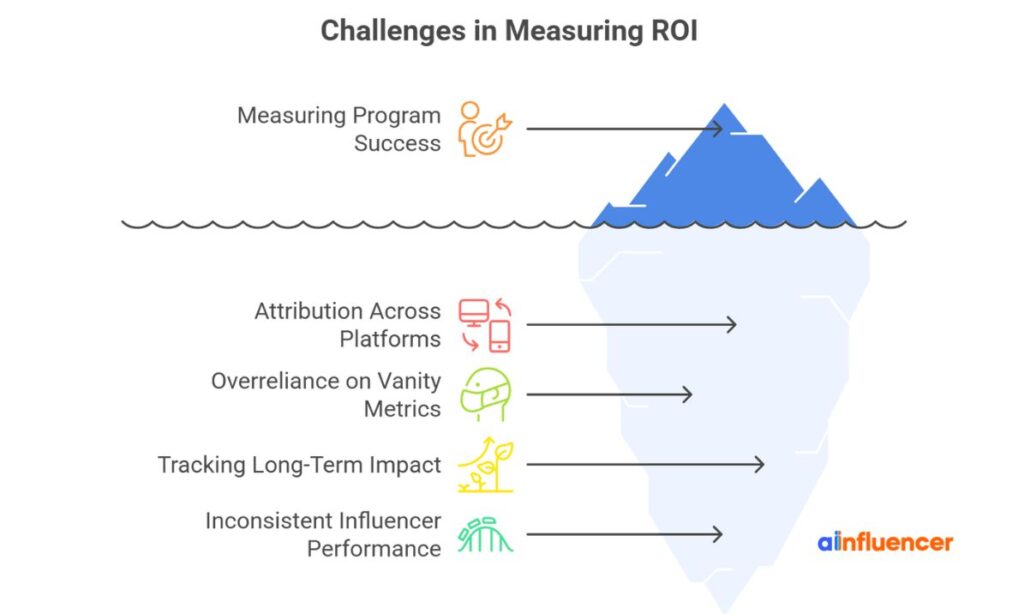
#1 Attribution Across Multiple Platforms
Tracking the customer journey across multiple touchpoints presents significant difficulties for brands calculating influencer marketing ROI. Subsequently, attribution becomes particularly challenging because:
- Consumers interact with multiple influencers before purchasing.
- Media exposure often occurs on one device while conversion happens on another.
- Cross-platform inconsistencies create incomplete data and misattributed results.
Brands measuring native and paid channels in silos consequently miss 40-60% of campaign value. For effective attribution, consider implementing multi-touch attribution models that credit all customer touchpoints throughout the journey.
#2 Overreliance on Vanity Metrics
Certainly, one of the most common pitfalls is focusing on surface-level engagement. Nearly 80% of marketers still believe easily-faked metrics like views and engagement are measures of campaign “success, undeniably creating an illusion of popularity without reflecting actual brand impact.
True ROI measurement requires looking beyond:
- Likes and follower counts.
- Impressions (which count as less than one second of viewing).
- Superficial engagement that doesn’t drive business outcomes.
The key lies in prioritizing quality engagement, save-to-view ratios, and meaningful audience actions.
#3 Tracking Long-Term Brand Impact
Measuring immediate conversions is straightforward, whereas capturing the full long-term value of influencer marketing ROI proves enormously challenging. Influencer collaborations affect:
- Brand awareness and consideration.
- Trust and credibility.
- Customer retention.
Regardless of attribution difficulties, measuring these impacts requires monitoring metrics over extended periods, monthly, quarterly, or yearly.
#4 Inconsistent influencer performance
Notwithstanding your careful planning, influencer results can vary dramatically:
| Challenge | Impact on ROI |
| Binary effect | Some posts do nothing while others go viral |
| Variable returns | The same creator can have wildly different results per post |
| Unpredictable timing | Influencers often post on their own schedules |
This unpredictability makes influencer ROI harder to forecast than other marketing channels. The best approach combines multiple imperfect signals, platform analytics, qualitative feedback, and brand lift studies to form a complete picture.
How to Maximize ROI from Influencer Campaigns
Maximizing your influencer marketing ROI requires strategic approaches that go beyond basic tracking.
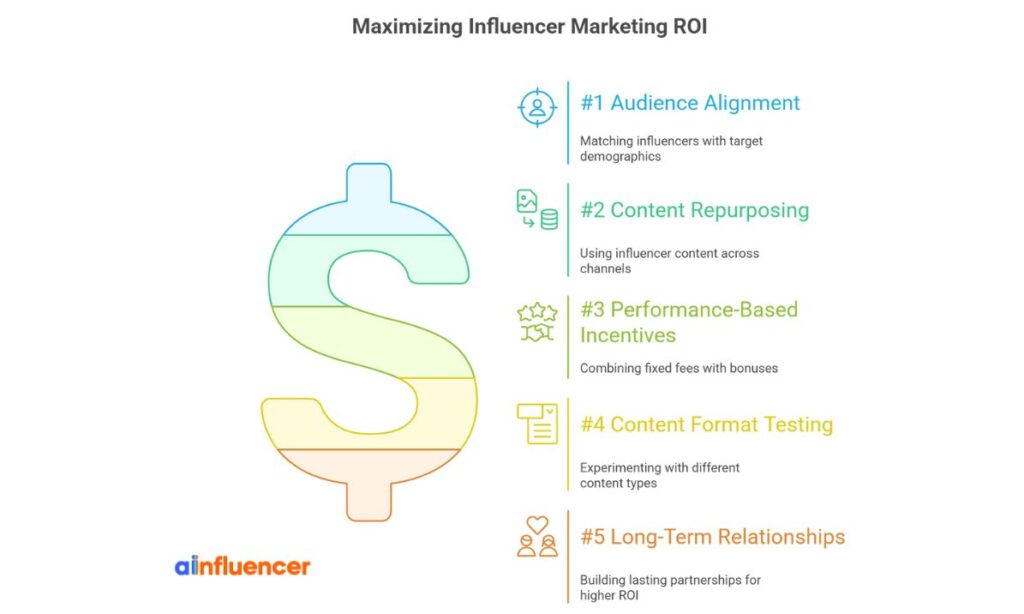
1. Choose Influencers with Audience Alignment
Finding a perfect audience match matters more than follower count. Specifically, 79% of brands now prioritize values alignment over reach when selecting partners.
Look for influencers whose followers match your target demographic in terms of age, location, interests, and lifestyle habits. This approach ensures your message reaches potential customers, ultimately enhancing your influencer marketing ROI.
2. Repurpose Influencer Content Across Channels
Brands that repurpose influencer-generated content experience 10x content ROI plus save over $10,000 on creation costs. This content can power:
| Content Destination | ROI Benefit |
| Social media feeds | 76% higher purchase likelihood |
| Paid advertising | 82% increase in purchase outcomes |
| Website/email | 40% higher performance vs branded content |
3. Use Performance-Based Incentives
Hybrid payment models combine fixed fees with performance bonuses. Indeed, 52% of marketers now use this approach, offering influencers:
- Base payment for content creation.
- Commission on sales generated.
- Bonuses for exceeding performance thresholds.
4. Test Different Content Formats & Platforms
Experiment with various content types since effectiveness varies by industry. Presently, livestreaming and short-form video lead as top-performing formats. Additionally, viewers are less likely to skip influencer content than standard brand ads.
Try creative formats such as livestreams, short-form videos, or Instagram Takeovers to increase real-time engagement and drive conversions.
5. Build Long-Term Influencer Relationships
Long-term partnerships consistently outperform one-off collaborations. Ambassador programs deliver the highest ROI, especially since most creators prefer ongoing relationships over single campaigns.
Learn when to invest in long-term ambassadors vs. one-off shoutouts and how each model affects CAC, CLV, and content reuse.
Brands maintaining 12+ month partnerships see higher engagement rates with reduced content creation costs.
Conclusion
Influencer marketing ROI is both measurable and necessary: if a brand has clear objectives, tracks all its costs, and partners with the right creators, it can achieve a much higher return on its investment.
Quite a few brands even state that their average gains are around 520%. Repurposing creator content and prioritizing conversion-focused tactics multiply the impact at a lower production cost.
Treat ROI as a continuous optimization: experiment with formats, deepen long-term relationships, and keep up the good work.
FAQs
How should I measure long-term ROI (including CLV)?
Employ multi touch attribution along with a longer measurement window that is typically between 90/360 days. Determine customer lifetime value (CLV) using the formula: Average Order Value (AOV) × purchase frequency × gross margin × retention period. Then, compare customer lifetime value with influencer customer acquisition cost (CAC), i.e., divide the total campaign cost by the number of customers acquired.
What disclosure and legal obligations exist?
At the very beginning of the posts, reveal significant relationships in a straightforward and eye-catching manner (for instance, “#ad,” “Paid partnership”). Include disclosure obligations in agreements and stick to the directions of local regulators (FTC/ASAI/CMA).
How do I spot and prevent influencer fraud?
Run authentic pre-campaign audits using a structured Vetting Influencers checklist to catch red flags like sudden follower spikes, low view-to-like ratios, and generic comments before contracts are signed; keep track of the performance in real time, and if the metrics seem to be artificially generated, then stop the amplification.