How Much Do Amazon Influencers Actually Make in 2026?
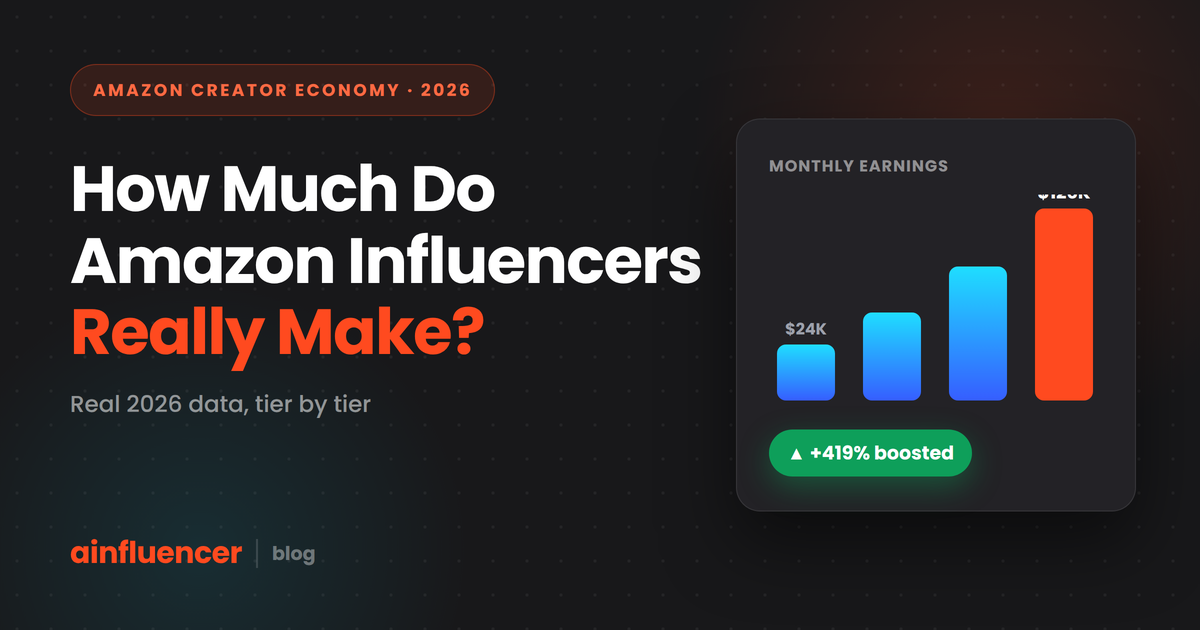
Earnings by follower tier, reconciled numbers from boosted creators (one went from $24K to $126K a month), and the five levers that decide which band you land in.
Those are creator earnings. From the brand side the same numbers are a cost, and Amazon influencer marketing agencies sets out what it costs to have the whole programme run for you.
The honest answer to how much do Amazon influencers make is: anywhere from grocery money to six figures a month, and the gap has surprisingly little to do with follower count. It comes down to how many earning layers a creator has switched on, which commission categories they live in, and whether anything amplifies their reach beyond their own follower graph. This guide breaks down real 2026 numbers tier by tier, shows reconciled earnings from creators whose posts were boosted with paid ads, and walks through the five levers that decide which income band you land in.
How Amazon Influencers Actually Get Paid
Before the numbers make sense, you need the mechanics. Amazon influencer income is not one paycheck; it’s a stack of separate streams that land in the same account, and most creators only ever activate the first one.
Storefront commissions: the foundation
Creators accepted into the Amazon Influencer Program get a personal storefront at amazon.com/shop/their-handle and earn a commission on every qualifying purchase that flows through it. Rates vary by product category, which is why two creators with identical traffic can earn wildly different amounts. A creator whose audience buys premium beauty converts the same click into several times the commission of a creator pushing low-rate electronics.
Onsite commissions: the passive layer most creators miss
Once Amazon approves a few of your review videos, they can appear directly on product listing pages. From that moment, you earn from Amazon’s own shoppers, people who have never seen your social profile and never will. For established creators, onsite earnings routinely grow into the largest single line item, because Amazon’s product pages receive traffic at a scale no individual social account can match. The approval path is covered step by step in our Amazon Influencer Program requirements guide.
Bonuses and brand-funded campaigns
On top of base commissions, Amazon runs tiered bonus structures that unlock at volume milestones, and Amazon Creator Connections lets brands fund extra commission percentages on their own products for campaign windows. These stack on the same sales you were already driving, which makes them the cheapest raise in the business: a few minutes of opting in, applied to work you were doing anyway.
Amazon Influencer Earnings by Tier: The 2026 Ranges
With the mechanics clear, here’s where earnings actually cluster. These ranges reflect what active storefront creators report across niches, assuming consistent posting and a reasonably curated storefront:
| Creator tier | Followers | Typical monthly earnings | Main driver |
|---|---|---|---|
| Nano | 1K to 10K | $50 to $500 | Storefront links in bio, a few shoppable posts |
| Micro | 10K to 100K | $500 to $3,000 | Consistent finds content, idea lists, onsite videos |
| Mid | 100K to 500K | $3,000 to $15,000 | Daily content, seasonal pushes, brand deals on top |
| Macro | 500K+ | $15,000 to $100,000+ | Volume plus onsite placements plus paid amplification |
Nano creators: proof of concept money
At 1K to 10K followers, most earnings come from a handful of posts that happen to convert. The creators who break out of this band early share one habit: they treat the storefront as a store from day one, with named idea lists and weekly updates, instead of a dumping ground for random links.
Micro creators: where consistency starts compounding
The $500 to $3,000 band is where Amazon income becomes a real side salary. Micro creators who complete onsite video approval often double their earnings without gaining a single follower, because Amazon’s own traffic starts working for them around the clock.
Mid and macro creators: the distribution game
Above 100K followers, the question shifts from “can I earn” to “what’s my ceiling.” And here’s the uncomfortable truth this guide exists to deliver: the ceiling is set by distribution, not audience size. Organic reach caps what even a huge account can earn, which is exactly why the highest verified numbers we’ve seen come from creators whose posts had paid media behind them.
Real Numbers: What Boosted Creators Earned in One Month
The figures below are reconciled December 2025 results from the Amazon Creator Boost Program, where Ainfluencer funds paid ad campaigns behind creators’ existing Amazon-linked posts. The creators paid nothing toward the ad budget, kept 100% of their Amazon commissions and bonuses, and additionally received half the campaign profit:
| Creator | Followers | Earnings before boost | Earnings after boost | Extra profit share |
|---|---|---|---|---|
| Andr***s | 330K | $24,320 / mo | $126,360 / mo | +$43,092 |
| A****a | 160K | $112,394 / mo | $646,539 / mo | +$90,201 |
| C***y | 1.1M | $290,783 / mo | $566,234 / mo | +$65,862 |
Read that table twice, because it breaks the assumption most earnings guides are built on. The 160K-follower creator out-earned the 1.1M-follower creator in profit share. Andr***s, the smallest account of the three, grew monthly earnings by 419% in a single month, and 82% of her total sales that month came from boosted distribution rather than organic reach. Audience size set none of these outcomes; distribution set all of them.
⚡ Why these numbers look nothing like other guides
Standard earnings surveys only measure organic reach, so they quietly assume your follower count is your ceiling. Paid amplification removes that ceiling, and in this program the creator pays none of the ad budget and carries zero downside risk: if a campaign loses money, the loss is absorbed for them.
The 5 Factors That Decide Your Earnings
1. Commission rate by category
Rates differ several-fold across categories. Auditing which categories your audience actually buys from, then deliberately weighting content toward the strongest rates, is the fastest raise available to any creator, and it requires zero new followers.
2. Onsite placements
Approved review videos earning on product pages are the difference between income that stops when you stop posting and income that accrues while you sleep. If you promote products you own on camera, you’re a few uploads away from this layer.
3. Content volume and storefront freshness
Storefronts updated weekly convert measurably better than abandoned ones. Shoppers read staleness as untrustworthiness, and Amazon’s surfaces favor active creators.
4. Traffic beyond your followers
SEO, Pinterest, YouTube search, and paid amplification all put your links in front of people who never followed you. Our guide on how to promote your Amazon storefront covers the organic side of this in depth.
5. Bonus stacking
Tiered bonuses and Creator Connections campaigns multiply the value of sales you already drive. In December’s boosted campaigns, incremental bonus unlocks alone ranged from $49,600 to $149,566 per creator, on top of base commissions.
When and How the Money Arrives
Amazon pays on its own schedule: bonuses typically land about one month after the earning month, and commissions about two months after. Plan cash flow around that lag, especially in Q4 when a huge December can feel invisible until February. Creators in the boost program keep this exact schedule, since Amazon continues paying them directly; profit shares are settled after each Amazon payout lands, so the creator is always paid first.
How to Move Up a Tier
If you’re earning nano or micro numbers today, the path up runs through the five factors above, worked in order: fix category mix first, complete onsite approval second, systematize storefront freshness third, then add traffic layers. Our full playbook on how to increase Amazon affiliate earnings ranks nine tactics by effort and impact. The single biggest jump, though, comes from the layer almost nobody can access on their own: paid distribution funded by someone else.
Earning $2K/mo from Amazon? The boost can multiply it
Ainfluencer funds paid ads behind the Amazon posts you already published. Amazon keeps paying you directly, you keep 50% of the profit on top, and losses are covered. Zero cost, zero risk.
See the Creator Boost Program →Do Amazon Influencers Get Paid for Views or Followers?
No, and internalizing this early saves months of misdirected effort. Amazon pays for one event only: a qualifying purchase tracked to your links or placements. There is no payment per view, per click, per follower, or per storefront visit. This is why the entire strategy in this guide optimizes for conversion events rather than vanity reach, and why creators who chase viral view counts often earn less than smaller accounts that quietly build buying audiences.
Niche compounds the effect. A 20K-follower creator in home organization, whose audience actively furnishes apartments, will typically out-earn a 200K meme account, because purchase intent is baked into the audience itself. When you evaluate your own trajectory, weigh three questions: does my audience buy things, do they buy things in categories with healthy commission rates, and do my formats make buying easy? Those three answers predict income far better than any follower milestone, and they’re all improvable this quarter without growing the account at all.
Realistic Expectations for Your First Year
A grounded trajectory looks like this: months one to three, expect $50 to $300 while you learn what converts. Months four to eight, $500 to $1,500 as onsite approval lands and your storefront finds its shape. Months nine to twelve, $1,500 to $5,000 if you’ve stacked bonuses and built one evergreen traffic layer. Creators who then qualify for funded boosting, typically via the star badge or a 5%+ average commission rate, are the ones who break the organic ceiling entirely. If you also want income that doesn’t depend on Amazon’s schedule, our overview of ways to get paid to promote Amazon products covers brand deals and UGC fees that stack alongside.
Frequently Asked Questions
How much do Amazon influencers make per month on average?
Most active storefront creators land between $500 and $3,000 per month. Top creators combining onsite videos, high-rate categories, bonus stacking, and paid amplification reach five and six figures monthly, as December’s reconciled boost data shows.
Do you get paid for followers on Amazon?
No. Amazon pays commissions on tracked sales only. A 15K account that converts can out-earn a 500K account that doesn’t, which is why distribution and conversion matter more than raw audience size at every tier.
How much does Amazon pay per click or view?
Amazon doesn’t pay per click or view at all. Earnings come from commissions on qualifying purchases, plus bonus programs layered on top for eligible creators. This is why conversion-focused content beats reach-focused content for income.
How long until Amazon influencer income becomes meaningful?
With consistent posting, most creators cross $500 per month within four to eight months, and the curve steepens sharply after onsite video approval. The timeline in this guide maps a realistic first year.
What’s the fastest way to increase Amazon influencer earnings?
Fix your category mix, complete onsite approval, and put paid distribution behind proven posts. Through the Amazon Creator Boost Program, that ad budget is funded for you and you keep half the profit on top of your commissions.
Published on the Ainfluencer Blog. Related reading: Amazon Influencer vs Associates, get paid to promote Amazon products, and Amazon influencer tools.