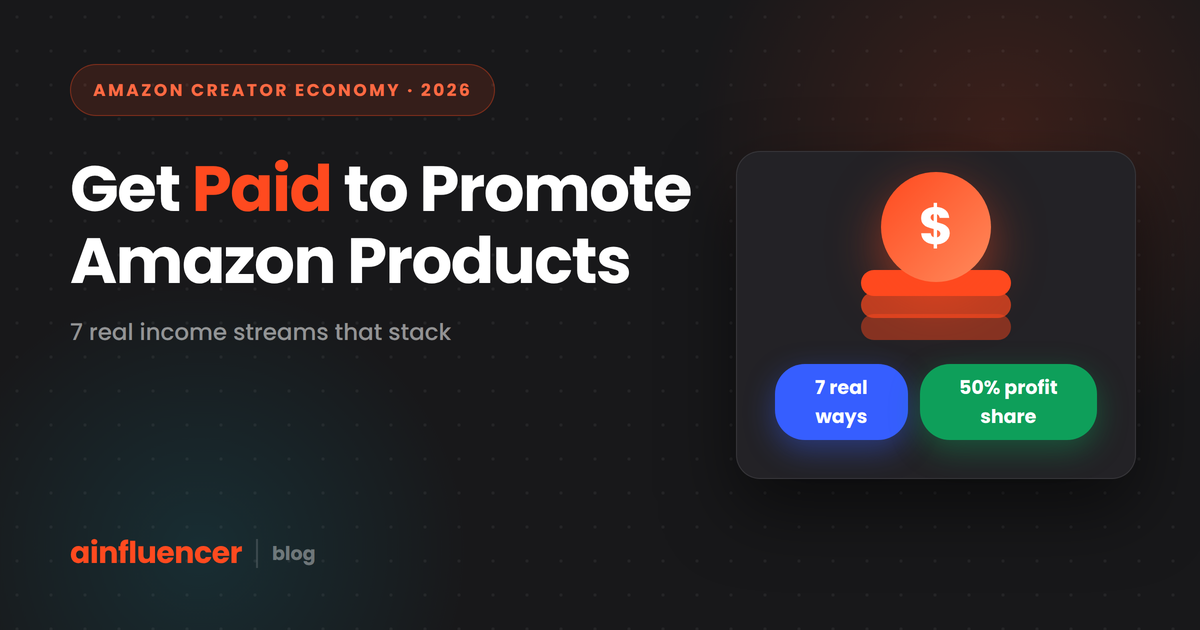
Get Paid to Promote Amazon Products: 7 Real Ways in 2026
Three payers, seven streams, one stacking blueprint: from your first commission to profit-share checks on campaigns you didn’t fund.
Yes, you can genuinely get paid to promote Amazon products, and in 2026 the opportunity is wider than most guides admit: commissions, storefront earnings, brand-funded bonuses, direct brand deals, UGC fees, and even a program that pays you half the profit of ad campaigns run on your behalf. The trick isn’t finding one way; it’s understanding how the seven real income streams stack on top of each other, because top creators earn from four or five of them on the same piece of content. Here’s the full map, ranked from easiest entry to highest ceiling.
First, Understand How the Money Flows
Amazon promotion money comes from three sources, and knowing which source pays which stream keeps the whole landscape simple. Amazon itself pays commissions and bonuses on tracked sales. Brands pay for content, posts, and extra campaign commissions, because your promotion sells their inventory. And platforms like Ainfluencer pay profit shares when they fund amplification behind your content. Every stream below is one of these three sources wearing a different shape, and none of them exclude the others.
The Amazon-Native Ways (Streams 1-4)
Amazon Associates commissions
The classic entry point: share tracked links, earn a category-based commission on qualifying purchases. The bar is low and the mechanics work from a blog, an email list, or social captions. Two things beginners miss: you need qualifying sales within 180 days to keep the account, and category choice quietly decides your margin before you write a word. Start with our Amazon affiliate for beginners guide.
The Amazon Influencer Program storefront
A personal shop at amazon.com/shop/you, commission on everything it sells, and the evergreen asset that separates hobbyists from earners: every bio you own points at one compounding destination instead of scattered links. Entry is reviewed on engagement rather than follower count; the full path, including the two-tier approval, is in our Amazon Influencer Program requirements guide.
Onsite commissions from review videos
Once Amazon approves a few of your product review videos, they can appear directly on listing pages and earn from Amazon’s own shoppers, people who will never see your social profile. This is the stream that turns promotion into passive income: it pays whether or not you posted that day, and for many established creators it grows into the largest line item within a year.
Creator Connections campaign bonuses
Brands fund extra commission percentages, commonly 5 to 20%, on top of your base rate for promoting their products during campaign windows. It’s free to join from your dashboard, applies to content you’d often make anyway, and stacks with every other Amazon stream on the same sale. Full guide: Amazon Creator Connections.
The Brand-Side Ways (Streams 5-6)
Direct brand deals and product seeding
Amazon sellers pay flat fees, gift products, and layer custom commissions for dedicated content, because external creator traffic lifts their organic rank and qualifies them for Amazon’s referral rebates. Free marketplaces like Ainfluencer make these deals findable without cold outreach: brands post campaigns, you negotiate in-platform, and payments run through escrow. Your storefront track record doubles as your pitch.
UGC content fees
Get paid for creating the content itself, separate from posting it. Sellers constantly buy creator video for their listings, ads, and social channels, and UGC work has no audience-size requirement at all: they’re buying your production and authenticity, not your reach. For creators still growing, UGC is often the first four-figure month, and every delivered asset strengthens the portfolio that wins the next deal.
The Ceiling-Breaker (Stream 7)
Profit share from funded ad campaigns
Highest ceilingThe highest ceiling on this list, and the least known. Through the Amazon Creator Boost Program, Ainfluencer funds paid ad campaigns behind your existing Amazon-linked posts and runs them professionally. Amazon continues paying your commissions and bonuses directly, exactly as before, and you additionally receive 50% of the campaign profit. You contribute zero budget, and if a campaign loses money, the loss is absorbed for you: the most you ever return is capped at what Amazon paid you from the boosted sales, and if there are no sales you pay nothing at all.
Why it breaks the ceiling: every other stream on this list monetizes your organic reach. This one manufactures reach, then splits the profit of monetizing it. The qualifying bar is roughly a star badge or a 5%+ average commission rate.
The Stacking Model: How the Streams Combine
| Income stream | Pays for | Stacks with |
|---|---|---|
| Base commissions | Tracked sales | Everything below |
| Onsite earnings | Amazon’s own shopper traffic | All streams |
| Creator Connections | Campaign-window sales | Base + bonuses |
| Tiered bonuses | Volume milestones | Base + campaigns |
| Brand deals / UGC | Content and posts | Independent of Amazon payouts |
| Boost profit share | Funded-ad campaign profit | On top of every stream above |
Read the table as a blueprint, not a menu. A single boosted post can earn base commission, campaign commission, a bonus-tier unlock, and profit share simultaneously, while the same week’s UGC delivery pays a flat fee on the side. That’s how one 330K-follower creator’s December reached $126,360 in monthly Amazon earnings plus $43,092 in profit share; the full math lives in how much Amazon influencers make, and the optimization system in how to increase Amazon affiliate earnings.
What Each Stream Realistically Pays
Grounded expectations keep you building instead of quitting. Base commissions and storefront earnings for an active micro creator commonly land between $500 and $3,000 monthly, with onsite placements capable of doubling that once a video library matures. Creator Connections campaigns add meaningful percentage points on top during windows rather than standalone income. Brand deals range from product-only gifting at the start to hundreds or thousands of dollars per post as your conversion track record accumulates, and UGC packages typically price per delivered asset, stacking predictably with volume.
Profit share sits in its own tier entirely: December’s boosted creators received $43,092 to $90,201 each in a single month, on top of six-figure commission growth. The pattern across all seven streams is consistent: income follows proof of conversion, and each stream’s results become the pitch for the next one. Track your numbers from the first week, because the data itself becomes an asset you’ll monetize.
What Getting Paid Should Never Cost You
The popularity of this search attracts predators, so anchor on one rule: legitimate Amazon promotion income never charges you to participate. Amazon’s programs are free to join. Real brand deals pay you, not the reverse. Genuine marketplaces monetize brands or take transparent success-based fees, never upfront “activation” charges from creators. And the funded boost model works precisely because the platform carries the budget and the risk, with the split defined in a signed agreement you can read before committing.
Red flags worth memorizing: anyone selling “guaranteed acceptance” into Amazon’s programs, mentorship packages priced before you’ve earned your first commission, deals that route payment through gift cards or off-platform transfers, and any partner who resists putting terms in writing. Every stream in this guide can be started this week for zero dollars, which is exactly how you should insist on starting.
Getting Started This Week
Day one: apply to Associates or the Influencer Program, whichever matches where your audience lives (our Influencer vs Associates comparison settles it in five minutes). Day two: join Ainfluencer’s free marketplace and browse live brand campaigns in your niche. Day three: publish your first shoppable post and structure your storefront or link strategy. Within the month: submit onsite review videos, opt into every visible bonus program, and pitch two UGC deals with your best content as the portfolio. Each stream you switch on makes the next one easier to win, and the profit-share ceiling opens once your track record proves out.
Get paid on every layer at once
Free brand deals on the marketplace today, funded ad boosting when you qualify. Both cost you nothing.
Start Free on Ainfluencer →Treat It Like a Business From the First Dollar
Every stream in this guide is taxable self-employment income in most jurisdictions, so build the boring foundations early: a separate bank account for creator income, a simple ledger of payments by stream and payer, and receipts for deductible expenses like equipment, props, and the products you buy to review. Amazon issues tax documentation for program earnings past reporting thresholds, brands and platforms issue their own, and reconciling five small income streams in April is painless only if you logged them in the months they arrived.
The business lens also sharpens strategy. Streams have different margins on your time: onsite videos front-load effort and pay passively, UGC pays immediately but only once per asset, and profit share scales with zero marginal hours. Reviewing income per hour by stream each quarter tells you where your next block of effort compounds hardest, which is precisely the discipline that separates creators who plateau at pocket money from the ones whose stacking model matures into a durable income.
Frequently Asked Questions
Can beginners get paid to promote Amazon products?
Yes. Associates has a low entry bar, small engaged accounts get accepted to the Influencer Program regularly, and UGC fees have no audience requirement at all. Start with one platform, one niche, and consistent shoppable content.
Do brands really pay flat fees for Amazon promotion?
Constantly. Sellers pay for dedicated posts, UGC video for their listings, and storefront placements, because external creator traffic lifts their organic rank and earns them Amazon’s referral rebates. Marketplaces make these deals findable without cold outreach.
How do I get paid without a huge following?
Stack the streams that don’t depend on reach: UGC fees pay for production, onsite videos earn from Amazon’s traffic, Creator Connections raises your rate, and funded boosting supplies reach you don’t have. Conversion beats audience size across this entire model.
How much can you realistically earn promoting Amazon products?
Active storefront creators commonly earn $500 to $3,000 monthly from Amazon streams alone, with brand deals and UGC stacking on top. Creators with funded amplification have verified five and six figure months; the tier-by-tier data is in our earnings guide.
What’s the catch with the 50% profit share program?
There isn’t a hidden one: Ainfluencer funds the ads, absorbs losses, and profit is split only after ad spend is fully covered. The most a creator ever returns is capped at what Amazon paid them from boosted sales, and the qualifying bar is a star badge or roughly a 5%+ average commission rate.
Is there an Amazon creator fund?
Not in the way TikTok or YouTube run one. Amazon does not pay creators a share of a fixed pool for posting. Everything Amazon pays is tied to a purchase or to a specific campaign: Associates commissions, onsite commissions on shoppable videos, and Creator Connections bonuses agreed with an individual brand. If you are looking for guaranteed money that does not depend on sales, that comes from the brand side of this list, through flat fees for posts and UGC.
Can I get paid through an Amazon wish list?
A public wish list gets you products, not commissions. Creators share one so brands and followers can send items, which is product seeding rather than income, and gifted product still has to be disclosed. To turn that attention into money, pair the wish list with your storefront and affiliate links so the same audience buys through a link that pays you.
Published on the Ainfluencer Blog. Related reading: Amazon Influencer vs Associates, how to promote your Amazon storefront, and best influencer programs.