YouTube Influencer Marketing Platforms
Four different products are sold as a YouTube influencer platform. Which ones really index YouTube, what each category costs, how to test one.
Four completely different products are sold as a YouTube influencer platform, and buying the wrong category is the mistake that wastes the budget. A database will not run your campaign. A marketplace will not give you enterprise reporting. A creator CRM assumes you already have creators.
So this guide sorts them by what they actually are, then applies the filter that matters on this channel specifically: which ones genuinely index YouTube, rather than treating it as a third network bolted onto an Instagram tool.
Four Products, One Name
What you are actually buying
| Category | What it does | What it will not do | Priced by |
|---|---|---|---|
| Database | Searches a large index of public creator profiles and reports audience data | Contact them for you, run a brief, or move money | Monthly seat |
| Marketplace | Creators opt in to receive offers. You message, agree and pay inside it | Give you enterprise governance or a 350 million profile index | A fee on each collaboration |
| Creator CRM and workflow | Manages a roster you already have: briefs, approvals, contracts, payouts | Find creators for you in any depth | Monthly, or usage, or an annual contract |
| Audience analytics | Scores authenticity, demographics and fraud risk on creators you supply | Anything operational at all | Monthly seat |
The common failure is buying a database when the bottleneck was never finding people. If your problem is that nobody replies, a larger index makes it worse, not better.
Which Ones Actually Index YouTube
This is the filter most comparison articles skip. Plenty of platforms list YouTube on a feature page and hold very little of it. Reported network coverage, which you should confirm with any vendor before signing:
Network coverage, as each vendor reports it
| Platform | Networks covered | Category | Reported cost |
|---|---|---|---|
| Ainfluencer | Instagram, TikTok, YouTube | Marketplace | No subscription, a fee per collaboration |
| Modash | Instagram, TikTok, YouTube only | Database | $299 a month Essentials, $599 Performance, 14 day trial |
| Upfluence | Seven, including X, Pinterest, Twitch and blogs | Database plus workflow | From $649 a month on a three month commitment |
| HypeAuditor | Instagram, TikTok, YouTube | Audience analytics | About $299 Basic, $499 Pro, annual billing |
| Heepsy | Instagram, TikTok, YouTube | Database | From about $89 a month, free tier |
| GRIN | Multi-network, ecommerce led | Creator CRM | Usage credits, $0 to $1,000 a month since 2026 |
| CreatorIQ | Multi-network, enterprise | Enterprise workflow | Vendr median $37,000 a year |
| Traackr | Multi-network | Measurement led | No public price, estimates of $25,000 to $55,000 a year |
| Emplifi | Multi-network, inside a social suite | One module of three areas | Quoted |
Two readings worth taking from that table. Breadth is not depth: a platform covering seven networks is not automatically better on YouTube than one covering three, and the three-network tools are often the ones that treat YouTube as a first-class citizen. And category predicts price far better than features do: databases cluster near $300 a month, enterprise workflow near $37,000 a year, and a marketplace has no subscription at all.
On Supply, YouTube Is Not the Small One
Most platforms were built Instagram-first, which leaves people assuming YouTube supply is thin. In our own marketplace it is the opposite.
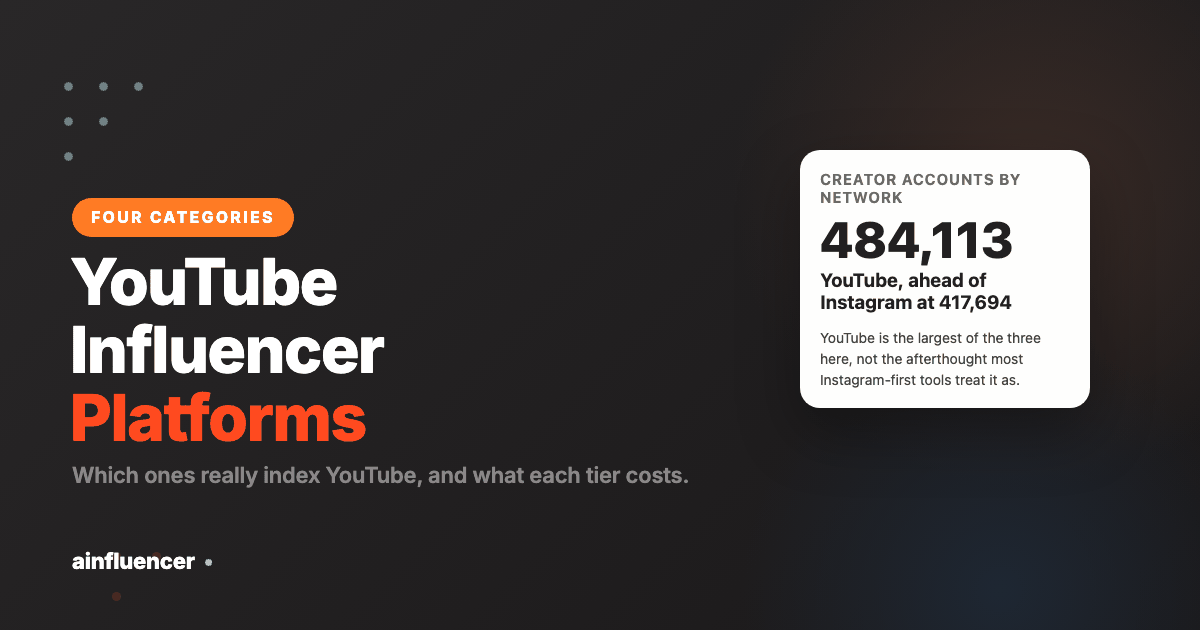
Creator accounts by network, October 2026
| Network | Creator accounts |
|---|---|
| YouTube | 484,113 |
| 417,694 | |
| TikTok | 181,950 |
And the shape of that supply decides which tier you should be shopping in. 78% of those YouTube accounts sit under 100,000 subscribers, they record 5.82% engagement between 1,000 and 10,000 against 3.22% above a million, and across 204,281 brand offers we counted, 77% went to creators under 100,000. The full breakdown is in YouTube influencers.
The practical consequence for choosing a platform: if your shortlist will be micro and mid creators, a 350 million profile index is not the thing you are short of. Reachability is.
Databases: Deep Data, No Reply
These search a large index of public profiles and tell you about the audience. They are excellent at research and silent on outreach.
- Modash covers Instagram, TikTok and YouTube only, which is the right three for most consumer brands. Reported at $299 a month for Essentials and $599 for Performance, with payments and affiliate payouts on the higher tier at 0% up to $10,000 of annual volume and 5% above. See Modash alternatives
- Heepsy is the budget entry, from about $89 a month with a free tier. Thinner data, tightly limited lower tiers
- Upfluence is the broadest on networks and the most expensive to start, from $649 a month on a three month commitment. See Upfluence alternatives
The structural limit is the same for all of them. An index is a list of people who never agreed to hear from you, so whatever its size, your reply rate is your cold outreach reply rate.
Marketplaces: Fewer Profiles, Actual Replies
A marketplace inverts the problem. Creators join it to receive offers, so the message arrives somewhere they already check, and the relevant number is not how many profiles exist but how many will answer.
On Ainfluencer there is no subscription and no subscriber minimum. You search, message, agree terms and pay inside the platform, the minimum collaboration is $10, and the fee runs from 25% on the free plan down to 3% on the top plan. That is the whole cost: a quiet quarter costs nothing, which is the structural difference from every seat-priced tool above.
- Pick it when you do not have a roster, your activity is seasonal, or outreach replies are the bottleneck
- Do not pick it when you need a 350 million profile research index or multi-brand enterprise governance
- A common working setup is a cheap database for research plus a marketplace to transact, which still costs less than one suite
Collabstr is the other marketplace shape: you buy a piece of content outright rather than negotiate a collaboration. Good for a one off, poor for a programme.
Creator CRMs and Enterprise Workflow
These assume you already have creators and give you the machinery to run them: briefs, approvals, contracts, payouts and reporting.
- GRIN repriced in 2026 to usage-based credits running $0 to $1,000 a month, month to month with no contract, which makes it the only one here you can genuinely trial. See GRIN alternatives
- CreatorIQ is the enterprise standard, with procurement data putting the median contract near $37,000 a year. See CreatorIQ alternatives
- Aspire covers comparable ground at a tracked median of $15,588 a year
- Traackr is measurement led. Choose it when the problem is proving value rather than running work
- Emplifi only makes sense if you want the wider social suite, since Influencers is one module of three areas. See Emplifi alternatives
Be honest about the trigger before you buy one. A CRM pays for itself when you are managing dozens of active creators and losing track. At a dozen collaborations a quarter, a spreadsheet and a marketplace do the same job.
Audience Analytics, and When It Is a Separate Purchase
HypeAuditor is the clearest example: it scores audience authenticity and fraud risk on creators you supply, and does nothing operational. Reported at about $299 a month for Basic and $499 for Pro on annual billing.
Worth knowing before you treat any score as truth: no vendor can see a creator’s real subscriber list, so every authenticity score is a model inferring quality from engagement patterns and growth curves. Two defensible models disagree on the same creator and neither is lying. Use a score to decide where to look, not who to book. HypeAuditor alternatives goes through which check you actually need.
How to Test One Before You Commit
A trial that tells you something
| Step | What to do |
|---|---|
| 1. Run your own three searches | Not the vendor’s demo data. Use the exact niche, country and size band you will actually book, in every shortlisted tool, and compare what comes back |
| 2. Count the YouTube results specifically | Plenty of tools return mostly Instagram for a YouTube query. This is the single fastest way to see whether YouTube is real there |
| 3. Check recency, not just count | Every directory carries channels that went quiet. Look at last upload date on ten results before you believe the total |
| 4. Message ten creators | Reply rate is the number that decides whether the tool works, and it is the one no feature table shows |
| 5. Price it against your creator spend | If the licence is a large fraction of what you pay creators, the ratio is the problem, not the feature list |
| 6. Only then look at reporting | It is the easiest thing to be impressed by and the last thing that determines results |
For the wider field across all networks rather than YouTube specifically, our ranked guide to influencer marketing platforms covers 15 in depth plus 26 more. If you would rather hand the whole programme over, we reviewed the YouTube influencer marketing agencies, and finding creators on YouTube covers doing it without a platform at all.
Frequently Asked Questions
What is the best YouTube influencer marketing platform?
It depends which of four products you need. For research, Modash covers Instagram, TikTok and YouTube and is reported at $299 a month. For actually booking and paying creators, a marketplace with no subscription is cheaper. For managing an existing roster, GRIN or CreatorIQ. For vetting only, HypeAuditor.
Is there a free YouTube influencer platform?
Partly. Heepsy has a free tier with tight limits and several analytics tools give one free report. Ainfluencer has no subscription at all: you pay a percentage of each collaboration instead, with a $10 minimum.
What is a YouTube influencer database?
An index of public creator profiles you can search and filter, with audience data attached. It is research, not outreach: the creators in it never agreed to be contacted, so your reply rate is whatever your cold outreach reply rate is.
Do these platforms actually cover YouTube?
Coverage varies and breadth is not depth. Modash, HypeAuditor and Heepsy cover Instagram, TikTok and YouTube; Upfluence reports seven networks. Run the same YouTube search in each shortlisted tool and count the YouTube results before you believe a feature page.
How much do YouTube influencer platforms cost?
Category predicts price better than features. Databases cluster around $300 a month, Upfluence starts at $649 on a three month commitment, GRIN runs $0 to $1,000 a month on usage credits, and enterprise contracts run from a tracked median of $15,588 a year for Aspire to $37,000 for CreatorIQ.
Is YouTube supply smaller than Instagram?
Not here. Our marketplace held 484,113 YouTube creator accounts in October 2026 against 417,694 on Instagram and 181,950 on TikTok, so YouTube is the largest of the three. 78% of those YouTube accounts sit under 100,000 subscribers.
Do I need a platform at all?
Not for a handful of collaborations. Searching YouTube directly and contacting creators works at low volume, and a marketplace removes the subscription question entirely. A paid platform earns its place when research volume or roster size becomes the bottleneck.