Modash Alternatives
Modash covers three platforms and charges 5% on payouts above $10,000. Alternatives mapped to each gap, with reported prices and the fees compared.
Modash sells one thing very well: the size of its index. Reported at roughly 350 million creator profiles with 1,000 followers or more, it is one of the largest searchable databases in the category. So the useful way to compare it is not feature by feature. It is to map where that index runs out, and to match the gap to the tool that fills it.
There are four edges, and they send you to four completely different places: platforms it does not cover, creators an index cannot reach at all, price, and the point where data stops and the work begins.
Modash Covers Three Platforms. Check Yours First.
Instagram, TikTok and YouTube. That is the whole list, and it is consistent across every source we checked. For most consumer brands those three are the programme, and this section does not apply. For anyone else it is the first thing to confirm, because no index size compensates for a network that is not in it.
Platform coverage, and where to look if yours is missing
| Network | In Modash | If you need it |
|---|---|---|
| Yes | Modash is strong here | |
| TikTok | Yes | Modash is strong here |
| YouTube | Yes | Modash is strong here |
| Twitch | No | Upfluence covers it, per its own platform list |
| No | Upfluence | |
| X and blogs | No | Upfluence, or a listening tool such as Brandwatch |
| Snapchat | No | Specialist tools, or direct outreach |
| No | Specialist tools, or direct outreach |
Our Modash review covers the product itself, and Upfluence review is the right page if broader platform coverage is what pushed you here.
The Payout Fee Most Comparisons Miss
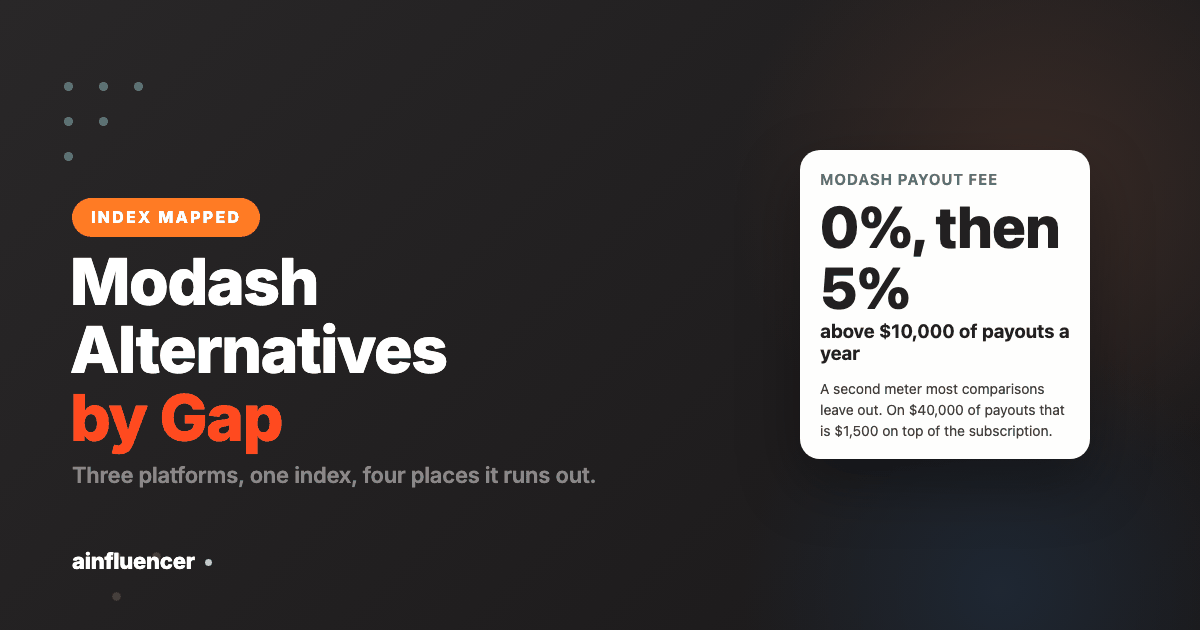
Modash is no longer only a discovery tool. It now handles creator payments and affiliate payouts, and that carries a fee that a feature table will not show you. Reported terms, which you should confirm with the vendor before budgeting:
Reported Modash pricing and payout terms
| Plan | Reported price | Payments and affiliates |
|---|---|---|
| Essentials | $299 a month, or $199 paid annually | Not included |
| Performance | $599 a month, or $499 paid annually | 0% fee up to $10,000 of combined payout volume a year, then 5% on the amount above |
| Enterprise | Reported from $14,700 a year | 0% up to $100,000 a year, then tiered |
Work out what that costs you. A brand paying out $40,000 a year on Performance is above the allowance by $30,000, so the 5% is $1,500 on top of roughly $6,000 of subscription. That is not a scandal, it is simply a second meter most comparisons leave out, and it is the number that decides whether a marketplace or an affiliate platform is cheaper for you.
Two details in Modash’s favour, worth stating plainly: creators are not charged, they receive the full approved amount, and the trial is 14 days with no card.
An Index Is Not a Marketplace
This is the edge that costs teams the most, and it has nothing to do with size. A database of 350 million profiles is a list of people who do not know you exist and never agreed to be contacted. Finding them is the easy half. Getting a reply is the half that fails.
A marketplace inverts that. Creators join it to receive offers, so a message lands in a place they already check. Ainfluencer held 484,107 YouTube creator accounts, 417,694 on Instagram and 181,950 on TikTok when counted in October 2026. That is far smaller than Modash’s index and it is the wrong comparison: the relevant number is not how many profiles exist, it is how many will answer.
There is no subscription. You search, message, agree terms and pay inside the platform, and the cost is a percentage of each collaboration, from 25% on the free plan to 3% on the top plan, with a $10 minimum.
Two different products, honestly compared
| Modash | A marketplace | |
|---|---|---|
| What it is | An index of public profiles | A pool of creators who opted in to receive offers |
| Size | Reported around 350 million profiles | Around 1 million accounts across three networks |
| How you reach them | Export contacts and run outreach yourself | Message inside the platform |
| Reply rate | Cold outreach rates, whatever yours are | Higher, because the creator is there to be hired |
| Cost | Subscription, plus a payout fee above the allowance | No subscription, a percentage of each collaboration |
| Where it wins | Researching a market, building a target list, audience data | Actually booking and paying the work |
Plenty of teams run both, and that is a reasonable answer rather than a compromise: the index to decide who to approach, the marketplace to run what gets agreed.
Modash Alternatives When the Price Is the Problem
Cheaper search exists, and it is honest to say the data is thinner.
- Heepsy, from around $89 a month with a free tier. The lower tiers are tightly limited, and advertised prices are often discounted rates
- HypeAuditor, reported at about $299 a month for Basic. Not cheaper than Modash, but deeper on fraud and authenticity, which is a different purchase. See HypeAuditor review
- trendHERO, cheap Instagram-focused reports for occasional checks
- Influencity, multi-platform discovery at a mid-market price
Before paying for any of them, count last year’s searches. Teams routinely buy annual discovery capacity, use it heavily for one quarter, and renew out of habit.
Where Data Stops and the Work Starts
The last edge is the most common reason to leave. Modash tells you who to approach. It does not brief them, approve content, handle contracts at scale or manage a roster over time. If that is the gap, a discovery tool is not what you are missing.
- GRIN, a creator CRM, repriced in 2026 to usage-based credits from $0 to $1,000 a month with no contract. See GRIN review
- CreatorIQ, enterprise programme management, with a median contract near $37,000 a year. See CreatorIQ review
- Aspire, campaign workflow with a creator marketplace attached
- Refersion, UpPromote or GoAffPro, if what you need is commission tracking rather than a creator CRM
When Modash Is Still the Right Call
- Your programme is Instagram, TikTok and YouTube, which is most consumer brands
- You are researching a market or building a target list, where index size is genuinely the product
- Audience data drives your decisions, and you want it deeper than a marketplace provides
- Your annual payout volume sits under the $10,000 allowance, which makes the payments module effectively free
Leave if your network is not one of the three, if cold outreach reply rates are the bottleneck rather than finding people, or if your payouts are large enough that the 5% above the allowance outweighs the subscription saving. For the wider field, see our guide to influencer marketing platforms.
Coverage Is Not the Same as Accuracy
Every list of Modash alternatives compares index products on how many creators they hold, which is the easiest number to publish and the least useful one to choose on. Two indexes can both contain the same creator and disagree about almost everything else recorded against them.
Four fields drift in different ways, and knowing which is which saves you a lot of arguing with a vendor:
- Follower count is close to objective, and still goes stale between refreshes. On a fast-growing account a six week old record is simply wrong
- Engagement rate is a calculation, not a fact, and vendors use different denominators. One may divide by followers, another by reach, another by recent-post averages. Two tools quoting different numbers for the same creator are frequently both correct under their own definition
- Audience demographics are modelled, never measured. No index can see who is watching: the platforms do not expose it. Instagram’s own insights are available only to the account owner, through their own authorisation, so any third party quoting your creator’s audience split has inferred it rather than read it
- Contact details come from scraping, from the creator submitting them, or from a bought list. These are very different in accuracy and in how comfortable you should be using them
None of this makes an index a bad purchase. It makes the size figure a bad basis for choosing one, which is a different claim. A smaller index that is refreshed weekly and honest about which fields are inferred will serve you better than a larger one that has been accumulating rows since 2021 and presents every field with the same confidence.
So when you shortlist Modash alternatives, ask per field rather than overall: how often is this refreshed, and is this measured, calculated or inferred? A vendor who answers that cleanly is telling you something real. One who answers with a database size is answering a different question.
Paying Creators Is a Separate Problem From Finding Them
Modash bundles payouts with discovery, which is unusual in this category and is the reason its fee structure keeps appearing in comparisons. It is worth separating the two in your own head before you shop, because the tool that wins on discovery is rarely the one that wins on paying people.
Paying creators is harder than it looks for reasons that have nothing to do with software, and the difficulty scales with the number of creators rather than with the money involved:
That last point is the one that quietly decides which campaigns a company can run at all. A brand that can comfortably pay three creators $5,000 each will often find it cannot pay fifty creators $300 each, not because the budget is different but because the finance process was never designed for fifty small counterparties. Teams discover this after the creators have already delivered, which is the worst possible moment, and it is the single most common reason a promising small-creator programme is quietly dropped after one round.
- They are in different countries. A campaign with eight creators across five countries is five payment methods, five currencies and five sets of bank details, and the transfer fees land on somebody
- They are not suppliers in your finance system. Most finance teams need an invoice, a tax form and a vendor record before money moves, and a creator with 12,000 followers has none of those ready
- The amounts are small and the admin is not. Processing a $300 payment costs about as much internal time as processing a $30,000 one, because the approval chain, the vendor record and the compliance check are identical regardless of the figure. That is why small-creator campaigns get quietly abandoned inside large companies even when they performed well
There is a second question worth asking in the same breath: what happens when a creator in a country the platform does not pay to turns out to be the one you want. Every payout product has a country list, and it is shorter than the discovery index it sits next to. Finding out at the end of a campaign that you cannot pay the person who already delivered is a genuinely bad week, and it is avoidable with one question at the start.
Which gives a straightforward test for any of these tools: ask who is the counterparty on the payment. If the platform pays the creator and invoices you once, you have removed the admin above and the fee is buying something real. If it simply surfaces bank details for your finance team to process one by one, a lower fee is not the saving it appears to be.
When the Creator You Want Is Not in Any Index
This happens more than vendors admit, and it is the situation no comparison of Modash alternatives covers. You have a specific creator in mind, they are clearly real and active, and the tool returns nothing.
Usually it is one of four things, and three of them are fixable in minutes:
- They are below the index threshold. Most indexes drop accounts under a certain follower count, often one to five thousand. The creator is not missing, they were never admitted
- The account is private, or was when the index last looked. Private accounts cannot be indexed from public data
- They renamed the account. If the index tracks usernames rather than platform ids, a rename orphans the record and the old handle lingers as a dead row
- They are on a platform the index does not cover. Check the platform list before concluding anything about the creator
There is a fifth possibility worth ruling out before you blame the tool: you are searching for the display name rather than the handle. Display names are free text, change often, and frequently contain emoji or punctuation that will not match. Search the handle, and search it without the @ as well as with it, before concluding the creator is missing.
The practical response is the one that works regardless: write to them directly. An index is a convenience for finding people you do not already know. It is not a prerequisite for working with someone, and a creator you found yourself and approached personally will usually reply at a higher rate than one pulled from a list, because the message reads as though a person wrote it.
What platforms does Modash cover?
Instagram, TikTok and YouTube. It does not index Twitch, Pinterest, X, LinkedIn, Snapchat or blogs, so confirm your network is one of the three before comparing anything else.
How much does Modash cost in 2026?
Reported third-party figures put Essentials at $299 a month, or $199 paid annually, and Performance at $599 a month, or $499 annually, with enterprise from around $14,700 a year and a 14 day trial. Modash quotes rather than publishing a fixed ladder, so confirm before budgeting.
Does Modash charge a fee on creator payments?
On the Performance plan the reported terms are 0% up to $10,000 of combined payments and affiliate payout volume per year, then 5% on the amount above. Enterprise is reported at 0% up to $100,000. Creators are not charged and receive the full approved amount. Sources disagree on the detail, so confirm it with Modash.
What is the best free Modash alternative?
For discovery, Heepsy has a free tier, though it is tightly limited. For actually booking and paying creators, Ainfluencer has no subscription at all and charges a percentage of each collaboration instead.
Is a bigger creator database better?
Only for research. An index lists public profiles who never agreed to be contacted, so size tells you how many people exist, not how many will reply. If outreach response is your bottleneck, a marketplace where creators joined to receive offers will beat a larger index.
Can Modash replace a campaign platform?
Not really. It finds creators, holds audience data and, on the higher plan, pays them. It does not brief creators, run content approval or manage a roster over time, which is what a creator CRM such as GRIN or an enterprise platform such as CreatorIQ is for.