On this page
Loomly Review 2026: Pricing, the Tier Gap and Alternatives
Loomly is a social media management platform built around approval workflows. If your posts need sign-off before they go out, that is what it does better than most. Its pricing has one feature that decides whether it works for you, and it is not on the marketing page.
Prices below are from Loomly’s own pricing page, read on 5 October 2026.
Loomly pricing
| Plan | Monthly | Billed yearly | Accounts | Users |
|---|---|---|---|---|
| Starter | $65/mo | $49/mo ($588/yr) | 12 | 3 |
| Beyond | $332/mo | $249/mo ($2,988/yr) | 60 | Unlimited |
| Enterprise | Custom | 61+ | Unlimited | |
Yearly billing saves 25%.
The gap between the two plans
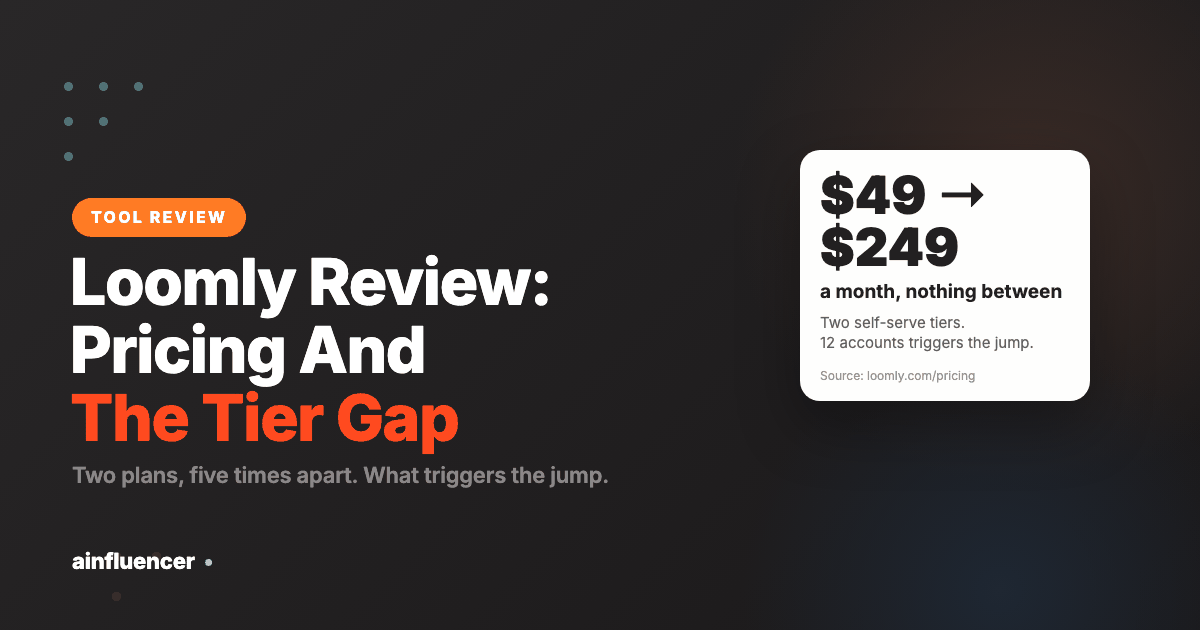
Look at that table again. There are only two self-serve tiers, and the jump between them is five times the price: $49 to $249 a month on annual billing. Nothing sits in between.
That matters because of what triggers the upgrade. Starter caps you at 12 social accounts and 3 users. A small agency with four clients on three networks each is already at the ceiling, and a fourth team member breaks it too. The next step is $2,988 a year.
So the honest way to evaluate Loomly is to count your accounts and seats first, before reading a single feature. If you are comfortably under 12 and 3, it is reasonably priced. If you are near either limit, price the Beyond plan and compare that number against the alternatives, because that is what you will actually be paying within a quarter.
What you get
The approval workflow is the reason to be here. You can define custom roles, route posts through review, and enforce who signs off before anything publishes, which is the requirement in regulated industries and in agencies that cannot afford a client seeing a post they did not approve.
Around that sit the expected tools: scheduling and direct publishing, a content calendar with list, calendar and post views, an ideas board, a media editor and slideshow creator, Canva export, Unsplash and Giphy, Google Drive upload, link shorteners with their own analytics, and iOS and Android apps.
The AI features are present but metered, and the metering is worth noting: social listening runs 2 times a month on Starter and 5 on Beyond. That is not a social listening tool in any meaningful sense, so if listening matters, this is not where you get it.
Beyond adds custom branding including a branded subdomain, custom logo and favicon, custom roles and workflows, a hashtag manager, and 2FA enforcement across the calendar.
Loomly pros and cons
Pros
- Approval workflows that agencies and in-house teams actually use for client sign-off
- 96% positive sentiment on Capterra across 509 reviews, a large sample
- Post ideas and optimisation hints built into the composer
- A calendar clear enough to put in front of a client
- Covers every major network with per-network previews before you publish
Cons
- Price rises are the loudest complaint, and reviewers report a 315% increase
- Four tiers became two, which removed the middle of the range and left a gap at the bottom
- Instagram publishing has required manual steps for many reviewers
- Reviewers report being charged to export their own content before leaving
- Support described as largely automated replies, with a real person hard to reach
- No comment or DM handling, so it schedules and reports but nothing else
What real users say about Loomly
How Capterra reviewers rate Loomly
Positive 96% Not positive 4%
Capterra reports 96% positive sentiment across 509 reviews, read 5 October 2026. We show it as a share rather than a star score because the share is what Capterra publishes. Loomly’s sample is also the oldest in this set, which matters: a large part of those 509 reviews was written under a price list that no longer exists.
A review that only reports the vendor’s own pricing page is half a review. Here is what the people paying for it report, and the pattern is consistent enough to be useful.
The ratings
Loomly scores well in aggregate. Capterra reporting puts it at 96% positive sentiment across 509 reviews, and the praise is specific rather than vague: the dashboard organisation, the calendar, and how well it handles customising one post for several platforms.
That number and the complaints below are not in conflict, and understanding why is the most useful thing in this review. The satisfied reviews come overwhelmingly from established teams on larger plans. The angry ones come from small businesses. Same product, different side of a pricing line.
The price increase that dominates the complaints
The most repeated grievance is not about features. One user reported that Loomly raised their annual price from $300 to $2,988, an increase of around 996%, with roughly thirty days of notice. A G2 reviewer summarised the trajectory as the value declining significantly while the price increased substantially.
This is where the earlier section on the tier gap gets its explanation. Loomly used to run four self-serve tiers, Base, Standard, Advanced and Premium. It now runs two. Removing the middle is what produced the canyon between $49 and $249 a month, and anyone who was sitting on one of the removed tiers experienced that as a sudden multiple of their old bill rather than as a pricing page update.
The phrase that recurs in those reviews, and it is worth quoting because it explains the intensity, is that the company feels “predatory and unkind to small businesses”. Whether that is fair is a judgement; that it is widely felt is a fact you should price in if you are a small business considering a multi-year commitment.
The functional complaint that recurs
Separately from price, Instagram publishing problems appear consistently across G2, Capterra and Trustpilot. For a tool whose core job is scheduling, that is the complaint to weigh most heavily, and it is worth testing specifically during the trial rather than taking on trust. Users also report difficulty exporting their content, which matters if you ever want to leave.
How to read all that
The honest synthesis: Loomly is a well-built product with a strong calendar and the best approval workflow in its price range, sold by a company that has repositioned upmarket and treated existing small customers roughly on the way. If you are an established team that fits the Beyond plan, the complaints largely are not about you. If you are a small business on Starter, the risk you are taking is not that the software is bad, it is that the next repricing moves the floor again.
How to decide across a five-fold gap
A pricing ladder with one enormous step is a deliberate design: it is built so that a specific kind of buyer self-selects upward. The way to resist it is to name what the upper tier actually gives you and check whether you need any of it.
Across this category the jump almost always carries the same four things:
- Seats. The most common reason to move, and the easiest to count honestly in advance
- Approval workflows. Genuinely valuable if a client or a manager signs off posts, and worth nothing if you publish your own work
- Advanced analytics and custom reporting. Valuable when somebody external reads the report, and decorative when nobody does
- Support response times. Hard to value until the week you need it
The test that cuts through it: write down the one feature you believe justifies the jump, then check what you would do without it. If the answer is a spreadsheet and ten minutes a week, the gap is not worth crossing yet.
One limit no tier changes, worth knowing because people blame schedulers for it. Meta provides no native scheduling endpoint, so any scheduled post is held by the software and published at the chosen minute rather than queued by the network, and accounts are capped at 100 API-published posts in a rolling 24 hours. Paying more does not move either constraint.
What Loomly’s negative reviews actually say
Loomly is the only tool in this set where the loudest complaint is about a change rather than a feature. Most of the anger in its recent reviews comes from existing customers at renewal, which is why a 96% positive rate and a wave of one-star reviews can both be accurate.
The price change reviewers describe, in annual cost
One reviewer’s reported figures, with about thirty days of notice. We cannot verify an individual invoice and are reporting the claim rather than asserting it. We include it because it is consistent with the broader pattern reviewers describe and with the tier structure changing from four plans to two.
| Complaint | What reviewers describe | What to do about it |
|---|---|---|
| Price increases | The dominant theme. Reviewers report a 315% rise, being charged more than the renewal figure shown in their own account, and in one case an annual cost going from a reported $300 to $2,988 with roughly thirty days of notice. Several say the increases came without new features to justify them. | This is the reason the tier structure matters. Loomly ran four plans and now runs two, so the middle of the range is gone. Price the plan above the one you want, because that is where you land if you outgrow yours. |
| Instagram publishing | One of the most common functional complaints across G2 and Capterra: reviewers describe needing to publish manually, in one case about half of their scheduled posts, with third-party integrations offered as the workaround. | If Instagram is your main channel, test direct publishing in the trial before anything else. A scheduler that needs you present at publish time is not solving the problem you bought it for. |
| Export charges | Reviewers describe feeling their content is held hostage, and report being charged to export it before leaving. We are reporting what reviewers say rather than confirming a current policy. | Keep your content somewhere you own it, a spreadsheet or a drive folder, from the first week. That is good practice with any scheduler and it removes this risk entirely. |
| Support quality | Reviewers report support relying almost entirely on automated responses, making a real person difficult to reach. This appears alongside the billing complaints, which is the worst possible combination. | Raise anything commercial in writing and early, not at renewal. |
| Connection drops and failed posts | Recurring technical glitches, including losing platform connections and occasional publishing failures. | Check the calendar weekly. Common to the whole category, and not a reason to single Loomly out. |
| No inbox | You cannot read or reply to comments or direct messages inside Loomly. It is strictly scheduling and reporting. | Fine if approvals are the problem you are solving. A gap if you wanted one place for everything. |
The useful thing about Loomly’s reviews is that the two halves do not contradict each other, even though they read as though they should. A 96% positive rate on 509 Capterra reviews and a wave of anger about pricing describe different people: teams who need approval workflows get real value and absorb the cost, while small users who wanted a calendar found the plan they were on disappear underneath them. Which group you are in is decided before you sign up, by whether anyone has to approve your posts.
Who Loomly suits
A good fit if approval workflow is a hard requirement, you are inside the 12 account and 3 user limit, and you want the calendar and collaboration side done well. For an in-house team at one brand with a compliance step, it is well judged.
A poor fit if you are an agency scaling past a handful of clients, where the tier gap makes it expensive quickly, or if analytics depth and social listening are what you are shopping for.
Loomly alternatives
| Tool | Entry price | Choose it when |
|---|---|---|
| Metricool | $20/mo | You want ads reporting alongside organic, and per-brand pricing that scales gently |
| Publer | $4/mo per account | You want to pay only for the accounts you actually connect |
| SocialBee | $24/mo | Evergreen content recycling is the job |
| Hootsuite | Higher | You want the most established tool with the broadest integrations |
On price per account at small scale, Loomly is the most expensive of this group. What you are paying the difference for is the approval layer, so the question is simply whether you need it.
One thing Loomly does not do
It manages the channels you own. It has no creator side, so it cannot help you get your product in front of an audience you do not already have. That is a different job, and Ainfluencer is built for it: creators posting to their own followings rather than you scheduling to yours. Most brands end up running one tool for each, and they are complements rather than competitors.
What Loomly actually costs at three sizes
Because the tiers are set by accounts and seats rather than features, the useful comparison is total annual cost at the size you actually are.
| Situation | Loomly plan | Per year |
|---|---|---|
| One brand, 4 networks, 2 people | Starter | $588 |
| Small agency, 4 clients, 3 networks each, 4 people | Beyond, on the user limit | $2,988 |
| Agency, 20 clients | Enterprise | Quote |
The middle row is where most people get caught. Twelve accounts sounds generous until you count a client as three or four accounts, and the third team member is free while the fourth costs $2,400 a year. If your plan is to grow past four clients, build the Beyond price into the decision now rather than discovering it later.
The AI features, honestly
Loomly includes an AI assistant chat, post generation, AI captions, reply suggestions and AI analytics, with usage described as limited on Starter and extended on Beyond rather than given as a number.
Two things worth knowing before they influence the decision. The post generation is useful for first drafts and unremarkable compared with what any general assistant will produce from the same brief. And the social listening cap, 2 runs a month on Starter, is low enough that it should be read as a sampling feature rather than monitoring. Neither is a reason to pick Loomly; the approval workflow is.
Frequently asked questions
How much does Loomly cost?
Loomly has two self-serve plans. Starter is $65 a month billed monthly or $49 billed yearly, which is $588 a year, and covers 12 social accounts and 3 users. Beyond is $332 a month or $249 billed yearly, which is $2,988 a year, and covers 60 accounts with unlimited users. Enterprise, for 61 or more accounts, is quoted. Yearly billing saves 25%.
Why is there such a big jump between Loomly plans?
Because there are only two self-serve tiers and nothing between them. Going from Starter to Beyond is a five-fold increase, $49 to $249 a month on annual billing, and the upgrade is triggered by hitting 12 social accounts or 3 users rather than by wanting a feature. Count your accounts and seats before comparing features, because that is what sets your price.
Does Loomly have a free plan?
No. Loomly offers a free trial rather than a free tier, so the entry point is $49 a month on annual billing. If a permanently free plan matters, Publer and Metricool both have one, with their own limits.
Is Loomly good for agencies?
For a small agency inside 12 accounts and 3 users, yes, and the approval workflow and custom roles are genuinely strong for client sign-off. Past that it gets expensive fast: a fourth team member or a fifth client pushes you to $2,988 a year. Agencies scaling beyond a handful of clients usually find per-brand or per-account pricing cheaper.
Does Loomly do social listening?
Only nominally. Social listening is capped at 2 runs a month on Starter and 5 on Beyond, which is a sampling feature rather than monitoring. If listening is a real requirement, this is not the tool for it.
What is the main reason to choose Loomly?
Approval workflows. You can define custom roles, route posts through review and enforce sign-off before anything publishes, which is the requirement in regulated industries and in agencies that cannot risk an unapproved post going live. If you do not need that layer, cheaper tools cover the rest of what Loomly does.
The summary: Loomly is worth its price if approval workflow is a requirement and you fit inside 12 accounts and 3 users. Check those two numbers against your team before anything else, because crossing either one takes you from $588 a year to $2,988 with no step in between.