Want free, consistent Amazon sales in 2025? It all starts with how you rank Amazon products organically.
When your product fails to rank, visibility drops, and sales follow. But the opposite is also true. Higher rankings generate more sales, and those sales push your product even higher.
In this guide, you’ll learn how to optimize listings, target the right keywords, use ads strategically, and track performance to climb Amazon search results and stay there.
1. Mastering Keyword Strategy For Amazon SEO
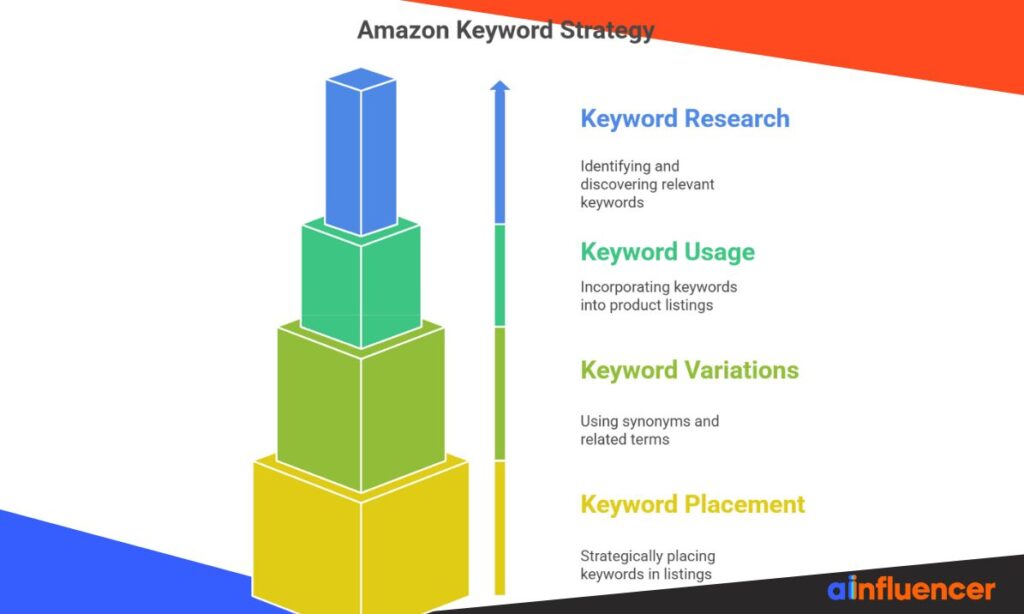
Keywords are the foundation of becoming a top seller on Amazon. Amazon’s algorithm uses them to match your products with customer searches, making strategic keyword selection essential to rank Amazon products organically.
How To Find Keywords You Already Rank For
Start by identifying keywords your products already rank for to build upon existing momentum. Access Amazon Brand Analytics (available to registered brand owners) to see which search terms drive traffic to your listings.
These insights help you understand which search terms are already driving real buyer engagement.
Discovering New Keywords With High Intent
High-intent keywords drive conversions because they match what buyers are actively searching for. Focus on relevant, buyer-driven terms that indicate strong purchase intent (e.g., “best wireless earbuds for running”).
Target long-tail keywords that face less competition and often yield higher conversion rates than shorter terms. For example, “wet food cat” has a 42.83% conversion rate compared to just 12.93% for “wet cat food”.
Keyword research methods table:
| Method | Benefits | Best For |
| Amazon Autocomplete | Shows actual customer search terms | Quick research |
| Competitor Analysis | Reveals proven-performing keywords | Market gaps |
| PPC Search Term Reports | Identifies converting keywords | Refinement |
| Specialized Tools | Provides volume and competition data | In-depth strategy |
Using Synonyms, Use Cases, & Variants
Amazon’s algorithm recognizes variations of keywords, making synonyms, alternate spellings, and use cases valuable additions to your strategy. Additionally, include abbreviations, plurals, and regional spelling differences.
Notably, Amazon’s broad match feature now includes variations and synonyms related to keywords, expanding your reach without manual entry.
Combine related words like “dresser, bedroom, drawer tall” to capture searches for various combinations like “tall dresser for bedroom”.
Placing Keywords In Title, Bullets, & Backend
Keyword placement dramatically affects your organic ranking. Your title should include your primary keywords, with the most important terms at the beginning. Bullet points should highlight benefits while incorporating secondary keywords naturally.
Furthermore, use the backend search terms field (limited to 249 bytes) to capture relevant terms that don’t fit naturally in visible content. This space is ideal for synonyms, misspellings, and alternate names.
2. Optimizing Listings To Match Amazon’s Algorithm
The structure of your listing directly influences how you rank Amazon products organically. Once you’ve identified your keywords, proper optimization translates them into actual ranking improvements.
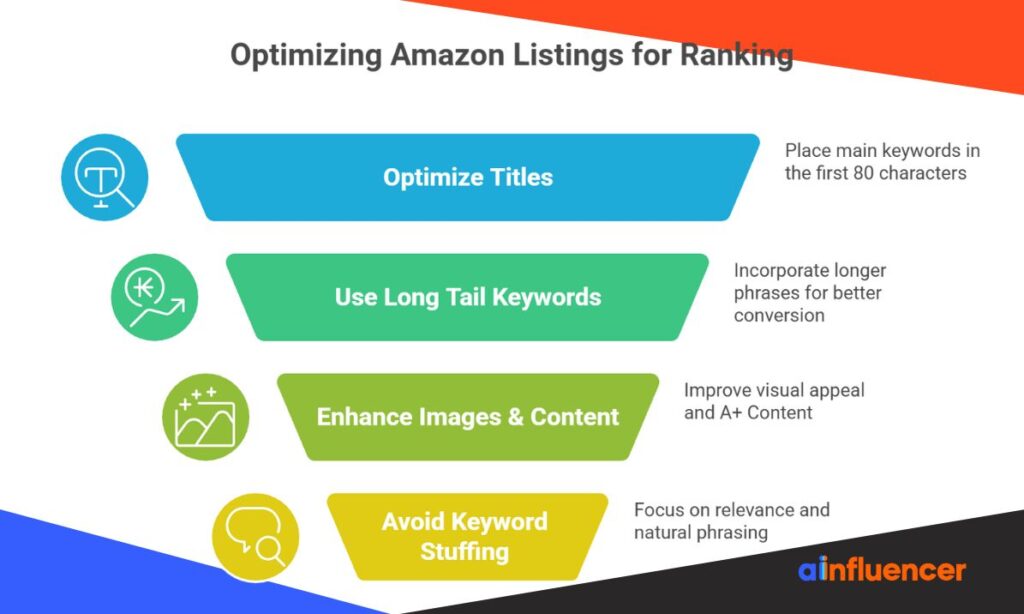
Improving Product Titles & Descriptions
Product titles serve as your most potent ranking factor. The first 80 characters hold particular weight, so place your main keywords there first. Structure titles with brand name, product type, key features, and size/quantity.
Descriptions should flow naturally while incorporating keywords from search term reports that drive actual conversions.
Using Long Tail Keywords For Better Conversion
Long tail keywords typically convert at 3-5 times higher rates than generic terms. Unlike short, competitive terms, these longer phrases (containing 3+ words) precisely match buyer intent.
Consequently, they often have lower PPC costs while delivering better results. Incorporate these naturally into bullet points and product descriptions rather than stuffing them awkwardly into titles.
Enhancing Product Images & A+ Content
While images don’t directly contain searchable text, they significantly impact conversion rates, which subsequently affects ranking. High-quality images showing products from multiple angles increase customer confidence.
A+ Content (formerly Enhanced Brand Content) allows you to showcase benefits through comparison charts and lifestyle imagery, increasing conversion rates by 3-10%.
| Image Element | Impact on Conversion | Best Practice |
| Main Image | First impression (+/-15% CTR) | Clean background, product fills 85% of the frame. |
| Lifestyle Shots | Shows product in use (+5-8% conversion) | Real-world application images |
| Infographics | Explains features visually (+3-7% conversion) | Simple, branded diagrams |
Avoiding Keyword Stuffing & Irrelevant Terms
Keyword stuffing actually damages your ranking potential. Amazon’s algorithm penalizes unnatural phrasing and irrelevant terms that lead to poor customer experiences.
Focus on relevance above all else, products ranking for terms they truly satisfy perform better long-term than those that temporarily rank through manipulation tactics.
Remember that conversion rate ultimately determines sustained ranking more than keyword density.
3. Using Ads To Support Organic Ranking Growth
Amazon advertising does more than just generate immediate sales; it directly boosts how you rank Amazon products organically.
Products with video ads achieved 117% better ranking performance in the UAE and an extraordinary 18.3x better positioning in KSA. This powerful connection creates a growth cycle that smart sellers leverage strategically.
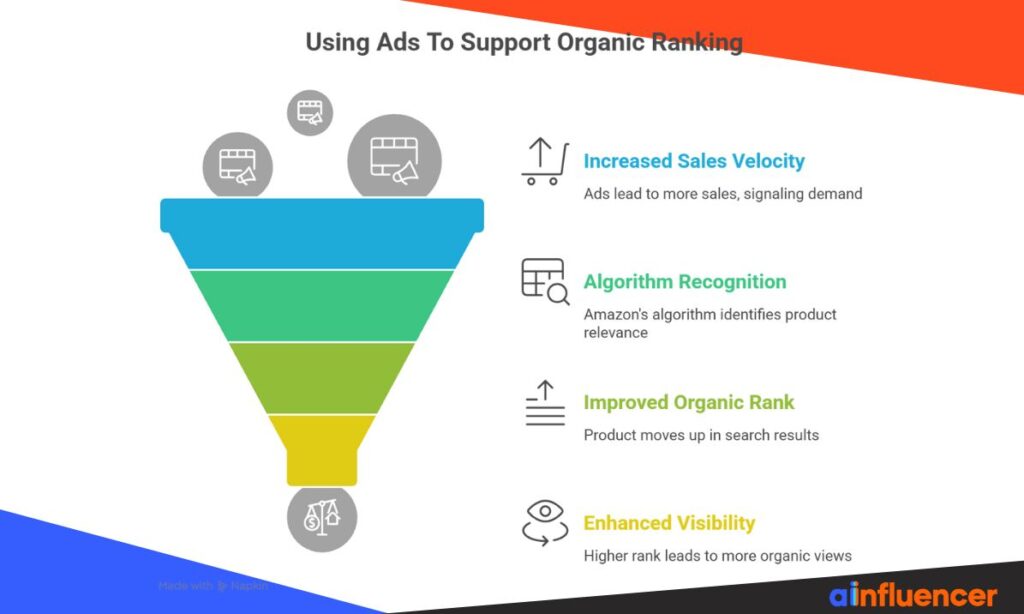
How Amazon PPC Affects Organic Rank
Amazon PPC impacts organic ranking primarily through sales velocity. When your ads drive traffic and conversions, they signal to Amazon’s A10 algorithm that your product is relevant and in demand.
In addition to Amazon PPC, external traffic driven by influencer promotions through platforms like Ainfluencer Amazon can boost sales velocity and conversions, both of which signal relevance to Amazon’s ranking algorithm.
The algorithm evaluates these signals alongside other ranking factors, improving your product’s position in search results over time. Moreover, higher sales velocity tells Amazon shoppers want your product, which boosts organic visibility.
When To Use Ads For Keyword Testing
Use ads to test keywords during product launches when organic visibility is naturally low. New listings struggle to rank because they lack reviews, sales history, and click-through data.
Through Sponsored Products campaigns, you can identify which search terms convert best, then incorporate those proven performers into your listing optimization. This approach yields valuable data much faster than waiting for organic results.
Balancing Ad Spend With Organic ROI
Track Total Advertising Cost of Sales (TACoS) to measure the true impact of your advertising. This metric shows advertising spend as a percentage of total revenue (PPC + organic sales).
A healthy TACoS demonstrates a balanced relationship between ad spend and organic growth, ideally decreasing over time as organic sales increase.
| Metric | What It Measures | Target Trend |
| ACoS | Ad spend ÷ Ad sales | Stable |
| TACoS | Ad spend ÷ Total sales | Decreasing |
| Organic Rank | Position in search results | Improving |
Tracking Ad-Driven Organic Rank Changes
Monitor keyword ranking positions before, during, and after running ads to identify correlations. Whenever you see a spike in ad-driven sales for a particular keyword, check if there’s a corresponding improvement in organic ranking for that term.
Tools like YouTube Engagement Checker provide detailed tracking of creator-driven traffic, helping you measure its impact on organic ranking precisely.
4. Monitoring Performance & Adapting Strategy
Continuous tracking of performance metrics enables you to effectively rank Amazon products organically by making data-driven adjustments. Regular monitoring reveals exactly what works and what needs refinement.
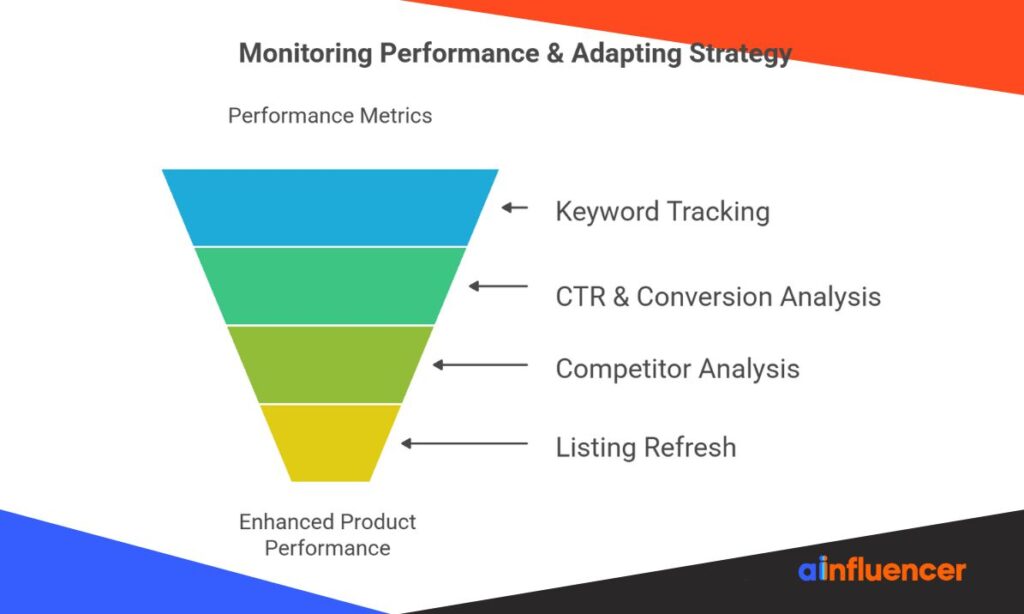
Setting Up Keyword Tracking Tools
While keyword tracking tools monitor organic positions, complementary platforms like Ainfluencer Amazon focus on affiliate and influencer-driven performance data.
Sellers who track rankings daily adjust their strategy 2.7× faster than weekly trackers, resulting in 18% higher average keyword positions.
Reviewing CTR, Conversion, & Rank Trends
Monitor your unit session percentage (conversion rate) through Seller Central’s Business Reports. A sudden drop signals potential issues with listing content, pricing, or images.
Amazon conversion rate benchmarks indicate poor performance at 1-8%, average at 8-12%, excellent at 13-15%, plus anything above 16% suggests insufficient advertising.
Learning From Competitor Keyword Rankings
Leverage tools like SmartScout or Helium 10 to perform detailed competitor keyword gap analyses, uncovering valuable terms competitors rank for but you don’t.
Sellers who optimize based on top competitors’ keywords reduce wasted ad spend by 19%.
Refreshing Listings Based On Customer Feedback
Utilize Amazon’s Voice of Customer dashboard with its Fix Recommendations tool to improve product listings.
This AI-powered tool analyzes customer feedback, offering strategic guidance on listing improvements along with data showing how changes could impact customer satisfaction and reduce returns.
Final Thoughts
To rank Amazon products organically, you need a system built on continuous optimization. Start with solid keyword research, expand into high-intent and long-tail terms, and focus on what actually converts.
Your listing quality drives visibility. Clear titles, optimized bullets, strong images, and A+ Content improve conversion rates, which matter more than keyword stuffing.
Smart PPC supports organic growth. Strategic ads increase sales velocity and strengthen ranking signals when TACoS stays under control.
Track performance consistently and adjust fast. Data-driven decisions help you outpace competitors and secure long-term visibility with less ad spend.
FAQs
How Long Does It Take To Rank Amazon Products Organically?
Organic ranking usually takes 2–8 weeks, depending on competition, sales velocity, and conversion rate.
Do Reviews Directly Affect Amazon Organic Ranking?
Reviews do not directly increase rankings, but they strongly impact conversion rate, which affects ranking.
Can You Rank Amazon Products Organically Without Running PPC Ads?
Organic ranking without PPC relies on external traffic, low-competition long-tail keywords, and strong conversion rates.
However, without ads, Amazon receives fewer sales signals, which slows ranking progress. PPC accelerates sales velocity and keyword data, making organic growth faster and more stable in competitive niches.