How to Become a Top Seller on Amazon
Two different things get called being a top seller on Amazon, and they are earned in completely different ways. One is the account standing that comes from fulfilling reliably and keeping your metrics clean. The other is the orange Best Seller badge on a product, which is pure sales volume in a category and can appear and disappear within a day. This guide covers both, starting with the five steps that build the business. If you want to learn how to become a top seller on Amazon, you need a strategy and a launch plan that drives sales now, not later.
This guide breaks down those proven steps in plain English, from finding profitable niches to fine-tuning your product page and building a brand that keeps momentum. Follow it, and you’ll know exactly what to do to stand out among millions of sellers.
Become the Best Amazon Seller on Amazon
Standing out as a top seller on Amazon requires more than just listing products; it demands a strategic approach.
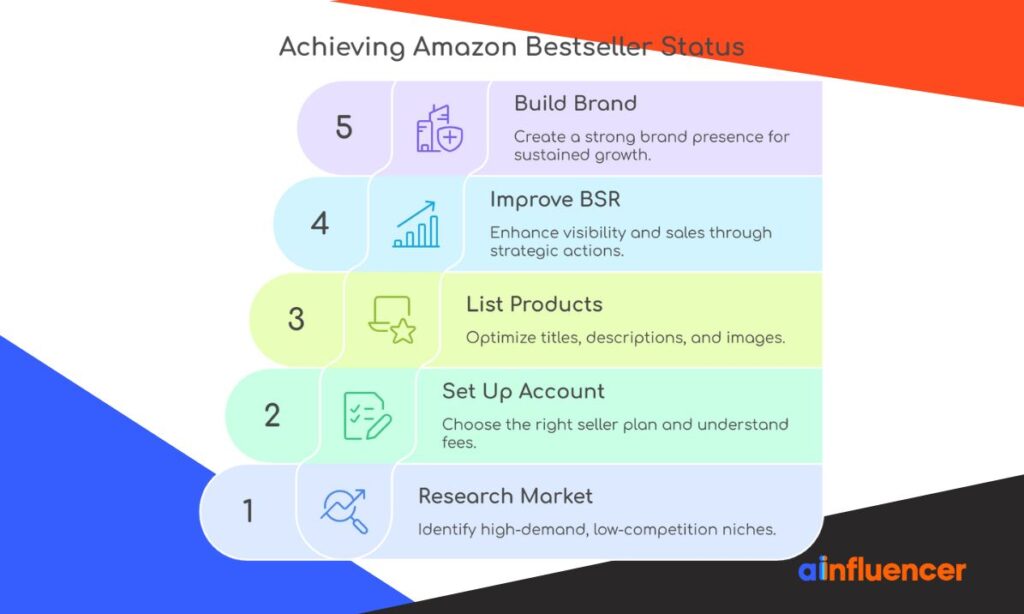
1. Research The Market & Choose The Right Product
Success on Amazon begins with finding the right product. The most profitable sellers follow a simple formula: spending one-third on sourcing, one-third on Amazon fees, and keeping one-third as profit.
Identify High-Demand, Low-Competition Niches
Finding profitable niches requires examining both demand and competition levels. For optimal results, look for products with at least 3,000 monthly searches but fewer than 1,000 competing listings.
Additionally, target products where top listings have fewer than 200 reviews to indicate lower market saturation.
Start your research by:
- Brainstorming product categories that interest you.
- Using Google Trends to check if interest is rising.
- Browsing Amazon Best Sellers for popular items.
- Reading negative reviews to spot market gaps.
There are many independent Amazon sellers that generated over $1M + annualy in sales. To join their ranks, examine promising niches like eco-friendly products, pet accessories, home office supplies, and fitness equipment, all categories with sustained demand and growth potential.
Use Amazon Best Sellers Rank (BSR) For Product Ideas
Amazon’s Best Sellers Rank (BSR) indicates how well a product sells compared to similar items. A lower BSR means higher sales. This metric is calculated using sales volume data, with recent sales counting more than older ones.
Products can have multiple BSR numbers if they fall under different categories. For instance, a stainless-steel tumbler might rank #1 in Tumblers & Water Glasses but #2 in Kitchen & Dining.
When analyzing BSR, look for:
- Products with consistent demand but manageable competition.
- Categories where top items have an average of 1,000 monthly sales.
- Items priced between $25-$50 for better profit margins.
Best practice: Visit Amazon’s Best Sellers lists frequently as they update hourly, providing real-time insights into what customers are buying.
Moreover, use tools like Amazon’s Product Opportunity Explorer to analyze trends in searches, purchases, and reviews.
Validate With Customer Reviews & Trends
Customer feedback offers invaluable insights for product selection. When analyzing reviews:
- Focus on reviews that mention both pros and cons.
- Look for common complaints that you could address.
- Identify features customers wish existed.
Amazon’s system for reviews is designed to ensure authenticity; only customers who have spent at least $50 on Amazon in the past 12 months can submit ratings.
Furthermore, reviews labeled “Verified Purchase” indicate the reviewer bought the item on Amazon and paid a price available to most shoppers.
Beyond Amazon, monitor social platforms, online communities, and current influencer marketing trends to identify emerging customer needs before they become saturated.
The key to becoming an Amazon best seller lies in finding products that solve problems. As one successful seller noted, “If you’re chasing a fad, you might have a couple of great years, but over time your sales will slide with the fad”.
Instead, focus on addressing everyday problems for everyday consumers to build a brand with staying power.
2. Set Up Your Amazon Seller Account
After finding the right products to sell, creating your Amazon seller account is the next crucial step on your journey to becoming a top Amazon seller. Setting up the right account type from the start ensures you have access to the necessary tools for growth.
Choose Between Individual & Professional Plans
Amazon offers two primary seller account types with different fee structures and features. The Individual plan charges $0.99 per item sold with no monthly fee, while the Professional plan costs $39.99 monthly regardless of sales volume.
Initially, determine your expected sales volume. If you plan to sell fewer than 40 items monthly, the Individual plan makes financial sense. Once you exceed 40 items per month, the Professional plan becomes more cost-effective.
Beyond cost considerations, these plans differ significantly in available features:
| Feature | Professional | Individual |
| Monthly subscription | $39.99 | None |
| Per-item fee | None | $0.99 per sale |
| Bulk listing capability | Yes | No |
| Inventory management tools | Yes | No |
| Eligibility for Buy Box | Yes | No |
| Create new product pages | Yes | Yes |
| Amazon advertising access | Yes | No |
Notably, only Professional sellers can compete for the Buy Box position, which is essential since most Amazon purchases happen through this feature. Additionally, Professional sellers can sell in restricted categories that Individual sellers cannot access.
Understand Referral & FBA Fees
Even after choosing your plan, Amazon collects additional fees on each sale. Referral fees are Amazon’s commission on every sale you make, ranging from 8% to 15% of the total sales price, depending on the product category.
For example, if you sell a toy priced at $25 with $4.50 shipping and $3.50 gift wrapping, your total referral fee would be $4.95 (15% of $33 total). For certain products like books, DVDs, and music, a fixed closing fee of $1.80 applies per item.
Many top sellers use Fulfillment by Amazon (FBA) to handle shipping and customer service.
FBA has its own fee structure based on product size and weight, plus storage fees for inventory kept in Amazon warehouses. Using FBA can reduce shipping costs by up to 70% compared to premium options from other carriers.
During refunds, Amazon returns most of the referral fee you paid, minus a refund administration fee (the lesser of $5.00 or 20% of the referral fee).
Register For Amazon Brand Registry
For long-term success as an Amazon seller, consider registering your brand. Amazon Brand Registry is a free program that helps protect your intellectual property and unlocks powerful selling tools.
To qualify for Brand Registry, you need:
- A registered trademark or pending trademark application for your brand name/logo.
- Your brand name is permanently affixed to products or packaging.
- Images showing your branded products.
The benefits are substantial, including:
- Protection against counterfeit products.
- Access to A+ Content, which can increase sales by up to 8% (or 20% with Premium A+ Content).
- Brand Analytics tools for customer insights.
- Store creation (customers who visit Stores purchase 53.9% more frequently with 71.3% higher average order value).
If you don’t yet have a trademark, Amazon’s IP Accelerator can connect you with legal services at competitive rates while providing early access to Brand Registry benefits.
Properly setting up your Amazon seller account provides the foundation needed to become a top seller on Amazon. Select the right plan based on your sales goals, understand all applicable fees, and consider brand registry to unlock additional growth opportunities.
3. List & Optimize Your Products
Your product listing quality directly impacts your path to becoming a top seller on Amazon. Optimizing every element of your listing ensures better visibility, higher click-through rates, and increased sales conversion.
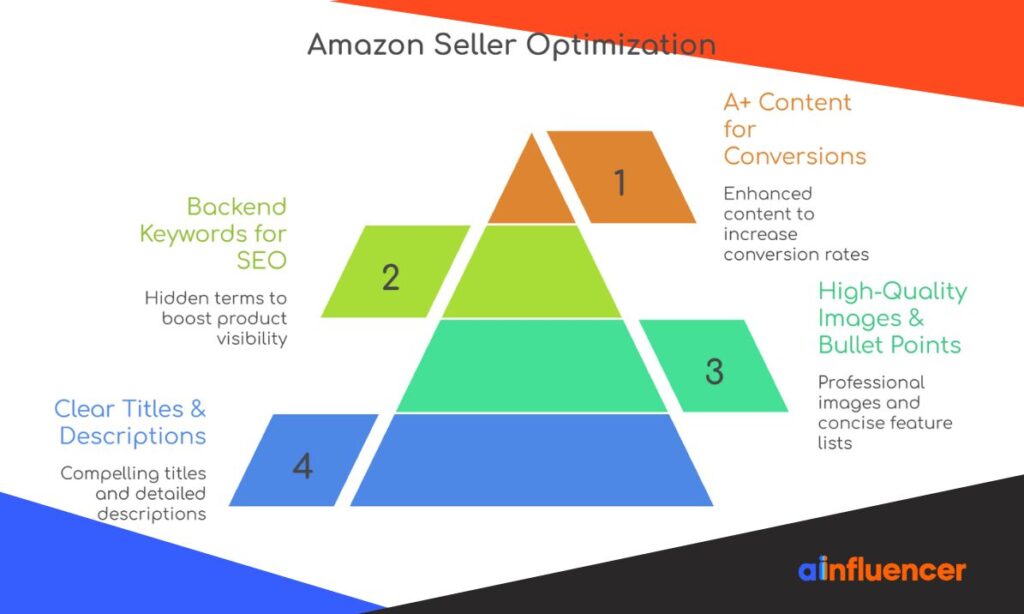
Write Clear Titles & Descriptions
Creating compelling product titles requires following Amazon’s specific guidelines.
Your title should include your brand name, product type, and key features without exceeding 200 characters. Start with your brand name (if recognizable), followed by the most relevant keywords customers use for searching.
Product descriptions provide space to expand on features and benefits. This area gives you 2,000 characters to weave in brand story, use cases, and benefits in a more narrative format. According to Amazon, well-crafted descriptions can reduce return rates by setting proper expectations.
Add High-Quality Images & Bullet Points
Images act as your “silent sales team” on Amazon. Your main product image must have a pure white background (RGB 255,255,255) with the product filling at least 85% of the frame. Upload at least seven images, as Amazon recommends six additional images beyond the main photo.
High-quality images offer these benefits:
- Help customers assess products accurately.
- Improve product discoverability in search.
- Increase customer confidence in purchasing.
- Reduce product returns.
Bullet points sit directly under the title, giving shoppers a quick overview of key features. Keep bullets concise (under 200 characters) while naturally incorporating high-impact keywords.
Use Backend Keywords For SEO
Backend keywords are hidden search terms that boost your product visibility without cluttering your visible listing. Amazon allows up to 250 bytes (roughly 250 characters) for backend keywords.
These invisible keywords help when customers don’t use the exact words from your product title. Use this space for specific, intent-driven terms that don’t fit naturally in your front-facing content. Avoid repetition, since Amazon already indexes words in your title and bullets.
Enable A+ Content For Better Conversions
A+ Content transforms your standard product description into a visual showcase with enhanced images, videos, and comparison charts. This premium feature is free for brand-registered sellers and can increase conversion rates by up to 10%.
A+ Content appears in the product description section and allows you to highlight aspects of your brand story or dive deep into product features. This enhanced content helps answer common customer questions and drive faster purchase decisions.
To become an Amazon best seller, your product listing must stand out. Optimized titles, professional images, strategic keywords, and enhanced content work together to improve visibility and conversion rates, which are essential factors in climbing Amazon’s bestseller ranks.
4. Improve Your Amazon Best Sellers Rank
The Amazon Best Sellers Rank (BSR) is your product’s performance indicator that directly affects visibility and sales. Improving this crucial metric requires strategic actions across multiple areas of your Amazon business.
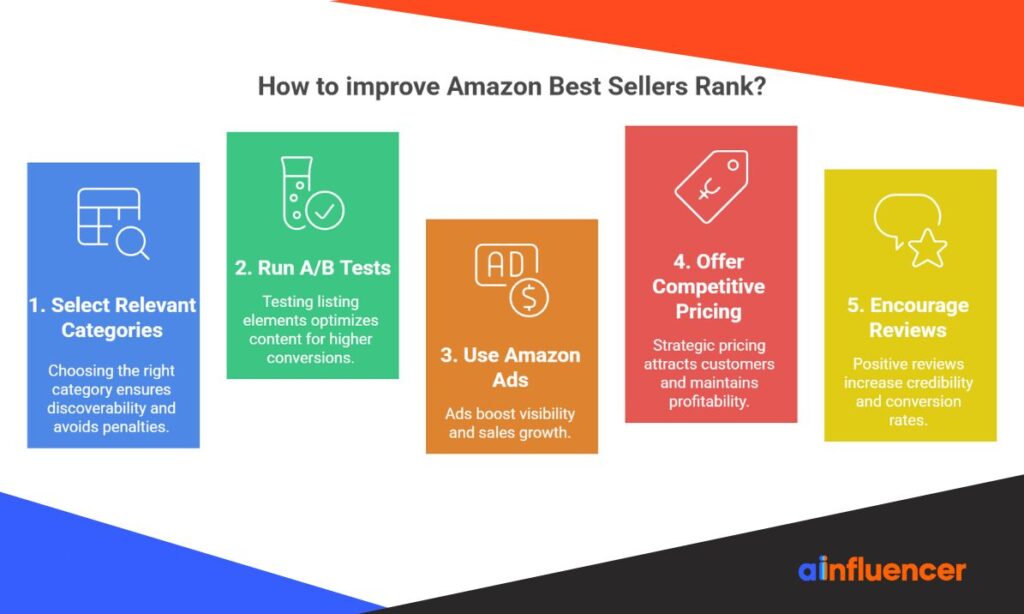
Select The Most Relevant Product Categories
Choosing the right product category dramatically impacts your BSR performance. Amazon restricts shopping results to specific item type keywords when customers search, making accurate categorization essential for discoverability.
Above all, products classified at the most granular level (like “brownie mixes” rather than “cooking-and-baking-supplies”) appear more frequently in relevant search results.
When selecting categories:
- Check if your product requires approval before purchasing inventory
- Choose categories where your product can rank competitively
- Avoid incorrect categorization, which may result in Amazon penalties
Run A/B Tests On Listings
Testing different versions of your listing helps identify what drives more conversions. Amazon’s free Manage Your Experiments tool allows Professional sellers enrolled in Brand Registry to run split tests on content elements. These tests can increase sales by up to 20% through optimized content.
First, test your main product image as it’s the biggest factor affecting click-through rates from search results. Thereafter, experiment with titles, pricing, bullet points, and descriptions; even a slight conversion rate improvement can significantly boost sales.
Use Amazon Ads To Boost Visibility
Sponsored Products ads are cost-per-click (CPC) advertisements that promote individual listings and help new products gain traction. These ads appear in prominent locations, including the top of search results and competitor product pages.
In fact, sellers using Sponsored Products saw 34% more sales growth compared to those who didn’t, four weeks after adoption.
In parallel with Sponsored Products ads, many sellers also collaborate with influencers to drive external traffic and accelerate early sales velocity.
Offer Competitive Pricing
Price your products strategically to maintain a strong BSR. Generally, your price should be at or below competitor prices while still ensuring profitability. To find your pricing sweet spot:
- Monitor competitive external prices from other major retailers.
- Track the lowest price on the Amazon store.
- Consider your profit margin before making adjustments.
- Try A/B testing different price points to determine optimal performance.
Encourage Customer Reviews
Reviews directly influence your BSR by increasing credibility and conversion rates. Immediately after purchase, use Amazon’s Request-a-Review tool to send an official, compliant email asking for feedback. This automated message can be triggered between 5-30 days after delivery.
Remember that Amazon prohibits offering incentives for reviews or manipulating feedback. Focus instead on providing excellent customer service and product quality to naturally generate positive reviews that boost your BSR.
5. Build A Brand & Scale Your Sales
Building a strong brand beyond Amazon’s platform is essential for sustained growth.
Successful Amazon sellers don’t rely on ads alone; a clear influencer marketing strategy helps build long-term brand awareness and repeat demand outside Amazon.

Create A Social Media Presence
Social media platforms help Amazon sellers reach over 5 billion active users worldwide. Establishing a robust social presence introduces your products to potential customers who might never discover them on Amazon alone.
To effectively leverage social media:
- Select platforms matching your target audience demographics.
- Create engaging visual content showcasing your products.
- Use hashtags strategically to increase visibility.
- Respond promptly to comments and messages.
Platforms like Instagram remain central to Instagram influencer marketing, especially for visual product categories such as home goods, fitness, and lifestyle accessories.
Use Email Marketing To Build A List
Email marketing generates an impressive ROI of $36 for every dollar spent. Many brands combine it with automated cold email marketing to scale outreach and reach new audiences faster.
Unlike social media’s increasing noise, email offers a more personal connection with your audience.
The six pillars of effective email marketing include:
- Using tested templates rather than creating from scratch.
- Writing clear, concise copy that respects subscribers’ inboxes.
- Developing nurturing emails for new customers.
- Implementing proper email segmentation.
- Testing regularly to optimize performance.
Leverage Author Central Or Storefront
Amazon Author Central creates a customizable profile where customers can discover all your products in one place. Your Author Page receives over 2 million hits yearly, making it valuable real estate for building your brand.
Alternatively, Amazon storefronts help differentiate your brand. Shoppers who visit a Store purchase 53.9% more frequently and have 71.3% higher average order value compared to those who don’t.
Track Performance With Brand Analytics
Brand Analytics provides valuable insights through multiple dashboards available to Brand Registry members. These tools help you understand customer behavior through:
- Search analytics showing query performance and catalog visibility.
- Customer behavior data, including repeat purchases and demographics.
- Market basket analysis reveals which products customers buy together.
These insights empower you to make strategic decisions about product development, marketing campaigns, and customer targeting.
Sellers who want to experiment before committing budget can start with Free influencer marketing tools to research creators, evaluate engagement quality, and estimate collaboration costs without upfront investment.
How Products Actually Become Best Sellers
This is the part most guides skip, and it is the question people ask most often. The orange #1 Best Seller flag on a listing is not the same thing as your Best Sellers Rank, and it is not the same thing as Amazon’s Choice. Three different mechanisms, three different ways to earn them.
| Best Seller badge | Best Sellers Rank | Amazon’s Choice | |
|---|---|---|---|
| What it is | An orange flag on the listing | A rank number on the product page | A grey badge shown on a search result |
| Tied to | A category or subcategory | A category | A specific search keyword |
| Earned by | Being number one on sales volume | Relative sales volume, as a ranking | An algorithm weighing price, rating, Prime availability and conversion on that query |
| Updates | Hourly | Hourly | Continuously, and unpredictably |
What this means in practice
The badge goes to one product per category. The Best Sellers list shows the top hundred in a category; the badge belongs to whatever sits at number one right now. That is why it appears and vanishes: it is a live position, not an award you keep.
Subcategory choice decides whether it is reachable. Being number one in Home & Kitchen is a different proposition from being number one in a narrow subcategory, and the badge is awarded at both levels. Sellers who earn it early almost always do so in a specific subcategory where the volume required is achievable, not in the broad parent. Check what the current number one in your target subcategory actually sells before deciding the badge is a goal rather than a byproduct.
It is sales velocity, not reviews or copy. Everything in the five steps above helps you sell more, and selling more is the only path to the badge. There is no separate lever, no application, and nothing to opt into. Any service offering to get you the badge directly is selling you sales volume, usually in a way that violates Amazon’s terms.
Amazon’s Choice is the one worth chasing first. It is awarded per keyword rather than per category, so it is reachable without being the biggest seller in your niche. If the aim is visibility rather than bragging rights, a well-priced listing with strong conversion on a specific search term is a far shorter road than outselling every competitor in a category.
Final Thoughts
Mastering how to become a top seller on Amazon comes down to getting the fundamentals right: choosing a high-demand product, using the right seller account, and building conversion-focused listings.
Strong titles, high-quality images, and targeted keywords directly improve visibility, sales velocity, and your Best Sellers Rank.
Long-term success requires consistent optimization. Smart pricing, the right category placement, and positive customer reviews strengthen credibility, while marketing outside Amazon, like social media or email, helps you build a stable brand that keeps driving sales even as competition changes.
FAQs
How do products become best sellers on Amazon?
The orange Best Seller badge goes to whichever product is number one by sales volume in a given category or subcategory, and it updates hourly, so listings gain and lose it as sales move. It is not an application or an award you keep, and it is separate from both Best Sellers Rank, which is the rank number itself, and Amazon’s Choice, which is tied to a search keyword rather than a category. The only route to it is selling more than everyone else in that category.
Can anyone become an Amazon seller if they’re not a business?
Yes, anyone with a valid ID, email, phone, and bank account can start selling on Amazon as an individual. You don’t need a registered business to begin, but forming a business is recommended for scaling and accessing advanced features like Brand Registry.
Do I need to prepare my products before sending them to FBA warehouses?
Yes, you must create product listings before shipping to FBA so Amazon can generate barcodes and labels. Proper packaging and labeling help ensure your inventory is accepted and ready for sale quickly.
How long does it take to receive payment after a sale on Amazon?
Amazon usually pays sellers every 14 days after the first sale, holding funds during this period for returns and refunds. Payments are deposited directly into your bank account, and you can adjust payout settings in Seller Central.