
In recent years, influencer campaigns have stopped being just “vibes” and started being a real growth channel. This is only possible if you can prove what’s working and what’s not. Knowing how to track influencer marketing is what turns simple shoutouts into a repeatable revenue engine you can scale.
Imagine you are preparing email templates for influencer collaboration. But who is the best option for your brand? Which one will help you build trust with your audience? And the most important question is, which one will raise your overall revenue?
These are the questions we will answer in this article, so stick around to raise your influencer marketing level.
Importance of Defining Your Goals
Before learning how to track influencer marketing, you should know what “winning” looks like. Every method you use to track influencer marketing results should map back to a single primary goal.
Always remember: “What you don’t define, you can’t measure.” The first question in every influencer campaign should be, “What are we trying to achieve?” What are the best influencer marketing KPIs, and how do you interpret the findings?
It is considerably simpler to link campaign performance to actual results when you know your goals. Additionally, it helps your team and the influencers you collaborate with understand what success means.
4 Main Goals of Influencer Marketing
Now that you know the importance of having a clear goal in learning how to track influencer marketing, let’s go through some of the main ones to help you out with your influencer marketing strategy:
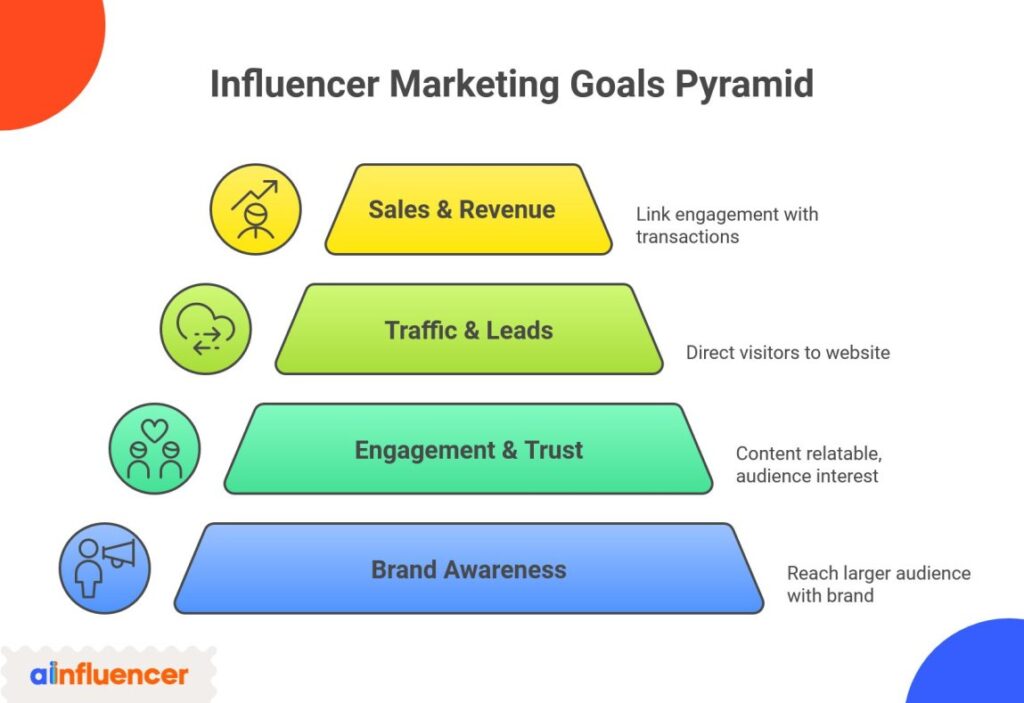
1. Brand Awareness
Getting your name out there is the aim of this goal. You want to reach a larger audience with your goods or brand. Impressions, reach, video views, and social media mentions are important metrics in this context.
2. Engagement & Trust
The next step in learning how to track influencer marketing is engagement. It means that your content is relatable. Likes, comments, saves, shares, and follower growth are examples of metrics that reflect how well the message is being received. Stronger audience interest and increased trust are evident in higher engagement, so don’t underestimate its importance.
3. Traffic & Lead Generation
Trackable links, UTMs, and click-through rates are crucial if your objective is to direct visitors to your website or landing page and learn how to track influencer marketing. Additionally, you can monitor downloads, sign-ups, and other lead-related activities that occur after a user’s click.
4. Sales & Revenue
This is frequently the easiest goal to track and achieve. The secret is to link influencer engagement with actual transactions, whether you’re tracking purchases, subscriptions, or other conversions.
To track influencer marketing campaigns properly, pick one main goal per campaign, learn how to DM influencers, and start the process strong.
How to Track Influencer Marketing: Metrics That Actually Matter
Always remember that not all numbers deserve your complete attention. To track influencer marketing success, you must distinguish between those metrics that matter and those that can be false at times. Here are some that matter in learning how to track influencer marketing:
Use with caution:
- Follower count.
- Raw likes or views.
- Total impressions without context.
Action-driving metrics:
- Engagement rate (likes + comments +…)
- CTR from influencer content.
- Conversion rate from influencer traffic.
- Revenue, ROAS, CPA, and customer lifetime value.
- Audience quality.
To achieve your goal, which is learning how to track influencer marketing, you must first learn to measure ROI in the right way and distinguish between the important numbers and those that don’t say that much, just like what has come here.
What Are The Core Metrics You Must Track For Influencer Marketing?
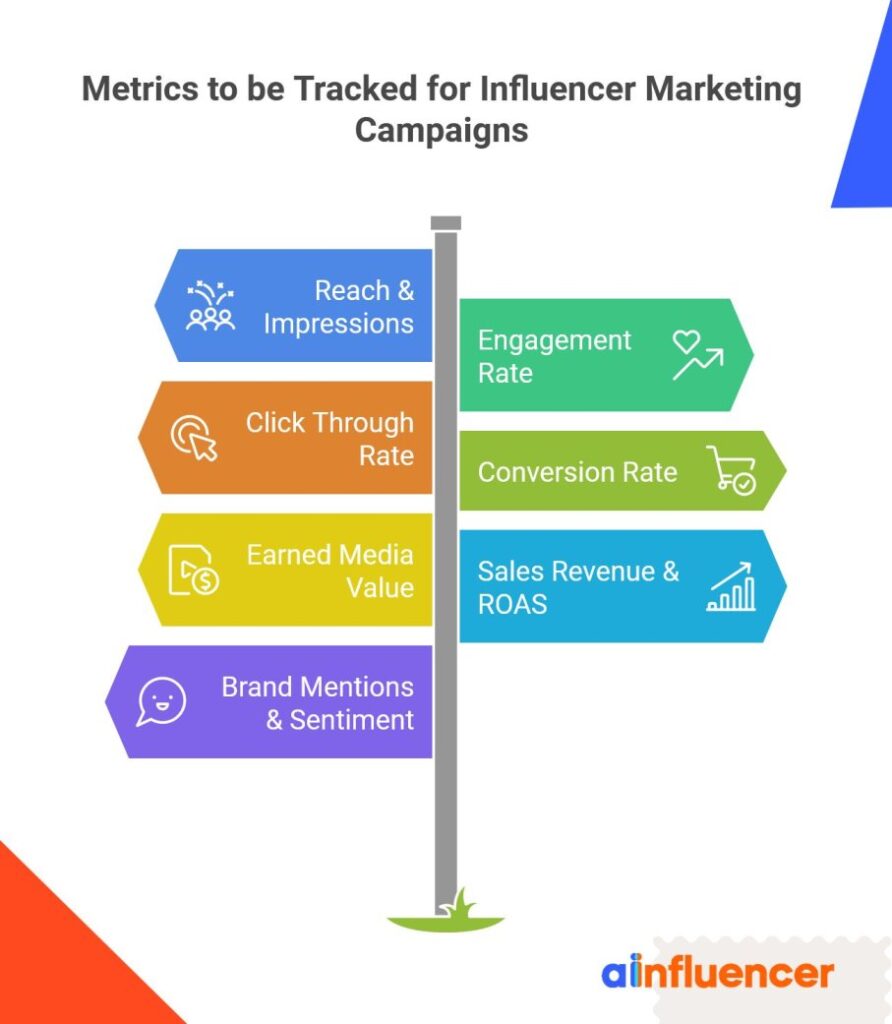
To track influencer marketing campaigns or, more generally, learn how to track influencer marketing, build your reporting around these main metrics:
1. Reach & Impressions
Reach shows the number of distinct users who viewed your content. Even if the same person viewed it more than once, impressions show how frequently it was shown. These numbers help you in estimating the size of your audience and are crucial for brand recognition.
You can use native analytics like Instagram Insights, TikTok Analytics, YouTube Studio, and Meta Business Suite, or reliable tools like Ainfluencer to see reach and impressions per post and per creator.
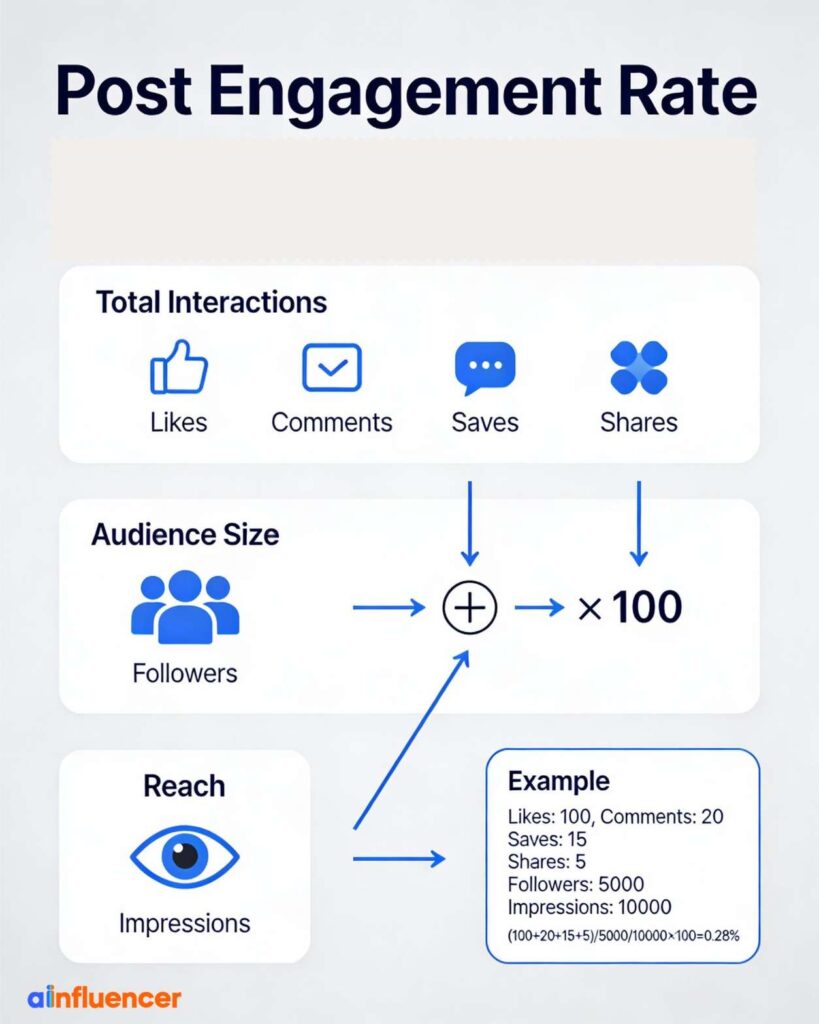
2. Engagement Rate
Engagement rate is an important step in learning how to track influencer marketing. It tells you if people actually care or are just scrolling politely.
Common formulas:
- Post engagement rate: (Likes + Comments + Saves + Shares) / Followers / Impressions * 100.
Compared to just looking at likes or comments, this gives a more comprehensive picture. It shows how much your audience is genuinely engaged by the topic.
3. Click Through Rate (CTR)
Another important step in learning how to track influencer marketing is CTR. The number of people who clicked on a link after seeing the content is measured by CTR. It’s a great approach to monitor interest and intent, especially for efforts that aim to increase visitors to your product or landing pages.
4. Conversion Rate
This indicates the number of users who completed a desired activity, like subscribing to a newsletter, adding a product to their cart, or making a purchase. If you look at influencer marketing rates 2026, it is among the most straightforward measures of the effectiveness of a campaign.
5. Earned Media Value (EMV)
EMV calculates the cost of the influencer-generated content if you had paid in traditional media ways. It’s a helpful comparative metric, but to get the whole picture, use it in comparison with other metrics. Remember that different industries and platforms may have different EMV values.
6. Sales Revenue & Return on Ad Spend (ROAS)
Track the entire amount of money made by influencer-driven traffic. You can see how much you made for every dollar you spent by using ROAS. A ROAS of 5.5, for instance, indicates that you made $5.50 for every $1 invested in the campaign.
7. Brand Mentions, Sentiment, and Share of Voice
If you want to know how to track influencer marketing in the right way, you must have different metrics for different parts of the marketing funnel. For the top of the marketing funnel, you must track influencer marketing success beyond just last‑click sales.
Use social listening tools for:
- Volume of mentions during and after campaigns.
- Sentiment (positive, neutral, negative).
- Share of voice, which compares how often your brand is mentioned in comparison to competitors during the campaign period.
A campaign that lifts positive mentions, increases branded search, and boosts share of voice has real value, even if conversions are a little lower than expected.
Comparing Influencers: A Simple Scorecard
To decide who to keep or cut, track influencer marketing success at the creator level, not just the campaign level. You may wonder about micro-Influencers vs. macro-Influencers and their benefits for your brand or other situations. Here is a simple way to structure your comparison:
| Dimension | What to Track | Why It Matters |
| Audience fit | Location, age, interests, brand affinity | Ensures influence over your buyers, not random followers. |
| Engagement quality | Authentic comments, saves, shares | Signals trust and purchase‑driving influence. |
| Traffic quality | Time on site, pages/session, bounce | Shows if they are serious, not curiosity clicks. |
| Conversion & ROAS | Sales, revenue, ROAS, CPA | Direct business impact per creator. |
| Content value | UGC reuse potential, EMV | How much is the content worth beyond one post? |
| Brand impact | Sentiment, mentions, SOV | Long‑term brand equity, not just short‑term sales. |
Rate influencer on each dimension based on your current priority. Then use your best influencer outreach templates to start your collaboration.
Common Influencer Tracking Mistakes to Avoid
Even advanced teams still fall into these traps when they think they know how to track influencer marketing campaigns.
- Treating all influencers as one mass line in analytics.
- Relying purely on last‑click attribution.
- Chasing follower counts without checking audience quality or geography.
- Ignoring dark social: codes, “heard from a friend,” and branded search spikes
- Forgetting to tag every link and clearly brief influencers on how to use them.
Fixing these issues alone can significantly improve your data and ROI picture. So, be careful about them.
Conclusion
Remember that strong influencer marketing is never an accident; it is the result of clear goals, disciplined tracking, and relentless optimization. When you know how to track influencer marketing with the right mix of UTMs, discount codes, platform analytics, and conversion data, every collaboration can be a great opportunity for your brand.
FAQs
1. How to Track Influencer Marketing Without Paid Tools?
Yes, you can track influencer marketing without paid tools by using tools like Ainfluencer. It is a completely free tool that helps you measure engagement, reach, and ROI with detailed performance insights for every campaign.
2. What Metrics Are Most Important When Learning How to Track Influencer Marketing?
The most important metrics depend on your campaign goal, but commonly tracked metrics include:
– Engagement rate.
– Click-through rate (CTR).
– Conversions and sales.
– Cost per acquisition (CPA).
– Return on investment (ROI).
– Audience growth and brand mentions.
3. How Do UTM Links Help Track Influencer Marketing?
UTM links help you to track where traffic comes from by tagging influencer URLs with campaign parameters. When users click these links, analytics tools can show which influencer, platform, or post brought the traffic and conversions.
4. How Often Should Influencer Marketing be Tracked?
It must be tracked throughout the campaign. Performance also should be monitored weekly or in real time, with a full evaluation conducted at the end of the campaign to measure results and ROI.