
Think about the process of converting each like, mention, or branded post into an expected bit of revenue rather than a hopeful guess. Brand managers make a difference by mastering how to track influencer marketing KPIs.
Many times, campaigns produce excellent work but weak evidence: broken tracking, overlooked conversions, and spreadsheets that cannot be translated into budget increases.
Read on to learn the step-by-step methods and the reporting templates so you can prove influence as a business driver, optimize each creator’s impact, and win the next budget conversation with data, not hope.
TL;DR
- Reach & Impressions — visibility and potential audience.
- Engagement Rate — how strongly the audience interacts (1–5% is solid).
- Click-Through Rate (CTR) — how often viewers click your link.
- Conversions — completed actions tied directly to results.
- Audience Growth — new followers gained from the campaign.
- Brand Sentiment — overall audience perception.
- EMV (Earned Media Value) — the measurable value of organic exposure.
- ROI — campaign profitability (avg reference: $5.78 return per $1 spent).
8 Key Influencer Marketing KPIs
Once you’ve set clear campaign goals, tracking the right influencer marketing KPIs becomes your roadmap to success. Here are Influencer marketing metrics that will help you quantify campaign performance and optimize your influencer marketing strategy. Let’s explore eight essentials.
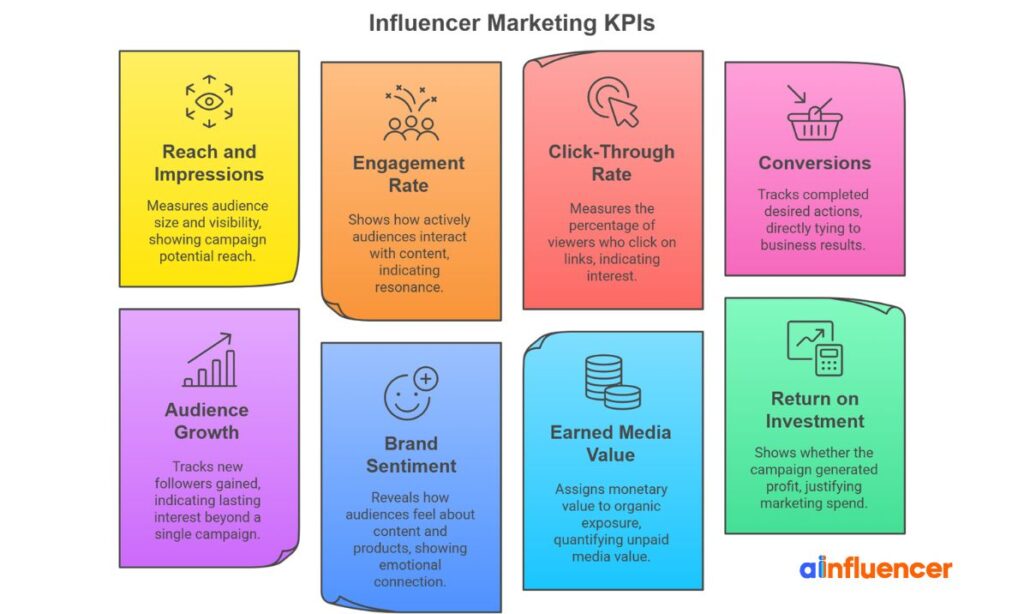
1. Reach & Impressions
Reach measures the number of unique users who see influencer content, while impressions count the total views regardless of who’s looking. These metrics serve as foundation stones for brand awareness campaigns.
The right influencer partner can connect you with potential customers who might otherwise be difficult to reach through traditional advertising. Moreover, many influencers provide media kits with average reach numbers to set expectations upfront.
2. Engagement Rate
Engagement rate has become the gold standard for influencer marketing analytics, showing how actively audiences interact with content through likes, comments, shares, and saves. To calculate engagement rate, divide total interactions by follower count and multiply by 100.
According to Hootsuite’s benchmarks, good engagement rates typically fall between 1-5%, though this varies by platform, industry, and follower count. Generally, Instagram averages 3.5% engagement across industries, while TikTok averages around 1.5%.
3. Click-Through Rate (CTR)
CTR measures the percentage of viewers who click on links in influencer content, indicating how effectively the call-to-action drives traffic.
This metric is especially valuable for determining content quality and influencer fit. Calculate it by dividing clicks by impressions and multiplying by 100. For example, if an ad receives 3 clicks from 100 impressions, the CTR is 3%.
4. Conversions
Influencer campaigns can directly drive conversions and sales with the right approach. In fact, 86% of consumers make purchases inspired by influencers at least once a year. Conversions might include purchases, sign-ups, downloads, or other predetermined goals.
Tracking can be accomplished through UTM parameters, promo codes, or affiliate links to attribute results to specific influencers.
5. Audience Growth
Audience growth tracks new followers or subscribers gained during and after influencer campaigns. This metric indicates lasting interest beyond a single campaign and shows how your audience expands over time.
To calculate growth rate, subtract pre-campaign follower count from post-campaign count, divide by pre-campaign count, and multiply by 100.
6. Brand Sentiment
Brand sentiment reveals how audiences actually feel about your content and products, going beyond quantitative metrics. This qualitative KPI categorizes audience reactions as positive, neutral, or negative using text analysis and natural language processing.
Hence, it provides crucial insights into how influencer partnerships affect brand perception. Positive sentiment isn’t just a bonus; it’s a strategic KPI reflecting real brand trust and connection.
7. Earned Media Value (EMV)
EMV assigns monetary value to organic exposure generated by influencer campaigns. It measures what you would have paid for equivalent advertising space or time.
A common formula for calculating EMV is: Total impressions × CPM × Adjustment Factor. This KPI helps quantify the value of all organic exposure your influencer campaigns generate.
8. Return on Investment (ROI)
ROI remains the ultimate influencer marketing KPI, showing whether your campaign actually generated profit. The basic formula is: (Revenue generated – Campaign cost) / Campaign cost × 100 = ROI, so Measuring ROI & KPIs can help you more.
For example, if you spent $10,000 on influencer marketing and generated $20,000 in profit, your ROI would be 200%. Obviously, brands measuring influencer marketing ROI effectively see average returns of $5.78 for every dollar invested.
Set Clear Campaign Goals Before Choosing KPIs
Setting the right goals before selecting influencer marketing KPIs is essential for campaign success. According to recent surveys, marketers who set clear goals are 4× more likely to succeed with their influencer marketing initiatives.
Furthermore, 62% of social media marketers prioritize engagement generation, 60% focus on reaching new audiences, and 42% aim to drive revenues through influencer campaigns. Let’s explore how to establish meaningful goals for your next campaign.
#1 Define Your Campaign Objective
Before diving into influencer marketing metrics, identify what your business needs most right now. Your primary objective determines which KPIs for influencer marketing will be most relevant:
- Brand Awareness: If you’re entering a new market or launching products, focus on maximum exposure to relevant audiences. This objective typically prioritizes reach, impressions, and social mentions.
- Engagement: Building community requires measuring interactions like comments, shares, and clicks. Additionally, 53% of marketers aim to strengthen their social community through influencer partnerships.
- Sales and Conversions: For revenue-focused campaigns, track discount code redemptions, affiliate link purchases, or checkout sessions. This turns creators into a performance channel with clear ROI measurement.
| Campaign Objective | Primary Influencer Marketing KPIs | Best Creator Type |
| Brand Awareness | Reach, Impressions, Mentions | Macro-influencers with a broad audience |
| Engagement | Comments, Shares, Saves | Micro-influencers with high engagement |
| Sales | Conversions, ROI, Revenue | Niche experts with a high trust factor |
| Content Creation | Content pieces, Usage rates | Creative specialists in your industry |
#2 Understand Your Audience & Platform Fit
Knowing where your audience spends time helps determine which platforms will deliver the best results for your influencer marketing analytics. Subsequently, different platforms require different approaches since engagement rates and conversion expectations vary between Instagram, YouTube, and TikTok.
Consider these factors:
- Review platform demographics and usage patterns.
- Analyze where your target audience is most active.
- Examine which platforms show success through organic or paid activity.
- Study engagement patterns specific to each platform.
Consequently, this understanding helps you select influencers whose audience demographics align with your target customers. Before partnering, review their historical performance metrics, including engagement rates, follower growth, and audience demographics.
#3 Align Influencer Goals with Brand KPIs
For maximum impact, your influencer marketing KPIs must connect directly to broader business objectives. Otherwise, you risk tracking vanity metrics that look impressive but deliver little business value.
First, extract which corporate objectives influencer marketing can meaningfully affect, usually a mix of growth, brand equity, and efficiency. Then, create a “ladder” between influencer metrics and business results.
For instance:
- If your business KPI is incremental sales, track qualified traffic through audience-category fit.
- If preventing brand-safety incidents is important, include alignment screens and moderation SLAs among your influencer marketing KPIs.
- For brand awareness goals, measure reach and impressions to show how partnerships extend visibility.
Specifically, establish a pre-built connection between how to track influencer marketing results and what the business must achieve. This approach transforms influencer campaigns from creative experiments into boardroom-ready performance channels.
How to Track Influencer Marketing KPIs Effectively
Tracking your influencer marketing KPIs effectively requires the right tools and systems. Without proper tracking, you’ll never know if your campaigns are actually generating returns on your investment.
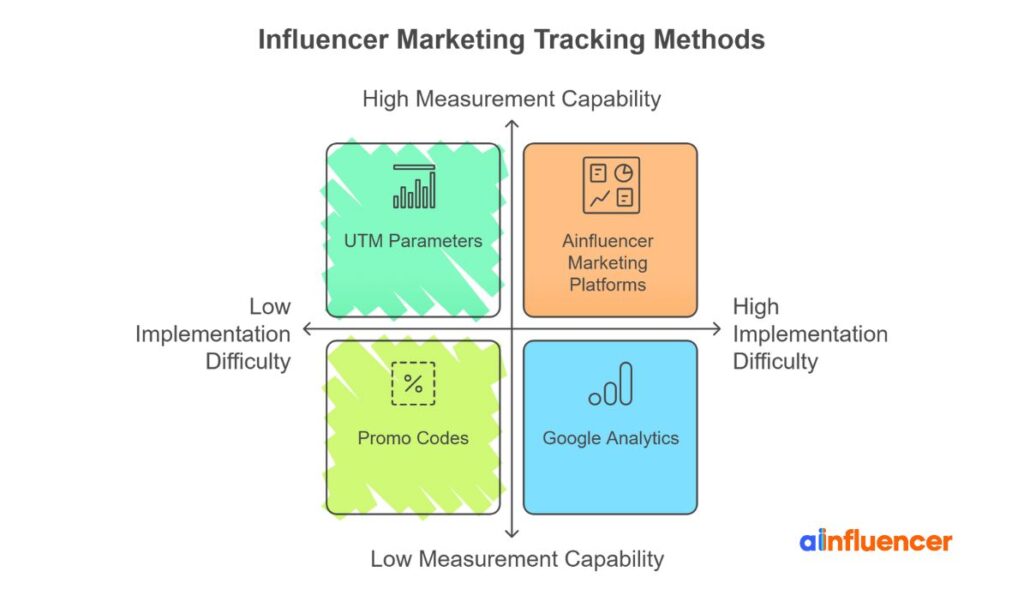
1. Use UTM Parameters & Custom URLs
UTM parameters work like digital breadcrumbs, showing exactly where your website traffic comes from. Adding these tracking codes to influencer links lets you monitor both campaign and individual influencer performance. A properly structured UTM should include:
- Source: Identify the platform (Instagram, YouTube).
- Medium: Typically, “influencer” is used to separate from other channels.
- Campaign: Include influencer name and timeframe.
- Content: Specify content type (story, feed post).
This structure allows you to track everything from traffic volume to conversion rates in your analytics dashboard.
2. Leverage Promo Codes & Affiliate Links
Unique discount codes provide a foolproof way to track conversions when clickable links aren’t an option. This approach works excellently for platforms like podcasts or TikTok, where direct link tracking is challenging.
Affiliate links complement promo codes by tracking clicks and attributing sales to specific creators. The combination gives you comprehensive performance insights across multiple channels. Many brands centralize these data points to compare creator performance and optimize campaign strategy.
3. Track with Google Analytics & Social Dashboards
Google Analytics remains a powerhouse for tracking influencer marketing KPIs.
It allows you to:
- Monitor traffic from influencer links.
- Set up conversion goals.
- Track audience behavior after clicking.
- Measure session quality.
Pair this with platform-specific analytics to track engagement metrics like likes, comments, and shares directly from source platforms.
| Tracking Method | Best For Measuring | Implementation Difficulty |
| UTM Parameters | Website traffic, conversions | Low |
| Promo Codes | Direct sales, offline conversions | Low |
| Affiliate Links | Revenue attribution, commission tracking | Medium |
| Google Analytics | User behavior, full-funnel view | Medium |
4. Use Influencer Marketing Platforms Like Ainfluencer
Use influencer marketing platforms like Ainfluencer. These platforms streamline tracking by consolidating metrics in one place.
Ainfluencer provides performance data such as click-through rates and social reach per post and centralizes campaign reporting; it also supports linking campaign results to your web analytics and conversion tools so you can analyze conversions at the post level.
These specialized tools save countless hours that would otherwise be spent manually collecting data from multiple sources.
Analyzing Influencer Marketing Metrics for Insights
Collecting data is only half the battle in influencer marketing. The real value comes from analyzing those influencer marketing KPIs to extract actionable insights. First and foremost, thorough analysis helps identify what’s working, what’s not, and where opportunities exist for optimization.
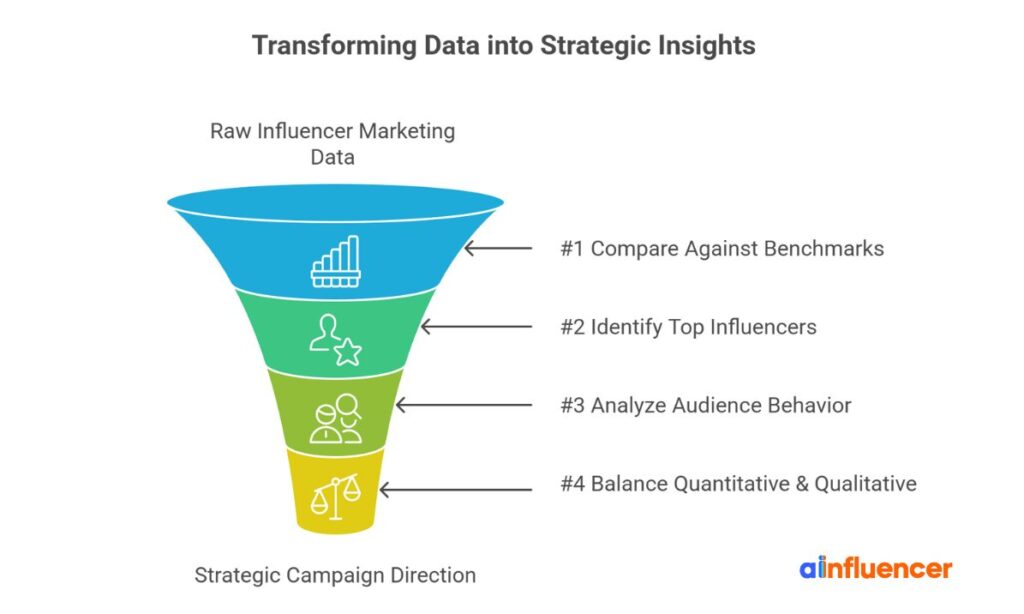
#1 Compare Performance Against Benchmarks
Industry benchmarks provide essential context for your influencer marketing metrics. Without them, numbers exist in a vacuum. Notably, engagement rates vary significantly by platform.
Instagram averages 1-3% for macro-influencers and 3-6% for micro-influencers, whereas TikTok sees 5-9% across all tiers. You can also see a full comparison of Micro-Influencers vs. Macro-Influencers.
To accurately measure success, always compare campaign data against both industry standards and your previous performance. This approach helps determine if your campaigns are truly outperforming expectations.
#2 Identify Top-Performing Influencers
A data-driven strategy reveals which creators deliver the best results. Using real-time tracking features, you can quickly determine which partners resonate with audiences. Filter by specific KPIs for influencer marketing, including reach, impressions, engagement metrics, and conversions.
Furthermore, analyze each influencer’s content performance to identify commonalities among successful posts. This methodical evaluation helps optimize future partnerships and budget allocation.
#3 Look for Patterns in Audience Behavior
Look beyond individual metrics to uncover meaningful patterns. Ask yourself: Are certain content formats outperforming others? Do Instagram Stories convert better than static posts?
Examine which marketing channels drive higher engagement and which content types inspire action. Yet remember that audience behavior varies by platform; what works on TikTok might flop on YouTube.
#4 Balance Quantitative & Qualitative Data
The most complete analysis combines numbers with context. Although quantitative data (like reach and conversions) reveal what happened, qualitative insights (such as sentiment and brand alignment) explain why.
This balanced approach prevents over-reliance on “vanity metrics”. Consider this comparison:
| Quantitative Metrics | Qualitative Insights |
| Engagement rate | Audience sentiment |
| Click-through rate | Content quality |
| Conversion data | Brand alignment |
| ROI figures | Community feedback |
Indeed, the most successful brands use both types of data, quantitative metrics to track performance and qualitative analysis to understand audience connection.
This comprehensive approach transforms raw influencer marketing analytics into a strategic direction for future campaigns.
Optimizing Campaigns Based on KPI Data
Turning data into action is what separates successful influencer marketing KPIs from mere measurements. After collecting and analyzing your campaign data, the next crucial step is optimization.
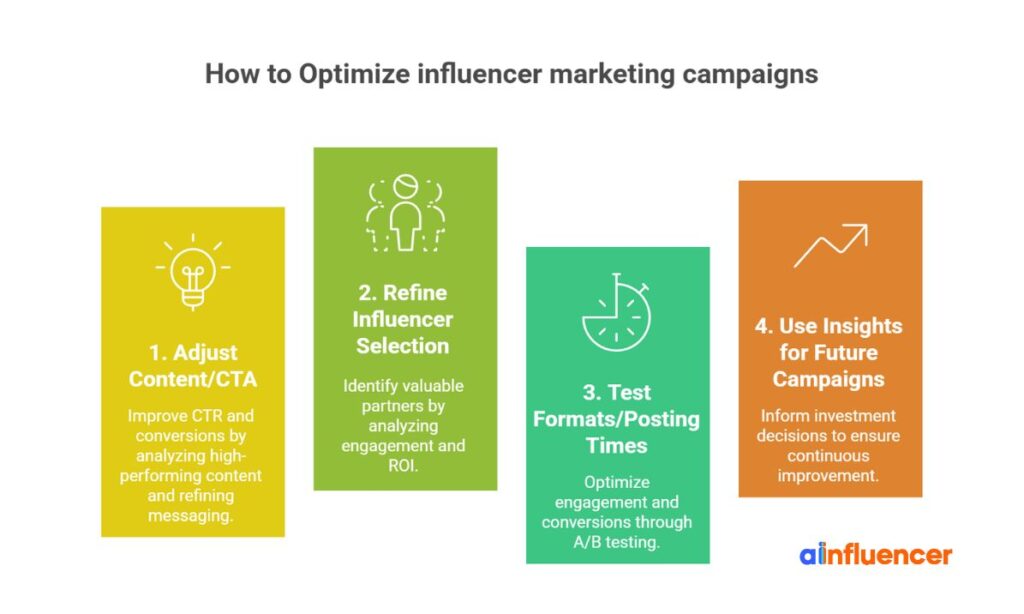
1. Adjust Content or CTA Based on CTR & Conversions
Low click-through rates often signal weak calls to action. Firstly, examine influencer content with higher CTR to identify what drives audience action. Besides improving CTR, you can enhance conversions by refining your messaging strategy based on performance data.
2. Refine influencer Selection Using Engagement & ROI
Data-driven selection helps identify your most valuable partners. Evidently, some nano influencers generate significantly better results despite having a smaller reach. Create a pre-saved list of top performers for each brand to streamline future campaigns. Correspondingly, this approach has helped brands achieve up to 4x ROAS compared to industry benchmarks.
3. Test Different Formats & Posting Times
A/B testing is crucial for campaign optimization. Test different variables such as:
| Testing Element | What to Measure | Expected Outcome |
| Content formats | Engagement rate | Identify best-performing content types |
| Posting times | Reach and engagement | Find optimal audience activity periods |
| CTAs and offers | Conversion rates | Determine the most effective prompts |
Multiple content formats should be tested to identify which drives higher conversions.
4. Use Insights to Plan Future Campaigns
Thereafter, use performance insights to develop data-driven strategies. Your influencer marketing analytics should inform which creators, content types, and platforms receive future investment. This continuous optimization cycle ensures each campaign outperforms the last.
Conclusion
Influencer marketing KPIs change social partnerships to measurable marketing investments from mere guessing. Simply use awareness, engagement, and conversion metrics together and benchmark them by platform. The thing that works on Instagram may not necessarily work on TikTok or YouTube.
Use strong tracking (UTM parameters, promo codes, analytics) to capture both quantitative and qualitative signals and figure out which creators deliver real results for your goals.
Keep improving constantly: decide each campaign as data to refine creator selection, formats, and calls to action.
Clarify your objectives first, choose the right metrics, track accurately, analyze frequently, and iterate. This way, influencer collaborations become predictable, measurable, and growth drivers for your brand.
FAQs
1. How do I choose the right KPIs for different types of influencer campaigns?
Match KPIs to your primary objective: use reach and impressions for awareness, engagement metrics for community-building, and conversions or ROI for sales-driven campaigns. The goal dictates the KPI, never the other way around.
2. How frequently should I report and review influencer KPI data?
Review key metrics weekly during live campaigns and run a full performance analysis at the end. For long-term partnerships, evaluate cumulative performance monthly or quarterly to identify trends.
3. How do I prevent incorrect or inflated KPI reporting from influencers?
Use third-party verification tools such as Ainfluencer, compare engagement patterns against platform benchmarks, and request screenshots from native analytics. Check for sudden follower spikes, unusually low comments, or repetitive engagement, common signs of inflated metrics.