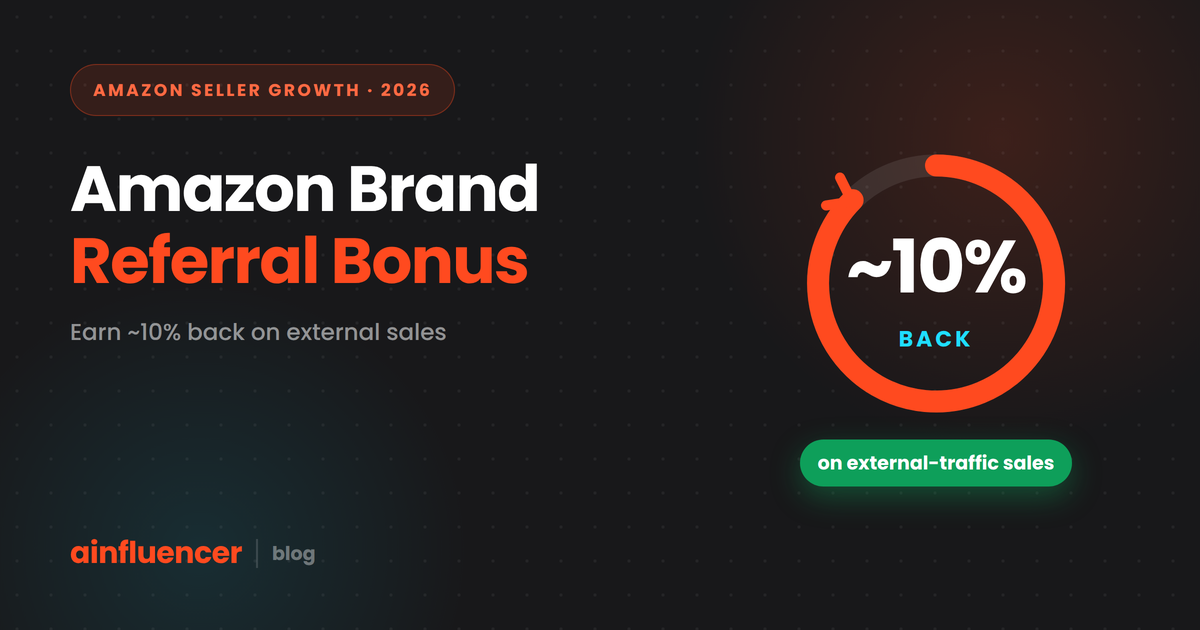
Amazon Brand Referral Bonus: Earn ~10% Back on External Sales
The rebate most brands half-claim: the effective-fee math, exact enrollment steps, the tag discipline that captures every dollar, and the funded-traffic triple stack.
The Amazon Brand Referral Bonus is the closest thing to free money in the seller toolkit: Amazon rebates you an average of roughly 10% of the sales you drive from outside Amazon, credited against your referral fees. Yet most enrolled brands leave it half-claimed through sloppy tagging, and most eligible brands never enroll at all. This guide covers what the program is and why Amazon runs it, the effective-fee math that changes your channel economics, exact enrollment steps, the tag discipline that captures every dollar, and the funded-traffic stack that compounds all of it.
What Is the Brand Referral Bonus (and Why Amazon Pays It)
Amazon wants demand it didn’t have to generate. Every shopper you bring from Instagram, Google, or a creator’s audience is a customer Amazon acquired for free, so the Brand Referral Bonus exists to make sellers do more of exactly that. Enrolled, Brand Registered sellers earn a bonus averaging around 10% of qualifying sales driven through Amazon Attribution links from non-Amazon channels.
Two design details matter. First, the bonus arrives as credits against your referral fees, typically one to two months after the sale, rather than as cash, which is why many sellers never notice how much they’re earning (or forfeiting). Second, it applies not just to the advertised product but to qualifying products from your brand purchased in the same window, so a strong external campaign earns on the halo, not only the click target.
The Math That Changes Your Channel Economics
A worked example
Say your external campaigns drive $100,000 in attributed monthly sales. The bonus returns about $10,000 in fee credits. If your referral fee is 15%, your effective fee on those sales drops to roughly 5%. Now compare two identical $30 sales: one sourced from Amazon PPC carries the full fee plus the ad’s CPC; the external one carries a discounted fee and no auction cost. External revenue isn’t just additional, it’s structurally cheaper.
Treat the bonus as negative CAC
When you model channel profitability, book the expected rebate as negative acquisition cost on external channels. Campaigns that look break-even on last-click ROAS frequently turn solidly profitable once the ~10% credit and the organic-rank lift are priced in. This single accounting change is why sophisticated sellers keep scaling external spend that naive dashboards call marginal.
Category variance
The bonus rate tracks Amazon’s category fee structure, so the exact percentage varies by what you sell. Check your categories in Seller Central rather than assuming the average; high-fee categories often see the richest rebates, which makes external traffic disproportionately attractive exactly where fees hurt most.
Who Qualifies
| Requirement | Detail |
|---|---|
| Brand Registry | Active enrollment for your brand |
| Marketplace | Available to sellers in the US store |
| Tracking | Sales must come through Amazon Attribution tags |
| Traffic source | Non-Amazon channels: social, search, email, creators |
| Payout form | Credits applied against referral fees, roughly 1 to 2 months later |
The practical gatekeeper is Brand Registry: if you’re registered, enrollment is a few clicks; if you’re not, Registry is worth completing for a dozen reasons beyond this bonus. Managing it all happens inside Amazon Seller Central.
How to Enroll and Claim It, Step by Step
Confirm Brand Registry status
Enrollment runs through your Brand Registered account. In Seller Central, find the Brand Referral Bonus page under the Brands menu; if you can see the enrollment flow, you’re eligible today.
Enroll your brand in the program
A few clicks, no cost, no ongoing obligations. Once active, qualifying attributed sales start accruing bonuses automatically. There is no reason any eligible brand should skip this step, and thousands do.
Create Attribution tags for every external campaign
In the Amazon Attribution console, build tags per channel, per campaign, and per creator. This is the step that decides how much of the bonus you actually capture, because only tagged sales qualify.
Reconcile monthly
Match Attribution reports against bonus credits in your payment reports, feed the realized rebate back into channel CAC models, and audit for untagged campaigns leaking rebate. Twenty minutes a month protects five figures a year at scale.
Tag Discipline: Where the Half-Claimed Money Hides
The per-creator rule
One tag per creator, always. Aggregate tags tell you influencers “kind of work”; per-creator tags tell you creator A returns 24x while creator B returns 3x, which is the difference between a reallocation decision and a shrug. The recruiting side of that equation is covered in how to find influencers on Amazon.
The no-naked-links rule
Any external placement carrying a bare Amazon URL is forfeiting its rebate: creator bios, email footers, Pinterest pins, old blog posts. Quarterly, sweep every live external link your brand touches and re-wrap the naked ones in Attribution tags. Brands doing this sweep for the first time routinely discover they’ve been donating a meaningful slice of the bonus back to Amazon.
⚡ The half-claimed trap in one sentence
The bonus only counts sales carrying an Attribution tag, so every untagged external campaign is external traffic you paid for and a rebate you refused.
The Triple Stack: Bonus + Rank + Funded Traffic
Here’s the full compounding loop. External sales earn the ~10% rebate. The same sales add velocity that lifts organic rank, covered in depth in how to drive external traffic to Amazon listings. And on Ainfluencer’s Ultimate plan, the traffic itself can be funded: the Amazon Creator Boost Program puts up to $500,000 of Ainfluencer’s own ad spend behind the posts you create with influencers on the platform. Every resulting sale is external, attributed, and bonus-eligible, so you collect the revenue, the rank velocity, and the ~10% rebate on traffic whose media cost to you was zero. December’s program campaigns drove $13.4M in product sales on $800K of Ainfluencer’s spend at a 16.8x blended ROAS.
Bonus-eligible sales, on our ad budget
Up to $500K in funded ad spend behind your creator posts. External, attributed, and every dollar of it rebate-eligible for your brand.
Explore the Boost Program →Proving the External Traffic Caused the Sale
The rebate pays on sales that arrive through an Attribution tag. That same tag is the only thing that lets you answer the harder question your finance team will ask: did the external channel create the sale, or did it just take credit for a shopper who was going to buy anyway?
Three habits separate a number you can defend from one you cannot:
- One tag per channel, per campaign, per creator. A single tag across all of paid social tells you that social worked. A tag per campaign tells you which creative worked, and a tag per creator tells you who to pay again. The rebate is identical either way, so the only cost of being precise is the five minutes it takes to generate the tags.
- Read the clicks and the conversions together. A channel with high clicks and low attributed sales is sending the wrong audience, and the rebate it earns will not cover what you paid for the traffic. A channel with fewer clicks and a high attributed conversion rate is the one to scale.
- Compare tagged periods against untagged ones. The cleanest incrementality read available without a formal test is to run a channel hard for two weeks, pause it for two, and watch total category sales rather than attributed sales alone. If total sales track the pause, the channel was incremental. If they do not, you were paying for shoppers Amazon already had.
Attribution reporting is free, and the tags cost nothing to create, so the only reason most brands cannot answer the incrementality question is that they used one tag for everything. Fixing that before you scale spend is worth more than the rebate itself.
Brand Referral Bonus vs Amazon’s Other Incentives
Sellers juggle several Amazon incentive mechanisms, and knowing where the rebate fits prevents double-counting and missed stacking. Coupons and deals buy conversion rate at the cost of margin; they spend your money to move volume. PPC buys placement inside Amazon’s auction; it also spends your money. The Brand Referral Bonus is the odd one out: it’s the only mechanism where Amazon pays you, and the only one that rewards building demand outside the platform.
The strategic implication is that the rebate should shape channel allocation, not just accounting. A deal-plus-PPC push and an external creator push might produce identical top-line sales, but the external push arrives with a ~10% rebate, rank velocity Amazon’s auction didn’t tax, and audience data you own. When two growth options look equal on revenue, the bonus is the tiebreaker, and over a year of allocation decisions that tiebreaker compounds into a structurally cheaper business.
A 90-Day Plan to Maximize Your Rebate
Month one is infrastructure: confirm Brand Registry, enroll, build the tag taxonomy (per channel, per campaign, per creator), and run the first naked-link sweep across bios, emails, and legacy content. Month two is measurement: reconcile the first credits against Attribution reports, book the rebate as negative CAC in every channel model, and identify which external sources are producing bonus-eligible volume most efficiently.
Month three is scale: shift budget toward the top rebate-efficient channels, schedule the quarterly sweep as a recurring task, and for Ultimate-plan brands, layer funded boost traffic on top so the rebate accrues on media you didn’t pay for. By the end of the quarter the bonus stops being a pleasant surprise in your payment reports and becomes what it should be: a planned, growing line item that discounts your entire external strategy.
Common Pitfalls to Avoid
Four errors cost brands most of their rebate. Enrolling but never tagging, the classic set-and-forget failure. Tagging campaigns but not evergreen placements like bios and email footers. Judging external channels without booking the rebate as negative CAC, which starves profitable channels of budget. And assuming the bonus rate without checking your categories, which misprices every channel decision downstream. All four are fixed by the enrollment steps and the quarterly sweep above; the broader growth context lives in our Amazon sales increase strategies guide.
Reading the Reports: Where the Credits Actually Appear
The bonus hides in plain sight because it never arrives as a payment line. Look in your transaction and payment reports for referral-fee adjustments in the one-to-two-month window after attributed sales, then cross-reference against the Attribution console’s conversion reports for the same period. The delta between attributed external sales and credited bonuses is your leakage number, and it’s almost always untagged campaigns rather than Amazon under-crediting.
Build a three-column monthly sheet: attributed external sales, expected bonus at your category rates, and credits actually received. When the third column trails the second for two straight months, run the naked-link sweep again; the gap has a source, and it’s nearly always a bio link, an old email footer, or a creator who swapped in an untagged URL. Ten minutes of reconciliation converts the bonus from folklore into a managed revenue line.
Frequently Asked Questions
How much is the Amazon Brand Referral Bonus?
It averages around 10% of the qualifying sale price, varying by category in line with Amazon’s fee structure, and is credited against your referral fees roughly one to two months after the sale.
Who is eligible for the Brand Referral Bonus?
Brand Registered sellers in the US store. Enrollment is free inside Seller Central, and sales must be tracked through Amazon Attribution links from non-Amazon traffic sources to qualify.
Does the bonus apply to influencer-driven sales?
Yes, as long as the traffic originates outside Amazon and carries your Attribution tag. Creator campaigns are among the most bonus-efficient channels because they convert at recommendation-level rates.
Is the Brand Referral Bonus paid in cash?
No, it arrives as credits against your referral fees, which is why many sellers underestimate it. Track it explicitly in your payment reports and book it as negative acquisition cost in channel models.
Do boosted-campaign sales qualify for the bonus?
Sales driven by the Creator Boost Program’s funded ads are external, attributed traffic to your listings, exactly the profile the bonus rewards. Confirm your tags are in place and the rebate stacks on top of the funded media.
Published on the Ainfluencer Blog. Related reading: drive external traffic to Amazon, Amazon Seller Central, and Amazon sales increase strategies.