Crypto Influencer Marketing Agency: Rules, Costs and 9 Compared in 2026
Crypto influencer rules by region, SEC token cases, printed prices and nine agencies checked on their own sites, with what to ask before you hire.
Before you compare any crypto influencer marketing agency, learn the rules, because in crypto the rules decide who can promote what, where and how. A paid post for a token can be a criminal offence in the UK without the right approval, a regulated marketing communication in the EU, and something Singapore’s regulator tells providers not to do at all. This guide sets out the rules we could confirm on official pages, then the costs agencies print and nine agencies whose own sites show crypto or web3 creator work.
This is not legal advice. Rules differ by country and change often, so have a lawyer check the current text in each market you target. Every agency figure is that agency’s own claim, read on its own site on 8 November 2026. Every rule comes from a regulator or platform page read the same day.
Is Crypto Influencer Marketing Legal? The Rules by Region
What regulators say about promoting crypto (read 2026-11-08)
| Region | What the regulator says | What it means for a campaign |
|---|---|---|
| United Kingdom | Since 8 October 2023 a crypto promotion to UK consumers is lawful only by one of four routes: made by an FCA authorised person, made by an unauthorised person and approved by an authorised one, made by a cryptoasset business registered under the money laundering regulations, or covered by an exemption. The FCA says a breach is a criminal offence under section 21 of FSMA, with up to 2 years in prison, an unlimited fine, or both, and that overseas firms are covered. The FCA’s social media guidance FG24/1 (March 2024) adds that influencers who promote without approval may commit an offence even with no commercial link to a firm. | A UK-facing paid post needs a lawful route first. Ask the agency which route your project uses and who the approver is. |
| European Union | MiCA applies from 30 December 2024. Article 7 says marketing communications for most crypto-assets must be clearly identifiable as marketing, be fair, clear and not misleading, say that a white paper has been published and give a website, and state that no EU authority has reviewed or approved the communication and that the offeror is solely responsible. ESMA’s guidelines on reverse solicitation (26 February 2025) say a third-country firm paying an EU-based influencer to push its crypto-assets is soliciting EU clients. | Paying an EU creator can bring you inside MiCA even if you are based elsewhere. The offeror owns the content, not the creator. |
| United States | The SEC has charged people with illegal touting for promoting crypto asset securities without disclosing payment (see the next section). The CFTC’s advisory on pump and dump schemes lists a single social media tip, urgent buy-now messages, promises of quick wealth and guaranteed returns as red flags. | Whether a token is a security is a legal test this page cannot answer. Treat every undisclosed payment as a risk. |
| Singapore | MAS guidelines PS-G02 (17 January 2022), paragraph 2.3, say digital payment token service providers should not engage third parties “such as social media influencers” to promote their services to the general public. They are guidelines addressed to providers, in the wording “should not”. | If you are a licensed provider in Singapore, a paid influencer push is something MAS tells you to avoid. |
| Australia | ASIC’s information sheet INFO 269 (March 2022) says influencers are responsible for making sure their content complies, that paid promotion makes content more likely to be treated as advice, and that calling an investment risk-free or guaranteed is likely misleading. It does not mention crypto. | Ask your lawyer whether your token is a financial product. If it is, these points apply. |
| Dubai (VARA) | VARA’s marketing rules cover social media, endorsements, videos, podcasts and live streams. Paid third-party promotion must carry a clear notice that it is a paid arrangement, marketing must not urge people to buy or sell, and the business that orders a campaign stays responsible when an agency runs it. Records must be kept for at least eight years. | The agency’s approval does not move the liability away from you. |
For the full text, read the FCA’s page on marketing cryptoassets to UK consumers. The UK’s advertising regulator, the ASA, adds that its CAP Code still covers non-technical points such as social responsibility in crypto ads. For general finance creators and the broader rulebook, see our guide to finance influencer marketing agencies.
Paying a Crypto Influencer in Tokens: What the SEC Has Charged
Many crypto projects pay creators partly or wholly in tokens. The SEC treats a token payment as compensation that has to be disclosed when the token is a security. These are the cases it announced, all read in the SEC’s own press releases.
SEC actions on undisclosed token payment to promoters
| Release | What the SEC says | Outcome |
|---|---|---|
| 2023-34 (17 February 2023) | Paul Pierce was paid more than $244,000 in EMAX tokens to promote them on Twitter and did not disclose it, and posted misleading content about his holdings. | He agreed to a $1,115,000 penalty plus about $240,000 disgorgement and interest, and a three-year bar on promoting crypto asset securities. He neither admitted nor denied. |
| 2023-59 (22 March 2023) | Justin Sun paid celebrities to promote TRX and BTT and directed them not to disclose their pay. The SEC charged eight celebrities with illegal touting. | Except two, they agreed to pay more than $400,000 combined without admitting or denying. |
| 2022-167 (19 September 2022) | The SEC alleges in a federal complaint that crypto influencer Ian Balina did not disclose a 30 percent bonus on SPRK tokens as payment for promoting them on YouTube, Telegram and other platforms. | These are allegations in a complaint. |
Two lessons follow for a brand. First, token allocations, bonuses and vesting terms are compensation, so they belong in the contract and in the disclosure. Second, in the Sun case the SEC’s allegation is that the promoter told creators to stay quiet, so an instruction to hide payment is itself a risk. Read the SEC’s release on the Pierce case for how it describes the touting provision.
Which Platforms Allow Crypto Promotion
A creator’s organic post and a brand’s paid ad fall under different policies. The table covers both kinds, and shows what each platform’s own pages say.
Platform policies on crypto and paid promotion (pages read 2026-11-08)
| Platform | What its page says | Gap |
|---|---|---|
| Meta ads | Written permission from Meta, based on a recognised regulatory licence or registration, is needed for exchanges, trading platforms, crypto lending, wallets with extra services and solicitation to invest. Exempt: crypto news, education and events that offer no product, wallets that only store crypto, NFTs and mining hardware. | Rules for a creator’s own post are not on this page. |
| Google Ads | Prohibited everywhere: ads for ICOs, DeFi trading protocols and buying, selling or trading crypto, and destinations that offer trading signals or investment advice. Exchanges and wallets need Google certification and approved locations, with FCA registration in the UK and MiCA authorisation in the EU. Educational content with no investment advice is allowed. | Applies to ads, not to a creator’s video. |
| TikTok | Crypto ad rules differ by market and often need a local licence, 18+ targeting and a TikTok sales representative application. Creators must switch on the commercial content disclosure toggle for branded content. | Crypto is not named on the branded content policy page, so its treatment is unconfirmed. |
| YouTube | Creators must declare sponsorships with the paid promotion setting, which adds a label at the start of the video. Financial services is a restricted branded content category with age and country restrictions. | Crypto is not named on the branded content pages. |
| X | Not confirmed. X’s ad policy pages blocked automated reading, so we state nothing about them. | Read X’s current financial services policy before you book. |
The pattern is clear: platforms mostly restrict crypto products that handle money and leave education and news open. A campaign that teaches how a wallet works sits in safer ground than one that urges a purchase. Be wary of any agency that describes ways around a platform ban, such as backup accounts after a suspension. Ad platforms treat that as a policy breach.
How to Vet a Crypto KOL: A Fraud Audit in Six Checks
Fake followers and bought engagement are a bigger risk in crypto than in most niches, because a creator’s price is set by reach. Flexe, one agency below, says it screens accounts for bought engagement with Wallchain, Sorsa and TwitterScore and rejects roughly a third of applicants, which is its own claim. Whoever does the checking, these are the six checks we would ask for, drawn from our general guide to auditing an influencer profile and adapted for crypto.
- Engagement against followers. Compare likes, replies and reposts with followers over the last 20 posts. Many followers and almost no replies is a warning.
- Comment quality. Read the replies. Strings of emoji, identical praise and wallet addresses are signs of purchased engagement.
- Follower growth shape. A step jump in followers with no viral post behind it suggests a purchase.
- Promotion history. List the last 10 projects they promoted and check how many are still active. A creator who promotes a new token every week is a risk to your reputation.
- Conflicts. Ask what tokens they already hold in your project and whether they have been offered an allocation. Undisclosed holdings are exactly what the SEC cases are about.
- Price against reach. If a creator with a small audience asks a macro price, ask what the number is based on.
For a wider method, see our guide to vetting influencers before you pay them. Put a replacement or refund clause in the contract in case a check fails after the money has moved.
Contract Clauses for a Crypto Creator Campaign
Clauses to ask the agency to include, and the rule behind each
| Clause | Why it is there | Where the rule comes from |
|---|---|---|
| The creator discloses all compensation, including tokens, bonuses and vesting terms | Undisclosed token payment is what the SEC has charged. | SEC releases 2023-34, 2023-59 and 2022-167 |
| Posts carry the platform’s paid promotion label and a plain word such as Ad in the text | Platforms provide the tools, and the brand cannot rely on the audience guessing. | YouTube paid promotion setting, TikTok commercial content toggle. The wording is our house rule, not a platform rule. |
| No claims of returns, safety or guaranteed outcomes | Dubai and Australia treat these as misleading, and the CFTC lists them as red flags. | VARA marketing rules, ASIC INFO 269, CFTC advisory |
| No call to buy or sell | VARA bars marketing that urges people to buy or sell. | VARA marketing rules |
| A risk warning and the white paper statement where the market requires them | The UK and EU require prominent warnings or statements. | FCA regime, MiCA Article 7 |
| Every post is approved by your compliance reviewer before it goes live | The business that hires the agency stays responsible. | VARA marketing rules, MiCA Article 7 |
| Records of drafts, approvals and payments are kept for the required period | VARA requires at least eight years. | VARA marketing rules |
| A refund or replacement if engagement proves bought | You need a remedy when a fraud check fails. | Our recommendation |
Crypto YouTube Influencer Marketing
YouTube is where long explanations live, so it suits products that need teaching: wallets, protocols, tools. Three things set it apart from a post on X. A video is evergreen, so the disclosure has to be right on day one, because an old sponsored video can be watched for years. The paid promotion setting adds a label at the start, but YouTube says the creator remains responsible for a clear and prominent disclosure. And age and country restrictions can be set on a branded video, which matters when only some regions may see a crypto promotion.
Ask the agency for the format (a dedicated review, an integration inside a longer video, or a live Q and A), the creator’s average views over the last ten videos, and the date of the last sponsored video. Flexe and Coinbound both name YouTube work on their own pages, and our guide to YouTube influencer marketing agencies covers the wider field.
What Crypto Influencer Marketing Costs: Prices Agencies Print
Most crypto agencies print no price. Figures on listicle pages for the same agency conflict by multiples: one agency is quoted at about $3,000 to $8,800 a month on one page and with a $50,000 minimum on another, and none of the pages gives a source. We use only figures printed on the agency’s own site.
Prices printed on agency sites (read 2026-11-08)
| Agency | What its own page prints | Note |
|---|---|---|
| Flexe | Single-channel campaigns from $4,000. Full launch programmes from $50,000 to $500,000 over three to six months. Community management from $2,000. | Creator account cost and agency fee are separate lines. Page figures dated 22 September 2026. |
| Inquivix (Korea) | About $5,000 to $20,000 a month in agency fees for comprehensive programmes. KOL partnerships KRW 500,000 to KRW 5,000,000 or more per creator. | Korean market page. It says it is not legal advice and points to Korean counsel. |
| Lunar Strategy | No rate card. The contact form offers budget bands of $15,000 to $25,000, $25,000 to $50,000 and $50,000 or more. | The bands are form options, not a stated minimum. |
| Coinbound, Cryptic, NeoReach, AP Collective, theKOLLAB, Surgence | Not published. Quotes follow a call, a form or a scoping step. | Ask for creator costs and agency fees as separate lines. |
For how agencies charge in general (retainers, percentages, pass-through creator fees), see influencer marketing agency pricing and fee models. The one number that decides a crypto budget is the creator fee, so insist that it is not hidden inside a single retainer.
Crypto Influencer Marketing Agencies With Named Crypto Cases
These four agencies show crypto creator work with named clients on their own sites. We rank none of them. Each row says what the site shows and what we could not confirm.
Crypto-native agencies with named cases (own sites, 2026-11-08)
| Agency | Based and founded (as printed) | What its own site shows | What to check |
|---|---|---|---|
| Coinbound | Says it operates out of New York. Founded 2018. | A Web3 influencer section with case pages for MetaMask (50 or more crypto influencers), OKX (it claims 10,000 or more new users through YouTube creators), Algorand and Sui (it claims 440 or more sponsored posts). | We found no disclosure statement on the pages read. It publishes its own best-agency lists that rank itself first, so treat them as marketing. No rate card. |
| Lunar Strategy | Lisbon, Portugal, with a printed address. Since 2019. | A creator service that sources and vets crypto-native influencers, briefs each creator and handles contracts. Cases on its page for TheorIQ, Warden Protocol and Limitless with its own CPM figures ($20 and $19.60). A disclosure page lists the projects it is paid to promote and was empty when read. It says some clients pay creators in token allocations or hybrid models. | Token allocations as creator payment is a disclosure risk the service page does not address. Its cases page was empty at the time we read it. |
| Flexe | Registered in Dubai Silicon Oasis, no street address. Launched July 2018. | A dedicated crypto influencer page with shortlists on X and YouTube, screening, briefs that cover prohibited content and disclosure wording, and disclosure checks against the FTC endorsement guides. Named projects: VAIX (its figures: 507,133 impressions over 18 days on a $25,000 budget and 80 new holders) and Margex. | Its benchmark of a 2.8x median net return across 150 campaigns is its own, unverified, and reads like an investment claim. No named team or street address. It says it is a poor fit for anyone who wants a guaranteed price. |
| Cryptic | Dubai Silicon Oasis, with London, Amsterdam and Riyadh addresses. Founded 2020. | Sixteen case studies, at least seven of them KOL work, including Algorand Foundation (it claims 20,000 or more wallet sign-ups and 30 million or more impressions) and Mantle (750,000 or more impressions, 9.4% engagement). It claims a network of 2,000 or more KOLs. | No disclosure or vetting language on the pages read, and some cases are not creator work. Treat every figure as its own claim. |
Agencies With Thinner Crypto Evidence
These five show real crypto activity but less proof, or a model that needs a question before you sign. They are listed so you can judge them, not recommended.
Agencies with partial evidence (own sites, 2026-11-08)
| Agency | Based (as printed) | What its own site shows | What to check |
|---|---|---|---|
| NeoReach | Mailing address in Orlando, Florida, not labelled headquarters. Says it has worked since 2013. | A dedicated crypto page and one named crypto client, Tezos, in an awareness case. It says briefs do not promise financial returns, so it does not offer token price promotion, and that sponsored disclosures are required. | One crypto case only. Its large totals are not crypto specific. |
| AP Collective | Not stated. The footer names AP Collective Limited. Since 2023. | Named clients on its homepage including Raydium, Pudgy Penguins and NEAR Protocol, and a service page that assesses creators on audience relevance, credibility, content quality and engagement rate. It claims 5,000 or more creators. | No headquarters and no compliance statement found. The service page names no campaign, and its $30B+ figure is a portfolio claim not tied to its own work. |
| theKOLLAB | Lists offices in Dubai, New York, London, Singapore and Switzerland. Founded 2023. | Case studies for Orange, Masa AI and Soul Protocol, and client logos including Trust Wallet. It offers KOL Fundraising, where creators can join presale or OTC rounds alongside promoting a project. | Nothing on the site addresses disclosure of that arrangement. Creator payment in allocations raises the SEC questions above. |
| Surgence | Says it is headquartered in Dubai, with teams in Bangkok, Singapore, Seoul and New York. Says 200 or more clients since 2022. | Dedicated crypto creator and YouTube creator services, and named cases including Jupiter Gacha and ETHGas. Fees are set after a 30 minute call, with creator spend on top. | We found no regulatory or disclosure statement. Some of its badges point to its own product. Asia heavy. |
| Inquivix | Two Seoul addresses, not labelled headquarters. | Korean KOL partnerships alongside Naver search work, with prices printed. No named clients. | Ask for cases. Korean rules differ and the page says to use Korean counsel. |
Which Crypto Agencies We Left Out and Why
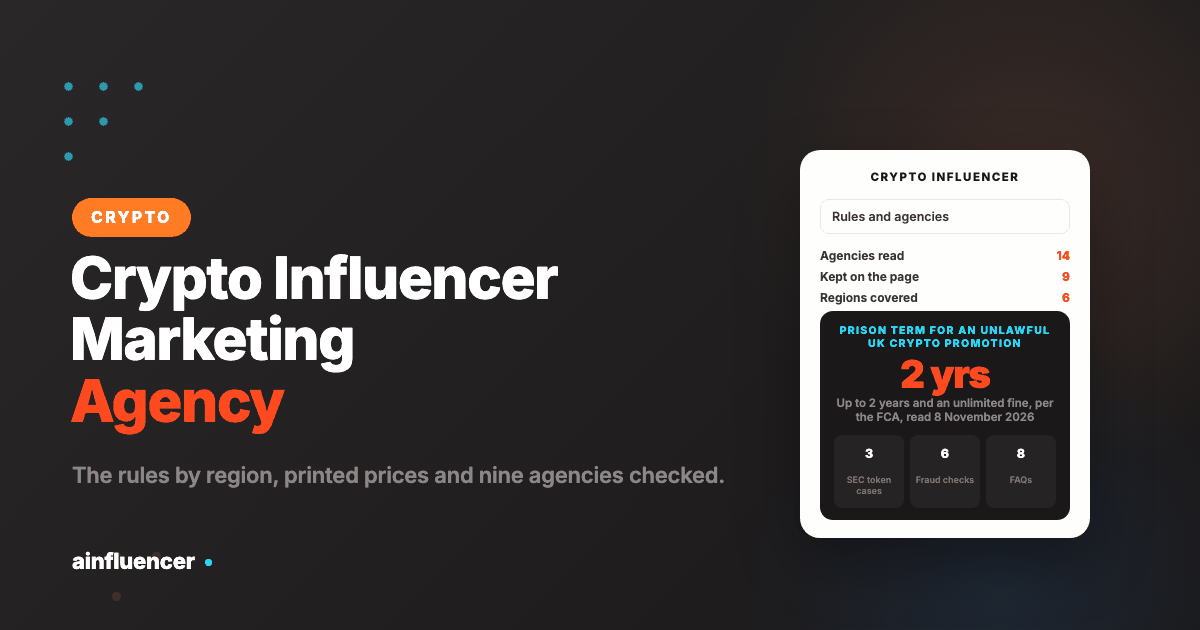
We read 14 agency sites. We left an agency out when its own site showed any of these:
- A guaranteed price, volume, placement or return, or a headline return with no method.
- Case studies that describe getting around ad platform bans, such as backup accounts after a suspension.
- An in-house investment arm that may take stakes in the clients it promotes.
- No crypto or web3 creator work at all, only a passing mention on a general page.
- A site we could not read after repeated tries, so there was no proof to check.
General influencer agencies without crypto proof also stay out. For those, see our best influencer marketing agencies list. Projects that want performance deals tied to sales rather than posts should read our crypto affiliate marketing agencies guide.
Agency, Freelance KOL Manager or Direct Outreach?
A freelance manager can work if you have one market, a small budget and a lawyer who reads each post. An agency earns its fee when you need several markets, many creators and a paper trail. Direct outreach to a creator is cheapest and gives you the least protection, because nobody else checks the disclosure. Whichever route you take, the contract clauses above do not change.
How to Measure a Crypto Creator Campaign Beyond Impressions
Impressions say how many people may have seen a post. They do not say who did anything. Ask for these instead:
- A tracked link per creator, so clicks and sign-ups can be traced to each post.
- Wallet connections or sign-ups after the click, not only the click.
- New holders or active users in the weeks after the post, compared with the weeks before.
- The cost per qualified user, with creator fees and agency fees both counted.
Do not accept a price move as proof. A rise in a token’s price after a post can come from many causes, and a campaign sold on price is the kind regulators describe as a pump. Flexe’s own VAIX case is a useful honest example: it reports about 80 new holders from a $25,000 budget, which is a small gain presented plainly.
Frequently Asked Questions About Crypto Influencer Marketing Agencies
What does a crypto influencer marketing agency do?
It finds and vets creators, writes briefs, negotiates and contracts, checks disclosures, tracks results and reports. The better ones also screen for fake engagement and keep records for compliance.
How much does crypto influencer marketing cost?
Few agencies print prices. Flexe prints single-channel campaigns from $4,000 and full launch programmes of $50,000 to $500,000, and Inquivix prints about $5,000 to $20,000 a month in agency fees. Creator fees are charged on top and should be a separate line.
Is it legal to promote crypto through influencers?
It depends on the market. In the UK a promotion needs one of four lawful routes and breach is a criminal offence. In the EU MiCA sets marketing rules. In the US undisclosed paid promotion of a crypto security has been charged by the SEC. Check with a lawyer in each target market.
Do crypto influencers have to disclose paid posts?
Yes in practice. The SEC has charged undisclosed payment, VARA requires a clear paid-arrangement notice, and YouTube and TikTok provide disclosure tools that creators must use.
Can I pay crypto influencers in tokens?
You can, but a token payment is compensation. The SEC cases treat undisclosed token payment as the problem, so put allocations, bonuses and vesting terms in the contract and require disclosure.
How do I spot a fake crypto influencer?
Compare engagement with followers, read the comments, look for step jumps in follower growth, list the projects they promoted and check how many survive, and ask about holdings in your project.
What is the difference between a KOL agency and an influencer agency?
KOL is crypto’s word for key opinion leader, a creator trusted by a crypto audience. A KOL agency works mainly with those creators on X, YouTube and Telegram, while a general influencer agency works across many niches.
Should a crypto project hire an agency or work with creators directly?
Hire an agency when you need many creators, several markets and a record of approvals. Work directly only when you have one market, a small budget and a compliance reviewer for each post.