Influencer Marketing Agency Pricing: How Much Do Agencies Charge? Costs, Fees and Models (2026)
How much influencer marketing agencies charge: five pricing models, the ANA’s 30% benchmark and 9 agencies with published prices, from $500 to $50,000.
There is no reliable published market rate for influencer marketing agencies, and any article that gives you one number is guessing. What does exist is a short list of pricing models, one real benchmark from the United States, and a handful of agencies that state a price or a minimum. This guide gives all three and says where each figure comes from.
Figures come from Kolsquare (October 2026), the Association of National Advertisers (ANA) report (February 2026, as covered by the press) and agency and directory pages we read on 26 October 2026. Agency prices are the agencies’ own or a directory’s listing, and they change, so confirm any figure before you budget.
How Much Do Influencer Marketing Agencies Charge? The Short Answer
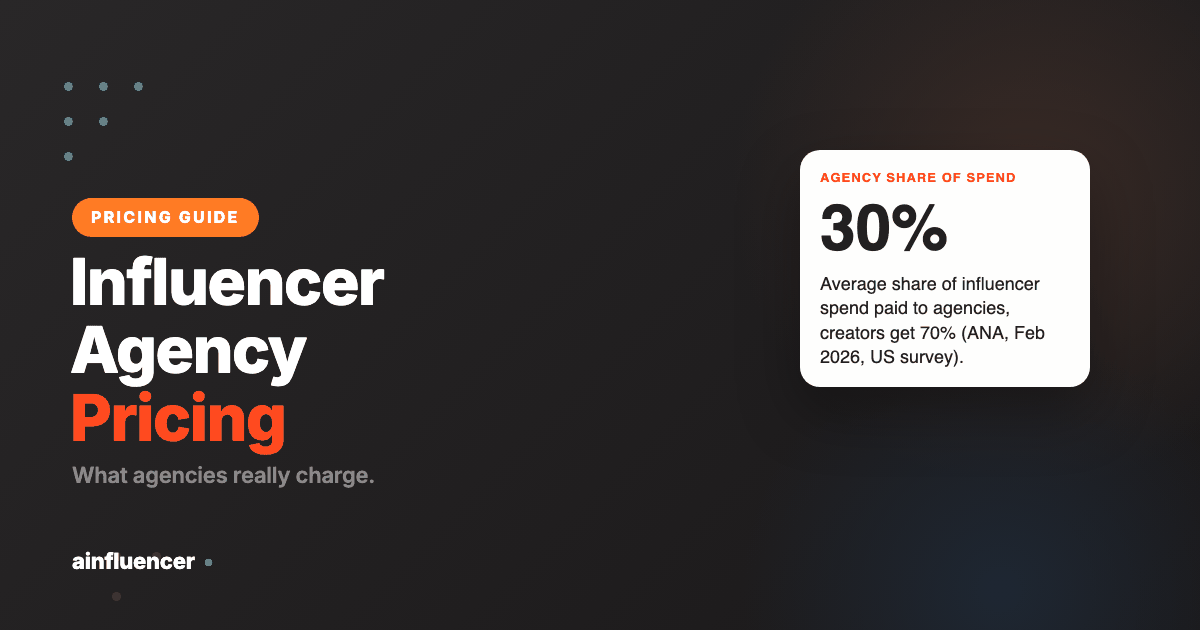
- The one benchmark: the ANA’s survey found that agencies receive on average 30% of influencer marketing spend and creators 70%. It is a US survey with 106 respondents.
- The usual structure: a monthly retainer, a fixed project fee, a percentage of budget, a markup on creator fees, or a base fee plus a performance bonus. Creator fees are often extra.
- Published prices: range from about $500 for a small Chicago pilot to $50,000 minimums at large agencies.
- The real cost is higher than the headline fee: usage rights, exclusivity, production and paid media are often billed on top.
Influencer Marketing Agency Pricing Models: Retainer, Project Fee, Percentage and Hybrid
Kolsquare describes five models. Agencies use one or a mix of them.
Pricing models, what each covers and where the risk sits
| Model | How it is calculated | Best for | Creator fees included? | Watch for |
|---|---|---|---|---|
| Retainer | Fixed monthly fee for an agreed scope | Always-on programmes | Usually billed on top | Scope creep, unused hours lost |
| Project fee | Fixed price per campaign | Launches and first tests with an agency | Varies, check the proposal | Changes mid-campaign cost extra |
| Percentage of budget | A share of total spend or creator fees | Programmes whose budget changes | Depends on the base used | The fee grows with spend, not with results |
| Markup on creator fees | The agency adds a margin to creators’ rates | Brands that want to pay once | Yes, bundled | You may not see what the creator is paid |
| Performance or hybrid | Base fee plus a bonus tied to targets | Sales-led campaigns | Usually billed on top | Disagreement over how results are measured |
Retainer Fee: What Do Agencies Charge per Month?
A retainer is a fixed monthly fee for an agreed scope. Few agencies publish it, so ask for the scope, the hours and what is billed on top.
Project-Based Fee (Flat Fee)
A flat fee for one campaign suits a launch or a first test with a new agency. Check what a change of plan costs.
Percentage of Spend (Commission-Based)
The agency takes a share of total spend or of creator fees. The fee grows with spend, not with results, so ask which base the percentage applies to and whether it is capped.
Markup on Creator Fees
The agency adds a margin to creator rates and bills one number. It is simple to buy, but you may not see what the creator is paid, so ask whether the margin is disclosed.
Performance-Based and Hybrid Pricing
A base fee plus a bonus or cost per action tied to agreed targets. It works when both sides agree how results are measured and on whose data.
Hourly Rate
Hourly billing is used for audits, consulting and reporting, and rarely for full campaigns. Published rates conflict: Favikon’s guide gives $100 to $300 or more an hour, while Clutch’s self-reported platform average is $25 to $49.
Is a Percentage-of-Spend Fee a Conflict of Interest?
It can be, because the agency earns more when spend rises. Ask for a cap, a lower rate above a threshold and a written definition of what the percentage applies to.
What Percentage Do Influencer Marketing Agencies Take? Commission and Fee Benchmarks
The most useful figure comes from the Association of National Advertisers (ANA), which published its first Influencer Marketing Agency Compensation report in February 2026. According to press coverage and the ANA’s own summary, agencies receive on average about 30% of influencer marketing spend, with about 70% going to creators. Only about half of marketers (51%) have full visibility into what creators are actually paid, and MediaPost reports that 61% use compensation models that are non-transparent or unknown to them. Even so, 73% said they were satisfied with their current agreement.
Treat the 30% as a starting point, not a rate card. The survey ran from 1 October to 1 December 2025, had 106 respondents of whom 84 passed the screening questions, and is a US sample. The full report is for ANA members, so we have only press coverage of it. Vendor blogs quote 20 to 30% margins or a 15 to 20% share of ad spend, but none gives a method, so we do not rely on them.
Kolsquare adds that 23% of brands now fully outsource influencer marketing, up from 10% a year earlier, and that no UK equivalent of the ANA study exists.
Agency Fee vs Talent Manager Commission: A Worked Example
Kolsquare’s illustration, using round numbers and not a market average, shows how two intermediaries can sit on one post.
A 6,000 deal with a talent manager and a brand-side agency (illustrative)
| Step | Amount | Who receives it |
|---|---|---|
| Talent manager’s 20% commission | 1,000 | The creator’s manager |
| Creator’s take-home | 4,000 | The creator |
| Brand-side agency’s 20% management fee, on top | 1,000 | The brand’s agency |
| Total paid by the brand | 6,000 |
The talent manager’s cut is already inside the creator’s quote, typically 10 to 20%. The brand-side agency fee is separate. That is the difference we explain in our guide to influencer management agencies.
Factors That Affect Influencer Marketing Agency Cost
- Scope of work: strategy, sourcing, contracts, reporting and paid amplification.
- Creator tier and number of creators: more and larger creators raise both creator fees and management time.
- Platform mix and niche: some niches and platforms cost more per post.
- Contract length and rights: longer terms and wider usage rights change the price.
- Agency size and type: full-service agencies, specialists and talent managers charge differently.
What Is Not Included in Influencer Agency Fees? Extra Costs on Top
A fee normally pays for the agency’s own work: strategy, sourcing, vetting, briefing, contracts, review rounds and reporting. Creator payments, usage rights, production and paid amplification are usually extra.
- Usage rights and buyouts: reusing creator content beyond the post. Kolsquare’s cost guide puts this at 25% to 200% of the post fee.
- Exclusivity: the creator agrees not to work with competitors for a period. The price depends on the creator and the length.
- Content production: multiple shoots, special edits or locations cost more.
- Rush fees: a launch two weeks after the first call usually carries a surcharge.
- Paid media and whitelisting: running ads from a creator’s handle is often priced separately.
Influencer Marketing Agency Pricing Examples: Published Prices and Minimums
The nine at a glance (26 October 2026)
| Agency | Price or minimum |
|---|---|
| 1. Ainfluencer | $7,999 to $29,999 per package |
| 2. Socialander | $10,000+ |
| 3. Viral Nation | $10,000 to $15,000 a month, sources disagree |
| 4. Linqia | $50,000+ minimum |
| 5. Intuition Media Group | $50,000+ minimum |
| 6. The Goat Agency | $50,000+ minimum |
| 7. Zapwater and Reilly Connect | $5,000+ |
| 8. Heron Agency | $1,000 to $5,000 |
| 9. Brenton Way | $500 to $1,000 |
These are the few agencies we could find that state a number. Most do not, and the ranges are not comparable because they measure different things: a package, a monthly retainer or a minimum campaign. None of the agencies paid to be listed. The one exception to “nobody is ours” is Ainfluencer, marked as such.
1. Ainfluencer
Published campaign packages. Ainfluencer is our own service, so weigh this entry accordingly. Its fully managed service publishes four packages: $7,999 for a one-month campaign with 25 creators, $9,999 for two months with 50 creators, $15,000 for three months with 75 creators and $29,999 for four months with 200 creators. The page does not spell out how creator payments are handled within each package, so ask before you compare.
- Best for: Brands that want a stated price before a sales call.
- Price or minimum: $7,999 to $29,999 per package
2. Socialander
Lagos digital and influencer agency. Listed by HypeAuditor in its Nigeria directory with 51 to 200 staff and a price of $10,000+, with services including creator discovery and vetting, contracts, content approval and reporting.
- Best for: Brands that want a Nigerian agency that also handles contracts.
- Price or minimum: $10,000+
3. Viral Nation
Enterprise creator programmes. Its pricing is not public. One 2026 comparison lists it from $10,000 a month, while a table on the same page gives $15,000 a month. That gap is a good illustration of why you should ask for a written quote.
- Best for: Enterprise brands with a large, ongoing programme.
- Price or minimum: $10,000 to $15,000 a month, sources disagree
4. Linqia
Retail-linked creator campaigns. Its profile on Influencer Marketing Hub lists a minimum campaign size of $50,000+ and describes it as best for Fortune 500 brands.
- Best for: Large brands selling through major retailers.
- Price or minimum: $50,000+ minimum
5. Intuition Media Group
Creators plus paid amplification. Its profile on Influencer Marketing Hub lists a minimum campaign size of $50,000+, for mid-market and enterprise brands.
- Best for: Established brands that want creator campaigns tied to paid reach.
- Price or minimum: $50,000+ minimum
6. The Goat Agency
Global creator campaigns. Listed on Influencer Marketing Hub’s TikTok agency list with a minimum campaign size of $50,000+.
- Best for: Brands running campaigns in several markets.
- Price or minimum: $50,000+ minimum
7. Zapwater and Reilly Connect
Chicago premium tier. The hub’s Chicago guide puts both in its premium tier at $5,000 and above. See influencer marketing agencies in Chicago for details.
- Best for: Brands that want integrated PR and creator work, or health and beauty expertise.
- Price or minimum: $5,000+
8. Heron Agency
Chicago intermediate tier. Listed in the hub’s intermediate tier at $1,000 to $5,000, with PR, social and non-paid influencer campaigns.
- Best for: Medium-sized businesses that want planning and vetting.
- Price or minimum: $1,000 to $5,000
9. Brenton Way
Chicago budget tier. Listed in the hub’s budget tier at $500 to $1,000, mostly micro-creator collaborations. The hub also reports an average of about $2,799 for a full Chicago campaign.
- Best for: Startups and small businesses with a very small budget.
- Price or minimum: $500 to $1,000
Influencer Marketing Agency Cost by Agency Type
Full-service agencies charge a fee to the brand. Specialists charge for one channel or niche. Talent managers take a commission from the creator, not from the brand. For the creator side, see influencer management agencies.
Agency vs In-House vs Influencer Marketing Platform: What Each Costs
An agency costs a fee and brings a team. An in-house hire costs a salary, benefits and tools, and covers fewer skills. A platform costs a plan or per-deal fee plus creator fees, and leaves the work to you. Compare the full cost of each, not the headline.
Red Flags in Influencer Agency Pricing Proposals
- A guaranteed result or sales figure.
- A vague scope with no split between agency and creator fees.
- A long lock-in with no pilot or exit clause.
- A refusal to show creator rates.
- An uncapped percentage of spend.
How to Tell Whether an Agency Is Worth the Price
Ask for the metrics before signing: reach, cost per engagement, creator retention and tracked sales. Reach and impressions alone are weak. Under US rules, paid posts must be clearly disclosed whoever the agency is, as the FTC’s Disclosures 101 for social media influencers explains.
How to Compare Influencer Marketing Agency Proposals: Questions to Ask Before You Sign
- Are creator fees listed separately from the agency fee? If not, ask for the split.
- Is any markup applied to creator fees, and how much?
- Who owns the content, and for how long? Usage rights can add 25% to 200% of a post fee.
- What does the retainer include, and what is billed extra?
- How is performance measured, and on whose data?
- Is the timing of creator payments guaranteed?
- Compare the total programme cost, not the headline fee.
Cheaper Routes Than a Full Influencer Agency Retainer
If an agency is more than you need, the cost of the work itself is easier to estimate. Our influencer rates guide shows what creators charge by platform and size, the micro-influencer guide covers lower budgets, and micro influencer marketing agencies are priced for smaller programmes. For general social media work see social media marketing agencies, and for a wider shortlist see the best influencer marketing agencies.
Influencer Marketing Agency Pricing FAQ
How much do influencer marketing agencies charge?
There is no reliable published market rate. The ANA’s February 2026 survey found agencies receive about 30% of influencer spend on average. Published prices range from about $500 for a small Chicago pilot to minimum campaigns of $50,000 or more at large agencies.
What commission do influencer agencies take?
The ANA’s survey reports an average of about 30% of influencer marketing spend going to agencies and 70% to creators. Vendor guides quote 20 to 30% margins, but without a method. Your contract sets the real figure.
Is a retainer or a project fee better for influencer marketing?
A retainer suits always-on programmes, and a project fee suits launches, seasonal pushes and first tests with a new agency, according to Kolsquare.
Are creator fees included in an influencer agency’s price?
Often not. Creator fees are frequently billed on top of a retainer or project fee, or bundled into a markup. Ask for the split in writing.
What extra costs come on top of influencer agency fees?
Usage rights and buyouts (25% to 200% of the post fee per Kolsquare’s cost guide), exclusivity, content production, rush fees and paid media or whitelisting.
What is the difference between an agency fee and a talent manager’s commission?
An agency fee is what the brand’s agency charges the brand. A talent manager’s commission is what a creator’s manager takes from the creator’s fee, typically 10 to 20%, and it is already inside the creator’s quote.
Can small businesses afford an influencer agency?
Some can. Published entries start around $500 to $1,000 for small Chicago pilots and about $7,999 for Ainfluencer’s managed packages, while many large agencies set minimums of $50,000. A self-serve platform or direct creator booking costs less.
How much is a monthly retainer for an influencer marketing agency?
Few publish it. Published entries in this guide range from small pilots of about $500 to $1,000 to minimum campaigns of $50,000. Ask for the scope behind any monthly figure.
Does the percentage apply to creator fees, ad spend or both?
It depends on the contract. Ask for a written definition of the base, a cap and any lower rate above a threshold.
Can pricing models be combined?
Yes. A base retainer plus a performance bonus is common. Agree how results are measured and on whose data.
How do influencer marketing agencies make money?
Through retainers, project fees, a percentage of spend, a markup on creator fees and sometimes software or production. Ask which apply and whether any margin is disclosed.