HypeAuditor Alternatives
Most lists of HypeAuditor alternatives answer the wrong question. They line up campaign platforms against an audit tool, which is like replacing a thermometer with a hospital. HypeAuditor exists to tell you whether a creator’s audience is real. Whether you need a different tool depends entirely on which check you are actually trying to run, so that is how this guide is organised.
What HypeAuditor Is For, and What It Is Not
HypeAuditor is an analytics and fraud-detection product. It scores audience authenticity, estimates demographics, flags suspicious follower growth and benchmarks engagement. It does not brief creators, manage content approval, sign contracts or move money.
That matters for cost. If you are paying an analytics subscription to solve an execution problem, no alternative in the analytics category will fix it. Our HypeAuditor review covers the product in full.
| If the real question is | You need | Not |
|---|---|---|
| Is this audience real? | An audit tool. HypeAuditor, Modash, trendHERO | A campaign platform |
| Who is in this audience? | An audience data tool. Modash, Influencity | A fraud scanner |
| Which creators should I approach? | A discovery tool or a marketplace | An audit subscription |
| How do I actually run the collaboration? | A marketplace or a campaign platform | Any analytics product |
| Did the campaign work? | Your own tracking links and store data, plus campaign tracking | A creator-level authenticity score |
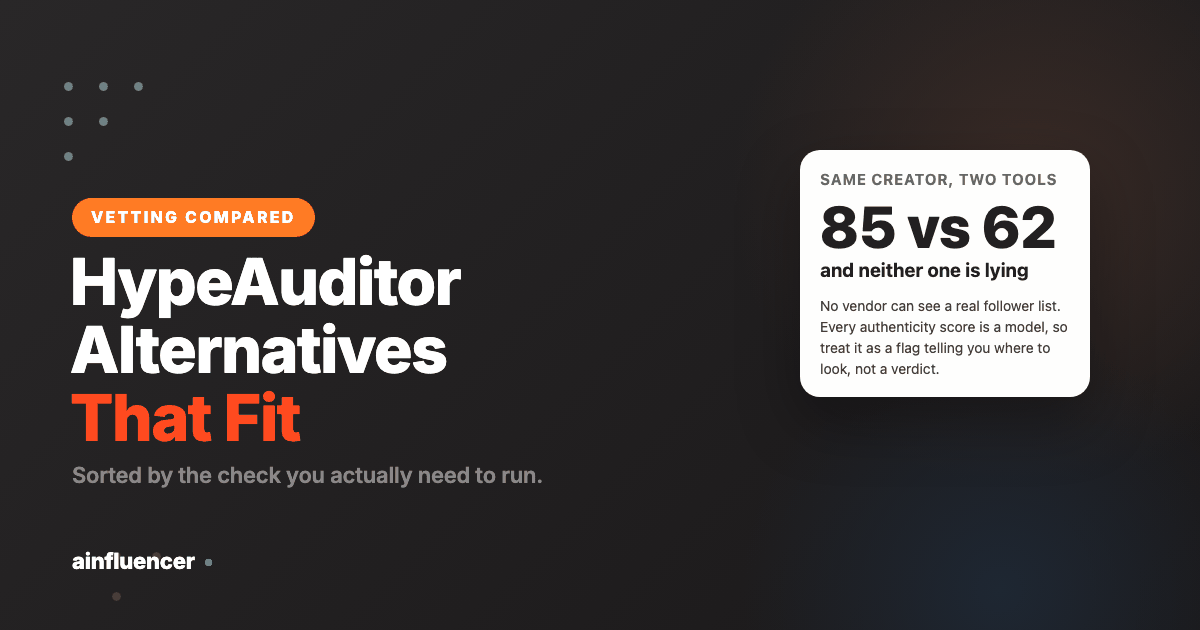
Why Two Tools Score the Same Creator 85 and 62
This is the most common reason teams start shopping, and it is worth understanding before you buy a replacement, because the replacement will disagree with the next tool too.
No vendor can see a creator’s real follower list. Every authenticity score is a model inferring quality from signals the platform does expose: follower-to-engagement ratios, comment patterns, growth curves, the distribution of accounts that interact. Different vendors weight those differently, sample differently, and refresh on different schedules. Two defensible models will disagree on the same creator, and neither is lying.
Three practical consequences. A score is a flag, not a verdict, so use it to decide where to look rather than who to book. Detection quality falls sharply in languages and markets the model saw little of, so a score in a market you do not operate in is weaker than it looks. And switching tools because you disliked one number usually buys you a different number. We go through the mechanics in AI powered influencer vetting.
If You Want the Same Job Done Elsewhere
These are genuine like for like swaps, meaning they audit audiences rather than run campaigns. Prices are the most recent third-party checks we could find and should be confirmed with each vendor, because none of them publishes a stable public ladder.
Modash
The closest competitor on audience data, and stronger on raw discovery breadth. Reported at $299 a month for Essentials and $599 for Performance, with an enterprise tier from $14,700 a year and a 14 day trial. Our Modash review has the detail.
Heepsy
Cheaper, with a free tier and a Starter plan reported around $89 a month. The audience data is thinner and the lower tiers are tightly limited, which is the trade. See our Heepsy review.
trendHERO and Influencity
Both sit in the same category from different angles. trendHERO is Instagram-centric and cheap for one off reports, while Influencity leans toward multi-platform discovery with analysis attached.
If You Only Run a Few Audits a Year
A subscription is the wrong shape for occasional use, and this is where most of the wasted spend on this category sits. Teams buy an annual analytics plan, run fourteen reports in January and nothing in July.
- Use the free single-report tools. Several vendors in this category, HypeAuditor included, offer a free report on one account. For a handful of checks a year that is the entire requirement
- Buy the check at the moment you need it rather than keeping capacity on standby. Monthly plans you can cancel beat annual billing when usage is lumpy
- Audit only above a threshold. A $200 gifting collaboration does not justify a paid report. A $5,000 booking does
The Checks You Can Run With No Tool at All
Before paying anything, run these. They catch the majority of obviously bad accounts, they take about ten minutes per creator, and they work on every platform.
- Open the comments and read thirty of them. Generic praise, emoji-only replies and the same handful of accounts on every post are the clearest signal there is, and no model reads them better than you do
- Compare recent posts against older ones. A follower count that jumped while engagement stayed flat is the classic purchased-followers shape
- Check whether the audience is in your market. Ask the creator for a screenshot of their own analytics. They have the real numbers; every tool is estimating
- Look at who they have worked with. Repeat brand partners are a stronger endorsement than any authenticity score, because those brands saw the results
- Ask for the last three campaign results. A creator who cannot or will not share them is telling you something
- Run one small paid test. One collaboration with real tracking tells you more than a year of audits
Our guide to auditing an influencer profile goes through each of these properly.
If What You Actually Needed Was a Platform
A large share of people searching for HypeAuditor alternatives are not unhappy with the audits. They have realised they are paying for data when what they lack is somewhere to run the work.
Ainfluencer is a marketplace rather than an analytics product. There is no subscription: you search, message, agree terms and pay inside the platform, and the only cost is a percentage of each collaboration, from 25% on the free plan down to 3% on the top plan, with a $10 minimum collaboration.
The marketplace held 484,107 YouTube creator accounts, 417,694 on Instagram and 181,950 on TikTok when counted in October 2026. Because creators join by choice, you can ask them directly for the analytics screenshot that any audit tool is only estimating, which is the cheapest verification available.
- Pick it when: the gap is execution, not data
- Do not pick it when: you need a formal authenticity score on creators you source elsewhere. Keep an audit tool for that
- Realistic setup: many teams run a marketplace for execution and a cheap audit tool for spot checks, which costs less than one all-in-one subscription
HypeAuditor Alternatives Compared
| Option | What it is for | Reported cost | Where it is weaker |
|---|---|---|---|
| HypeAuditor | Audience authenticity and fraud signals | About $299 a month Basic, $499 Pro, on annual billing | Not a campaign or payment system |
| Modash | Audience data and discovery breadth | $299 a month Essentials, $599 Performance | Also not a campaign system |
| Heepsy | Budget search with basic quality signals | From around $89 a month, free tier | Thinner audience data |
| trendHERO | Cheap Instagram-focused reports | Low monthly, often per report | Narrow platform coverage |
| Influencity | Multi-platform discovery with analysis | Mid market monthly | Less specialised on fraud than HypeAuditor |
| Ainfluencer | Finding, agreeing and paying creators | No subscription, a percentage of each collaboration | Not a formal audit tool |
| No tool | Reading comments, checking growth, asking for the creator’s own analytics | Free | Does not scale past a few creators a week |
How to Decide in Ten Minutes
- Count last year’s audits. Under about twenty, a subscription is hard to justify. Use free reports and manual checks
- Write down what you did after each one. If a low score never changed a decision, you are buying reassurance, not information
- Separate the audit budget from the campaign budget. They are different products and bundling them is how teams overpay for both
- Spot check the model against creators you know. Run five you have already worked with. If the scores disagree with your experience, that tells you how much weight to give the sixth
What is the best HypeAuditor alternative?
For the same job, Modash is the closest comparison on audience data and Heepsy is the cheapest credible option. If what you actually need is somewhere to run collaborations rather than analyse them, a marketplace with no subscription is a different category and usually cheaper.
How much does HypeAuditor cost?
HypeAuditor does not publish a straightforward public ladder. Third-party checks report about $299 a month for Basic and $499 for Pro on annual billing, with enterprise by quote, and some directories list $399 per user per month. Confirm with the vendor before budgeting.
Is there a free HypeAuditor alternative?
Partly. Several tools in this category, HypeAuditor included, give a free report on a single account, which covers occasional use. For execution rather than analysis, Ainfluencer has no subscription at all.
Why do HypeAuditor and another tool give different scores?
Because no vendor can see a creator’s real follower list. Every score is a model inferring quality from engagement ratios, comment patterns and growth curves, and different vendors weight those differently. Treat a score as a flag that tells you where to look, not as a verdict.
Can I vet creators without paying for a tool?
For a small roster, yes. Read thirty comments, compare follower growth against engagement, ask the creator for a screenshot of their own analytics, and look at which brands have worked with them more than once. That catches most obviously bad accounts and costs nothing.
Do I need an audit tool and a campaign platform?
Often yes, and that is cheaper than it sounds. A marketplace with no subscription plus a cheap audit tool for spot checks usually costs less than a single all-in-one platform, and each half does its job properly.