Influencer Management Agencies: What They Do, What They Cost and When You Need One
9 influencer management agencies compared, plus what they take: 10 to 20% of each creator deal, or a brand retainer. Contract clauses and red flags.
“Influencer management agency” means two different businesses, and the difference is who pays. If you are a creator, a management agency takes a cut of every deal it brings you. If you are a brand, a management agency charges you a retainer to run your creator programme. The risks, the contract and the test for whether you need one are different in each case, so this guide follows the money first and the contract second.
Figures below come from public agency and directory pages. Rates in this market are negotiated, not published, so treat every range as a starting point for a conversation, not a quote. Nothing here is legal advice.
What Is an Influencer Management Agency?
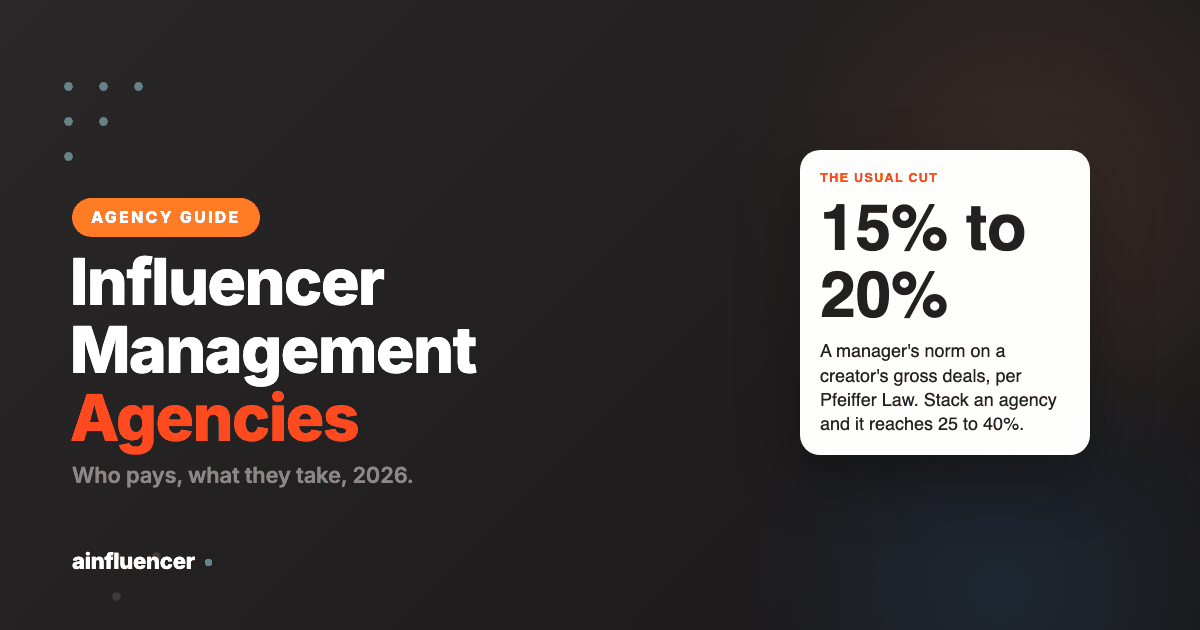
- Creators: a manager usually takes 15 to 20% of each deal and an agent or agency 10 to 20%. Both come out of your fee, and with two of them the total can reach 25 to 40%. Under roughly 100,000 followers, pitching brands yourself usually pays better.
- Brands: an agency running your creator programme is a retainer or project fee, often five figures a month at the top end. A self-serve platform or a managed service can do the same job for less if your programme is small.
- Everyone: never pay an upfront fee to be “signed”. Real managers earn on commission.
The nine agencies at a glance (details below)
| Agency | Side | Best for | Published price |
|---|---|---|---|
| 1. Ainfluencer | Both | Hands-on help for small and mid-size brands | From $7,999 per package |
| 2. Viral Nation | Both | Enterprise programmes, established creators | Not public |
| 3. NeoReach | Brand | Service plus self-serve software | Not public |
| 4. The Influencer Marketing Factory | Brand | Full-service Instagram and TikTok campaigns | Not public |
| 5. Audiencly | Both | Lifestyle and tech creators | Not public |
| 6. IZEA | Both | Creator matching and a platform | Not public |
| 7. INF Influencer Agency | Talent | Curated lifestyle roster | Not public |
| 8. Shine Influencers | Talent | Vetted North American talent | Not public |
| 9. Saulderson Media | Talent | UK gaming creators | Not public |
Influencer Talent Management vs Influencer Campaign Management
Talent management versus campaign management
| Talent management (creator side) | Campaign management (brand side) | |
|---|---|---|
| Who hires them | The creator | The brand |
| Who pays | The creator, out of each deal | The brand, as a retainer or project fee |
| How it is charged | 10 to 20% commission, sometimes a retainer | Monthly retainer, per campaign fee, or a percentage of spend |
| What you get | Deal sourcing, negotiation, contracts, career planning | Creator sourcing, briefs, contracts, approvals, payments, reporting |
| Biggest risk | Stacked cuts, long lock-in, commission on deals you found yourself | Paying a retainer for work a platform would do |
| Section below | If you are a creator | If you are a brand |
How Much Do Influencer Management Agencies Charge Creators?
Influencer Manager vs Agent vs Talent Agency: What Each Does
Typical roles and cuts, as reported by Make Influence’s creator guide
| Role | What they do | Typical commission |
|---|---|---|
| Manager | Day-to-day strategy, content direction, brand relationships, career advice, often for a handful of creators | 15 to 20% of the gross fee |
| Agent | Finds and negotiates specific brand deals on your behalf | 10 to 20% of the deal |
| Agency | A company with several agents and managers and a larger roster; may bundle both jobs | 10 to 20%, often the same as an agent |
Pfeiffer Law, an entertainment law firm in Santa Monica, says the range runs from 10% to 20% or more, with 15% to 20% the norm, and that the cut is usually taken on gross revenue, before any of your costs. In the US, California’s Talent Agency Act caps an agent’s commission at 10% for union work and 20% for non-union work, but that rule was written for traditional entertainment and does not set a ceiling for digital creator deals elsewhere.
How Influencer Management Commission Works on One $10,000 Brand Deal
A $10,000 brand deal with a manager and an agency
| Share | Amount | |
|---|---|---|
| Brand pays | $10,000 | |
| Manager (20%) | 20% of gross | $2,000 |
| Agency (10%) | 10% of the same gross | $1,000 |
| You keep | 70% | $7,000 |
That example assumes both cuts are taken on the original figure. Whether they are is a contract detail, not a rule, so get it in writing. If one is taken after the other, you keep less. The brand’s price does not change. What changes is how much of it reaches you.
When Do You Need an Influencer Management Agency?
- Under about 100,000 followers and deals rarely arrive: your time is usually better spent on a media kit and your own pitches than on handing over 10 to 20% of every deal.
- Deal volume has grown and admin eats your content time: the maths starts to work, but only if the manager lands more or better deals than you would have closed.
- You already have direct brand relationships: negotiate a carve-out for them before you sign, not after.
- You are considering both a manager and an agent: ask how the two commissions are calculated before agreeing to either.
Our guides to what to charge for a sponsored post and influencer rates by platform and size help you check whether a manager’s offer is above what you would have agreed yourself.
Influencer Management Contract: Six Clauses to Read Before You Sign
- The commission base. Gross is the industry standard, which favours the manager. Net favours you. Know which one you are signing.
- The scope of earnings. Does the cut cover only brand deals, or also merchandise, appearances and passive income such as ad revenue? Does it cover non-cash deals such as a free car or trip?
- Deals you find yourself. Some contracts exclude them. Others do not. Ask for the exclusion by name.
- Term and notice. How long you are locked in, and how much notice you must give to leave cleanly.
- The tail. Intermediaries in sales and brokerage contracts commonly keep commission on deals started before the contract ended, typically for 6 to 24 months according to contract reference site ContractKen. No influencer-specific figure is published, so ask whether yours has one.
- Extra fees. Pfeiffer Law calls an administrative fee a junk fee. Travel costs should be limited to the services named in the contract.
An entertainment attorney reading the contract before you sign is cheap next to a multi-year commission.
Red Flags to Avoid When Choosing an Influencer Management Agency
- An upfront fee. Pfeiffer Law’s rule is never to pay your manager upfront. Business Insider reported on IQ Advantage, a management firm that took $299 deposits from influencers and did not deliver, with one creator getting money back only after a PayPal dispute.
- A verbal deal. No written contract means nothing to point to later.
- Commission on everything. Including relationships you built before you signed.
- No way out. A termination clause you cannot explain in a sentence.
- A rate well above 20% with no explanation. Make Influence says to ask what the extra covers.
- Pressure to sign this week.
Alternatives to an Influencer Management Agency
A manager’s main job is finding brands. Platforms do part of that for free: on Ainfluencer a creator connects an Instagram, TikTok or YouTube account, builds a media kit and receives offers from brands directly, with payment held in escrow until the brand approves the post. Our guide to becoming an influencer and the Ainfluencer for New Creators walkthrough show how to start, and the micro-influencer guide covers how brands price smaller creators.
What Do Influencer Management Agencies Do for Brands?
A campaign management agency runs the work between “we want creators” and “we have results”: sourcing creators, writing briefs, contracting, approving content, paying creators and reporting. That is the service most searches for “Instagram influencer management agency” or “influencer management agency Dubai” are looking for.
Three ways to get the work done
| Route | You pay | Best when | Watch for |
|---|---|---|---|
| Agency retainer | A monthly fee, often with a minimum term and a minimum creator budget | Large programmes, many markets, a team that cannot run it in-house | Pricing is rarely public. One 2026 comparison lists Viral Nation from $10,000 a month while a table on the same page says $15,000 |
| Managed service | A fee for a team that runs your campaigns on a platform | Small and mid-size brands that want hands-on help without a full agency | What is in the fee versus billed on top |
| Self-serve platform | A plan or per-deal fee, plus the creators’ fees | Brands with someone to run it, and clear briefs | Your own time, and how fast you can respond to creators |
Ainfluencer offers a fully managed influencer marketing service as well as self-serve campaigns. For a wider comparison of agencies see the best influencer marketing agencies. For what these routes cost, see our guide to influencer marketing agency pricing.
How to Choose an Influencer Management Agency: Questions to Ask
- Who will run the account day to day, and how many other accounts do they run?
- Is the fee fixed, or a percentage of creator spend? What is the minimum creator budget?
- Who owns the content and the usage rights, and for how long?
- How are creators paid, and can you see each payment?
- What reporting do you get, and does it show sales, not only reach?
- What does cancelling cost, and what happens to the creator relationships?
Types of Influencer Management Agencies
Agencies differ by what they do. Talent-only agencies represent creators and take a commission. Campaign agencies run programmes for brands for a fee. Full-service agencies do both. Some specialise by platform, such as TikTok or Instagram, others by niche or by creator tier. For small creators, see nano influencer marketing agencies.
How Influencer Management Agencies Make Money
Four models recur: a commission on the creator’s fee, a monthly retainer, a per-campaign project fee and a percentage of campaign spend. A fifth, a markup added to creator fees, is common and often undisclosed, so ask whether the margin is visible.
Hidden Costs and Pricing Models for Brands
Agency and vendor pages report brand retainers from about $2,000 to $25,000 or more a month. Those are vendor estimates, not benchmarks. Ask what sits outside the fee: creator fees, usage rights, ad spend, whitelisting, production and any minimum term.
Compliance, Disclosure and Brand Safety
An agency does not remove your responsibility for clear disclosure. The FTC’s guidance says a paid relationship must be disclosed where people will notice it, as the FTC’s Disclosures 101 for social media influencers sets out. Its Q&A on the Endorsement Guides says advertisers and the agencies that recruit or direct influencers can be responsible as well as the endorsers; see the FTC’s questions and answers on the Endorsement Guides. Ask the agency how it checks disclosure and platform paid-partnership labels on every post.
Crisis Management: What the Contract Should Say
If a creator posts something controversial, the contract decides what happens next. Look for a morals or conduct clause, pre-approval of content, a takedown right and a named escalation contact. A promise of outcomes is not a clause.
How to Measure Influencer Campaign Success
Ask for reach, engagement, clicks, conversions and cost per result, with tracked links or codes. Engagement rate alone is not an outcome, and a report that shows sales, not only reach, is a better sign.
Benefits and Drawbacks of Hiring an Agency
An agency saves time on vetting, contracts and payments and brings creator relationships you do not have. It costs a margin, can start more slowly and gives you less direct contact with creators. For a small programme, a managed service or self-serve platform may do the job for less.
Influencer Management Agency vs Software
Software handles discovery, tracking, payments and reporting, while contracts and relationships stay human. Software replaces an agency when your programme is small and someone in-house can run it, and complements one when the agency uses it for reporting.
Top Influencer Management Agencies Compared
These nine cover both meanings of the phrase. A talent agency represents creators, a campaign agency runs programmes for brands, and several do both. Each description is limited to what the named source states, and none of the agencies paid to be listed. The one exception to “nobody is ours” is Ainfluencer, which we run, and which is marked as such.
1. Ainfluencer
Both sides. Marketplace plus fully managed campaigns. Ainfluencer is our own service, so weigh this entry accordingly. It runs a fully managed influencer and affiliate service: influencer collaborations and UGC, affiliate programme management and ads across Amazon, TikTok and Instagram. Its page publishes campaign packages, starting at $7,999 for a one-month campaign with 25 creators. For creators, brands send offers directly through the app, so you do not need a manager to receive them.
- Best for: Small and mid-size brands that want hands-on help, and creators who want offers without a middleman.
- Pricing: From $7,999 per campaign package, published on its own page
2. Viral Nation
Both sides. Enterprise creator programmes and representation. According to Influencer Marketing Hub, Viral Nation covers both sides: it is an influencer marketing agency for companies and a talent agency for creators. It represents creators across YouTube, Facebook, X, Snapchat, Twitch, TikTok and Instagram, with brand endorsements, representation and legal services, and creators apply to be considered. Its own site pitches enterprise brands a full social operating model and cites 85 billion creator-driven views in 2025, which is its own claim.
- Best for: Enterprise brands, and established creators who can pass a selection process.
- Pricing: Not public. One 2026 comparison lists from $10,000 a month, while a table on the same page says $15,000
3. NeoReach
Brand side. Data-led creator selection plus software. NeoReach says its team vets thousands of creators to recommend the best fit, and offers software to browse over 5 million creator profiles if you prefer to choose yourself. Influencer Marketing Hub lists The History Channel among its clients and describes a TikTok campaign with seven creators that reached 21 million people.
- Best for: Brands that want a service and self-serve software from one company.
- Pricing: Not public
4. The Influencer Marketing Factory
Brand side. Full-service Instagram and TikTok campaigns. A full-service agency whose services include influencer search, data reporting and analytics, and content guidance and management. See our Instagram influencer marketing agencies guide for how it compares with other Instagram specialists.
- Best for: Brands that want one team to plan, run and report an Instagram campaign.
- Pricing: Not public
5. Audiencly
Both sides. Talent management in lifestyle and tech. Founded in 2018 to create gaming advertising campaigns, Audiencly now works in lifestyle and technology and, per Influencer Marketing Hub, has more than 5,000 influencers. It helps creators understand their audience and performance, connect with brands and monetise, and helps brands find creators and define KPIs.
- Best for: Mid-size creators in lifestyle and tech, and brands in those verticals.
- Pricing: Not public
6. IZEA
Both sides. Platform and agency. A US-based agency and platform. Creators can set up a free profile and apply for sponsorship work with food, fashion, beauty and lifestyle brands, and IZEA also runs a marketplace for freelance writers, photographers and videographers.
- Best for: Creators who want to be matched with paid work, and brands that want a platform and a service.
- Pricing: Not public
7. INF Influencer Agency
Talent side. Managed roster in lifestyle categories. INF casts and manages talent for online campaigns. It exclusively manages a roster in beauty, fashion, lifestyle, home, parenting, wellness and travel, and works in partnership with music management group A&F Music in North America.
- Best for: Brands that want a curated roster, and creators in those categories.
- Pricing: Not public
8. Shine Influencers
Talent side. North American talent management. A talent management and influencer relations agency that grew out of Shine PR, launched in January 2015. It pre-vets creators for brands and agencies and represents inbound and outbound deals, with offices in Toronto, Montreal and Los Angeles.
- Best for: Brands and agencies that want creators vetted before they see them.
- Pricing: Not public
9. Saulderson Media
Talent side. UK gaming talent. A UK talent management and influencer marketing agency that works with gaming creators, with career and social management from Google and YouTube certified staff.
- Best for: Gaming creators in the UK and brands that want to reach gaming audiences.
- Pricing: Not public
Traditional entertainment agencies such as CAA, UTA and WME also represent YouTube, Instagram and TikTok creators, according to Business Insider, but they work mainly with the largest names. A Beacons industry report found that most top creator agencies are under five years old and describe themselves as boutique. Whichever you consider, check the roster, the contract terms and creator references yourself before you sign or pay.
Influencer Management Agencies FAQ
Which are the best influencer management agencies?
It depends on which side you are on. Viral Nation and Audiencly work with both creators and brands, NeoReach and The Influencer Marketing Factory serve brands, and INF, Shine and Saulderson Media focus on talent. Our guide above compares nine, including Ainfluencer, which is our own service.
What does an influencer management agency do?
For creators, it finds and negotiates brand deals, handles contracts and gives career advice in return for a commission. For brands, it runs a creator programme: finding creators, briefing, contracting, approving content, paying creators and reporting.
How much do influencer managers and talent agencies charge?
Reported ranges are 15 to 20% of a deal for a manager and 10 to 20% for an agent or agency, taken from the creator’s fee. Some managers charge a retainer instead. One US manager reports retainers from $800 to over $3,000 a month.
Is it normal to pay an upfront fee to an influencer talent management agency?
No. Entertainment attorneys advise creators never to pay a manager upfront, because managers should earn only when you are paid. Business Insider has reported cases where creators paid deposits and received nothing.
Can I have a manager and an agency?
Yes, but the cuts stack, and the total can reach 25 to 40% of a deal. Ask in writing whether both are calculated on the original gross.
Do small influencers need a talent management agency?
Usually not under about 100,000 followers. You will probably earn more by building a media kit and pitching brands yourself, or by receiving offers through a platform.
What is a tail clause in an influencer management contract?
A clause that lets the manager keep commission on deals begun before the contract ended, for a set period afterwards. Ask whether yours has one, how long it lasts and which deals it covers.
How much do influencer management agencies cost brands?
It varies and is rarely published. Retainers at larger agencies can reach five figures a month, and smaller managed services cost less. Ask for a written quote that states the fee, the minimum creator budget and what is billed on top.
How do influencer agencies make money?
Through a commission on creator fees, a monthly retainer, a per-campaign fee, a percentage of campaign spend or a markup on creator fees. Ask which applies and whether any margin is disclosed.
Should I hire an agency or manage influencers in-house?
Hire an agency when you lack time, relationships or a team to vet creators, handle contracts and report. Manage in-house, perhaps with software, when the programme is small and someone can run it.
What happens if an influencer creates controversy?
The contract decides. Look for a conduct clause, pre-approval, a takedown right and an escalation contact. No agency can promise an outcome.
How do agencies measure campaign success?
They should report reach, engagement, clicks, conversions and cost per result, with tracked links or codes. Sales, not only reach, is a better sign.