How to Become an Influencer
You are an influencer when a brand pays you. Which platform actually gets offers, what to charge, and why 1,343 creators under 1,000 followers got paid.
You are an influencer the day a brand pays you. Not at 10,000 followers, not when a platform verifies you. We counted 204,281 brand offers sent through our marketplace against the size of the creator who received each one, and 1,343 of them went to creators with under 1,000 followers.
So the path is shorter than it looks, and the first real decision is not what to post. It is which platform to post it on, because the demand for paid work is not spread evenly at all.
Which Platform to Start On
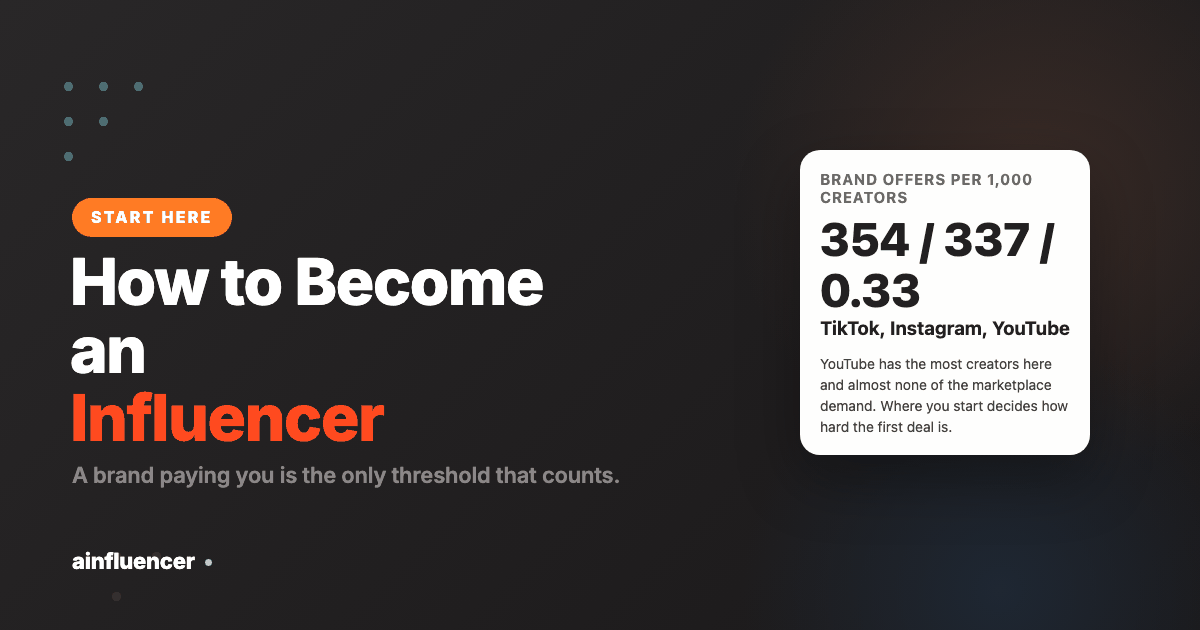
This is the decision that costs the most to get wrong, and almost every guide skips it. Here is where brand offers actually went in our marketplace, set against how many creators are on each network.
Brand offers by platform, October 2026
| Platform | Creator accounts | Offers sent | Offers per 1,000 accounts |
|---|---|---|---|
| 417,694 | 140,826 | 337 | |
| TikTok | 181,950 | 64,360 | 354 |
| YouTube | 484,113 | 159 | 0.33 |
YouTube has the most creators and almost none of the demand. A creator on Instagram or TikTok is roughly a thousand times more likely to be sent a paid offer here than one on YouTube.
One honest caveat before you act on that. This measures demand inside one marketplace, not the industry. YouTube brand deals are real and often large, but they mostly happen direct or through agencies rather than through marketplaces, which is exactly why the marketplace number is so low. So read this as: if you want brands to come to you with minimum effort, start on Instagram or TikTok. If you are willing to pitch and negotiate yourself, YouTube pays more per placement. The YouTube route in detail is in how to become a YouTube influencer.
Start on one. The advice to be everywhere is what keeps beginners at zero on three platforms. Pick the one where your format works, get to a point where brands approach you, then repurpose.
Pick a Niche Narrow Enough to Be Chosen For
Brands do not search for ‘lifestyle’. They search for the thing they sell. The narrower your niche, the shorter the list you appear on, and appearing on a short list is the entire game.
- Pick something you can make 100 posts about without resenting it. Running out of interest, not running out of reach, is what ends most accounts
- Pick something a brand sells into. Beauty, fitness, home, parenting, finance, pets and food all have advertisers. Pure entertainment has far fewer at any size
- Say the niche in your bio, in the words a brand would search. This is the cheapest optimisation available and most people skip it
- Be specific enough to be unusual. ‘Fitness’ competes with everyone. ‘Strength training for women over 40’ gets found by the brands who want exactly that
Getting to Your First Paid Collaboration
There is no follower threshold for brand work. The numbers back that up: of the 204,281 offers we counted, 77% went to creators under 100,000 followers, and the 10,000 to 100,000 band alone took 47.8%.
Your advantage early is real and measurable. Engagement falls as accounts grow: creators between 1,000 and 10,000 followers record 5.82% against 3.22% above a million. You are roughly 1.8 times more engaging than the creator a brand would otherwise pay far more for, and that is the argument to make in your pitch.
- Post consistently for 90 days first. A brand checks whether you are still active before anything else
- Make one thing that looks like an ad, before anyone pays you. Feature a product you already use, properly lit and properly captioned. It proves you can deliver a brief
- Know your numbers. Reach, engagement rate and audience country, taken from your own analytics. Quote them rather than guessing
- Decide your rate before the conversation. Our data on influencer rates is the starting point
- Make yourself findable. Join a marketplace where brands search and send offers, rather than waiting to be discovered organically
On Ainfluencer there is no subscription and no follower minimum: brands search, send you an offer, and you negotiate and get paid inside the platform, with a $10 minimum collaboration. That is how creators under a thousand followers appear in the figures above.
What to Charge, and When to Raise It
The most common early mistake is quoting a number pulled from a blog post written for a different market. Price against what you can actually deliver.
What moves your rate, and what does not
| Moves it | Does not move it |
|---|---|
| Audience country. A US or UK audience is worth substantially more to most advertisers than the same number of viewers elsewhere | Follower count on its own. Brands ask for reach and engagement |
| Engagement rate, especially while you are small, because it is where you beat bigger accounts | How long you have been posting |
| Niche. Finance, software and insurance audiences are worth more per head than general entertainment | Follower growth rate, which brands cannot verify |
| Usage rights and exclusivity. Letting a brand run your content as a paid ad is worth more than the post itself, and is the most commonly under-charged item | Being asked nicely |
| A record of delivering. Repeat clients and on-time delivery are what let you raise the number | Comparing yourself to a creator ten times your size |
Raise your rate when you are turning work down, not before. That is the only signal that your current number is too low.
Treating It as a Business
- Disclose paid partnerships. It is a legal requirement in most markets and brands check. Undisclosed ads are the fastest way to lose repeat clients
- Get the brief in writing, including deliverables, delivery date, usage rights and exclusivity, before you film anything
- Invoice and track. This is self-employment income in most countries from the first payment, not from some later threshold
- Keep the audience data. Screenshots of your reach and country split are what you send with every pitch
- Do not buy followers. Brands check engagement against follower count, and a mismatch is the clearest possible signal
What Does Not Work
- Waiting to be discovered. Organic discovery by brands is rare at any size. The creators who earn put themselves where brands are searching
- Posting on three platforms at once from day one. It is the most reliable way to stay small on all three
- Chasing a high-paying niche you have no standing in. Finance and software pay more and have audiences that detect pretending
- Free work ‘for exposure’ past the first one or two. One sample proves you can deliver. The fifth proves you work for free
- Measuring yourself in followers. Brands ask for reach, engagement and audience country. Those are the numbers to grow
If you want the platform-specific routes, we have them for YouTube and for getting your first deals on Instagram and TikTok. For what brands weigh when they shortlist, see how many followers to get sponsored.
Frequently Asked Questions
How many followers do you need to become an influencer?
None, if you mean being paid by a brand. Of 204,281 offers we counted, 77% went to creators under 100,000 followers and 1,343 went to creators with under 1,000. Brands ask for engagement and audience country far more often than for a follower number.
Which platform is best to become an influencer on?
For paid work arriving with least effort, Instagram or TikTok. In our marketplace they receive about 337 and 354 offers per 1,000 creator accounts, against 0.33 on YouTube. YouTube pays more per placement but its deals mostly happen direct or through agencies rather than marketplaces, so it suits creators willing to pitch for themselves.
How long does it take to become an influencer?
There is no honest average. What is fixed is the order: post consistently, make one piece that looks like an ad, learn your own numbers, then put yourself where brands search. The first paid deal has no threshold, so it can come far earlier than most people expect.
Can you become an influencer with a small following?
Yes, and small accounts are where most of the work is. Creators between 1,000 and 10,000 followers record 5.82% engagement against 3.22% above a million, so you are roughly 1.8 times more engaging than a creator a brand would pay far more for. Lead with that.
How do influencers get paid?
Per collaboration, negotiated with the brand, rather than per follower. Platform ad revenue is a separate and usually smaller stream that requires hitting the platform’s own thresholds. Brand deals and affiliate commission have no minimum at all.
Do I need to pick one niche?
Yes, and narrower than feels comfortable. Brands search for what they sell, not for ‘lifestyle’. A specific niche puts you on a short list, and being on a short list is what gets you chosen.
Is it too late to become an influencer?
No, but the easy reach is gone, so the route is different. Growing a general audience is hard; being the obvious choice in a narrow niche is not. That is also what brands are buying, which is why small specific accounts get paid.