How to Become a YouTube Influencer
77% of brand offers go to creators under 100,000 followers. The four stages, what gates each one, and why you can earn before monetization.
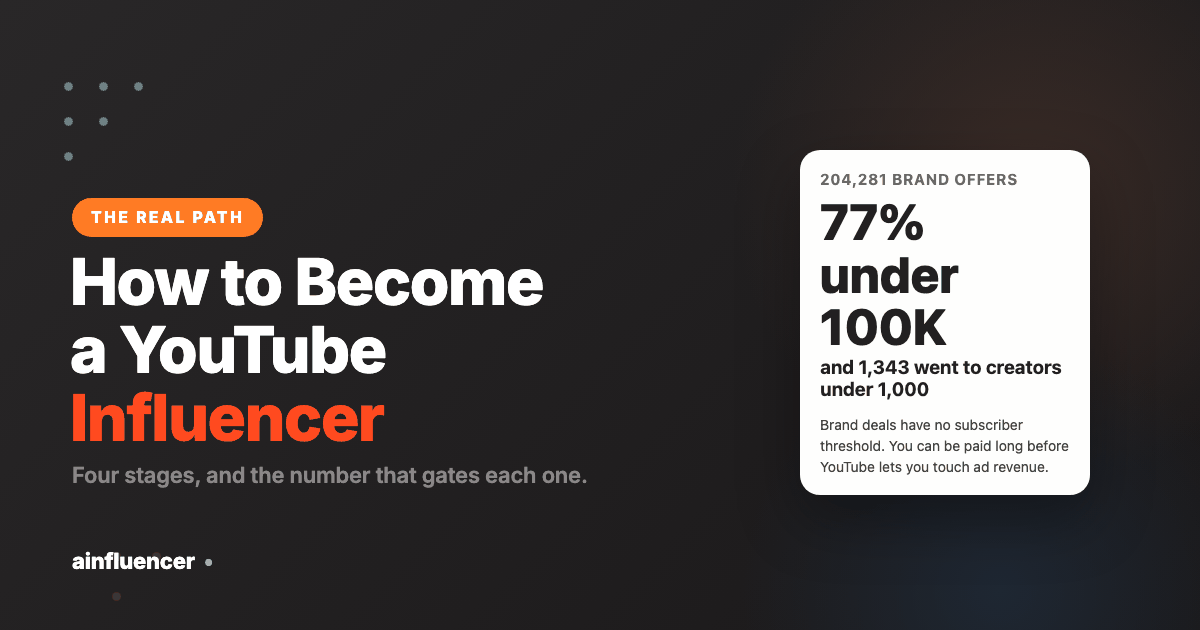
You become a YouTube influencer the moment a brand pays you, and that happens far earlier than almost every guide on this subject implies. We counted 204,281 brand offers sent through the Ainfluencer marketplace against the size of the creator who received each one. 77% went to creators with fewer than 100,000 followers, and 1,343 creators with under a thousand received one.
So the useful question is not how to get big. It is what to do at each stage, and which numbers actually gate the next one. That is what this page is.
Brands Pay Smaller Channels Than You Think
Here is the distribution, counted on 9 October 2026 across every offer in the marketplace, joined to the follower count of the creator it was sent to.
204,281 brand offers, by the size of the creator who received them
| Creator size | Offers received | Share of all offers | Creators who got at least one |
|---|---|---|---|
| Under 1,000 | 6,658 | 3.3% | 1,343 |
| 1,000 to 10,000 | 53,852 | 26.4% | 6,788 |
| 10,000 to 100,000 | 97,650 | 47.8% | 9,681 |
| 100,000 to 1 million | 41,940 | 20.5% | 3,377 |
| 1 million and above | 4,181 | 2.0% | 275 |
Two things follow, and both cut against the usual advice.
- The 10,000 to 100,000 band receives nearly half of all offers. It is the single busiest part of the market, not an awkward middle stage to rush through
- You do not need YouTube’s permission to earn. 1,343 creators with under a thousand followers have been sent paid work. The Partner Program will not let you touch ad revenue at that size, and it is irrelevant to a brand deal
Larger creators do receive more offers each, around 15 per creator above a million against 8 in the 1,000 to 10,000 band. But the volume of work sits with the small and mid channels, because that is where the brands are shopping. If you want the full picture of what brands weigh, how many followers to get sponsored goes through it tier by tier.
Stage 1: Choose a Niche, and a Country
Everyone tells you to pick a niche. Nobody tells you that on YouTube you are also picking an audience country, and that it changes your economics by an order of magnitude.
Across 483,898 YouTube creator accounts, the largest audience market is India at 33.7%, ahead of the United States at 27.5%. Those two audiences are not worth the same: the same hundred thousand views pays roughly $15 with an Indian audience and up to $1,500 with a US one, which we worked through in how much YouTube pays per view.
That is not an argument for faking an American accent. It is an argument for being deliberate: if your audience will be in a lower-paying ad market, plan on brand deals and affiliate commission as the main income from the start rather than treating them as something that comes later. Ad revenue will not carry you there.
- Pick a niche you can make 100 videos about without resenting it. Burnout, not the algorithm, is what ends most channels
- Pick one a brand sells into. Software, finance, beauty, fitness, home and parenting all have advertisers. Pure entertainment has far fewer, at any size
- Check who is already there. If every channel in your niche has a million subscribers, you are not early. If none do, ask whether the audience exists
Stage 2: The First 1,000 Subscribers
This is the stage people quit in, and the only one where the advice really is just volume and patience. A few things make it shorter.
- Decide format before topic. Long form builds watch time and earns more per view. Shorts build subscribers faster and pay almost nothing. Most channels that grow quickly use Shorts for discovery and long form for depth, and post both
- Publish on a schedule you can hold for six months, not the one you can hold for three weeks. One a week beaten consistently outruns four a week abandoned in month two
- Treat the thumbnail and title as half the work. They decide whether anything else you did matters
- Read your retention graph on every video. Where people leave is the only feedback that tells you what to change
- Post when your audience is there. Worth one hour of setup and no more, covered in the best time to post on YouTube
Do not buy subscribers or views. Beyond the obvious risk to the channel, YouTube excludes views from paid campaigns and from bots when it counts your eligibility, so purchased traffic moves you no closer to monetization while costing money.
Stage 3: Get Paid Before YouTube Pays You
This is the stage almost every guide leaves out, and it is the one that turns a hobby into an income. Brand deals have no subscriber threshold at all. Nothing stops you taking paid work at 400 subscribers except not asking.
Your advantage at this size is real and measurable: engagement falls as channels grow. Across more than 440,000 accounts, creators between 1,000 and 10,000 subscribers record 5.82% engagement against 3.22% above a million. You are roughly 1.8 times more engaging than the creator a brand would otherwise pay far more for, and that is the argument to make.
What to have ready before you approach anyone
| What | Why it matters |
|---|---|
| Your audience country split | The first thing a brand checks. Take it from YouTube Studio, Analytics, Audience, and quote it rather than guessing |
| Views per video, not subscribers | Subscribers accumulate, views do not. A brand that knows this is a brand worth working with |
| Your engagement rate | At your size it is almost certainly higher than the big channels you are competing against, so lead with it |
| A rate you will not flinch at | Decide before the conversation. Our data on influencer rates is the starting point |
| One past example | Even an unpaid collaboration or a product you covered on your own initiative. It proves you can deliver on a brief |
On Ainfluencer brands search and send the offer to you: there is no subscription, no subscriber minimum, and the minimum collaboration is $10, which is why creators under a thousand followers appear in that table at the top of this page. Sponsored YouTube videos covers how to price and structure one, and YouTube affiliate programs covers commission, which also has no threshold.
Stage 4: Turn On YouTube’s Own Monetization
Now the thresholds matter. There are two tiers and most guides describe only the top one.
What YouTube itself requires
| Fan funding tier | Full Partner Program | |
|---|---|---|
| Subscribers | 500 | 1,000 |
| Recent uploads | 3 public uploads in the last 90 days | Not required |
| Then either | 3,000 qualified watch hours in 365 days | 4,000 qualified watch hours in 12 months |
| or | 3 million qualified Shorts views in 90 days | 10 million qualified Shorts views in 90 days |
| What it unlocks | Memberships, Super Thanks, Shopping. No ads | All of that plus ad revenue and Premium |
The deadline worth knowing now: from 1 February 2027 the entry bar for new applicants doubles, to 8,000 qualified watch hours or 20 million Shorts views. Creators already in the programme are not affected. If you are anywhere near 4,000 hours, getting accepted before February is worth more than anything else on this page. The full detail, including what counts as a qualified hour and the separate 31 January terms deadline, is in YouTube monetization requirements.
How Long It Takes, Honestly
Nobody can give you a date, and anyone who does is selling something. What can be said is which stage gates which, and what each one depends on.
The path, and what actually controls each step
| Stage | What you need | What controls the pace |
|---|---|---|
| Find a format that works | Nothing | How quickly you read retention and change what you make |
| First 1,000 subscribers | Nothing | Publishing consistency, and whether the niche has an audience |
| First paid brand deal | No threshold | Whether you ask. 1,343 creators under 1,000 followers have been sent one |
| Fan funding | 500 subscribers plus 3,000 hours or 3M Shorts views | Watch time, which is a function of video length and retention |
| Ad revenue | 1,000 subscribers plus 4,000 hours or 10M Shorts views | The same, roughly doubled |
| A living from it | Usually several income streams at once | Audience country as much as audience size |
For scale, 78% of the 484,113 YouTube creator accounts in our marketplace sit below 100,000 subscribers, and that band receives three quarters of all brand offers. Being mid-sized is not a waiting room. It is the market.
The Mistakes That Cost the Most Time
- Waiting for monetization before trying to earn. The single most expensive mistake on this list. Brand deals and affiliate commission have no threshold
- Unlisting or deleting old videos. Watch hours from unlisted and deleted videos do not count toward eligibility, so a tidy-up can move you backwards
- Chasing a high-paying niche you do not belong in. Finance and insurance pay more per view and have audiences that detect pretending
- Changing the schedule to chase an optimal posting hour. Consistency is worth more than the hour
- Measuring yourself in subscribers. Brands ask for views and audience country. Those are the numbers to grow and to quote
- Buying anything. Purchased views and watch hours are excluded from eligibility and put the channel at risk
If you want the wider landscape, how many YouTube creators there are and how they break down by size, engagement and country, that is in YouTube influencers.
Frequently Asked Questions
How many subscribers do you need to become a YouTube influencer?
None, if you mean being paid by a brand. Across 204,281 offers in our marketplace, 3.3% went to creators with under 1,000 followers and 77% went to creators under 100,000. YouTube’s own ad revenue is different: that needs 1,000 subscribers plus 4,000 qualified watch hours or 10 million qualified Shorts views.
How long does it take to become a YouTube influencer?
There is no honest average, because it depends on niche, format and how quickly you act on retention data. What is fixed is the order: you can take paid brand work with no threshold at all, fan funding opens at 500 subscribers, and ad revenue at 1,000 plus a watch hour or Shorts view threshold.
Can you make money on YouTube without 1,000 subscribers?
Yes. Brand deals and affiliate commission have no subscriber minimum. Only YouTube’s own ad revenue is gated, and at 1,000 subscribers it pays very little anyway, particularly outside high-CPM markets.
Is it better to post Shorts or long videos to grow?
Both, for different jobs. Shorts build subscribers quickly and pay almost nothing per view. Long form builds the watch time that unlocks ad revenue and earns far more per view. The two thresholds are separate and cannot be combined, so pick which one you are chasing.
Do small YouTube channels really get brand deals?
Yes, and they get most of them. The 10,000 to 100,000 band alone received 47.8% of every offer we counted, and 1,343 creators with fewer than 1,000 followers received at least one. Small channels engage at roughly 1.8 times the rate of channels above a million, which is the reason.
What should I have ready before pitching a brand?
Your audience country split from YouTube Analytics, your typical views per video rather than your subscriber count, your engagement rate, a rate you have already decided on, and one example of work you have delivered, paid or not.
Are the YouTube monetization rules changing?
Yes, on 1 February 2027. New applicants will need 8,000 qualified watch hours in 365 days or 20 million qualified Shorts views in 90 days, double the current bar, still with 1,000 subscribers. Creators already in the Partner Program are not affected.