How Much Does YouTube Pay Per View?
$0.15 to $15 per 1,000 views, and your audience’s country decides which. RPM by market, the real arithmetic, and what changes on 1 February 2027.
Between roughly $0.0002 and $0.015 per view, which is $0.15 to $15 per thousand. That is a hundredfold range, and it is honest rather than evasive: the single biggest factor is not your niche, your subscriber count or your video length. It is which country your viewers are sitting in.
This article shows the whole chain from one view to one payment, what a view is worth in the five markets most creators actually have audiences in, and what changes on 1 February 2027 when YouTube’s new Partner Program rules take effect.
The Chain From a View to Your Bank Account
Most articles on this subject skip straight to a number. The number only makes sense once you can see the five things that happen in between, because every one of them takes a cut or loses a view.
What happens between a view and a payment
| Step | What happens | Where the money goes |
|---|---|---|
| 1. Someone watches | A view is counted | Nothing yet. Most views never carry an ad at all |
| 2. An ad is served, sometimes | Only a fraction of views are monetised, depending on advertiser demand, the viewer’s country, ad blockers and whether the video is advertiser friendly | This is the step that quietly destroys the maths in most online calculators |
| 3. The advertiser pays a CPM | CPM is the price per 1,000 ad impressions, set by auction | To YouTube, in full |
| 4. YouTube takes its share | You keep 55% of long-form ad revenue and 45% on Shorts, figures YouTube restated in its August 2026 announcement | 45% of long-form revenue stays with YouTube |
| 5. You see an RPM | RPM is what you receive per 1,000 views, after YouTube’s cut and averaged across every view including the unmonetised ones | Your AdSense balance, paid out once it passes the threshold |
The one definition most articles get wrong: RPM is not CPM multiplied by 0.55. CPM counts ad impressions, RPM counts all views. Because a large share of views never carry an ad, RPM is normally far lower than 55% of CPM. If a calculator tells you otherwise, it is overestimating your income, often by several times.
What a View Is Worth Where Your Viewers Live
Here is why a single answer is impossible, using data from our own marketplace rather than an industry guess. We counted the primary audience country of 483,898 YouTube creator accounts in October 2026, and set it beside the published RPM estimates for those same markets.
Audience country of 483,898 YouTube creator accounts, against reported RPM
| Audience market | Share of our creators | Reported RPM per 1,000 views | What 100,000 views pays |
|---|---|---|---|
| India | 33.7% | $0.15 to $1.00 | $15 to $100 |
| United States | 27.5% | $3 to $15 | $300 to $1,500 |
| Brazil | 9.3% | $0.50 to $1.50 | $50 to $150 |
| Japan | 4.3% | $1 to $3 | $100 to $300 |
| Germany | 3.7% | $2 to $6 | $200 to $600 |
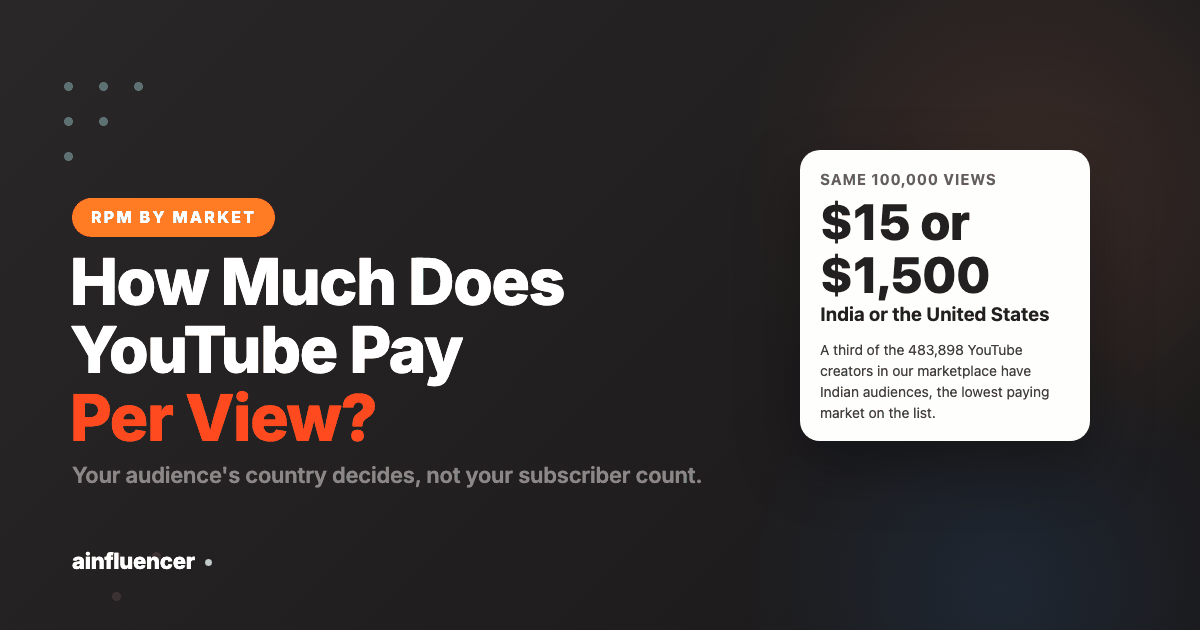
The same 100,000 views is worth $15 to an Indian audience and up to $1,500 to a US one. Comparing midpoints rather than extremes it is still roughly a fifteenfold gap.
And the largest single group of creators on this platform is the one at the bottom of that pay scale. A third of YouTube creators here have Indian audiences, against 27.5% with US audiences. If you are in that third, every earnings calculator you have used was built around the wrong country, which is why your real AdSense cheque never matches what they promised.
Two qualifications, stated plainly. Google publishes no official CPM or RPM by country, so every figure above comes from third-party estimates, and published 2026 estimates disagree with each other by up to three times. And niche cuts across geography: a finance channel with an Indian audience can out-earn a gaming channel with a US one. Treat the table as an order of magnitude, then read your own numbers in YouTube Studio under Analytics, Revenue, where RPM is broken out by country.
Shorts Pay Differently, and Less
Shorts are not a smaller version of the same deal. Three things differ.
- The share is 45%, not 55%. YouTube confirmed both figures again in August 2026
- It is a pool, not your ad. Shorts ad revenue is collected platform-wide each month, an amount is taken out to cover music licensing, and what remains is divided according to each creator’s share of engaged views
- The per-view rate is an order of magnitude lower. A long-form RPM measured in dollars sits beside a Shorts RPM measured in cents
That does not make Shorts worthless. It makes them a reach product rather than a revenue product: they are how people find you, and the money arrives through the audience they build, not through the Shorts themselves.
The pooling is worth understanding properly before you judge a Shorts figure, because you are paid a share of a country-level pot rather than for your own views. We worked through YouTube’s own example in YouTube Shorts monetization.
The Rules Change on 1 February 2027
This is the part worth reading twice, because it is recent and most earnings articles still describe the old system. In August 2026 YouTube announced what it called the first significant changes to the Partner Program since 2018. Per YouTube’s announcement, they take effect on 1 February 2027.
What YouTube announced, in its own terms
| What changes | The new rule | Who it affects |
|---|---|---|
| Joining the Partner Program | New applicants will need 8,000 qualified watch hours in the last 365 days, or 20 million qualified Shorts views in the last 90 days | New creators only. YouTube states the update will not impact creators already in YPP |
| Earning ad revenue on Shorts | 10 million qualified Shorts views over the last 90 days to be eligible for ads and subscription revenue sharing on Shorts | Channels below it stay in YPP and keep earning on long-form, and Shorts revenue sharing resumes automatically once they cross 10 million again |
| Fan funding and shopping | Entry thresholds remain unchanged | Nobody. This is the reassurance |
| The revenue split | 55% long-form and 45% Shorts, restated rather than changed | Nobody. No change announced |
Read in plain terms: the bar to start earning ads is going up sharply. The widely reported current requirement is 4,000 watch hours in 365 days, so 8,000 is double it, and the Shorts route for new applicants doubles from 10 million to 20 million views.
YouTube also says it will introduce new incentive programs for channels below the Shorts threshold, naming bonuses for YouTube Shopping, incentives for brand deals and earnings boosts for starting trends. No amounts, eligibility rules or dates have been published, so treat that as a stated intention and not as income you can plan around.
What to do about it. If you are close to the current threshold, applying before 1 February 2027 is worth more than any optimisation in this article, because existing partners are explicitly unaffected. If you are a long way off, plan on income that does not depend on YPP at all.
There is more to the February change than the thresholds, including a new definition of an active channel and a hard deadline of 31 January 2027 to accept updated terms in Studio. Our guide to YouTube monetization requirements goes through all of it, with both tiers and what actually counts as a qualified watch hour.
Ad Revenue Is the Smallest Part of Most Creators’ Income
Having gone through the arithmetic honestly, here is the conclusion it leads to. For the great majority of channels, per-view ad revenue is not a living. At an Indian RPM, a video would need roughly seven million views to pay $1,000. A single sponsored video from one brand can pay more than a year of AdSense on the same channel.
The three ways a channel actually earns, compared
| Income stream | What it depends on | Why creators end up here |
|---|---|---|
| Ad revenue | View count and audience country | Automatic once you qualify, and almost entirely outside your control |
| Brand deals | Audience fit, engagement and your own negotiation | Priced per video rather than per view, so a small engaged audience in a valuable niche is worth far more than raw reach |
| Affiliate commission | Whether your viewers buy what you recommend | No minimum audience, pays from the first sale, and stacks on top of everything else |
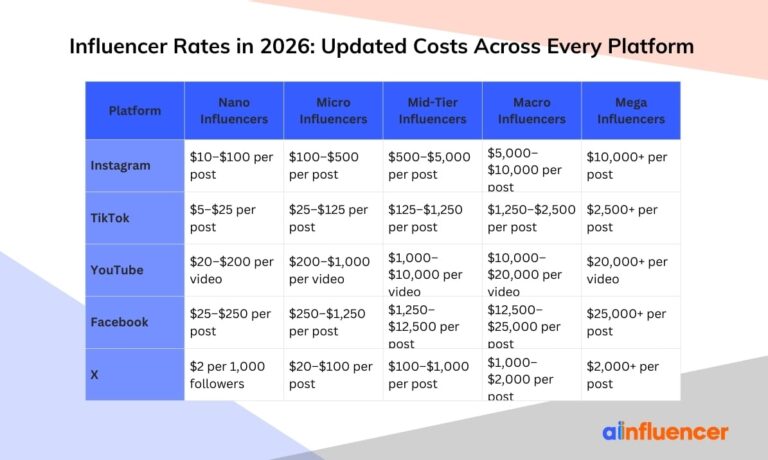
The second and third are where the geography problem reverses. An advertiser bidding on your Indian audience pays an Indian CPM, but a brand buying a sponsored video is buying your audience’s trust, and it negotiates against your rate card rather than an ad auction. Our data on influencer rates shows what creators actually charge, and sponsored YouTube videos covers how to price and structure one.
On Ainfluencer, brands search and send offers directly and you negotiate and get paid inside the platform. There is no subscription and no minimum subscriber count, which is the practical difference from waiting on YPP: the minimum collaboration is $10 and you can take your first deal before you qualify for a single cent of ad revenue. For commission on top, see YouTube affiliate programs.
If you would rather someone else brought the deals to you, the creator-side section of our guide to YouTube influencer marketing agencies sets out what talent managers and networks take and which contract clauses to read first. And if you are reading this from the other side of the table, as a brand working out what a placement should cost, YouTube influencer marketing is the companion piece.
Get More From the Views You Already Have
- Check your RPM by country first. YouTube Studio, Analytics, Revenue. If one market is carrying your income, making content that serves it is worth more than any posting tweak
- Watch time beats view count for ad revenue. A longer watched video carries more ad slots, which is why a 12 minute video and a 2 minute one with identical views pay differently
- Do not chase high-CPM niches you do not belong in. Finance and insurance pay more per view and have audiences that detect pretending
- Fix timing once, then leave it. Our guide to the best time to post on YouTube is worth an hour of your attention, not a week of it
- Add a second income stream before optimising the first. Going from zero to one brand deal moves more money than doubling an RPM measured in cents
Frequently Asked Questions
How much does YouTube pay per view?
Roughly $0.0002 to $0.015 per view, or $0.15 to $15 per thousand, depending almost entirely on where your viewers live. An audience in the United States is worth something like fifteen times an audience in India for the same number of views, and published estimates vary by up to three times even within a single market.
How much does YouTube pay for 1,000 views?
That figure is your RPM. Reported estimates run from about $0.15 to $1.00 for an Indian audience, $0.50 to $1.50 for Brazil, $1 to $3 for Japan, $2 to $6 for Germany and $3 to $15 for the United States. Your own number is in YouTube Studio under Analytics, then Revenue.
How much does YouTube pay for 1 million views?
Taking the midpoints of the ranges above, roughly $9,000 in the United States, $4,000 in Germany, $2,000 in Japan, $1,000 in Brazil and around $575 in India. Treat these as orders of magnitude rather than forecasts, because the underlying estimates disagree widely.
What is the difference between CPM and RPM?
CPM is what an advertiser pays per 1,000 ad impressions, before YouTube takes its share. RPM is what you receive per 1,000 views, after YouTube’s share and averaged across every view including the many that never carried an ad. RPM is not CPM multiplied by 0.55, and any calculator that treats it that way overestimates your income.
What percentage does YouTube take?
YouTube keeps 45% of long-form ad revenue and 55% on Shorts, which means you receive 55% and 45% respectively. YouTube restated both figures in its August 2026 Partner Program announcement and did not announce any change to them.
Are the YouTube monetization requirements changing?
Yes, on 1 February 2027. YouTube has announced that new applicants will need 8,000 qualified watch hours in the last 365 days, or 20 million qualified Shorts views in the last 90 days. Creators already in the Partner Program are explicitly not affected, and fan funding and shopping thresholds stay the same.
Will I lose Shorts revenue under the new rules?
Only Shorts revenue sharing, and only if you are under 10 million qualified Shorts views in the last 90 days from 1 February 2027. YouTube says such channels stay in the Partner Program, keep earning on long-form content, and have Shorts revenue sharing resume automatically once they cross 10 million views again.
Can I make money on YouTube without being monetized?
Yes, and most creators earn more this way than from ads. Brand deals are priced per video rather than per view and have no subscriber minimum, and affiliate commission pays from the first sale. Neither depends on the Partner Program.