YouTube Influencer Marketing
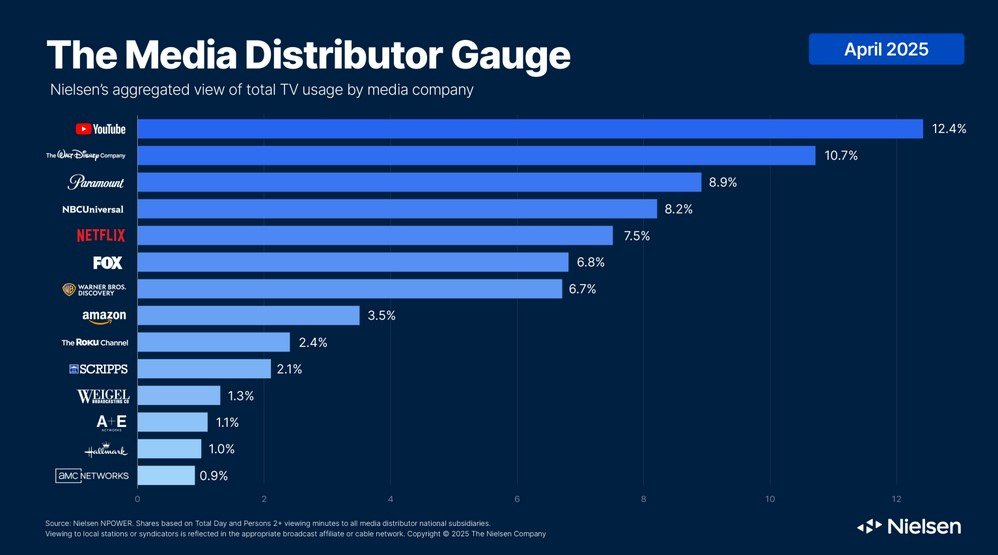
With more than 2.7 billion monthly users, YouTube is more than simply a platform for videos; it’s also a search engine, a center for entertainment, a classroom, and a shopping assistant all combined.
Brands that successfully use YouTube influencer marketing gain more than simply views; they also gain trust, viewing time, and long-lasting conversions. This is what YouTube is about nowadays.
So whether you’re a startup with no knowledge of influencer types or a seasoned brand, this guide breaks down how to do YouTube influencer marketing the smart way, without sounding like an ad no one asked for.
What Is YouTube Influencer Marketing?
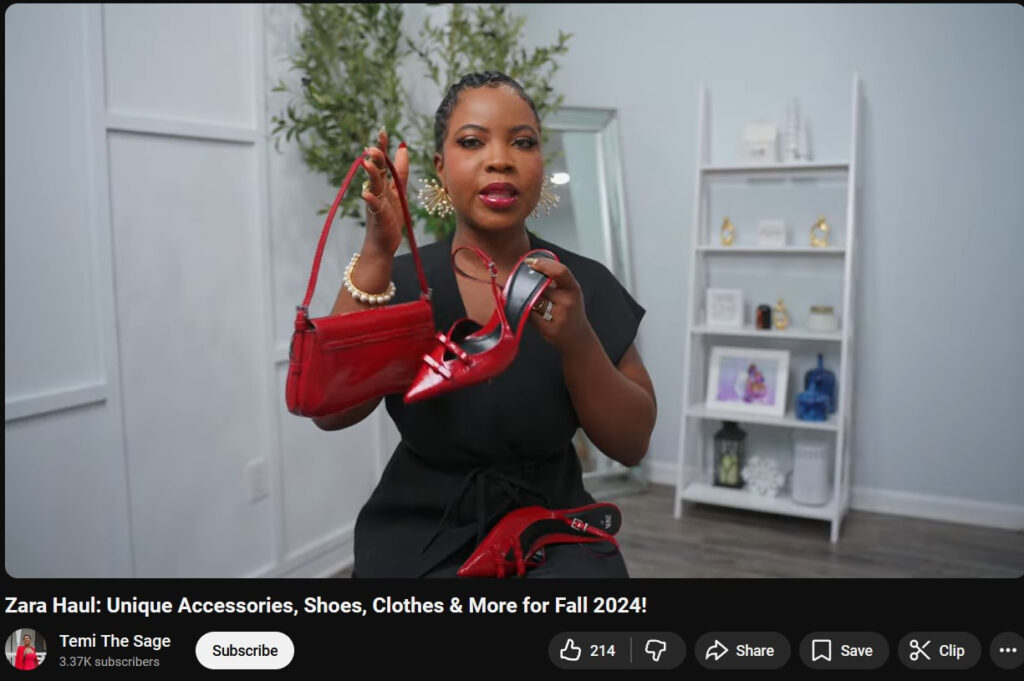
YouTube influencer marketing is a strategy where brands partner with YouTube content creators to showcase their products or services in their trendy videos.
This helps brands to tap into the creator’s trust, storytelling, and built‑in audience.
Unlike pre‑roll YouTube ads, these integrations feel more like recommendations than commercials, which is why they work better for conversions and brand love. Instead of shouting “Buy this!”, YouTube influencers show:
- How a product fits into real life
- Why do they personally use it
- What they like and don’t like about it
Why Does YouTube Influencer Marketing Work?
Compared to Instagram or TikTok, content on YouTube is much more durable thanks to its mix of TV, search engine, and community hub.
In exchange for paying more for each YouTube ad, brands receive content that can rank on Google, appear again in recommendations, and continue to generate hits and sales for months or even years.
Considering influencer rates, having content that lasts this long is a win by itself.
Here are the key advantages of YouTube influencer marketing:
- Long‑form storytelling: Influencers can put periods of 5 to 20 minutes, educating and weaving their offer naturally into their narrative. This is perfect for products that need demos, explanations, or comparisons.
- Search and discoverability: YouTube is the world’s second‑largest search engine, and its videos rank in Google results, giving your campaigns built‑in SEO value. This means that with the right titles, descriptions, and tags, one video can become an eternal ad for searches around your niche.
- Deep audience trust: YouTube viewers regularly watch creators for years, forming relationships that make recommendations feel like advice from a friend. Additionally, engagements in the comments, where people engage in conversations and ask questions, turn one video into a forum about your brand.
We have since broken the whole population down by size, engagement and audience country in YouTube influencers: the short version is that 3.4% of channels hold 61% of all subscribers, and the tiers below them engage at nearly twice the rate.
What the Marketplace Data Actually Shows
Most articles on this subject quote YouTube’s global user numbers. Those tell you the audience is large; they tell you nothing about whether you can book anyone. The figures below come from Ainfluencer’s own creator marketplace, counted in October 2026, and they describe supply rather than reach.
| Platform | Active creator accounts |
|---|---|
| YouTube | 483,754 |
| 383,143 | |
| TikTok | 171,437 |
YouTube is the largest of the three, which surprises most brands. It is also the newest, and far fewer brands are actively recruiting there, so a personalised invitation competes with very little.
| Subscribers | Accounts | What this band is good for |
|---|---|---|
| Under 5,000 | 120,349 | Rarely bookable. Most marketplaces expect around 5,000 at review |
| 5,000 to 10,000 | 43,655 | Tight niches, high trust, lowest cost per placement |
| 10,000 to 100,000 | 212,997 | The deepest pool, and where most brands should start |
| 100,000 to 1 million | 90,086 | Real reach, real production values, real fees |
| Over 1 million | 16,667 | Brand awareness plays, usually agency-brokered |
The 10,000 to 100,000 band holds almost half of all available YouTube creators. If your shortlist keeps coming back empty, the usual cause is a follower filter set too high rather than a shortage of creators.
Types of Content for YouTube Influencer Marketing
There are many types of content that you, as a brand, can ask influencers about.
This is purely based on your influencer marketing strategy and approach. Each one has its own benefits and is good for specific topics.
Let’s see what they are:
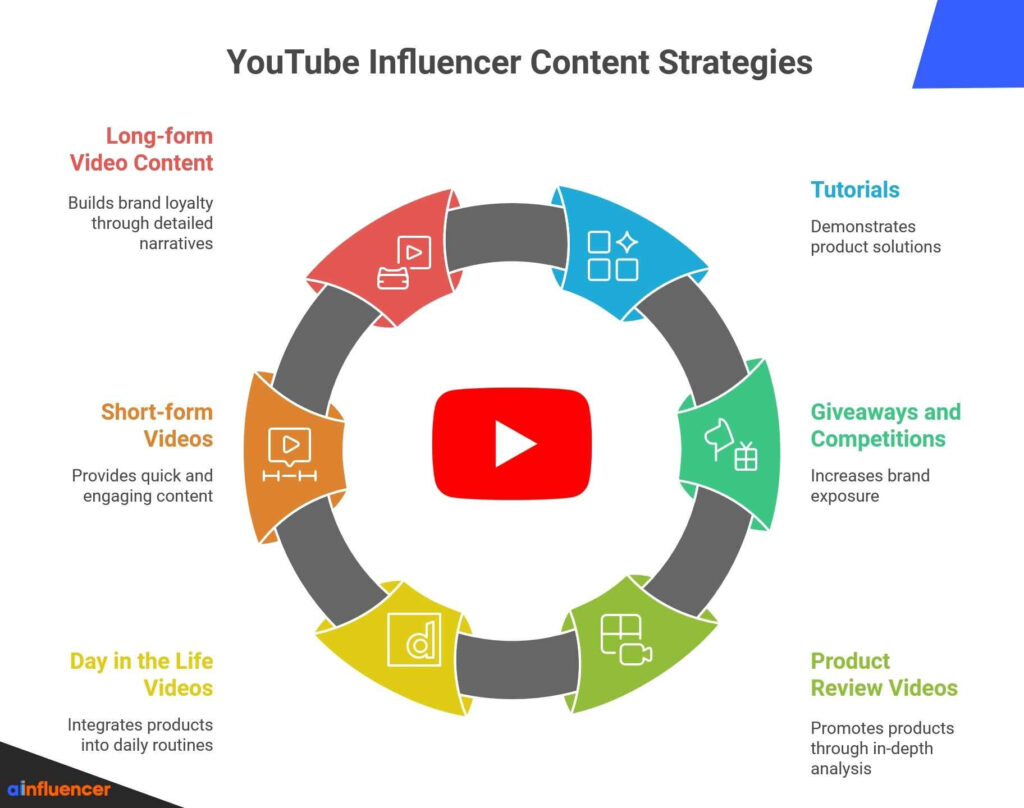
- Tutorials: How-to manuals and tutorials are excellent for demonstrating how a product or service solves actual issues.
- Giveaways and competitions: Offering a product or service as a prize increases brand exposure and engagement.
- Product Review Videos: Influencers can use in-depth research to promote your company. Unboxing videos or “getting ready with me” are two possible ways to achieve this.
- Day in the Life: Similar to “get ready with me” films, “day in the life” videos can be a fantastic method to incorporate the product or service into the content and establish a strong connection with the creator’s everyday life.
- Short-form videos on YouTube: Smaller material that is quick to engage.
- Long-form video content: Detailed narratives that increase brand loyalty.
You can use YouTube influencer content like above to increase conversions. This is if you match the video format with your overall goals.
You can also learn more from the best YouTube influencer marketing examples.
How to Do YouTube Influencer Marketing?
Now is the time to learn how to do a YouTube influencer marketing campaign in the right way to bring more audience and sell better. Let’s start:
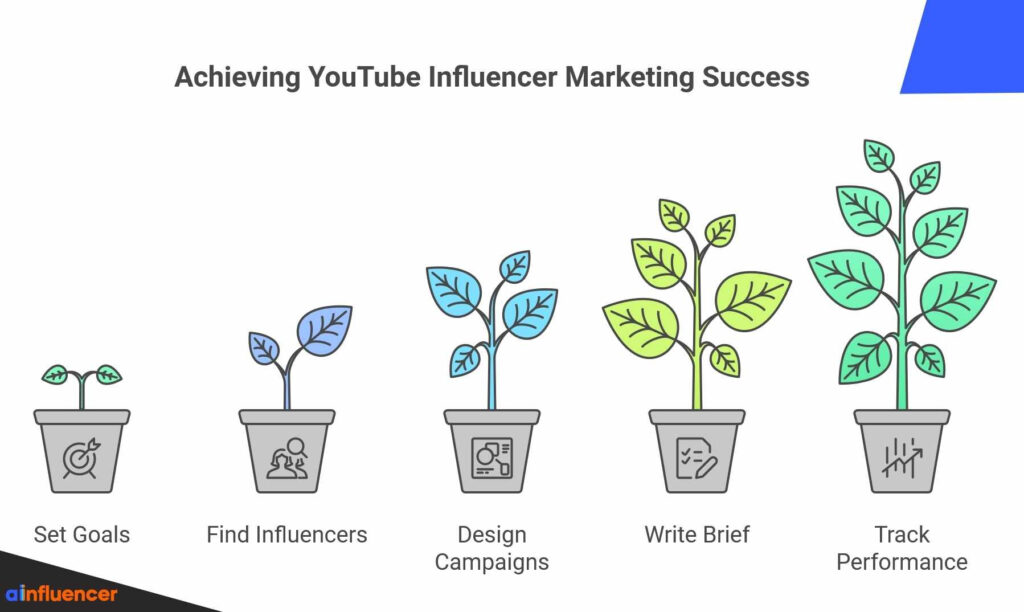
1. Set Goals and KPIs
Before anything else, define what you want from your marketing campaign and how you should track it:
- Awareness: This means more impressions, unique viewers, and new branded search volume.
- Engagement: If your goal is more likes, comments, average watch time, shares, or subscriber growth.
- Performance: Higher link clicks, sign‑ups, and sales can be another goal for your marketing campaign.
Learn about the best influencer marketing KPIs and tie each creator to a few focused KPIs and share them transparently in the brief so everyone knows what success means and what you expect from them.
2. Find the Right Influencers
You need creators that match your brand DNA and not just some big and famous names. This is an important factor to understand and must be kept in mind. Look for:
- Views‑to‑subs ratio: A nano influencer averaging 30K views per video is often more valuable than a mega influencer averaging 20K views. You can find these influencers in forums and communities as well.
- Comment quality: Look for thoughtful comments and questions rather than empty “nice video!” spam.
- Content style and tone: Does their storytelling naturally fit how your product should appear? For example, do you want a serious, playful, or educational tone?
- Brand alignment: Search their older uploads to check for controversial content, competitor promos, or values that clash with your positioning.
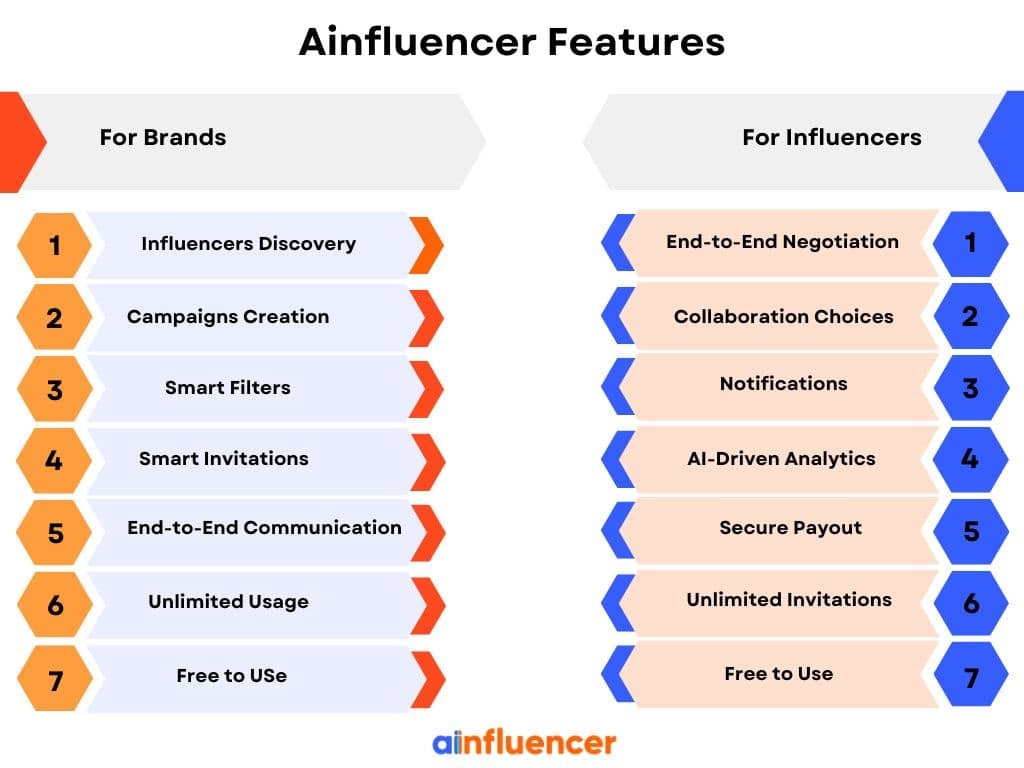
This is where YouTube influencer marketing platforms and search tools like Ainfluencer shine, helping filter creators by niche, engagement, and audience demographics.
If you would rather not run the search yourself, an agency will do it for you and take a margin for doing so. We compared fourteen of them in YouTube influencer marketing agencies, including what each pricing model costs and when booking creators direct is cheaper.
3. Design Campaigns as Storytelling
Storytelling feels real, while one-time ads are like product placement. Here is a straightforward framework for your influencer marketing campaign on YouTube:
- Soft introduction: Start with a casual inclusion of your brand in a vlog or relevant video with a low‑pressure mention and link in description. The goal is familiarity with your brand.
- Everyday usage: In this step, the creator integrates your product into routines, tutorials, or themed content showing real‑life use cases. This is the proof to show the audience that the product does what it’s supposed to do.
- Deep dive or review: This is the last step, which includes a detailed breakdown of features, pros and cons, comparisons, plus strong CTA and incentives. Your goal here is conversion.
This multi-step framework works particularly well for more expensive or complicated products, such as software or technology.
4. Write a Brief to Guide Influencers
The fastest way to destroy your YouTube influencer marketing campaign is to write a script so strict that the creator sounds like an advertiser.
Instead, follow these rules:
- Non‑negotiables: These are your key product facts, legal disclaimers, must‑mention benefits, and correct brand phrasing that can not be changed.
- Soft restrictions: What not to claim, any off‑limits topics, and required formats like at least 60 seconds of integrated mention.
- Freedom: Let the influencer decide storytelling angle, jokes, transitions, and how your product fits into their world.
Influencers built their audience without you. Your job is to put your product into what already works, not to turn them into your spokesperson.
5. Track Performance
Because YouTube allows clickable links in descriptions, it’s perfect for measurable performance.
Try to learn how to track influencer marketing results and build robust tracking into every YouTube influencer marketing campaign. Use:
- Unique links: Try one URL per creator, tagged with UTMs so you can see traffic and conversions by partner.
- Discount codes: These are easy to remember and share in‑video, especially for viewers watching on TV who can’t click.
- Time‑based analysis: Watch performance in the first 72 hours, 30 days, and 90 days to understand both the launch spike and long-term effect.
Use these data to double down on good performers or finish the ones that don’t meet your expectations.
Choosing the Placement Format
The section above covers what the video is about. This one covers what you are actually buying, which is a different decision and the one that sets the price. Four structures account for almost every YouTube deal, and briefing the wrong one is the most common way a budget gets spent badly.
| Format | What you get | Best for | What drives the cost |
|---|---|---|---|
| Dedicated video | The whole video is about you | A launch, a complex product, anything needing a demonstration | Days of scripting, filming and editing. The most expensive by a wide margin |
| Integration | A 60 to 90 second segment inside the creator’s own video | Most campaigns. It borrows the video’s audience without asking them to watch an ad | An hour of script and a reshoot, so far cheaper than a dedicated video while reaching the same viewers |
| Shorts | One or several short vertical videos | Reach and awareness, or testing a creator before a larger booking | Low production cost, but Shorts are a discovery format and convert differently |
| Series or ambassador | Several videos over weeks or months | Products that need repeated exposure before anyone buys | Negotiated as a package, usually cheaper per placement than booking the same videos one at a time |
The default for most brands is the integration. A dedicated video reads as an advertisement and is priced like a production; a 60 second segment inside a video someone chose to watch is both cheaper and, for most products, more persuasive. Start there unless the product genuinely cannot be explained in ninety seconds.
Whichever you pick, price the production rather than the placement. The transaction structure, the platform fee and what the creator actually receives are set out in the costs section below.
What Changes by Vertical
The mechanics are the same everywhere; what changes is which creator tier fits, which format works and what you can honestly measure. These are the four cases that behave most differently.
| Vertical | What works | Creator tier that fits | What to measure |
|---|---|---|---|
| SaaS and B2B | Integrations inside tutorial and workflow content, where the product appears while solving the problem the viewer searched for | Micro and mid. Audience relevance beats reach by a long way here, and a 12,000 subscriber channel in your category can outperform a general business channel ten times the size | Trial starts and demo bookings, not views. The sales cycle is long, so expect attribution to be partial |
| Ecommerce and DTC | Reviews, hauls and unboxings, with a discount code and a tracked link on every placement | Micro for volume, with a small number of mid channels for a flagship launch moment | Code redemptions and tracked link revenue. This is the one vertical where attribution is genuinely clean |
| Apps and games | Dedicated videos and Shorts, because the product is the content. Gameplay and walkthroughs do the selling | Mid and macro, since install volume needs reach | Installs by source, and day-7 retention. Install counts alone flatter a bad campaign |
| Local and services | Integrations with creators whose audience is actually in your catchment area | Nano and micro, almost always | Enquiries and bookings. Check audience location before anything else, because reach outside your area is worthless |
The filter that applies to all four is audience country. Across 483,898 YouTube creator accounts we counted, the largest audience market is India at 33.7%, ahead of the United States at 27.5%. If you sell in one market, a meaningful share of any unfiltered shortlist is reach you cannot convert, which is why it is the first filter rather than the last. YouTube influencers has the full breakdown by size, engagement and country.
And in every vertical the evidence points at the same tier. Of 204,281 brand offers we counted, 77% went to creators under 100,000 followers, with the 10,000 to 100,000 band alone taking 47.8%. Those smaller channels also record 5.82% engagement between 1,000 and 10,000 subscribers against 3.22% above a million, so the busiest part of the market is also the most engaged one. Micro influencers covers running that properly, and finding creators on YouTube covers narrowing a search by category, country and size.
Where YouTube Influencer Marketing Is Headed Next?
The future of YouTube influencer marketing is smarter. Creators are becoming businesses, and you need to learn how to collaborate with influencers.
Brands that succeed will be the ones that treat influencers as partners, not placements, and storytelling as strategy. Expect to see more:
- Long-term creator ambassadorships.
- SEO-driven video collaborations.
- Creator-led product education.
- Integrated shopping experiences.
In short, YouTube influencer marketing is evolving from just a tactic into a core growth channel.
If the UK is your market specifically, British YouTubers has the size and engagement breakdown for creators with UK audiences, and the creator-location versus audience-location trap that catches most UK shortlists.
Four Things That Behave Differently on YouTube
| What to expect | |
|---|---|
| Each channel is a separate listing | A creator with three channels appears three times, with different audience data on each. Invite the one you actually want |
| Lead times are longer | A scripted and edited integration is not a same-week job. Every deadline on the deal counts from the agreed publish date, so be generous with it |
| Agree a permanent duration | The entire value of YouTube is the long tail. A temporary post defeats the point, and duration is a recorded term on the offer |
| Check the live channel before you price | Marketplace data refreshes on a cycle, so subscriber counts on older profiles can lag. Open the channel and look |
If you are new to the delivery side, reviewing and approving a delivery explains the approval window and why nothing is approved automatically.
Conclusion
YouTube influencer marketing is no longer just about paying for a shoutout in some random videos.
It is about building repeatable and story‑driven partnerships that will help brands across search engines, social media, and communities.
You, as a brand, should treat creators as strategic partners to achieve a long‑form collaboration that educates, entertains, and sells in a way traditional ads can not. Don’t miss this opportunity.
What a YouTube Placement Actually Costs
There is no standard rate card, and anyone publishing one is guessing. What is fixed is the structure of the transaction, and knowing it stops you being surprised at checkout.
| Line | Who pays it | Detail |
|---|---|---|
| The agreed fee | You | Negotiated per creator. The platform minimum is $10, which is irrelevant for a video but is the floor |
| Platform fee | You, on top | 25% on Free, 20% on Starter, 15% on Pro, 3% on Ultimate |
| Payout fee | The creator, at withdrawal | A flat 20%, so a creator on a $500 deal receives $400 |
| Content insurance | You, optional | 10% of the product value, only if you ship something physical |
Price the production rather than the placement. A 60 second integration inside a 12 minute video is a day of scripting, filming and editing around it, which is why a YouTube fee sits well above a feed post from a similarly sized account. Where in the video the mention falls matters too: minute two and the outro are different products and are priced differently.
The structure that works best on YouTube is a fee plus an affiliate commission. The fee covers the production, which a creator cannot fund themselves; the commission covers the long tail, because the video keeps being found through search for years and the description link keeps converting. On Ainfluencer 6,512 creators have already connected a YouTube channel on the affiliate side, so the supply for that structure exists.
For the full mechanics, see how to work with YouTube creators and how to run an affiliate program.
FAQs
1. Why Is YouTube Influencer Marketing Effective?
YouTube influencer marketing works because Influencers often have loyal audiences who trust their recommendations more than traditional ads.
2. How Much Does YouTube Influencer Marketing Cost?
The cost of YouTube influencer marketing varies widely depending on the influencer’s subscriber size, engagement rate, content type, and exclusivity. It can start from a few hundred dollars for nano influencers to tens of thousands for top creators.
3. Do YouTube Influencers Need to Disclose Sponsored Content?
Yes, influencers are required to disclose sponsored content according to advertising regulations and YouTube policies. Clear disclosures help maintain transparency and trust with audiences.
4. How Long Does it Take to See Results from YouTube Influencer Marketing?
It can vary. Some campaigns see immediate traffic and sales, while others focus on long-term brand awareness. Since YouTube content is always searchable, performance often improves over time.