YouTube Shorts Monetization
There is no ad on your Short. Revenue is pooled by country, music comes out first, and you keep 45%. YouTube’s own example, worked through.
Shorts do not earn money the way long-form videos do, and almost every guide to this subject describes the wrong mechanism. There is no ad on your Short. Ad revenue from the whole Shorts Feed is pooled by country each month, music licensing is taken out of that pool, what remains is divided according to each creator’s share of engaged views, and you keep 45% of your slice.
Everything on this page is taken from YouTube’s Shorts monetization policies, read on 9 October 2026, including YouTube’s own worked example. Where YouTube does not state something, this article says so rather than guessing.
The Four Steps, as YouTube Describes Them
How Shorts ad revenue reaches you
| Step | What happens | What it means for you |
|---|---|---|
| 1. Pool | Revenue from ads running between videos in the Shorts Feed is added together each month | Whether an ad ran next to your Short is irrelevant. You are paid from a shared pot |
| 2. Calculate the Creator Pool | That revenue is allocated into the Creator Pool based on engaged views and music usage across Shorts from monetizing creators | This is where music licensing comes out, before anyone is paid |
| 3. Allocate | The pool is distributed by each creator’s share of total engaged views from monetizing creators’ Shorts in each country | You are competing for a share, so your earnings depend on what everyone else did that month, not only on what you did |
| 4. Apply the revenue share | Creators keep 45% of their allocated revenue, whether or not music was used | The remaining 55% stays with YouTube. On long-form the split is the other way round, 55% to you |
YouTube’s stated reason for pooling is to pay everyone who makes up the Shorts experience rather than only the creators who happened to have an ad next to their video. The practical consequence is that your Shorts income moves with the whole country’s Shorts output, which is why it can fall in a month when your own views went up.
YouTube’s Own Worked Example
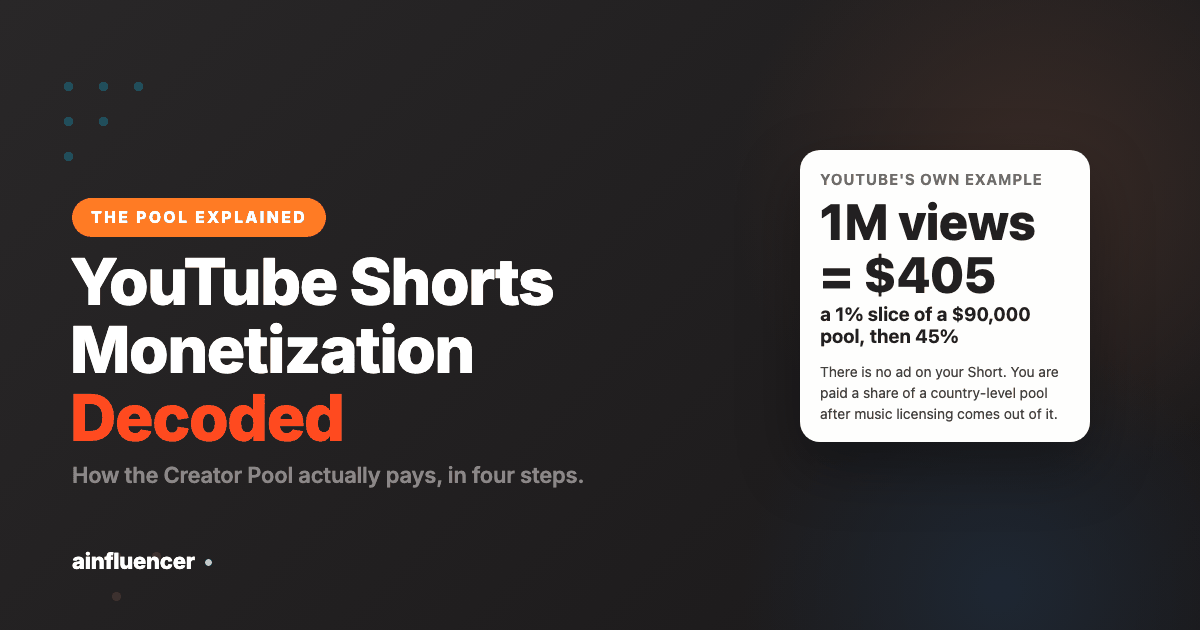
YouTube publishes a hypothetical, and it is the clearest thing on the subject anywhere. The numbers are invented to illustrate the mechanism, not to represent a typical month.
YouTube’s hypothetical: one country, one month
| Stage | Figure |
|---|---|
| Total engaged Shorts views in Country A | 100,000,000 |
| Ad revenue from the Shorts Feed | $100,000 |
| Share of those Shorts using 1 music track | 20% |
| Creator Pool after music licensing | $90,000, with $10,000 covering music licensing |
| Your Short’s engaged views | 1,000,000, which is 1% of the total |
| Your allocation from the pool | $900 |
| Your 45% revenue share | $405 |
Run the arithmetic to the end and that example implies roughly $0.40 per 1,000 engaged views, or about four cents per hundred. Treat that as the shape of the thing rather than as a rate: YouTube states no RPM for Shorts anywhere on the page, and every input in the example is hypothetical. Your real figure appears in YouTube Analytics, where estimated daily Shorts Feed ad revenue is shown from the day you start monetizing.
For the comparison that matters, long-form RPM is measured in dollars rather than cents, and it varies enormously by audience country. We broke that down in how much YouTube pays per view.
Music Shrinks the Pool, Not Your Share
This is the single most misreported part of Shorts monetization, and getting it right changes what you do. Many articles tell creators that using music cuts their earnings. It does not cut your share.
What music actually does, per YouTube
| Tracks in the Short | How much of that Short’s revenue reaches the Creator Pool |
|---|---|
| None | All of it |
| 1 track | Half. The rest covers music licensing |
| 2 tracks | One third. The other two thirds cover music licensing |
YouTube works through one and two tracks and states no rule beyond that, so neither will we. What it does state plainly is the part creators need: using music does not affect your allocation from the Creator Pool or your revenue share rate. You are credited with 100% of the engaged views on your Shorts either way, and you keep 45% either way.
So the effect is collective rather than personal. Music usage across the whole country shrinks the pool everyone draws from, which lowers the value of a view for every creator including the ones who used no music at all. In YouTube’s example, 20% of Shorts using a single track cost the pool $10,000 out of $100,000.
One more limit worth knowing: only music from YouTube’s music industry partners, or generated by Dream Track, is credited this way. YouTube says no other category of third-party content is credited as contributing to a Short at this time, even where a Content ID monetize policy is set.
The Module You Have to Accept, and What Waiting Costs
Being in the Partner Program is not enough. There is a separate Shorts Monetization Module to accept, in the Earn section of YouTube Studio, and until you do, your Shorts earn nothing from the pool.
Views accrued before you accept are not eligible, and they are not backdated. That revenue goes to music licensing or is retained by YouTube instead. If you qualified weeks ago and have not been through the Earn tab, that is money already gone.
The useful nuance, which almost nobody reports: the cutoff is the view date, not the upload date. From the moment you accept, engaged views of any Short on your channel count, including ones you posted months earlier. An old Short that starts circulating again will earn.
To check a given Short is counting, look at the Content section of YouTube Studio: Shorts whose views are being counted do not carry a No ad earnings notice.
Which Views Do Not Count
Payments are calculated on eligible engaged views. An engaged view means the viewer stayed past the initial seconds, and loops do not count. YouTube does not publish how many seconds, so anyone who gives you a number is guessing.
Views YouTube excludes from Shorts revenue sharing
| Excluded | Why it matters |
|---|---|
| Non-original Shorts: unedited clips from others’ movies or TV, reuploading other creators’ content from YouTube or another platform, or compilations with no original content added | This rules out the entire clip-farming model that most Shorts monetization advice is quietly built on |
| Artificial or fake views, such as from automated click or scroll bots | Bought views do not pay and put the channel at risk |
| Views of content inconsistent with the advertiser-friendly guidelines | On Shorts, only views of content following those guidelines are eligible at all |
| Private, unlisted and deleted Shorts, and Shorts viewed as an ad | Tidying up a channel by unlisting old Shorts removes them from the count |
| Image posts in the Shorts Feed | They appear in the feed but are not Shorts for revenue purposes |
| Shorts over one minute containing claimed content | These are blocked from monetization outright. Three-minute Shorts uploaded after 15 October 2024 can otherwise monetize normally |
Qualifying, and the 10 Million View Rule From February 2027
To reach the Shorts pool at all you need to be in the Partner Program. The Shorts route is 1,000 subscribers plus 10 million qualified Shorts views in the last 90 days, and there is a lower 500 subscriber tier that unlocks fan funding but not ads. The full picture is in YouTube monetization requirements.
From 1 February 2027 two things change for Shorts specifically.
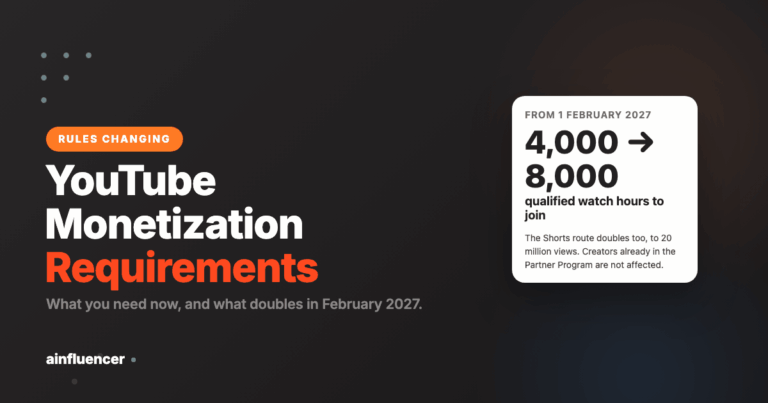
- New applicants need 20 million qualified Shorts views in 90 days, double the current bar, still alongside 1,000 subscribers
- Earning each month becomes conditional. To take a share of the Creator Pool and Premium revenue in a given month you will need at least 10 million qualified Shorts views in the last 90 days. Falling short does not remove you from the Partner Program and does not stop your long-form earnings
The measurement detail is worth writing down, because it decides whether you make a given month: the 90 day window ends on the 15th of the calendar month before the month you are being paid for. So the work that determines March’s payment was already finished in mid-February.
One addition in the other direction. From the same date, where an advertiser targets a small group of five or fewer channels, eligible creators earn a direct 45% of the net revenue from that specific ad, on top of the Creator Pool. That is the first Shorts money that is genuinely yours rather than pooled, and it rewards being individually worth targeting.
Where Shorts Actually Fit
Taking the mechanism seriously leads to an unglamorous conclusion. A pooled 45% share, measured in cents per thousand views, competed for against every other creator in your country, is not an income. Ten million views a month is a demanding treadmill to stay on from February 2027, and it buys a share of a pot rather than a cheque you control.
Shorts are a discovery product. They are the cheapest way to be found by people who have never heard of you, and the money arrives through what that audience is worth afterwards, not through the Shorts themselves.
What the same audience is worth through each route
| Route | How it is priced | Threshold to start |
|---|---|---|
| Shorts ad revenue | Your share of a country-level pool, then 45% of that | 1,000 subscribers and 10 million qualified Shorts views in 90 days |
| Long-form ad revenue | Your own views, at 55%, measured in dollars per thousand rather than cents | 1,000 subscribers and 4,000 qualified watch hours |
| Brand deals | Negotiated per video, against your audience rather than an ad auction | None |
| Affiliate commission | Paid when a viewer buys | None |
The last two have no threshold, which is the point. A channel pushing Shorts toward ten million views can be taking brand deals the whole way there rather than waiting. On Ainfluencer there is no subscription and no subscriber minimum: brands search, send offers, and you agree terms and get paid in the platform, with a $10 minimum collaboration. For what to charge, see influencer rates and sponsored YouTube videos, and for commission, YouTube affiliate programs.
If Shorts are your discovery engine, the two levers worth an hour each are posting when your audience is actually there, covered in the best time to post on YouTube, and making originals rather than compilations, since the latter are excluded from revenue sharing entirely.
Frequently Asked Questions
How does YouTube Shorts monetization work?
Ad revenue from the Shorts Feed is pooled each month by country. Music licensing is deducted from that pool, the remainder is distributed to monetizing creators according to their share of total engaged views in that country, and creators keep 45% of their allocation. There is no ad attached to your individual Short.
How much does YouTube pay per 1,000 Shorts views?
YouTube publishes no RPM figure for Shorts. Its own hypothetical example works out to roughly $0.40 per 1,000 engaged views, but every input in that example is invented to illustrate the mechanism. Your actual figure is in YouTube Analytics as estimated daily Shorts Feed ad revenue.
What are the requirements to monetize YouTube Shorts?
1,000 subscribers plus 10 million qualified Shorts views in the last 90 days, then acceptance of the Shorts Monetization Module in the Earn section of YouTube Studio. From 1 February 2027 new applicants will need 20 million qualified Shorts views instead.
Does using music reduce my Shorts earnings?
Not your share. YouTube states that using music does not affect your allocation from the Creator Pool or your 45% revenue share rate. What music does is shrink the pool everyone draws from: a Short with one track sends half of its associated revenue to music licensing, and one with two tracks sends two thirds.
Why did my Shorts earnings drop when my views went up?
Because you are paid a share of a pool rather than for your own views. If total engaged views across monetizing creators in your country rose faster than yours, or if more Shorts used music that month, your slice is worth less even though you did better.
Do Shorts I posted before accepting the module earn anything?
Views accrued before you accepted are not eligible and are not backdated. But the cutoff is the view date, not the upload date, so from the moment you accept, engaged views on any Short on your channel count, including older ones that start circulating again.
Do compilations and clips from movies or TV earn money on Shorts?
No. YouTube lists non-original Shorts as ineligible, naming unedited clips from others’ movies or TV shows, reuploads of other creators’ content, and compilations with no original content added. Those views are excluded from revenue sharing.
What happens if I fall below 10 million Shorts views after February 2027?
You stop earning from the Creator Pool and Premium for that month, but you stay in the Partner Program and your long-form earnings are unaffected. Revenue sharing resumes automatically once you are back above the threshold. Note the 90 day window ends on the 15th of the month before the earning month.
Is Shorts monetization worth it?
As an income on its own, rarely. A pooled share measured in cents per thousand views, now with a 10 million view monthly condition, is a hard way to earn. Shorts are far more valuable as a discovery engine, with the money arriving through brand deals and affiliate commission, neither of which has a subscriber threshold.