How to Audit an Influencer Profile
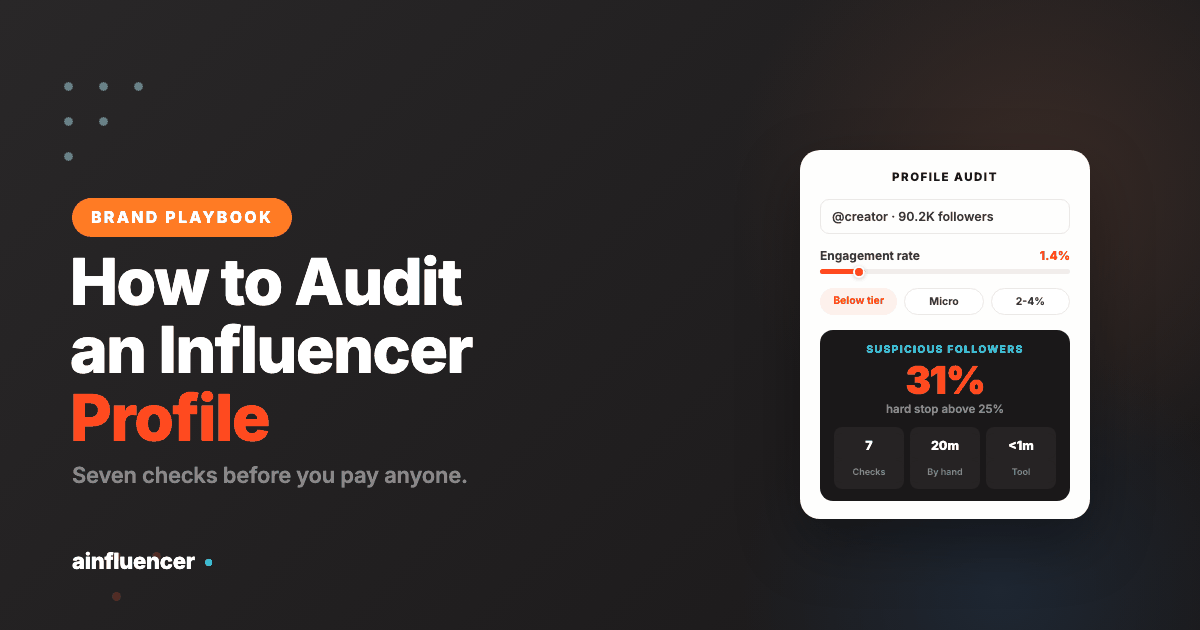
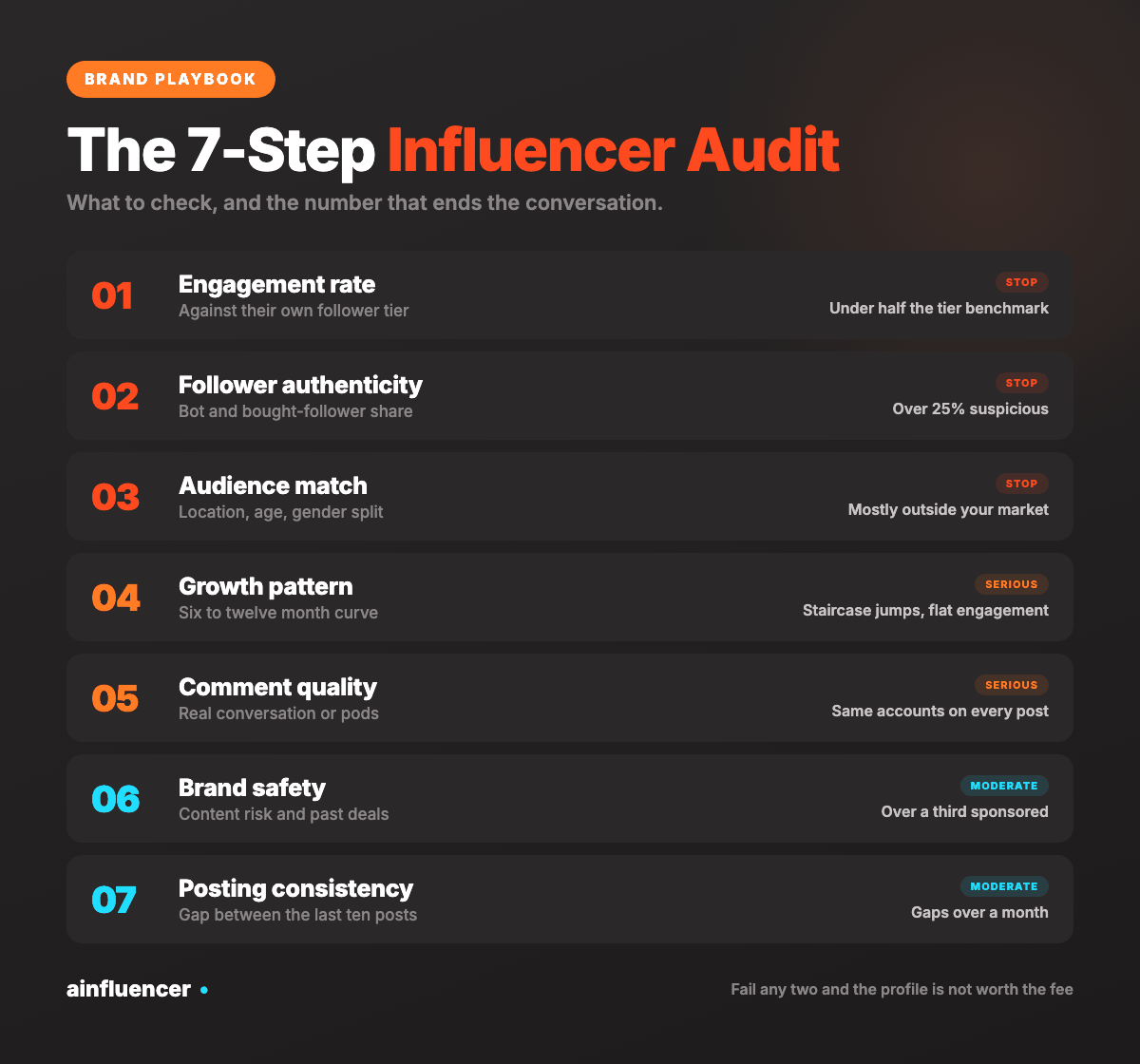
Auditing an influencer profile means checking seven things before you pay anyone: engagement rate against their follower tier, follower authenticity, audience location and age, growth pattern, comment quality, brand safety history, and posting consistency. A profile that fails any two of these is usually not worth the fee.
Most brands look at follower count, glance at a few posts, and send the offer. That is not an audit. An audit is the twenty minutes that tells you whether the 90,000 followers on screen represent 90,000 people who might buy from you, or 60,000 bots and 30,000 people in a country you do not ship to.
This guide walks through the seven checks in the order that saves you the most time, because three of them can disqualify a creator in under a minute.
What an influencer audit actually checks
An influencer audit is a structured review of a creator’s account that measures audience quality rather than audience size. It answers one question: if this creator posts about my product, how many real, relevant people will see it and act?
Follower count answers none of that. It is the number most easily bought, and it is the number every fake account inflates first.
The seven checks below run roughly in order of how quickly they can rule someone out. Engagement rate and fake followers eliminate most weak profiles in the first two minutes. The later checks take longer and matter most for creators you are seriously considering.
Step 1: Engagement rate, measured against the right benchmark
Engagement rate is likes plus comments divided by followers, expressed as a percentage. The number on its own is meaningless. It only means something compared against creators of a similar size, because engagement falls predictably as an account grows.
These are the ranges the industry generally works with on Instagram:
| Follower tier | Typical engagement | Treat as weak below |
|---|---|---|
| Nano, 1K to 10K | 4% to 8% | 2% |
| Micro, 10K to 100K | 2% to 4% | 1.5% |
| Mid, 100K to 500K | 1.5% to 3% | 1% |
| Macro, 500K to 1M | 1% to 2% | 0.8% |
| Mega, 1M+ | 0.8% to 1.5% | 0.5% |
A creator with 8,000 followers and 1.4% engagement is underperforming badly. A creator with 900,000 followers and the same 1.4% is doing fine. Comparing the two directly is the most common mistake in influencer selection, and it is why nano influencers often outperform far larger accounts on cost per engaged view.
Calculate it across the last twelve posts, not the top three. A single viral post distorts the average and creators know which post to show you.
Step 2: Follower authenticity
Bought followers are the fastest way to fail an audit, and they leave visible traces. Look for these signals:
- Follower to engagement mismatch. High followers with comments in the single digits is the clearest sign.
- Generic comments. Strings of emoji, “nice pic”, “great post”, and identical phrasing across many accounts.
- Follower accounts with no profile photo, no posts, and usernames ending in long random number strings.
- Sudden follower jumps with no matching jump in likes or comments.
You can check this by hand by opening twenty followers at random, or run the profile through our free Instagram fake follower checker, which scores the follower base automatically.
A follower base with more than 25% suspicious accounts should be treated as a hard stop, not a negotiating point. You are not buying a discount at that level, you are buying nothing.
Step 3: Audience match
A clean, engaged audience is still useless if it is the wrong audience. Three attributes decide this:
- Location. A US skincare brand looking at a creator whose audience is 70% outside North America is paying for impressions that cannot convert.
- Age. Check the audience age band against your actual buyers, not your intended buyers.
- Gender split, where the product is gender-specific.
Creators can share these figures from their own analytics. Ask for a screenshot of the audience tab rather than a number typed in an email, and check the date on it.
Step 4: Growth pattern
Plot the follower count over the last six to twelve months. Healthy accounts grow in a rough diagonal with occasional steps where a post performed well. Bought growth looks like a staircase: flat, then a vertical jump of several thousand in a day, then flat again.
A vertical jump is not automatically disqualifying. A creator can be featured somewhere large, or a single reel can break out. What matters is whether engagement rose with the followers. If 20,000 new followers arrived and comment counts did not move, those followers are not watching.
Step 5: Comment quality
Open the last five posts and read the comments properly. You are looking for evidence that a real audience is paying attention:
- Comments that reference something specific in the post
- Questions, and the creator answering them
- Conversations between commenters, not just replies to the creator
- Disagreement, which bots never produce
Comment pods are the harder version of this problem. Those are groups of creators who comment on each other’s posts to inflate engagement. The signal is the same handful of accounts appearing on every post, always within minutes of publishing, always with generic praise.
Step 6: Brand safety and partnership history
Scroll back through at least a year of posts. You are checking two separate things.
First, content risk: political statements, controversies, or anything that conflicts with your brand’s position. This is judgement, not a metric, and it is the check most often skipped.
Second, sponsorship density. A feed where every third post is a paid partnership has an audience that has learned to scroll past ads. Count the sponsored posts in the last thirty. Above roughly a third, expect weaker results regardless of how good the other numbers look.
Also check whether they have promoted a direct competitor recently, and whether those posts are still live.
Step 7: Posting consistency
An account that posted daily for two years and then dropped to twice a month is losing reach, and your campaign inherits that decline. Check the gap between the last ten posts. Irregular posting also predicts irregular communication once the campaign starts, which is the practical problem most brands actually hit.
Red flags, ranked by how much they should worry you
| Signal | Severity | What it usually means |
|---|---|---|
| Over 25% suspicious followers | Stop | Bought audience |
| Engagement under half the tier benchmark | Stop | Dead or bought audience |
| Audience mostly outside your market | Stop | Impressions cannot convert |
| Staircase growth with flat engagement | Serious | Follower purchases |
| Same accounts commenting on every post | Serious | Engagement pod |
| More than a third of posts sponsored | Moderate | Ad-blind audience |
| Posting gaps over a month | Moderate | Declining reach |
| Competitor promoted in the last 90 days | Moderate | Credibility and exclusivity risk |
Manual audit or audit tool
Both work. The difference is how many creators you are reviewing. If you are reviewing enough of them that a tool is the answer, AI powered influencer vetting covers what an authenticity score is actually computing and why two tools disagree about the same account.
There is now a third option. An agent can run the whole checklist against a profile and return the numbers, which is one of the influencer marketing skills for Claude Code and AI agents we walk through separately.
| By hand | With an audit tool | |
|---|---|---|
| Time per profile | 15 to 25 minutes | Under a minute |
| Follower authenticity | Sampling only | Scored across the base |
| Audience location and age | Needs creator screenshots | Estimated automatically |
| Brand safety judgement | Reliable | Still needs a human |
| Sensible at | Under 10 creators | 10 or more |
Run the numbers with a tool, then spend your time on the judgement calls a tool cannot make. Our free Instagram audit tool covers the metric side, and the checks in steps 3, 6 and 7 are where a person is still needed.
If you are auditing at volume as part of selection rather than verification, the process overlaps with vetting influencers, and the shortlisting stage is covered in our guide to influencer marketing platforms.
After the audit
An audit tells you whether a creator is worth approaching. It does not tell you whether the campaign worked. Agree the metrics before the first post goes out, and track them against the benchmarks you used during the audit. Our guide to influencer marketing KPIs covers which numbers to hold a campaign to, and tracking influencer marketing covers the mechanics.
Keep the audit. When you review the campaign, the gap between the engagement rate you measured and the engagement the sponsored post actually earned is the single most useful number you will have.
Frequently asked questions
How long should an influencer audit take?
Fifteen to twenty five minutes by hand for a creator you are seriously considering. With an audit tool handling the metrics, closer to five minutes, most of which goes on brand safety and partnership history. For a first pass across a long shortlist, engagement rate and follower authenticity alone will eliminate most candidates in about a minute each.
What is a good engagement rate for an influencer?
It depends entirely on size. Nano creators under 10,000 followers should sit between 4% and 8%. Micro creators between 10,000 and 100,000 should sit between 2% and 4%. Accounts over a million commonly run below 1.5% and that is normal. Judge every creator against their own tier, never against another tier.
How do you check an influencer for fake followers?
Look for high follower counts with very low comment counts, generic emoji-only comments, follower accounts with no photo and no posts, and follower jumps that engagement did not follow. Opening twenty followers at random gives a rough read. A fake follower checker scores the whole base rather than a sample.
Can you audit an influencer profile for free?
Yes. Every check in this guide can be done manually at no cost, and free tools cover the metric side including engagement rate and follower authenticity. Paid platforms mainly add audience demographics at scale and historical data, which matter once you are reviewing more than about ten creators at a time. We compared what each platform’s free tier really unlocks in our guide to free influencer marketing tools.
What should I look for when vetting influencers before a campaign?
Audience quality first, then fit, then reliability. In practice that means engagement against their tier, follower authenticity, audience location and age against your buyers, brand safety history, and posting consistency. A creator who passes on numbers but has promoted a direct competitor last month is still the wrong choice.
Is follower count worth anything at all?
Only as a bracket. It tells you which engagement benchmark to apply and roughly what the rate card will look like. It predicts almost nothing about how many people will act on a post, which is why the other six checks exist.