AI Powered Influencer Vetting
Vetting is the job models do best and the job teams use them for least. Roughly 36.67% of AI use in influencer marketing goes to discovery and about 7.22% goes to fraud detection, which is backwards: finding creators is a search problem with a human check at the end, while judging whether 40,000 followers are real is a pattern problem across millions of accounts, and that is what a model is for.
This guide covers what an authenticity score is actually computing, why two vendors disagree about the same account, what AI catches that a person cannot, and the checks that stay manual no matter what you buy. For the manual version of the whole process see how to audit an influencer profile, which is the specification any tool here is trying to automate.
What a model sees that a person cannot
A careful person auditing one account can check engagement rate, look at a sample of followers, read the comments and eyeball the growth chart. That takes 15 to 25 minutes and it catches obvious fraud.
What it cannot do is comparison at population scale. The judgement that matters is not whether this account looks odd, it is whether this account looks odd relative to twelve million accounts of the same size in the same category. A 3.1% engagement rate is excellent for a creator with 800,000 followers and mediocre for one with 8,000, and no amount of staring at a single profile reveals that.
| Check | A person can | A model adds | Why it matters |
|---|---|---|---|
| Engagement rate | Calculate it | Compare it against the right size band and category | The same number is a pass or a fail depending on the peer group |
| Follower authenticity | Sample 50 followers by eye | Score the whole follower base against known fake patterns | Fraud is distributional. A 50 account sample misses it |
| Comment quality | Read the top comments | Classify every comment as conversation, emoji, pod or bot | Engagement pods look like real engagement in every summary metric |
| Growth pattern | See obvious spikes | Detect the shape of purchased growth versus a viral post | Both are spikes. Only one is a problem |
| Audience location | Read the bio | Estimate the real distribution from follower signals | A creator in your market with an audience elsewhere is the commonest expensive mistake |
Why two tools score the same creator differently
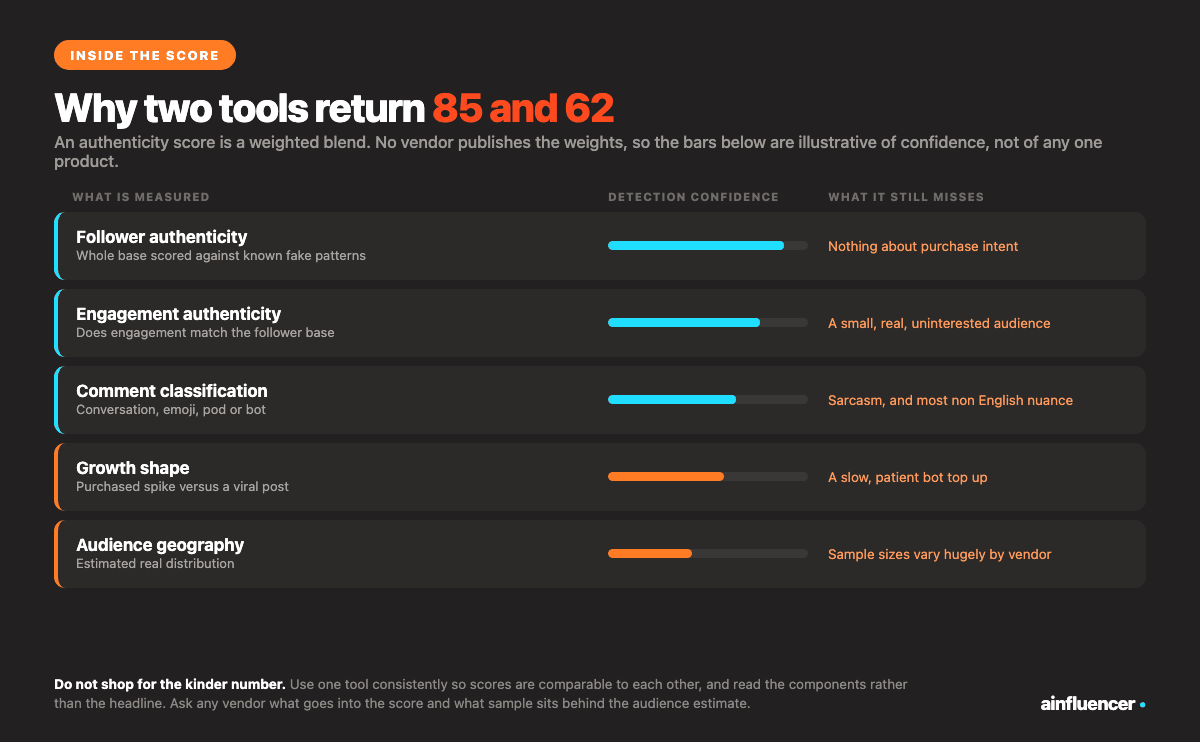
This is the question that makes people distrust the whole category, and the answer is mundane. An authenticity score is a weighted blend of five or six underlying measurements, and no vendor publishes the weights. One tool weights follower quality heavily, another weights comment authenticity, a third penalises audience geography mismatch. Feed them the same account and they will disagree.
An 85 and a 62 on the same creator is not a contradiction, it is two different questions being answered. The practical response is not to pick the vendor with the kinder number. It is to use one tool consistently so the scores are comparable to each other, and to look at the component measurements rather than the headline.
Ask any vendor two things before you trust a score. What goes into it, and what sample size sits behind the audience estimates. A vendor who cannot answer either is selling a formula, not a model, and AI tools for influencer marketing sets out the four questions that separate the two.
The four frauds, and which ones AI actually catches
| The fraud | What it is | Caught by AI? |
|---|---|---|
| Bought followers | Bulk purchased accounts, often dormant or newly created | Yes, reliably. The distribution is unmistakable at scale |
| Engagement pods | Groups of real creators agreeing to like and comment on each other | Mostly. The tell is the same accounts commenting every time, fast, with generic text |
| Bought engagement | Paid likes and comments on specific posts | Yes. Engagement that does not match the follower base |
| Audience mismatch | A real, engaged audience that is simply not your market | Yes, and this is the underrated one. Not fraud at all, but the same wasted budget |
The platforms treat the first three as policy violations in their own right. TikTok’s integrity and authenticity guidelines cover bought engagement and coordinated inauthentic behaviour, which means a creator carrying it is risking their own account as well as your budget.
What no vetting tool can tell you
- Whether the audience will buy. Authenticity is not intent. A real, engaged audience that has no interest in your category scores perfectly and converts nothing.
- Whether the creator is right for the brand. A model matches audiences. It does not hear tone, and tone is what ends up in the screenshot.
- Whether they are reliable. Missed deadlines leave no public trace.
- Brand safety in a language it saw little of. Detection quality falls sharply outside the languages a model was mostly trained on, and this is the failure that reaches the press.
The last one is worth a policy rather than a tool: native review for every market you are not fluent in, no exceptions, regardless of what the score says.
There is also a reason to vet that is not about waste. If a creator’s engagement is bought, the endorsement you paid for is being shown to an audience that does not exist, and the FTC guidance on endorsements and reviews places responsibility for the truthfulness of an endorsement on the advertiser, not only on the creator who published it.
A vetting workflow that scales
The mistake is running deep checks on everyone. Vetting should narrow in stages, with cost rising as the list shrinks.
| Stage | Applied to | What runs | Cost per profile |
|---|---|---|---|
| 1. Screen | Everyone, hundreds | Follower band, market, category, engagement rate floor | Effectively zero |
| 2. Automated audit | The shortlist, dozens | Full authenticity scoring, audience geography, growth shape | Seconds, and whatever your tool charges |
| 3. Manual review | Finalists, under ten | A person reads fifty posts and the comment sections | 20 minutes each, and worth every one |
| 4. Ongoing | Anyone under contract | Re-check quarterly. Accounts change, and partnerships outlast audits | Automated, negligible |
If you want the free version of stage two, our Instagram fake follower checker runs the follower authenticity class of check at no cost, and free influencer marketing tools covers what else is genuinely free. For running stage two across a large shortlist unsupervised, see influencer marketing AI agents, where auditing at volume is the single strongest case in the category.
Where to set the threshold
Vetting only saves money if a failing score actually stops a deal, and that requires a number agreed before you like anybody.
Suspicious follower percentage is the most useful single gate. Under 10% is normal for any real account, because every account accumulates some bots. Between 10% and 25% deserves a look at the growth chart. Above 25% the burden of proof sits with the creator, and a creator with a genuine explanation, such as a post that went viral in an unrelated market, will usually offer it without being asked.
Set this before the shortlist exists. A threshold agreed after you have fallen for a creator is a negotiation with yourself, and the guidance in vetting influencers and the benchmarks in influencer marketing KPIs are easier to hold to when they were written down first.
Why this is worth the effort
The argument for automating vetting is not the time saved, although 15 to 25 minutes per profile across a shortlist of two hundred is real. It is that vetting is the check teams skip under deadline pressure, and it is skipped on exactly the campaigns that most needed it, the rushed ones with the biggest budgets.
An automated stage two runs whether or not anyone has time. That is the whole benefit: not better vetting than a careful person would do, but vetting that actually happens. Combine it with per creator tracking, covered in how to track influencer marketing, and a bad creator is caught before the money moves rather than in the wrap report.
Frequently asked questions
What is AI powered influencer vetting?
It is using a model to judge whether a creator’s audience and engagement are genuine, by comparing that account against millions of others of the same size and category rather than looking at it in isolation. It scores follower authenticity, classifies comments as real conversation or pod activity, reads the shape of the growth curve and estimates audience geography.
Why do two influencer vetting tools give different scores?
An authenticity score is a weighted blend of five or six underlying measurements, and no vendor publishes the weights. One weights follower quality heavily, another weights comment authenticity, a third penalises audience geography mismatch. An 85 from one tool and a 62 from another is two different questions being answered, not a contradiction. Use one tool consistently so your scores are comparable to each other.
What percentage of fake followers is acceptable?
Under 10% is normal for any real account, because every account accumulates some bots. Between 10% and 25% is worth checking the growth chart for purchased spikes. Above 25% the burden of proof sits with the creator. Agree your threshold before you have a shortlist, because a threshold set afterwards is a negotiation with yourself.
Can AI detect engagement pods?
Mostly. The signature is the same set of accounts commenting on every post, within minutes of publication, with generic text. That pattern is visible across an account’s history and effectively invisible in any summary metric, which is why pods pass a manual check that only looks at engagement rate.
What can influencer vetting tools not tell you?
Whether the audience will actually buy, since authenticity is not purchase intent. Whether the creator suits your brand’s tone. Whether they hit deadlines, which leaves no public trace. And brand safety in languages the model saw little of, which needs native review as a policy rather than a tool.
Is automated vetting better than manual vetting?
It is better at population scale comparison and worse at judgement. The real argument for automating it is different: vetting is the check teams skip under deadline pressure, on exactly the rushed high budget campaigns that needed it most. An automated stage runs whether or not anyone has time.