Influencer Marketing AI Agents
An AI agent is not another AI feature on a dashboard. A feature improves one field. An agent takes an objective, decides the steps itself, uses tools to carry them out, and comes back with a result. In influencer marketing that difference matters, because it changes what you are buying from a better search box into something that can own a whole task.
It also changes what can go wrong. This guide covers what an agent can genuinely own in a creator programme today, how much autonomy to give it, where it fails, and the compliance line you cannot let it cross. For the wider question of where AI fits at all, start with AI in influencer marketing.
Agent, assistant or feature: the distinction that matters
The word agent is applied to all three, which is why buying one is confusing. The practical test is who decides the next step.
| Who decides the next step | What you give it | Typical influencer example | |
|---|---|---|---|
| AI feature | You do, every time | One input, one field at a time | A relevance score next to each creator in search results |
| AI assistant | You do, it advises | A question | “Summarise this creator’s last twenty posts” |
| AI agent | It does, within limits you set | An objective and permission to use tools | “Shortlist 40 fitness creators under 100k, audit each, flag anything above 15% suspicious followers” |
If your vendor calls something an agent but you still click through every step, you have bought an assistant. That is not a criticism. Assistants are safer, and for teams running fewer than ten creators a month they are usually enough. Our comparison of AI tools for influencer marketing sorts the market by the job the AI is doing, which is the useful axis when you are deciding between the two.
What an agent can actually own today
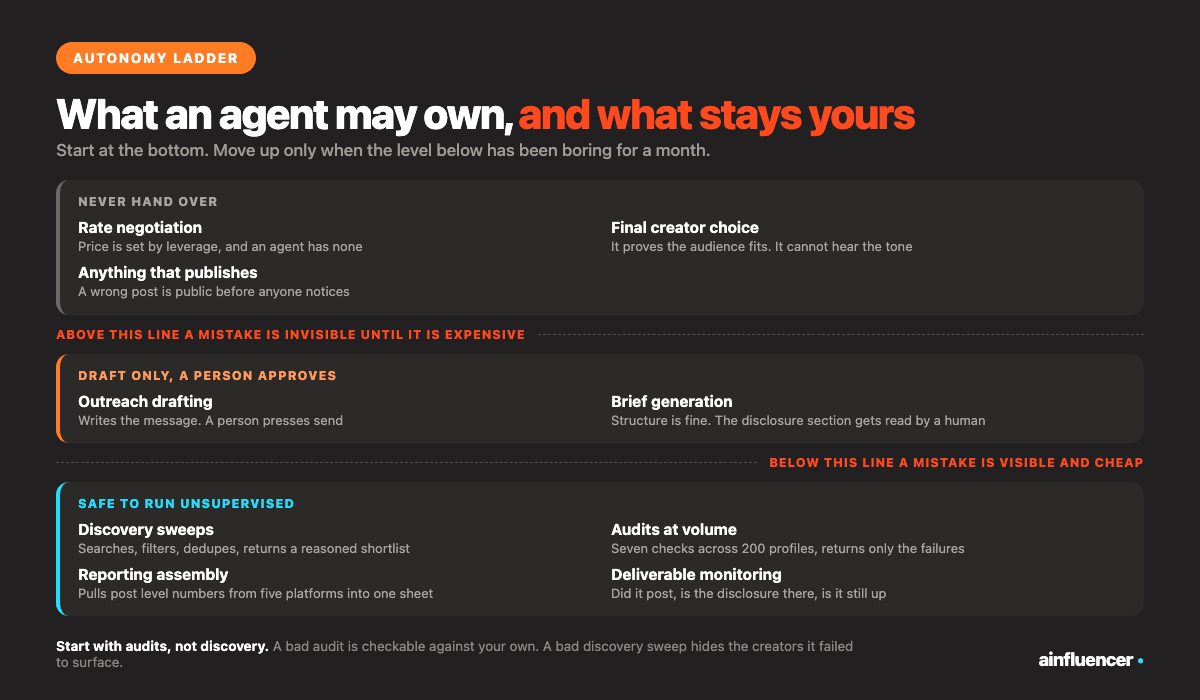
Five tasks are genuinely agent shaped: they are repetitive, they have a clear finish line, and a wrong answer is visible rather than silent. Three others are regularly promised and should not be handed over yet.
1. The discovery sweep
Give an agent a brief and it will search, filter, deduplicate across platforms and hand back a shortlist with reasons attached. This is the task with the clearest payoff, because manual shortlisting costs 10 to 20 hours per campaign and roughly 36.67% of all AI use in influencer teams already goes here.
What makes the agent version better than a saved search is that it can iterate. It runs the search, notices that 30 of 50 results are the wrong market, adjusts and runs again, without you watching. See influencer marketing platforms for the databases it will be searching against.
2. Audits at volume
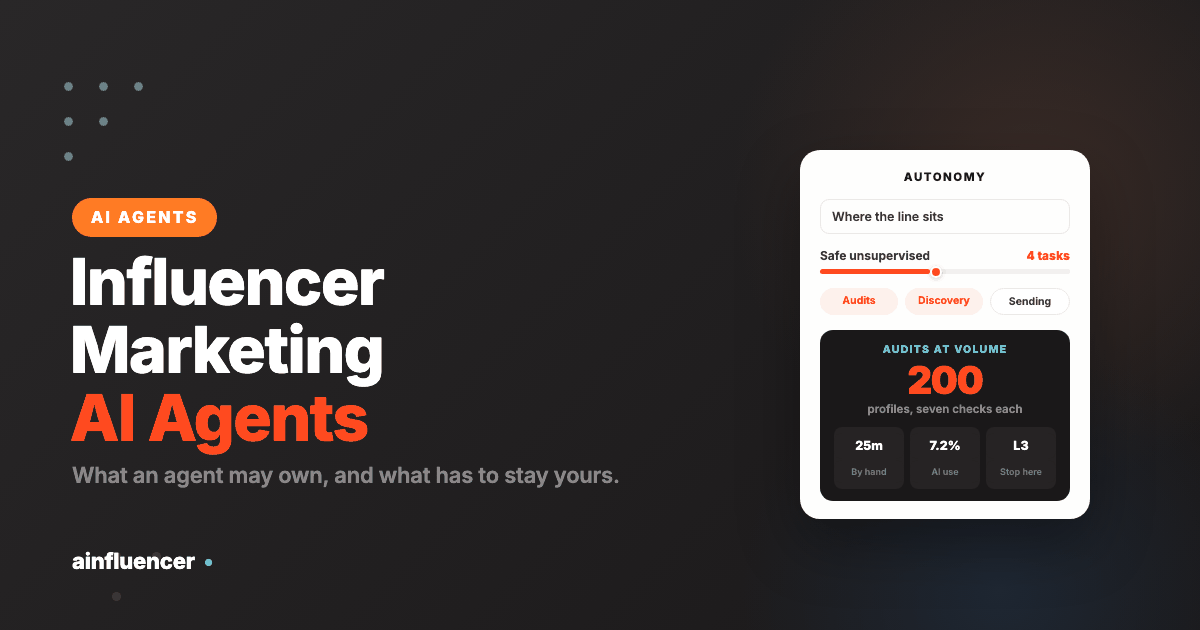
Auditing one creator by hand takes 15 to 25 minutes. An agent can run the same seven checks across a shortlist of 200 and return only the ones that fail. This is the strongest case in the whole category, and it is the least used: fraud detection accounts for only about 7.22% of AI use in influencer teams.
The checks themselves do not change. Our walkthrough of how to audit an influencer profile is the specification you would hand the agent, and vetting influencers covers what to do with the results.
3. Outreach drafting, not outreach sending
An agent can read a creator’s recent posts and draft a message that proves someone looked. It should not press send. The failure is not that the message is bad, it is that the same agent will send four hundred of them and creators spot the pattern within a week. Keep a human on the send button and use influencer outreach templates as the frame, plus how to DM influencers for what actually gets a reply.
What to generate and what to template in that message is covered in AI influencer outreach.
4. Reporting assembly
Pulling post level numbers from five platforms into one sheet every Monday is pure agent work: tedious, well defined, and instantly checkable. Decide what goes in the sheet first. Our list of influencer marketing KPIs and the mechanics in how to track influencer marketing are the two inputs that make the output worth reading.
5. Monitoring
Watching whether a creator posted the deliverable, kept the disclosure in, and left the post up for the contracted window is work nobody enjoys and everybody skips. An agent does not skip it. Once a campaign is live at scale this becomes the main job, and AI influencer campaign management covers how to triage it.
What to keep away from an agent
| Task | Why it fails | What to do instead |
|---|---|---|
| Negotiating rates | Price here is set by relationship and leverage, and an agent has neither. It anchors on public averages, which is how you overpay a micro creator and insult a good one | Use influencer rates for the range, then have a person make the offer |
| Final creator choice | An agent can prove the audience matches. It cannot tell you the creator’s humour will embarrass your brand | Agent shortlists, human picks. Always this order |
| Anything that publishes | A wrong post is public before anyone notices, and a deleted post is a screenshot | Draft and queue only, with a named human approver |
| Brand safety in another language | Detection quality drops sharply outside the languages a model saw most of | Native review for every market you are not fluent in |
How much rope to give it
Do not start at full autonomy and pull back after something breaks. Start at level one and move up only when the level below has been boring for a month.
| Level | The agent may | You review | Move up when |
|---|---|---|---|
| 1. Suggest | Propose actions, change nothing | Everything | Its suggestions stop surprising you |
| 2. Draft | Produce messages, briefs and reports as drafts | Every item before it leaves | Edits become cosmetic rather than corrective |
| 3. Act, reversible | Run searches, audits and reports on its own | The output, in batch | A month with no false confidence in a bad profile |
| 4. Act, with a budget | Spend within a cap, or contact within a list you approved | Exceptions and totals | Honestly, most teams should stop at 3 |
Build or buy
Two routes exist and they suit different teams.
Buy means a platform that ships agent features inside the product. You get the creator database included, which is the expensive part, and you accept that the agent only does what the vendor built.
Build means running an agent yourself against the tools and data you already have, usually through the Model Context Protocol or a similar connector layer, so the agent can reach your spreadsheet, your analytics and a creator API in one session. It is more work and far more flexible. Our list of influencer marketing skills for Claude Code and AI agents is the practical version of this route, with the ten tasks worth defining first.
If you have no budget at all, the honest answer is that the agent is not your constraint. Start with free influencer marketing tools and add an agent when the manual work is genuinely the bottleneck, which is usually somewhere above thirty creators a month.
The compliance line
This is the part that is not a preference. Under the FTC endorsement guides, responsibility for a missing or unclear disclosure sits with the advertiser, not only with the creator. Automating outreach does not move that responsibility, and an agent that drafts a brief will happily produce a disclosure line that is out of date or too vague.
Two rules that keep this simple. Every generated brief has its disclosure section read by a person before it goes out. And the agent never negotiates away a disclosure requirement because a creator pushed back, which is exactly the kind of helpful accommodation a model makes without flagging it.
A first month that works
Before adding an agent at all, check whether plain rules would do. Most of a creator programme is repetition rather than judgement, and influencer marketing automation maps which of the eleven steps go on rails without a model involved.
Pick the audit task, not the discovery task. Discovery is the exciting one and it is the one where a bad result is hardest to notice, because you cannot see the creators the agent failed to surface. An audit is checkable: run the agent and your own manual audit on the same ten profiles and compare. If it agrees with you on nine, promote it to level three on that task and leave everything else alone.
Then widen deliberately, one task at a time, and write down what each agent is allowed to touch. An undocumented agent with API keys is a security question, not just a marketing one. The wider programme logic sits in our guide to influencer marketing strategy.
Frequently asked questions
What is an influencer marketing AI agent?
It is software that takes an objective, plans its own steps, uses tools such as a creator database or an analytics API to carry them out, and reports back. That is different from an AI feature, which improves one field at a time, and from an assistant, which answers questions but leaves every decision to you. The practical test is whether it decides the next step without asking.
What can an AI agent do in influencer marketing?
Five tasks reliably: running discovery sweeps and returning a reasoned shortlist, auditing profiles at volume for follower authenticity and engagement quality, drafting personalised outreach, assembling reporting across platforms, and monitoring whether contracted posts went live and stayed live with their disclosures intact.
Can an AI agent replace an influencer marketing manager?
No. It replaces the shortlisting, the audits and the reporting assembly, which is most of the hours. It does not replace judging brand fit, negotiating a rate or keeping a creator relationship alive, which is most of the value. Agents also should not be given anything that publishes without a named human approver.
Is it safe to let an AI agent contact creators?
Drafting is safe, sending unsupervised is not. The risk is volume: the same agent that writes one good message writes four hundred mediocre ones, and creators recognise the pattern quickly. Keep a person on the send button until your edits to the drafts have been cosmetic rather than corrective for a month.
Should I build my own agent or buy a platform with agent features?
Buy if you need the creator database, which is the expensive part, and the vendor already does the task you care about. Build if you want the agent to reach your own spreadsheets, analytics and APIs in one session, which usually means a connector layer such as the Model Context Protocol. Below about thirty creators a month, neither is your constraint.
How much autonomy should an AI agent have?
Start at suggest only, move to drafting, then to acting on reversible tasks such as searches, audits and reports. Most teams should stop there. Giving an agent a budget or an approved contact list to act on buys much less than it costs in oversight.