AI Influencer Outreach
A model can read a creator’s last thirty posts in a second, which is twenty nine more than most outreach teams manage. That is the real case for AI in outreach: not writing faster, but actually looking before writing. The failure mode is equally specific. The same system that writes one good message writes four hundred passable ones, and creators compare notes.
This guide covers what to generate and what to keep, the one line that makes a generated message read as human, the volume ceiling nobody warns you about, and the channel rules that get brand accounts restricted. For the messages themselves see influencer outreach templates, and for channel etiquette see how to DM influencers.
Generate the research, not the personality
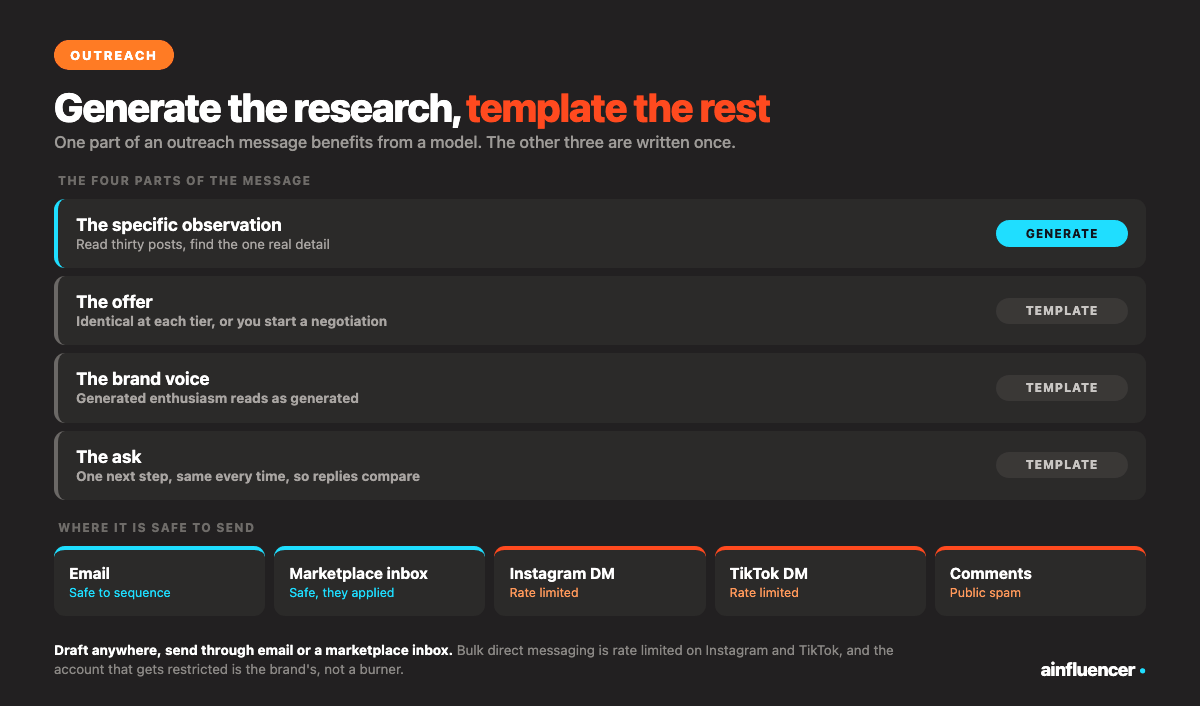
Outreach messages have four parts and they should not all come from the same place.
| Part of the message | Generate it? | Why |
|---|---|---|
| The specific observation | Yes, this is the whole point | Reading thirty posts per creator across two hundred creators is exactly what a person will not do and a model will |
| The offer | No, template it | It should be identical for everyone at the same tier. Varying it creates a negotiation you did not intend |
| The brand voice | No | Generated enthusiasm reads as generated. Write it once, reuse it |
| The ask | No, template it | One clear next step, the same every time, so replies are comparable |
The one line that decides everything
The difference between outreach that gets answered and outreach that gets ignored is whether the first line could have been written about anyone else. That is the entire test, and it is easy to check: if you can swap the creator’s name and send the same message to a different person, it fails.
Hi Sarah,

I love your content! Your feed is amazing and your engagement is
incredible. We think you would be a perfect fit for our brand and
would love to collaborate with you on an exciting campaign.
Hi Sarah,

Your post about returning three pairs of trail shoes before finding
ones that fit your narrow heel is the reason I am writing. That is the
exact problem our sizing guide was built for, and most creators will
not talk about returns at all.

We pay $X for one Reel plus usage. Would you like the details?
The second message is not longer and it is not more flattering. It is specific, and it proves someone read something. A model produces that first line reliably if you give it the creator’s recent posts and ask for the most specific thing they said about a problem your product addresses. It produces the first message reliably too, which is the trap.
The volume ceiling
Outreach scales until it does not, and the wall is social rather than technical.
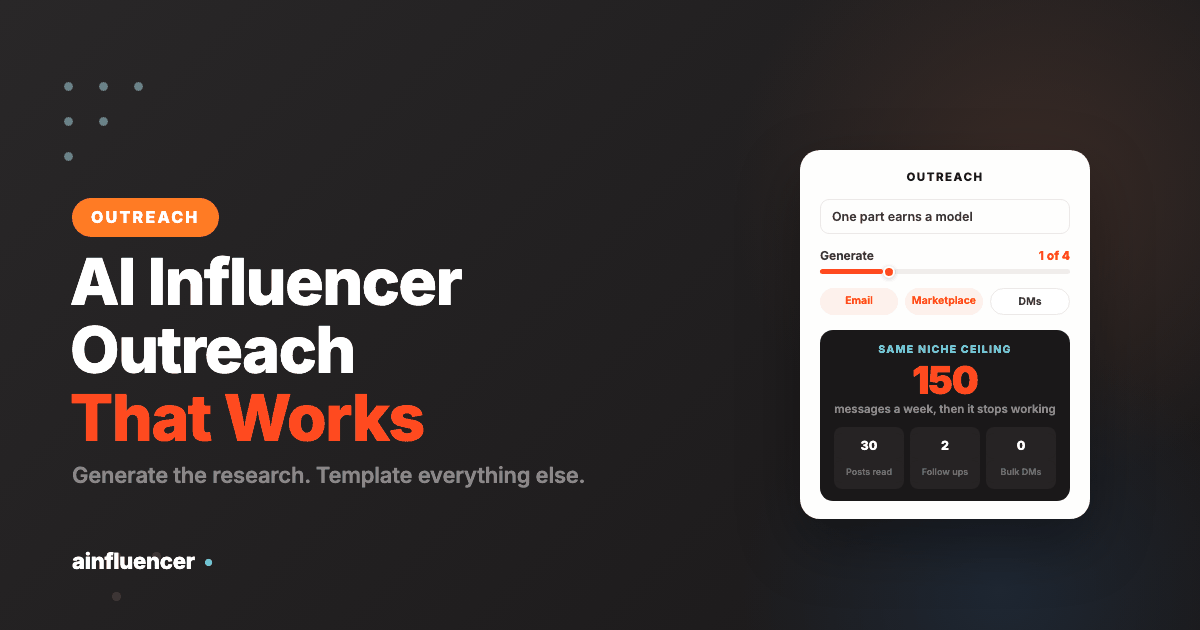
Creators in a niche follow each other. When two of them compare a message that opens with a personalised sentence and then continues into four identical paragraphs, the personalised sentence stops helping and starts hurting, because it reveals that the effort was automated rather than absent. A generic message is forgettable. A fake personal one is memorable in the wrong way.
Practically: vary the structure, not just the opener. If you are sending more than about a hundred and fifty messages a week into the same niche, you are past the point where personalisation is doing any work, and the answer is to send fewer better ones or to switch to inbound entirely.
The alternative nobody costs properly
Outbound outreach costs a fixed amount per creator regardless of whether they reply, and most do not. Inbound inverts the economics: publish a brief on a marketplace, creators apply, and you are filtering people who already want the deal.
This is not always better. Inbound gives up control over who applies, and for a campaign that needs specific creators it is the wrong tool. But for a campaign that needs twenty good creators in a category, the arithmetic is not close. Our list of free influencer marketing tools covers the free-forever marketplaces, and influencer marketing platforms covers the paid databases if you still need outbound reach.
Channel rules, and how brand accounts get restricted
This is the part that turns a tooling decision into an incident. Bulk direct messaging from a single account is rate limited and acted against on both Instagram and TikTok, and the account that gets restricted is the brand’s.
| Channel | Safe to sequence? | What to watch |
|---|---|---|
| Yes | The durable channel. Warm the domain, keep volumes sane, honour unsubscribes | |
| Platform inbox on a marketplace | Yes | Built for it, and the creator opted in by applying |
| Instagram DM | No | Rate limited. Bulk sending risks the brand account, not a burner |
| TikTok DM | No | Same, and messaging is restricted by account age and settings |
| Comments | Never | Reads as spam publicly, on the creator’s own post |
Automate the follow up, not the first message
Most teams do this backwards. They automate the first message, which is the one that has to feel like a person wrote it, then chase manually, which is the part nobody has time for and where deals quietly die.
Invert it. A person reads and sends the first message. Two follow ups go on a schedule, cancelled the instant any reply arrives. Follow ups are the right thing to automate because they are low stakes, they are genuinely tedious, and a slightly mechanical reminder is completely acceptable where a mechanical opener is not. The mechanics of putting that on rails are in influencer marketing automation, and if you want the whole sequence run by software that decides its own next step, the limits are set out in influencer marketing AI agents.
Vet before you contact, not after
An easy efficiency that most teams get wrong: run the audit on the shortlist before outreach, not after a creator replies. Contacting a creator, negotiating, and then discovering 40% suspicious followers wastes their time as well as yours, and creators remember being dropped after a negotiation.
Automated vetting makes this cheap enough to do in the right order. See AI powered influencer vetting for what the checks catch, and how to audit an influencer profile for the manual version.
What to measure
Reply rate is the wrong headline metric, because a message that gets a polite no counts the same as one that starts a deal. Track the funnel:
- Reply rate, as a sanity check on whether the message reads as human at all.
- Positive reply rate, which is the one that matters.
- Reply to signed rate, which tells you whether your offer is the problem rather than your message.
- Cost per signed creator, which is the only number that compares outbound against inbound honestly.
If replies are healthy and signings are not, stop rewriting the opener. The offer is the problem, and our data on influencer rates is the place to check it against. The wider set of numbers is in influencer marketing KPIs.
One compliance note
Outreach is where the material connection begins, and it is worth stating the disclosure requirement in the first message rather than in the contract. Under the FTC disclosure guidance for influencers responsibility sits with the advertiser as well as the creator, and a creator who learns about the requirement at contract stage has already formed an expectation about the work. Most want to get it right and simply do not know the rule.
Frequently asked questions
What is AI influencer outreach?
It is using a model to read a creator’s recent posts and draft the specific, personalised part of an outreach message at a scale a person cannot. The offer, the brand voice and the ask stay templated. The research is the only part that genuinely benefits, and it is the part that decides whether the message gets read.
Can AI write influencer outreach messages?
It can write the opening observation reliably if you give it the creator’s recent posts and ask for the most specific thing they said about a problem your product addresses. It should not write the whole message, because generated enthusiasm reads as generated, and it should not press send.
Is it safe to automate influencer outreach DMs?
No. Bulk direct messaging from a single account is rate limited and acted against on both Instagram and TikTok, and the account that gets restricted is usually the brand’s. Draft anywhere, but send through email or a marketplace inbox where the creator opted in by applying. For email at scale, a repeatable cold email outreach process keeps those sends personal and compliant.
How many outreach messages can you send before it stops working?
Around a hundred and fifty a week into the same niche. The ceiling is social rather than technical: creators in a niche follow each other, and when two of them compare a message with a personalised opener followed by four identical paragraphs, the personalisation starts hurting rather than helping.
Should you automate the first outreach message or the follow ups?
The follow ups. Most teams do it backwards. The first message has to read as though a person wrote it, while follow ups are low stakes and genuinely tedious, and a slightly mechanical reminder is acceptable where a mechanical opener is not. Cancel the sequence the instant any reply arrives.
What is a good influencer outreach reply rate?
Reply rate is the wrong headline. A polite no counts the same as a deal. Track positive reply rate, reply to signed rate and cost per signed creator instead. If replies are healthy and signings are not, the offer is the problem rather than the message, and rewriting the opener will not fix it.