Influencer Marketing Automation
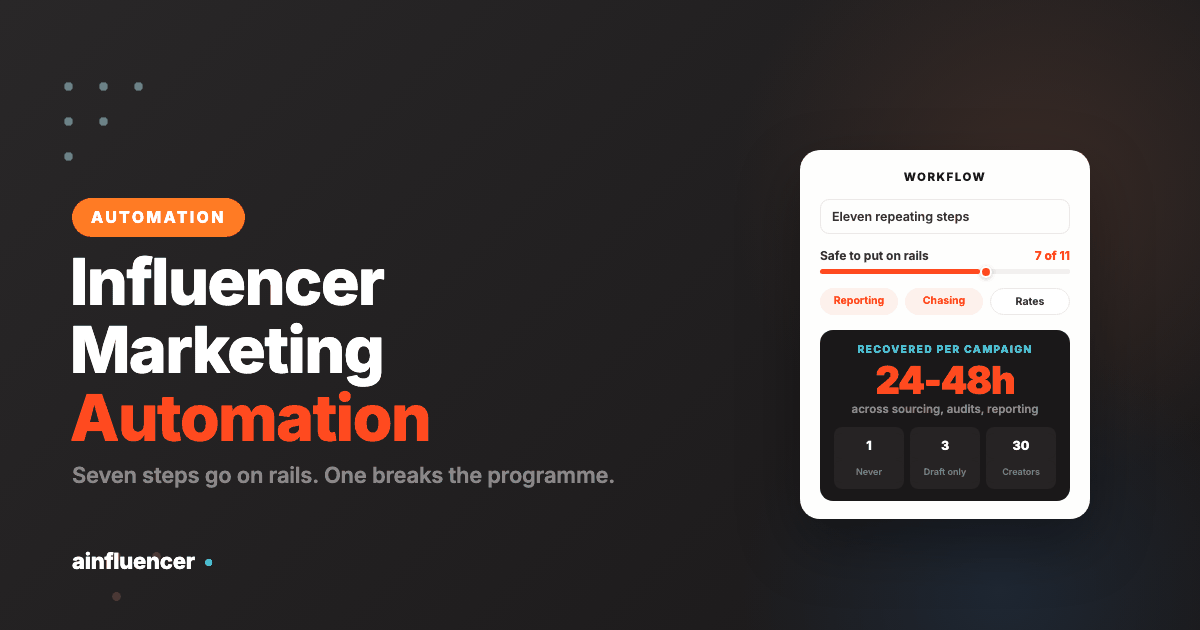
A creator programme has about eleven repeating steps. Seven of them can be put on rails today, three need a person to approve the output, and one breaks the programme if you automate it. Most of what works is not AI at all. It is a spreadsheet, a form, a tracking link and a calendar reminder.
This guide walks the workflow in order, says what to automate at each step and what it costs, and is honest about the point where automation stops paying. If you are specifically looking at software that decides its own next step rather than following rules you wrote, that is a different thing and it is covered in influencer marketing AI agents.
The eleven steps, and which ones automate
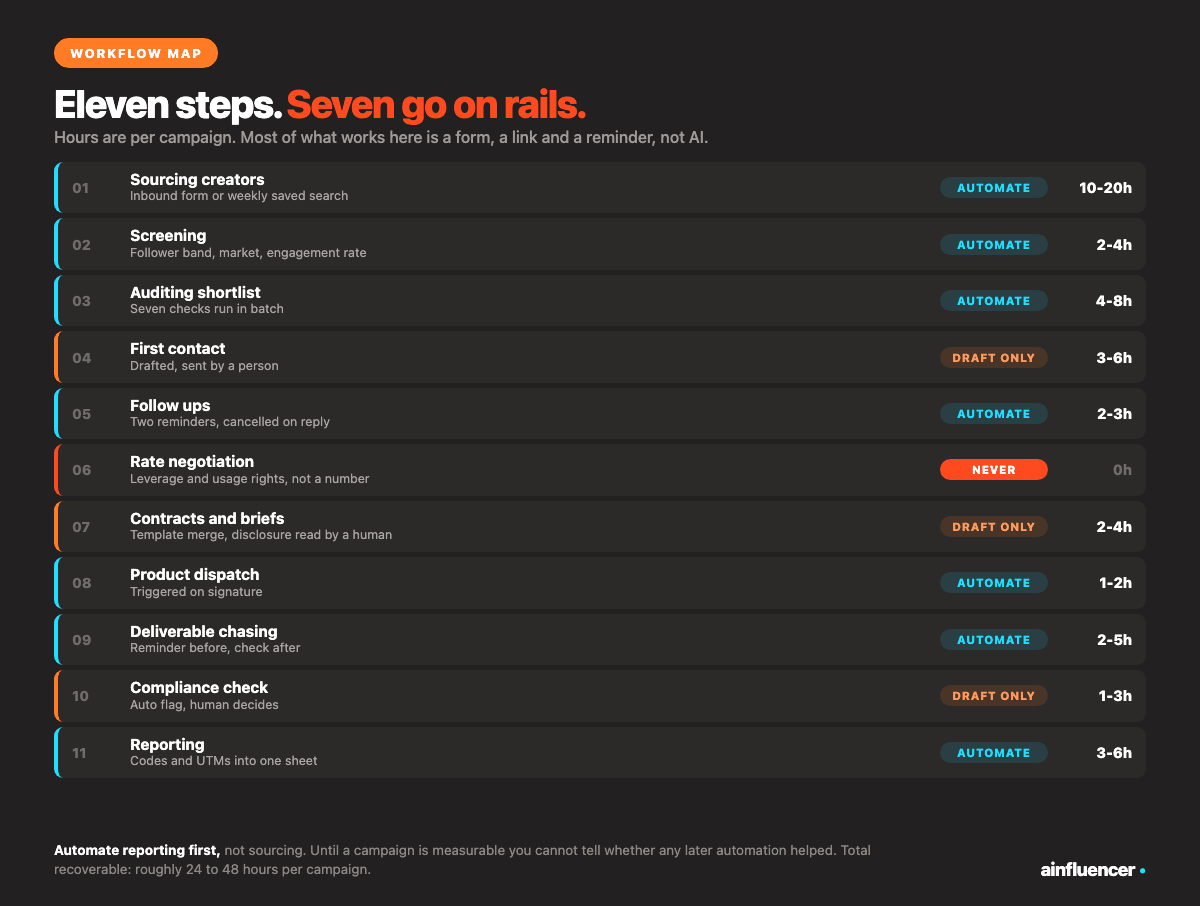
| Step | Automate? | What it actually takes | Hours back per campaign |
|---|---|---|---|
| Sourcing creators | Yes | An inbound application form, or a saved search that runs weekly | 10 to 20 |
| Screening against basic criteria | Yes | Filters on follower band, market and engagement rate | 2 to 4 |
| Auditing shortlisted profiles | Yes | A checker run across the shortlist rather than one at a time | 4 to 8 |
| First contact | Draft only | Generated from the creator’s recent posts, sent by a person | 3 to 6 |
| Follow ups | Yes | Two reminders on a schedule, cancelled on any reply | 2 to 3 |
| Rate negotiation | Never | Nothing. This is the step that breaks | 0 |
| Contracting and briefs | Draft only | A template with merge fields, disclosure section read by a human | 2 to 4 |
| Product or payment dispatch | Yes | Triggered on signature, not on a manual tick | 1 to 2 |
| Deliverable chasing | Yes | A reminder before the deadline and a check after it | 2 to 5 |
| Compliance checking | Draft only | Automatic flag, human decides. Language coverage is the weak point | 1 to 3 |
| Reporting | Yes | Codes and UTM links feeding one sheet on a schedule | 3 to 6 |
Start with sourcing, because it inverts the work
Outbound search is the most expensive habit in influencer marketing. You look for creators, you filter, you message, most do not reply. Every step scales linearly with how many creators you want.
Inbound inverts it. Publish a brief on a marketplace, let creators apply, and the filtering happens against people who already want the deal. The automation here is not clever software, it is the direction of travel. Our list of free influencer marketing tools covers the free-forever marketplaces that make this route cost nothing, and influencer marketing platforms covers the paid databases if you still need outbound reach.
Automate the audit, not the judgement
Screening and auditing are the two steps where automation is least glamorous and most valuable. Screening is a filter: follower band, market, engagement rate, done in seconds. Auditing is deeper, and by hand it costs 15 to 25 minutes per profile, which is why it gets skipped on exactly the campaigns that needed it.
Run the checks across the whole shortlist and only look at the failures. The seven checks are set out in how to audit an influencer profile, and vetting influencers covers reading the result. What stays manual is the decision. A profile can pass every numeric check and still be wrong for the brand.
Outreach: automate the follow up, not the first message
This is the distinction most teams get backwards. They automate the first message, which is the one that needs to feel like a person wrote it, and then chase manually, which is the part nobody has time for and where deals quietly die.
Invert it. Draft the first message with whatever help you like, then have a person read and send it. Automate the two follow ups, cancelled the moment any reply arrives. Our influencer outreach templates and the guide to how to DM influencers both start from the same rule: one specific true observation beats three paragraphs of enthusiasm.
A hard limit worth knowing before you build anything: Instagram and TikTok both rate limit and act against bulk direct messaging from a single account. Sequencing outreach through email or a platform inbox is durable. Sequencing it through DMs gets the account restricted, and the account you lose is usually the brand’s.
The full version of this argument, including the volume ceiling and the channels that get a brand account restricted, is in AI influencer outreach.
The one step never to automate
Rate negotiation. Not because a model cannot produce a number, but because the number is the wrong output.
Creator pricing is set by leverage, exclusivity, usage rights, timing and whether the creator wants the association. An automated offer anchors on public averages, which means it simultaneously overpays creators who would have said yes for less and insults the ones you most wanted. Worse, it removes the conversation where usage rights and exclusivity actually get agreed, and those are the terms that decide whether the deal was good.
Use influencer rates to know the range before you open the conversation. Then have a person open it.
Compliance is a flag, not a decision
Automated compliance checking works as a tripwire: did the post go up, is a disclosure present, is it in the first two lines rather than buried under a fold of hashtags. What it cannot do is judge whether the disclosure is clear to that audience, and under the FTC guidance for social media influencers the advertiser carries responsibility for that, not only the creator.
So automate the detection and route every flag to a person. A workflow that auto-approves posts because a keyword matched is worse than no check at all, because it produces a log that says everything was fine.
Reporting, the step with the best return
Reporting is repetitive, well defined and instantly checkable, which is the profile of a task worth putting on rails first. It is also where teams waste the most time, because assembling numbers from five platforms by hand every Monday is nobody’s job and therefore everybody’s.
Two things have to exist before the automation is worth anything. A decision about what you are measuring, covered in influencer marketing KPIs, and a tracking mechanism that survives the platform, covered in how to track influencer marketing. Unique discount codes and UTM links are cruder than platform attribution and they are auditable, which matters more than precision when someone questions the number.
What to actually build, in order
| Week | Build this | Why this order |
|---|---|---|
| 1 | Reporting: codes, UTM links, one sheet on a schedule | Fastest payback and it makes every later decision measurable |
| 2 | Deliverable chasing: reminder before the deadline, check after | Recovers revenue you have already paid for |
| 3 | Audit sweep across the shortlist | Stops the failure that costs a whole campaign |
| 4 | Inbound sourcing: a brief creators apply to | Changes the shape of the work rather than speeding up the old shape |
| 5 | Follow up sequences, cancelled on reply | Safe by then, because you know what a good reply looks like |
Below roughly ten creators a month, none of this pays. The manual version is faster than the setup. Above thirty it stops being optional. The wider programme logic sits in influencer marketing strategy.
All of the above is setup. Once the campaign is running and thirty creators are live at once the problem changes shape, from building rails to deciding who needs attention today. That is covered in AI influencer campaign management.
How automated programmes fail
- Silent breakage. A platform changes an export format and the sheet fills with zeros for three weeks. Put one alert on the row count, not on the numbers.
- Volume without judgement. The same sequence that works for twenty creators makes four hundred feel like spam, and creators talk to each other.
- Automating the relationship. Creators who deliver twice keep delivering because a person remembered something, not because a sequence fired on schedule.
- Trusting a green tick. A compliance log that never flags anything is not a clean programme, it is a broken check.
Frequently asked questions
What is influencer marketing automation?
It is putting the repeating steps of a creator programme on rails: sourcing, screening, auditing, follow ups, product dispatch, deliverable chasing and reporting. Most of it is not AI. A form, a saved search, a tracking link and a scheduled reminder cover the majority of the value.
What parts of influencer marketing should not be automated?
Rate negotiation, above all, because price here is set by leverage and usage rights rather than by follower count, and an automated offer both overpays and insults. Final creator choice, the first outreach message and the decision on any compliance flag should also stay with a person.
How much time does influencer marketing automation save?
Roughly 24 to 48 hours per campaign across sourcing, screening, auditing, follow ups, dispatch, chasing and reporting. Sourcing and auditing are the two largest single savings, at 10 to 20 and 4 to 8 hours respectively.
Can I automate influencer outreach DMs?
You can draft them automatically, but sending bulk direct messages from one account gets that account rate limited or restricted on both Instagram and TikTok, and it is usually the brand account you lose. Sequence follow ups through email or a platform inbox instead, and cancel the sequence on any reply.
When is influencer marketing automation worth setting up?
Below about ten creators a month the manual version is faster than the setup. Between ten and thirty it depends on how often you run campaigns. Above thirty it stops being optional, because the steps that get skipped under load are auditing and deliverable chasing, which are the two that cost real money.
What should I automate first?
Reporting. It is repetitive, well defined and instantly checkable, and until you can measure a campaign you cannot tell whether any later automation helped. Deliverable chasing second, because it recovers revenue you have already paid for.