AI Influencer Campaign Management
Campaign management is not finding creators. It is the six weeks after the contracts are signed, when thirty creators are live at once, four are late, one has posted without a disclosure, and you have no idea which two are carrying the whole campaign. The job is triage, and triage is what AI is genuinely good at.
This guide covers the in-flight problem specifically: what to watch, when to intervene, which decisions a model can support and which it cannot. Setting the campaign up is a different job, covered in influencer marketing automation, and choosing the software is covered in AI tools for influencer marketing.
The problem is attention, not information
A campaign with thirty creators produces roughly two hundred data points a week: posts, stories, saves, comments, code redemptions, link clicks. None of it is hidden. Every platform will show it to you.
The failure is that a manager with thirty creators and four hours a week reads the dashboard top to bottom, runs out of time somewhere around creator eleven, and spends the rest of the campaign reacting to whoever emailed. The creators who quietly underdeliver never surface, because nothing about them is dramatic enough to interrupt.
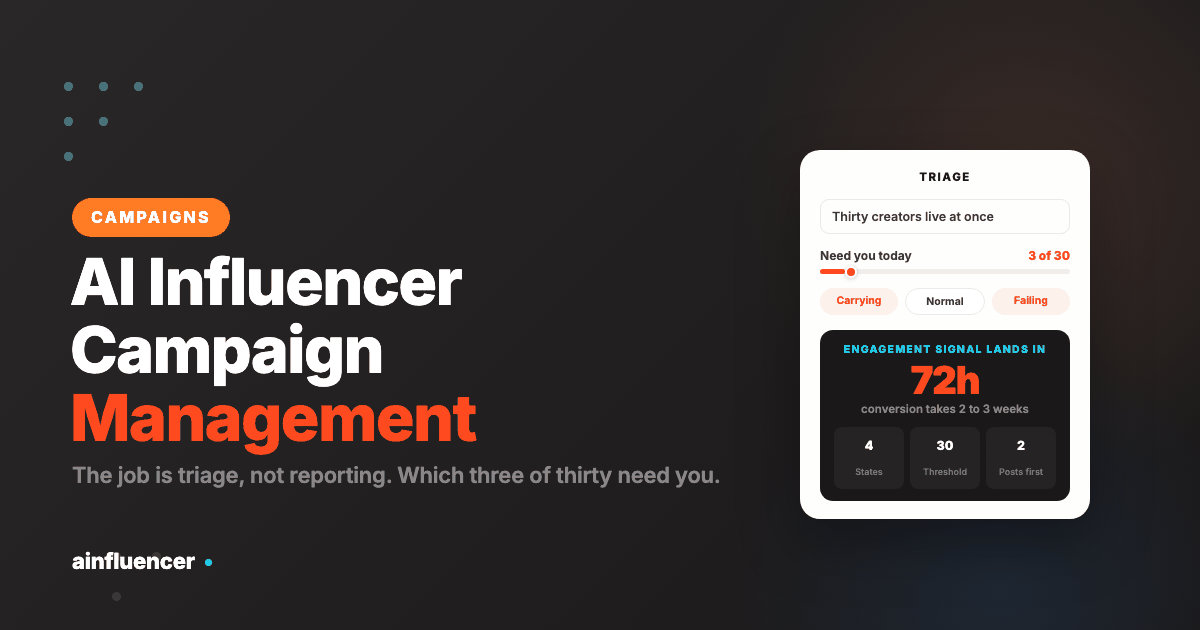
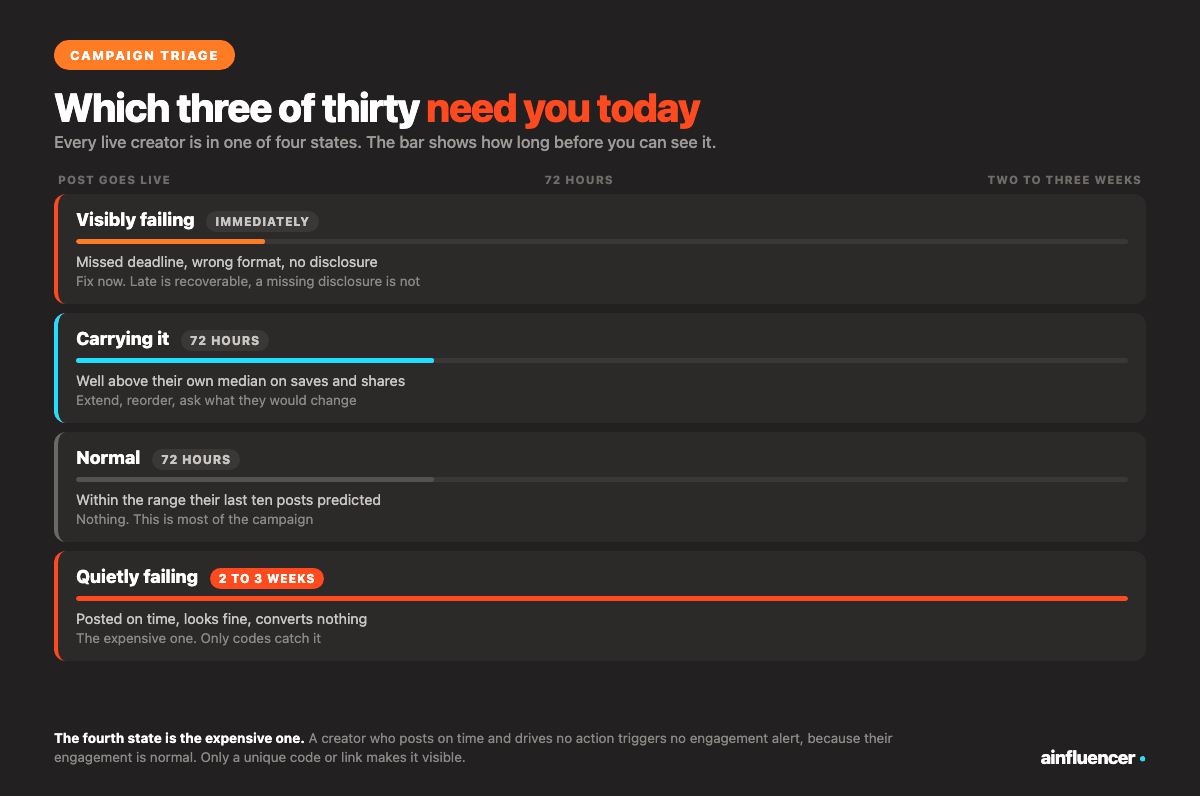
So the useful question is not what happened. It is which three of these thirty need me today. That is a ranking problem over noisy signals, which is the shape of problem models handle well.
The four states a live creator can be in
| State | What it looks like | Visible by | What to do |
|---|---|---|---|
| Carrying it | Well above their own median on saves and shares, not just views | 72 hours | Extend, reorder more, and ask what they would do differently |
| Normal | Within the range their last ten posts predicted | 72 hours | Nothing. This is most of the campaign and it is fine |
| Visibly failing | Missed the deadline, wrong format, disclosure missing | Immediately | Fix it now. Late is recoverable, a missing disclosure is not |
| Quietly failing | Posted on time, looks fine, converts nothing. Reach without intent | Two to three weeks | This is the expensive one. Catch it with codes, not with engagement |
The 72 hour signal
Most of a post’s lifetime engagement lands in the first three days on Instagram and in a wider but still front loaded window on TikTok. That has a practical consequence for management: by day three you already know roughly where a post will finish, and you still have the rest of the campaign to act on it.
Compare against the creator’s own median rather than a category benchmark. A creator whose posts normally reach 9,000 and reached 7,000 is having an ordinary week. A creator whose posts normally reach 9,000 and reached 30,000 has found something, and the campaign should be reorganised around them before it ends rather than noted in the wrap report. Our list of influencer marketing KPIs sets out which numbers to hold this comparison against.
What AI actually does in campaign management
| Task | What the model contributes | Verdict |
|---|---|---|
| Ranking who needs attention | Scores every live creator against their own baseline and surfaces the outliers in both directions | The strongest use. This is the whole job |
| Content approval queues | Pre-checks drafts against the brief, flags a missing disclosure or a banned claim before a person opens it | Strong, as a filter. The approval itself stays human |
| Deliverable reconciliation | Matches what was contracted against what actually went live and stayed up | Strong. Tedious, well defined, instantly checkable |
| Reallocating budget mid flight | Suggests where the next spend goes based on early performance | Useful, with a caveat below |
| Predicting final results from day three | Extrapolates the curve | Weak. Directionally right, precisely wrong. Do not report it |
Reallocating mid campaign, and the trap in it
Moving budget toward what is working is obviously right and routinely done badly. The trap is sample size. Three days of data on one post is not evidence that a creator is better, it is evidence that one post did well, and posts vary enormously within the same account.
Two rules keep this honest. Do not reallocate on a single post, wait for a second. And reallocate toward the format before the creator: if three unrelated creators all did better with a demonstration than with a testimonial, that is a real finding about your product, and it is worth more than any one creator.
When you do extend a creator, the commercial terms are a fresh negotiation, not an automatic multiple. Our data on influencer rates gives the range, and this is one of the decisions to keep away from any automated system, for the reasons set out in influencer marketing AI agents.
Approval queues, where teams actually lose days
On a thirty creator campaign the approval queue is the bottleneck nobody plans for. Drafts arrive unevenly, each needs checking against the brief, and the person who can approve is usually the person running the campaign.
A pre-check that runs before a human opens the draft removes most of the volume: is the disclosure present and in the first two lines, does it use the required product name, does it avoid the claims legal struck out, is the format what was contracted. Everything that fails goes back automatically with the reason. Everything that passes reaches a person who now only has to judge whether it is good.
What must not happen is auto-approval. Under the FTC endorsement guides the advertiser is responsible for disclosures being clear to that audience, and a keyword match is not a judgement about clarity. An approval log that never rejects anything is not a clean campaign, it is a broken check.
You cannot manage what you did not instrument
Every technique above depends on one thing being true before the campaign starts: each creator has a unique code or link. Without that, the quietly failing creator is invisible, and no amount of AI recovers the information, because it was never collected.
Unique codes and UTM links are cruder than platform attribution and they are auditable, which matters more when someone questions the number. The mechanics are in how to track influencer marketing. Set it up once and the whole management layer becomes possible.
One more distinction worth holding: everything above assumes a fixed campaign with an end date. When the same creators come back term after term the evidence you need changes, and AI for influencer partnerships covers the durability signals that only matter when you intend to work with someone again.
What to run, by campaign size
| Creators live | The management layer you need | Where the time goes |
|---|---|---|
| Under 10 | A spreadsheet and a calendar reminder | Nothing here needs software. You can hold ten creators in your head |
| 10 to 30 | Unique codes, one dashboard, a weekly outlier check against each creator’s own baseline | Approvals and chasing. Automate those two first |
| 30 to 100 | A platform with an approval queue, automated reconciliation and per creator baselines | Triage. This is where ranking who needs attention pays for itself |
| Over 100 | An enterprise suite, or your own warehouse fed by platform APIs | Data engineering, honestly, more than campaign management |
If you are choosing a platform rather than building the layer yourself, our comparison of influencer marketing platforms covers which ones carry a real approval queue as opposed to a shared inbox, and free influencer marketing tools covers doing the small version at no cost.
How managed campaigns go wrong
- Managing by dashboard refresh. Watching totals daily tells you nothing actionable. Watching each creator against their own baseline weekly does.
- Reacting to whoever emails. The creators who need attention and the creators who ask for it are different groups.
- Reallocating on one good post. Wait for the second.
- Reporting a day three projection as a result. It will be wrong and it will be remembered.
- Discovering the disclosure problem in the wrap report. By then the post has been live for six weeks.
The wider question of how the campaign should have been designed sits in influencer marketing strategy, and vetting the creators before any of this starts is covered in how to audit an influencer profile.
Frequently asked questions
What is AI influencer campaign management?
It is using a model to triage a live campaign: ranking which of your active creators need attention today by scoring each against their own historical baseline rather than against a category average. It also covers pre-checking content approvals and reconciling what was contracted against what actually went live. It is distinct from finding creators, which happens before the campaign starts.
What can AI do during a live influencer campaign?
Three things reliably: rank which creators are outliers in either direction, pre-check draft content against the brief and flag missing disclosures before a person opens it, and reconcile contracted deliverables against what actually posted and stayed up. Budget reallocation suggestions are useful but advisory, and day three projections of final results should not be reported as numbers.
How soon can you tell if an influencer post is working?
About 72 hours for the engagement signal, because most of a post’s lifetime engagement lands in the first three days. Conversion is slower and often takes two to three weeks, which is why a creator who posts on time and drives no sales is the hardest failure to catch and the most expensive.
When should you reallocate budget mid campaign?
After a second post, not a first. Posts vary enormously within the same account, so one good result is evidence about that post rather than about that creator. Where possible reallocate toward the format that worked across several creators before reallocating toward one creator.
Can AI approve influencer content automatically?
It can pre-check and reject, but it should not approve. Automatic checks work well for whether a disclosure is present, whether the required product name is used and whether the format matches the contract. Whether a disclosure is clear to that audience is a judgement, and under FTC guidance the advertiser carries responsibility for it.
At what campaign size do you need influencer campaign management software?
Around thirty concurrent creators. Below ten a spreadsheet is genuinely faster. Between ten and thirty you need unique tracking codes and a weekly outlier check. Above thirty a person can no longer read every creator every week, and the ones they skip are not random.