AI for Influencer Partnerships
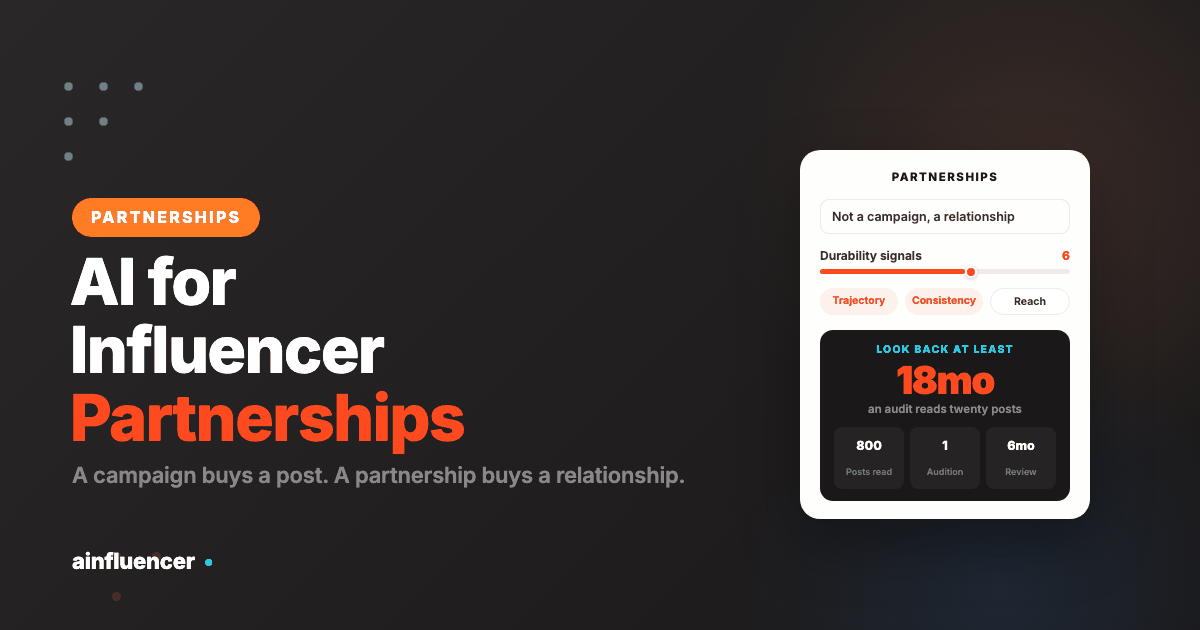
A campaign buys a post. A partnership buys a relationship, and the two need completely different evidence. For one post you care about reach and authenticity. For a twelve month partnership you care about whether this creator will still be posting, still be growing, and still be someone you want associated with your brand next spring. Those are durability signals, and they are exactly what a model can read across two years of history that no person has time to review.
This guide covers what changes when the deal repeats: which signals predict a partnership that lasts, what AI can genuinely assess, what it cannot, and the renewal decision at month six. For the single campaign version of this work see AI influencer campaign management, and for where AI fits across the whole discipline start with AI in influencer marketing.
What changes when a campaign becomes a partnership
| One off campaign | Ongoing partnership | |
|---|---|---|
| Time horizon | Six weeks | Six to twenty four months |
| What you are buying | Reach on a date | Repeated association, and the audience’s belief that it is real |
| The signal that matters | Audience authenticity and engagement quality right now | Trajectory. Is this account growing, stable or quietly declining |
| The main risk | A post underperforms. Annoying, contained | The creator changes, or stops posting, or says something you now own |
| How AI helps | Ranking a shortlist against a brief | Reading two years of history for stability, drift and consistency |
| What it costs to get wrong | One campaign budget | The budget, the content library, and the unwind |
The six durability signals
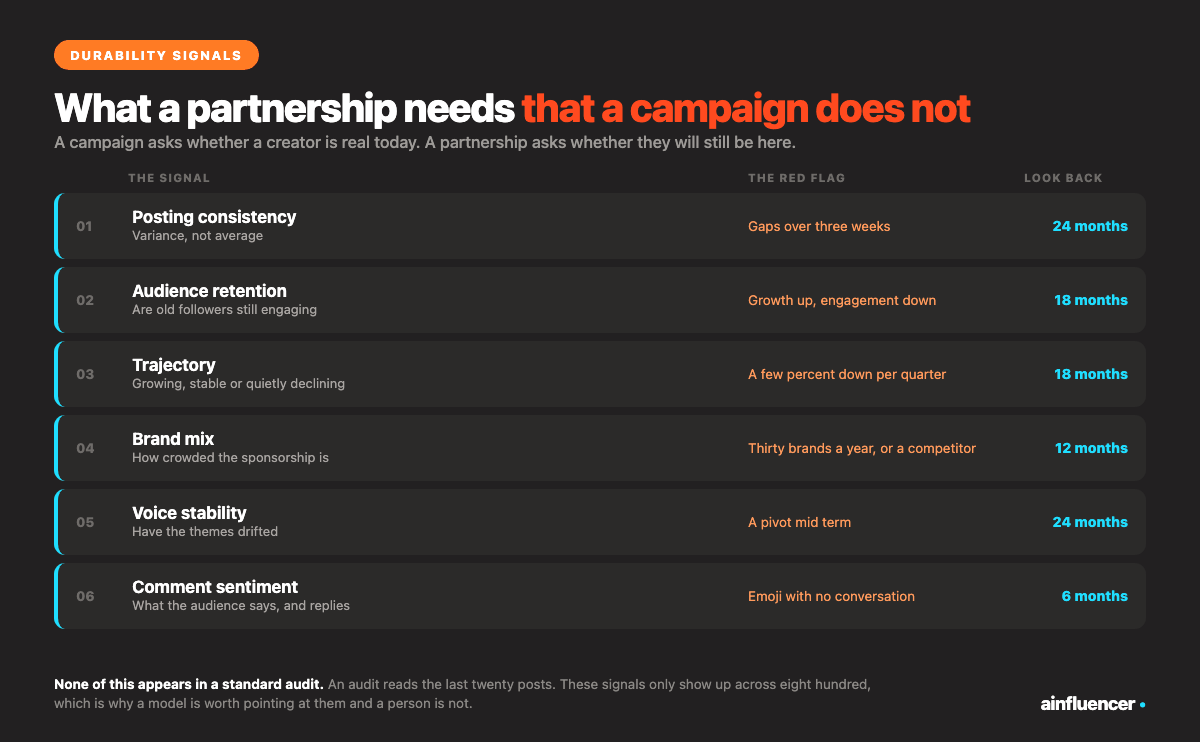
Each of these requires reading a long history, which is why they get skipped. A person checking a creator looks at the last twenty posts. A model can look at eight hundred, and the difference is the whole value here.
1. Posting consistency, measured as variance
Not how often they post, but how reliably. A creator averaging four posts a week with a standard deviation of one is a partner. A creator averaging four with a standard deviation of four posts eleven times one week and disappears for a month, and your quarterly content plan is built on sand. Look for gaps longer than three weeks in the last two years.
2. Audience retention rather than audience size
The question is whether the people who followed them eighteen months ago are still engaging. High follower growth with falling engagement is a warning, because it usually means the new audience arrived for one viral post and has no interest in the creator. Our walkthrough of how to audit an influencer profile covers the engagement rate benchmarks to measure against.
3. Trajectory, over at least eighteen months
Three shapes matter and only one is good for a partnership. Growing is obvious. Stable is fine and often undervalued, because a stable creator with a loyal audience renews well. Quietly declining is the trap: engagement drifting down a few percent a quarter is invisible month to month and obvious across two years. You are signing a twelve month deal on the audience they will have, not the one they had.
4. Brand mix, and how crowded it is
Count the sponsored posts in the last year and the number of distinct brands. A creator promoting thirty brands a year has an audience trained to scroll past sponsorship. A creator with four has a recommendation that still means something. Also check for direct competitors, and for the pattern where a creator has enthusiastically endorsed three competing products in your category.
5. Voice stability
Read the captions from two years ago against last month. Creators pivot, and a pivot mid partnership means the audience you bought is not the audience you have. This is a genuinely good use of a language model: summarising the themes of eight hundred captions across time is not work a person will actually do.
6. Comment sentiment, including the replies
Volume of comments says little. What the audience says, and whether the creator answers, says a great deal about whether a recommendation from them will be believed. A comment section full of emoji and no conversation is a different asset from one where people ask questions and get answers.
What AI cannot assess about a partnership
| The question | Why a model cannot answer it | How to actually answer it |
|---|---|---|
| Will they be good to work with | Reliability under deadline pressure leaves no public trace | Run one paid campaign first. Never sign twelve months cold |
| Do they actually like the product | Enthusiasm in a sponsored post is the thing being paid for | Send it unbranded, months before. Watch whether it appears |
| Will they honour exclusivity | It is a question about a person’s judgement, not their data | Write it into the contract, with a defined category and a term |
| Is the association right for the brand | A model can match an audience. It cannot hear tone | A person reads fifty posts. This is not delegable |
Structuring the deal, which stays human
Partnership terms are where the money actually is, and they are not a follower count calculation. Four things decide whether a deal was good:
- Usage rights. Can you run the content as paid media, for how long, on which channels. This is frequently worth more than the posts.
- Exclusivity. Which category, how tightly defined, for what term. A vague category is a dispute waiting to happen.
- Volume and cadence. Twelve posts across a year is a different product from twelve posts in March.
- The exit. What happens if they stop posting, or if you need to end it early.
Our data on influencer rates gives the range to open from. The negotiation itself is the one step to keep away from any automated system, for the reasons set out in influencer marketing AI agents. An automated offer anchors on public averages, which both overpays creators who would have said yes for less and insults the ones you most wanted.
Ambassador programmes, where this scales
An ambassador programme is many partnerships at once, and it fails in a predictable way: recruitment is enthusiastic, month three is quiet, and by month six nobody knows which ambassadors are still active. That is a monitoring problem, and monitoring is the cheapest thing to automate.
Three checks running continuously cover most of it. Did each ambassador post within their agreed cadence. Is the disclosure present each time. Has anyone taken on a competing partnership. The mechanics of putting those on rails are in influencer marketing automation, and nano influencers covers the tier where ambassador programmes tend to work best, because the relationship is worth more to the creator than the fee.
The disclosure problem gets harder, not easier
A one off sponsored post is straightforward to disclose. An ongoing relationship is not, because the material connection persists between posts. A creator who is on retainer and mentions your product in an unpaid story still has a material connection to disclose, and under the FTC endorsement guides responsibility for that sits with the advertiser as well as the creator.
Two things to build into a partnership from day one. A written rule that every mention is disclosed, paid or not, for the duration of the term. And an automated check that flags any post mentioning your brand without one, routed to a person rather than auto-cleared. The FTC disclosures guidance for influencers is worth sending to every partner at signing, because most creators want to get this right and simply do not know the rule.
The renewal decision at month six
By month six you have something you never had at signing: your own data on this specific creator with this specific product. That beats every predictive signal above.
| What you now know | Renew if | Do not renew if |
|---|---|---|
| Conversion per post | Steady or rising across the term | Falling after post three. Their audience has heard it |
| Cost per acquisition | Competitive with your other channels | Only justified by reach numbers nobody can act on |
| Content reusability | You have run their content as paid media and it worked | You have used none of it |
| Working relationship | Deadlines met, briefs understood, few revisions | Every deliverable needed chasing |
None of this is measurable unless each partner had a unique code or link from day one. The mechanics are in how to track influencer marketing, and the numbers to hold the decision against are in influencer marketing KPIs.
How to start
Run one paid campaign with a creator before discussing anything longer. It costs a fraction of a partnership and it answers the questions no dataset can: do they hit deadlines, do they read the brief, are they pleasant when something goes wrong.
Then use the durability signals to decide which of your one off performers to convert. That order round the right way: the campaign is the audition, the model reads the history, and a person makes the call. Where to find candidates in the first place is covered in influencer marketing platforms and, at no cost, in free influencer marketing tools. The wider programme design sits in influencer marketing strategy.
Frequently asked questions
What is the difference between an influencer campaign and an influencer partnership?
A campaign buys reach on a date and runs about six weeks. A partnership buys a repeated association and runs six to twenty four months. The evidence differs: a campaign needs current authenticity and engagement, a partnership needs trajectory, posting consistency and voice stability across at least eighteen months of history.
How can AI help choose an influencer partner?
By reading a long history that no person has time to review. Six signals predict durability: posting consistency measured as variance rather than average, audience retention rather than growth, trajectory over eighteen months, how crowded the creator’s brand mix is, whether their voice has stayed stable, and what the comment section actually says. A model can assess eight hundred posts. A person checks twenty.
What can AI not assess about an influencer partnership?
Anything that leaves no public trace. Whether the creator hits deadlines, whether they genuinely like the product as opposed to being paid to say so, whether they will honour exclusivity, and whether the association suits your brand’s tone. Models read what was published, and these are all questions about what was not.
How long should an influencer partnership be?
Long enough for the audience to register the association, which is usually at least six months, and short enough to exit if conversion falls. Twelve months with a six month review is a common structure. Never sign a long term deal without running one paid campaign with that creator first.
Do influencer partnerships need disclosure on every post?
Yes, including unpaid mentions during the term. A material connection persists between posts, so a creator on retainer who mentions your product in an organic story still has to disclose it. Under FTC guidance responsibility for clear disclosure sits with the advertiser as well as the creator.
When should you not renew an influencer partnership?
When conversion per post falls consistently after the third post, when the cost per acquisition is only justified by reach figures nobody can act on, when you have used none of the content as paid media, or when every deliverable needed chasing. Falling conversion is usually audience saturation rather than a failure of the creator, and rotating partners on a schedule works better than renewing the same few until they stop performing.