AI in Influencer Marketing
AI in influencer marketing means using machine learning to do the parts of a campaign that scale badly by hand: scoring millions of creator profiles against a brief, spotting bought audiences, drafting briefs, and pulling reporting together. Creator discovery is where it is genuinely useful today. Fraud detection is where almost nobody is using it, and where the money is being lost.
The phrase carries two meanings, and mixing them up wastes a lot of time. One is software that helps a brand run creator campaigns. The other is a virtual character with no human behind it. This guide covers both, starting with the one that has a budget attached.
The two things people mean by “AI influencer”
Before comparing anything, work out which conversation you are in.
- AI for influencer marketing. Software a brand uses to find creators, check them, brief them, and measure the results. The creators are real people. This is the larger market and the one with clearer returns.
- AI influencers. Synthetic characters such as Lil Miquela or Lu do Magalu, generated and scripted rather than filmed. There is no person behind the account. A small and very visible niche.
Both are legitimate. They need different budgets, different skills and, as the last section covers, different disclosures.
Where AI is actually being used
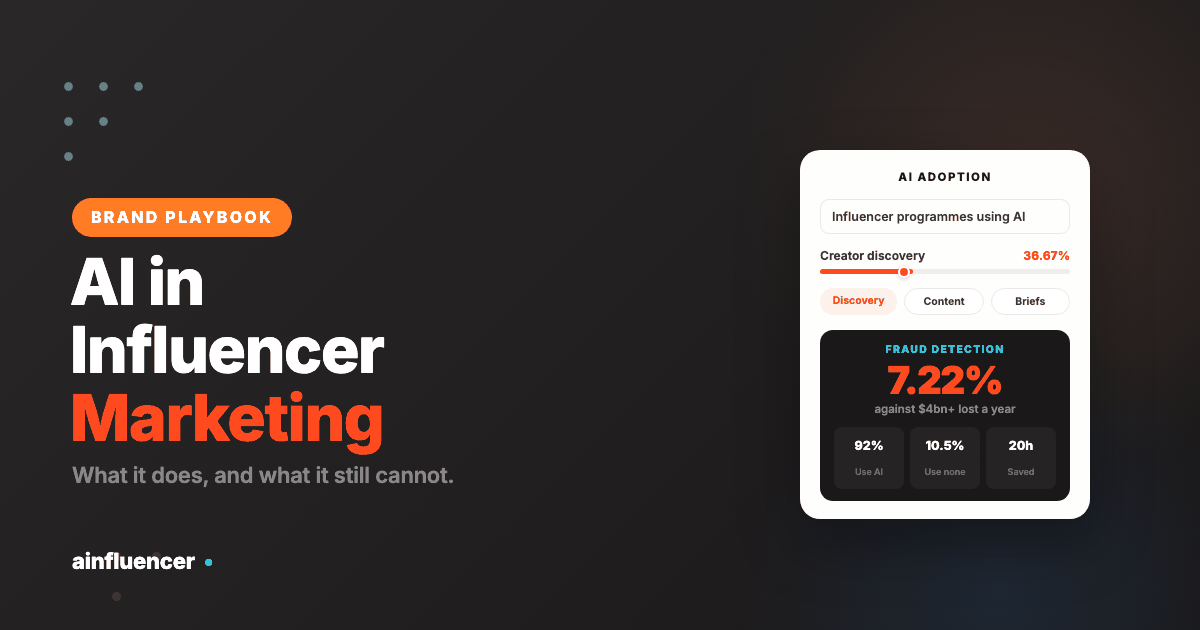
Adoption is close to universal in principle and quite narrow in practice. Around 92% of brands are using or open to using AI in their influencer workflows, and only 10.56% report no AI use at all. What they use it for is concentrated:
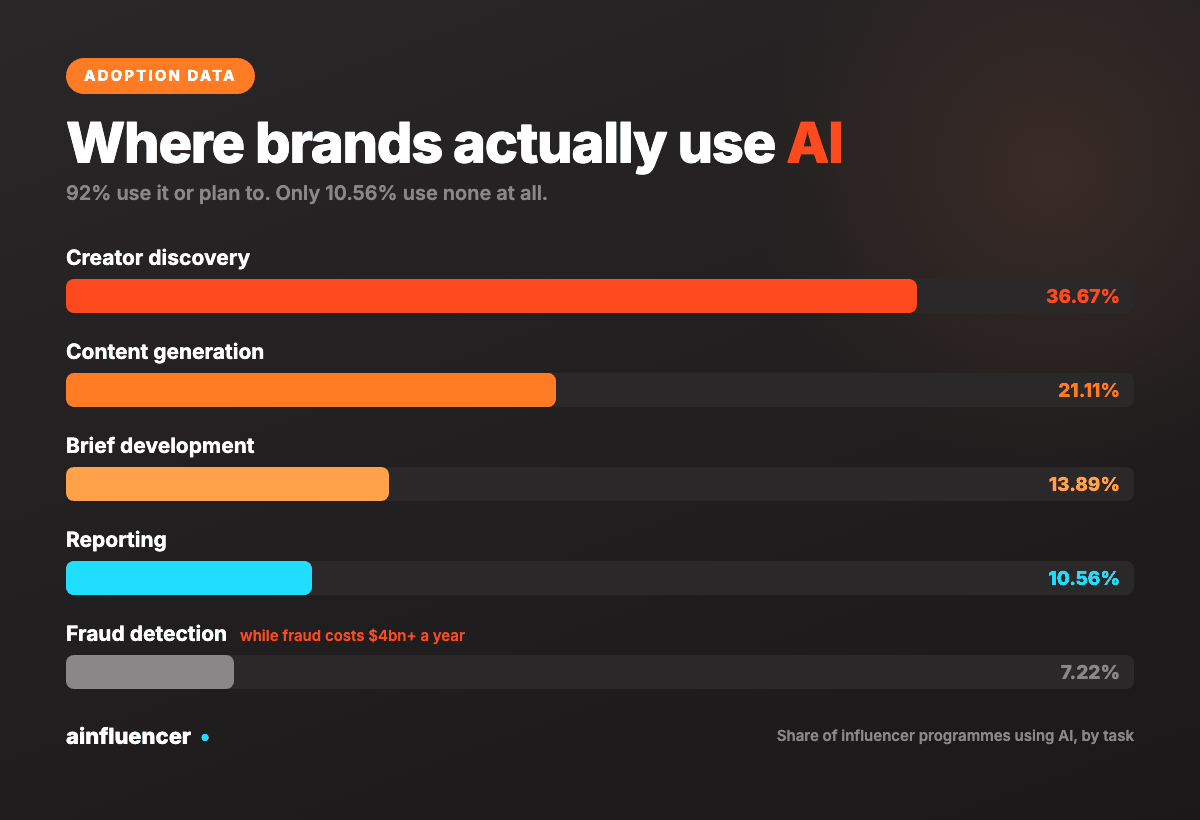
| Task | AI adoption | What it replaces |
|---|---|---|
| Creator discovery | 36.67% | 10 to 20 hours of manual shortlisting per campaign |
| Content generation | 21.11% | First drafts, caption variants, shot lists |
| Brief development | 13.89% | Brief structure and talking points |
| Reporting | 10.56% | Pulling numbers together across creators |
| Fraud detection | 7.22% | Manual follower and comment inspection |
The gap at the bottom of that list is the interesting part. Fraud detection sits at roughly 7% adoption while fraud losses run past $4 billion globally. That is the widest gap between a solvable problem and the tooling aimed at it anywhere in this discipline.
Creator discovery: the one that works
Discovery is the largest use because the manual version is genuinely painful. Building a shortlist of twenty or thirty creators by scrolling Instagram and TikTok took most teams ten to twenty hours per campaign. Scoring profiles against a brief is exactly the kind of narrow, repetitive judgement machines are good at.
A discovery engine typically ranks on four things:
- Audience fit. Location, age band and interests against your buyer, not the creator’s own demographics.
- Engagement quality. Whether comments read like people or like a pod.
- Niche alignment. What the account is actually about, inferred from captions and images rather than a self-declared bio.
- Partnership history. Who they have promoted, how often, and whether a competitor is in there.
What it does not do is decide whether a creator suits your brand. That last judgement is still yours, and it is the reason a shortlist is a shortlist rather than a booking.
Fraud detection: the gap worth exploiting
Bought followers and engagement pods are a measurement problem before they are an ethical one. If a quarter of an audience is not real, every downstream number is wrong, including the ones you use to justify the budget.
Machine learning is well suited to this because the signals are statistical rather than semantic: follower growth that arrives in steps, engagement that does not move when followers do, comment timing clustered within minutes of publishing, and follower accounts with no history. A human can spot these on one profile in fifteen minutes. A model can score a thousand.
Given that only about 7% of programmes use AI here, a brand that does gets an unusually cheap advantage. Our influencer profile audit checklist covers the same checks by hand, and the free Instagram fake follower checker scores a follower base without an account.
What AI does well, and what it still gets wrong
| Job | AI does this well | AI still gets this wrong |
|---|---|---|
| Shortlisting | Ranking millions of profiles on audience fit and engagement quality in seconds | Judging whether a creator’s tone suits your brand |
| Fraud checks | Scoring a whole follower base statistically rather than sampling twenty accounts | Distinguishing a genuine viral spike from bought growth without context |
| Audience data | Estimating location, age and interests at scale | Accuracy varies widely by vendor, and estimates go stale |
| Briefs | Structure, talking points, a first draft that removes the blank page | The creator’s own voice, which is the thing that actually sells |
| Reporting | Aggregating results across dozens of creators consistently | Deciding which number matters for this campaign |
Content and briefs: useful, with a ceiling
Content generation sits at about 21% adoption and brief development at 14%. Both work, with a caveat that matters more than it sounds.
AI is good at the scaffolding: a brief structure, a first draft of talking points, caption variants, a shot list. It is poor at the thing that makes creator content work, which is the creator’s own voice. Audiences are quick to spot a script, and the December 2025 Google core update made generic content a ranking liability as well as a conversion one.
Use it to remove the blank page, not to write the post. A creator handed a finished script tends to read it. A creator handed clear constraints and left alone tends to sell.
Choosing an AI influencer platform
Most platforms now describe themselves as AI powered. Four questions separate the ones where that means something. If you want the same test applied tool by tool, our guide to AI tools for influencer marketing sorts them by the job the AI is doing rather than by vendor.
- What is the model actually scoring? If a vendor cannot say whether the ranking is based on audience data, caption analysis or engagement patterns, it is a filter with a new label.
- Where does the audience data come from? Estimated demographics vary widely between vendors. Ask how it is derived and how often it refreshes.
- Does it detect fraud, or just report engagement rate? These are very different features sold with similar words.
- Can you see why a creator was ranked highly? A score with no explanation cannot be argued with, which means it cannot be improved.
Pricing in this category is opaque and moves quickly. We compared what each platform’s free tier really unlocks in our guide to free influencer marketing tools, and the wider market in influencer marketing platforms. For one vendor in this space specifically, see our Affable.ai review.
Virtual AI influencers
A virtual influencer is a character, not a person. The account is written and rendered by a team, and the audience follows the character rather than a life.
Where they work: full creative control, no scheduling, no scandal risk from a private life, and the ability to appear in situations that would be expensive to shoot. Brands in fashion, gaming and consumer electronics have used them as a recurring brand asset rather than a one-off partnership.
Where they do not: anything that depends on lived experience. A synthetic character cannot credibly review a mattress it did not sleep on, and audiences treat that gap as dishonesty rather than fiction. Production costs are also front-loaded, so a virtual influencer is a long programme rather than a campaign.
The practical test is whether your category rewards aspiration or evidence. Aspiration tolerates a character. Evidence does not.
Disclosure: the part with legal exposure
This is the section most AI influencer articles skip, and it is the one that carries a penalty.
The position of the US Federal Trade Commission is that virtual endorsers are subject to the same rules as human ones, including disclosure of any material connection that could affect how a consumer reads the endorsement. If someone viewing the content might reasonably believe it comes from an actual person with real opinions and experiences, failing to disclose that the endorser is AI generated is treated as deceptive.
That has two consequences in practice:
- A sponsorship disclosure is still required, exactly as it would be for a human creator.
- Where the audience could mistake synthetic content for a real person’s genuine experience, the synthetic nature needs disclosing too.
The FTC published updated guidance on AI endorsements in May 2026 covering synthetic influencers, AI generated testimonials, AI edited creator content and deepfake celebrity endorsements. If you are running anything in this space, that guidance is the document to read rather than a summary of it.
Sources: FTC Endorsement Guides, and the analysis in Arnold & Porter’s review of recent influencer marketing enforcement.
Longer relationships need different evidence again, which is covered separately in AI for influencer partnerships.
What AI cannot do
Four things, consistently.
- Judge brand fit. A model can tell you an account is about skincare. It cannot tell you the creator’s tone would embarrass your brand.
- Negotiate. Rates are relationship and leverage, not a lookup. Published influencer rates are a starting point, not a price.
- Read a room. Whether a campaign is well timed against what is happening in a niche is a human read.
- Own the outcome. An automated shortlist that produces a bad partnership is still your bad partnership.
How to start without buying anything
You can add most of the value before you add a subscription, and a good deal of it is ordinary influencer marketing automation rather than AI at all.
- Fix the measurement first. AI applied to metrics you do not trust produces confident nonsense. Agree what counts as success using our guide to influencer marketing KPIs.
- Automate the check, not the choice. Run every shortlisted profile through an audit tool, then decide with your own eyes.
- Use AI on the brief, not the post. Draft the structure, let the creator write.
- Measure the model. Track whether AI-shortlisted creators outperform hand-picked ones. If they do not, the tool is not working for your niche.
The order matters. Teams that buy a platform before they have agreed what a good campaign looks like end up with faster access to the wrong creators.
Frequently asked questions
What is AI in influencer marketing?
It is the use of machine learning to handle parts of a creator campaign that do not scale by hand: ranking creator profiles against a brief, detecting fake followers and engagement pods, drafting briefs, and assembling reporting. The creators involved are real people. It is distinct from AI influencers, which are synthetic characters with no person behind the account.
How many brands use AI for influencer marketing?
Around 92% are either using AI in their influencer workflows or open to it, and only about 10.56% report no AI use at all. Adoption is concentrated in creator discovery at roughly 36.67%, followed by content generation at 21.11%, brief development at 13.89%, reporting at 10.56% and fraud detection at 7.22%.
Can AI find influencers better than a human?
Faster, and better at the first pass. A model can score millions of profiles against audience fit, engagement quality and partnership history in seconds, where a manual shortlist took ten to twenty hours per campaign. It cannot judge brand fit or tone, so treat the output as a shortlist to review rather than a decision.
Do you have to disclose that an influencer is AI generated?
Yes, in the circumstances the FTC describes. Virtual endorsers are subject to the same rules as human endorsers, so the sponsorship must be disclosed. In addition, where a viewer might reasonably believe the endorsement comes from a real person with genuine experience, not disclosing that it is AI generated is treated as deceptive. The FTC issued updated guidance on AI endorsements in May 2026.
Are virtual influencers worth it for a brand?
They suit categories that trade on aspiration and visual control, such as fashion, gaming and consumer electronics, and they work as a long-running brand asset rather than a single campaign because production costs are front-loaded. They do not suit anything that depends on lived experience, where audiences read the gap between a synthetic character and a genuine review as dishonesty.
What is the biggest mistake brands make with AI here?
Using it to write the creator’s post. AI is good at scaffolding, briefs, structure and talking points, and poor at the specific voice that makes creator content persuasive. A creator handed a finished script reads it. A creator handed clear constraints sells. The second mistake is buying a platform before agreeing what a successful campaign looks like.