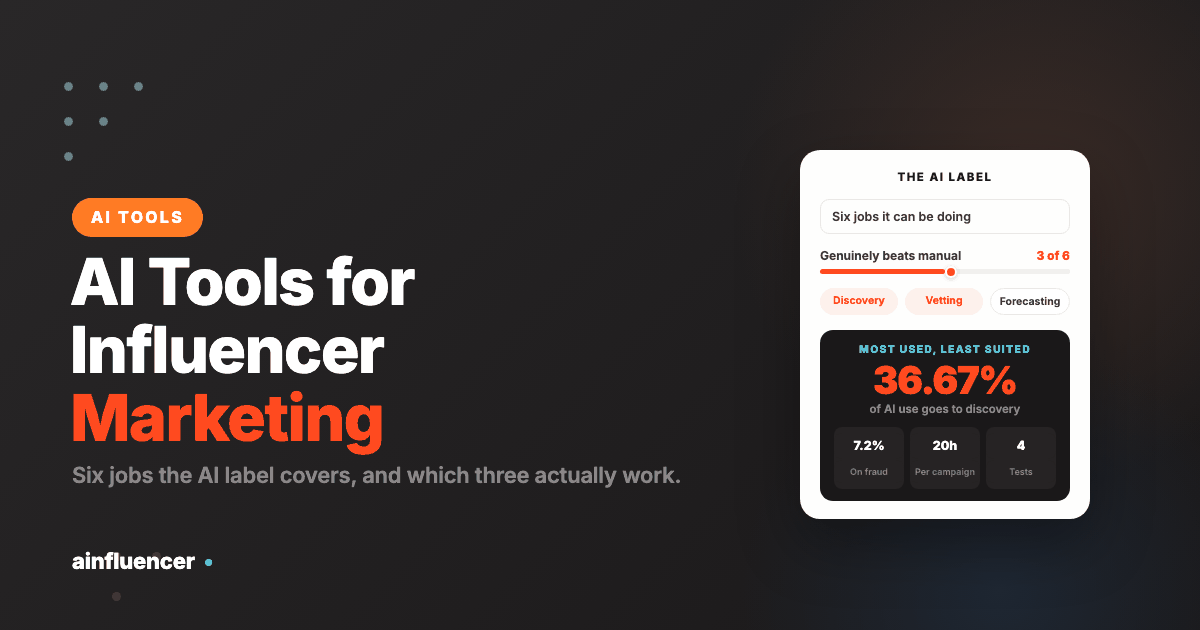
AI Tools for Influencer Marketing
Almost every influencer platform now has something on its dashboard labelled AI. Underneath the label there are only six jobs it can be doing, and they are not equally real. Three of them a model genuinely does better than a person. Two are useful but need a human on the other end. One is usually a saved filter with a new name.
For the store side specifically, ecommerce skills for Claude Code covers conversion, pricing, lifecycle email and churn as downloadable skill files.
This is a guide to which is which, sorted by the job rather than by the vendor. Where we have reviewed a platform in depth, its name links to that review. For the wider strategy question of where AI belongs in a creator programme at all, start with our guide to AI in influencer marketing.
The six jobs AI does in an influencer tool
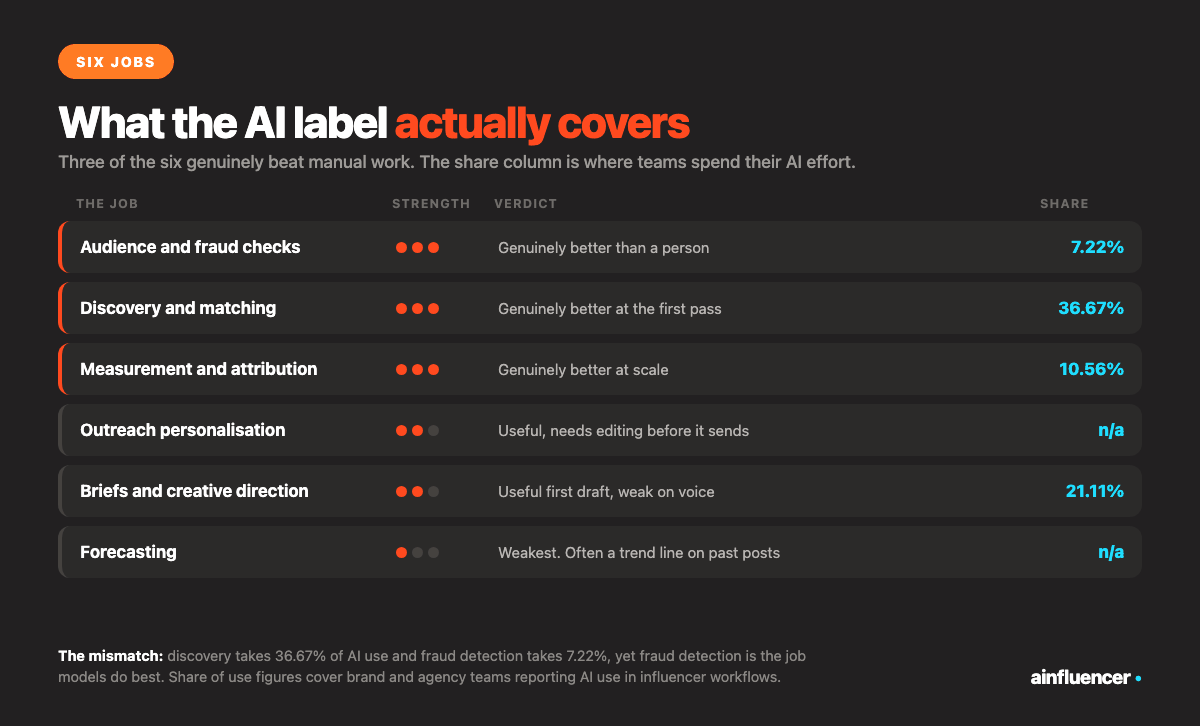
Adoption is not spread evenly across these. Surveyed marketers put roughly 36.67% of their AI use into creator discovery and only about 7.22% into fraud detection, even though fraud detection is the job models are best at. The gap between what AI is used for and what it is good at is the most useful thing to know before you buy anything.
| The job | What the AI actually does | How strong is it | Where it shows up |
|---|---|---|---|
| Discovery and matching | Ranks millions of profiles against a brief using audience, content and performance signals rather than keyword tags | Genuinely better than a person at the first pass | Search and shortlist screens |
| Audience and fraud checks | Scores follower authenticity, comment quality and growth pattern against a large base of known good and known fake accounts | Genuinely better than a person, and far faster | Audit and vetting reports |
| Measurement and attribution | Ties creator content to sessions, codes and conversions, and cleans the messy identity matching in between | Genuinely better than a person at scale | Reporting dashboards |
| Outreach personalisation | Drafts a first message per creator from their recent posts | Useful, but needs editing before it sends | Campaign and CRM screens |
| Briefs and creative direction | Turns a campaign goal into a brief, caption variants and shot lists | Useful as a first draft, weak on brand voice | Content modules |
| Forecasting | Predicts reach, engagement or cost before the campaign runs | Weakest of the six. Often a trend line on past posts | Planning and budgeting screens |
Discovery and matching
This is the job most people buy an AI tool for, and it is a fair reason to buy one. Manual shortlisting costs 10 to 20 hours per campaign, and the result is shaped by whoever happened to be in the marketer’s feed that week.
What a model adds is not speed alone. Keyword search finds creators who describe themselves as fitness accounts. Vision and language models find creators whose posts actually are about fitness, which catches the ones with a bare bio and misses the ones who put every keyword in their name to game search.
Platforms that position discovery as their core strength include Modash, Upfluence, Heepsy, Influencity and inBeat. Our wider comparison of influencer marketing platforms covers how they differ on database size and filter depth.
The test that separates real matching from a filter: search for something a tag cannot express. “Creators whose audience is mostly parents of toddlers” is not a category any creator selects. If the tool returns a sensible list, the model is reading audience signals. If it returns everyone tagged #momlife, it is a filter.
Audience quality and fraud checks
This is where AI is least hyped and most useful. Judging whether 40,000 followers are real means looking at follower age distribution, follower to following ratios across the audience, comment language patterns, and the shape of the growth curve. A person can do this for one account in about twenty minutes. A model does it for a thousand accounts in a minute, and it is more consistent, because it is not tired by account number 300.
HypeAuditor built its reputation on this, and Modash and Affable AI both ship authenticity scoring. Whatever you use, do not take a single score at face value. Our walkthrough of how to audit an influencer profile sets out the seven checks a score is compressing, and why an 85 on one platform and a 62 on another is normal rather than a contradiction.
If you only want the follower authenticity part and do not want a subscription, our free Instagram fake follower checker runs the same class of check.
The deeper version of this check, including where to set your threshold, is in AI powered influencer vetting.
Measurement and attribution
The hardest unglamorous problem in influencer marketing is connecting a story that vanished after 24 hours to a sale that happened three days later on a different device. The AI here is doing identity resolution and messy data matching, not anything that looks clever on a demo.
Enterprise suites carry the deepest version of this: CreatorIQ, Traackr, Tagger, Captiv8 and Lefty. They are priced for teams running dozens of creators at once. Below that tier the honest answer is that you do not need a model for this at all: tracking influencer marketing with discount codes and UTM links gives you attribution that is cruder but auditable, and it costs nothing.
Before you evaluate any of them, decide what you are measuring. A tool cannot fix an undefined goal, and a dashboard full of reach numbers will happily hide the fact that nothing was sold. Our list of influencer marketing KPIs is the shorter version of that argument.
Outreach personalisation
Generated first messages work, with one condition: the creator has to be able to tell that a human read their account. A model can do that, because it can actually read the last twenty posts, which is more than most outreach teams manage. What it cannot do is know that this creator publicly turned down a competitor last month.
The failure mode is volume. The same tool that writes one good message writes four hundred mediocre ones, and creators recognise the pattern within a week. Our influencer outreach templates and the guide to how to DM influencers both start from the same rule: one specific, true observation about the creator beats three paragraphs of generated enthusiasm.
Briefs and creative direction
Around 21.11% of AI use in influencer teams goes here, mostly on first drafts. That is roughly the right use. A model will produce a structurally complete brief in a minute: deliverables, deadlines, mandatory disclosures, do-not-say list. It will not produce your brand voice, and a brief written entirely by a model tends to over specify the creative and under specify the commercial terms, which is exactly backwards.
The disclosure section is the one to check by hand every time. FTC endorsement rules put responsibility on the brand, not the creator, and a generated brief will cheerfully produce a disclosure line that is out of date.
Forecasting, and why it is the weakest
Predicted reach and predicted engagement are the numbers most likely to be a trend line dressed up. The reason is structural rather than a criticism of any vendor: the outcome of a post depends on a creative execution that does not exist yet, on a platform whose ranking changes without notice, at a moment nobody has picked. Past performance genuinely constrains the range. It does not predict the post.
Treat a forecast as a sanity check on your own estimate, not as a plan. If a platform predicts 40,000 views on a creator whose last ten posts averaged 9,000, the forecast is not the thing that is right.
How to tell real AI from a renamed filter
Four questions, answerable in a trial account, in about fifteen minutes.
| Ask this | A filter answers like this | A model answers like this |
|---|---|---|
| Search for something no creator would tag themselves with | Returns the closest keyword match, or nothing | Returns a plausible list you would not have assembled |
| Ask why a specific creator was recommended | Shows the filters that matched | Names signals you did not filter on, such as audience overlap |
| Run the same search twice a month apart | Identical results | Results shift as the underlying accounts change |
| Ask for the confidence or the sample behind a score | No answer, the score is a formula | Gives a sample size or a confidence band |
What none of these tools can do
Worth saying plainly, because the category markets itself as though the list were empty.
- Judge brand fit. A model can tell you a creator’s audience matches yours. It cannot tell you their sense of humour will embarrass you.
- Negotiate. Rates in this market are set by relationship and leverage as much as by follower count. Our data on influencer rates gives you the range, not the deal.
- Own the relationship. Creators who deliver twice keep delivering because a person remembered their kid’s name, not because a CRM fired a sequence.
- Catch a brand safety problem in a language it was not trained on. This is the failure that ends up in a screenshot.
A stack that works, by budget
| Budget | Discovery | Vetting | Measurement |
|---|---|---|---|
| Zero | A free marketplace where creators apply to you, so inbound replaces search | A free fake follower checker plus the manual seven point audit | Discount codes and UTM links, read in your own analytics |
| Small | One mid tier discovery tool, monthly not annual | Whatever authenticity score ships with it, cross checked by hand on the final shortlist | The same codes and links, plus the tool’s own click tracking |
| Team | A full platform with saved briefs and collaboration | Platform scoring, with a manual audit reserved for anyone above your spend threshold | An enterprise suite, or your own warehouse fed by the platform’s API |
One consistent finding across every budget: teams overspend on discovery and underspend on vetting. Discovery is the fun part and it is where the demos are impressive. Vetting is where the money is actually lost, because a campaign with the wrong creator fails no matter how good the brief was.
Where this is heading
The next step past a tool with an AI feature is a tool that takes an instruction and does the whole task, discovery through to a drafted report. That is a different product shape, and it is early. Influencer marketing AI agents covers which tasks one can own and how much autonomy to hand over, and our guide to influencer marketing skills for Claude Code and AI agents is the implementation side of the same question.
Frequently asked questions
What are the best AI tools for influencer marketing?
There is no single best one, because the six jobs are handled by different products. For discovery, Modash, Upfluence, Heepsy, Influencity and inBeat all compete. For fraud and authenticity checks, HypeAuditor and Affable AI. For measurement at scale, CreatorIQ, Traackr, Tagger, Captiv8 and Lefty. Pick by the job you are actually short on rather than by the longest feature list.
Is AI in influencer marketing tools real or just marketing?
Both, depending on the feature. Discovery matching, authenticity scoring and attribution genuinely use models and genuinely beat manual work. Predicted reach is often a trend line on past posts. You can tell the difference in a trial account by searching for something no creator would tag themselves with and seeing whether the results still make sense.
Can AI tools replace an influencer marketing manager?
No. They replace the shortlisting, the follower checks and the reporting assembly, which is most of the hours. They do not replace judging brand fit, negotiating a rate, or keeping a creator relationship alive, which is most of the value.
What do most teams use AI for in influencer marketing?
Creator discovery at roughly 36.67%, content generation at 21.11%, brief development at 13.89%, reporting at 10.56% and fraud detection at 7.22%. Fraud detection is the smallest share and the job models are best at, which is the clearest mismatch in the category.
Are there free AI tools for influencer marketing?
Yes, though free usually means a metered tier rather than a free product. Free fake follower checkers and free-forever marketplaces where creators apply to you are the two genuinely useful free routes. Free discovery tiers tend to cap searches low enough that they only work for a single small campaign.