A successful Amazon pricing strategy is about aligning price with business goals, not just being the cheapest listing.
Start with accurate cost and margin calculations, protect profit with price floors, and use dynamic repricing to react to market changes. Test consistently, document results, and adjust for seasonality so your pricing supports both short-term sales and long-term growth.
This guide walks you through the practical steps, margin calculations, real examples, and dynamic repricing tools to price for visibility and help you become a top seller on Amazon over time.
Expert Amazon Pricing Strategies Explained
Implementing the right Amazon pricing strategy can increase your sales by 15-25% compared to static pricing approaches.
These pricing methods are among the most effective Amazon sales increase strategies because they improve visibility, Buy Box share, and long-term profitability.
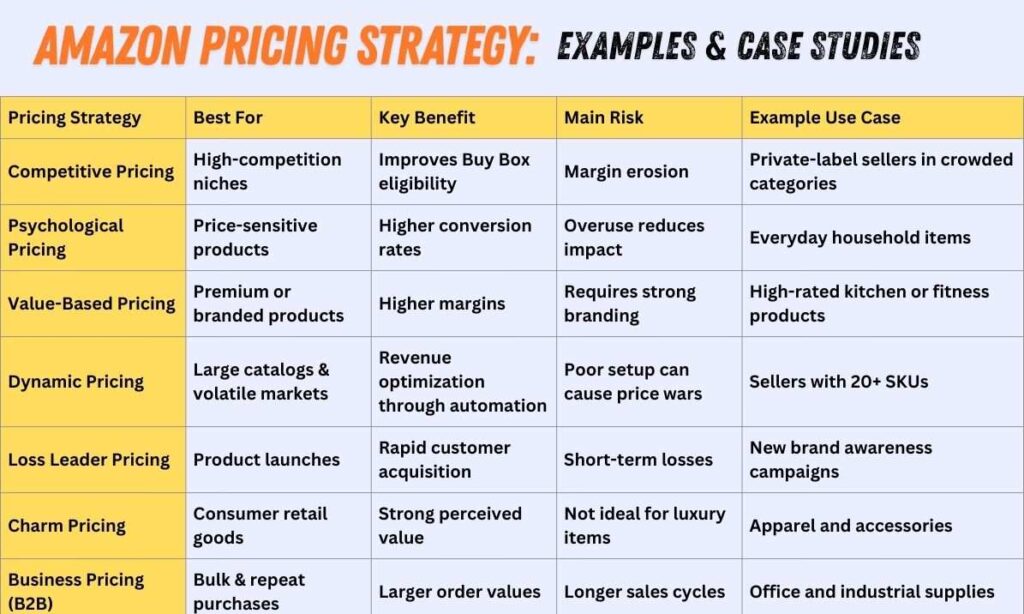
1. Competitive Pricing
Competitive pricing keeps your products aligned with market rates to win more sales. Amazon’s algorithm favors competitively priced products, directly impacting your search rankings and visibility.
This approach requires constant market monitoring to adjust prices against competitors both on and off Amazon.
Sellers using competitive pricing typically win the Buy Box 73% of the time versus 58% for those using static pricing.
2. Psychological Pricing
Psychological pricing leverages how customers perceive value rather than the actual numbers. Studies show that pricing strategies based on psychology can increase sales by up to 24%.
Buyers make emotional decisions first, then rationally justify their choices later. This approach works particularly well for everyday items where price sensitivity matters most.
3. Value-Based Pricing
Value-based pricing sets prices according to customer-perceived worth rather than production costs. This strategy works best for premium products with distinctive features or brand recognition.
Products with 4.5+ star ratings can command prices 12-20% higher than lower-rated competitors yet maintain sales velocity. Value-based pricing allows you to highlight quality, durability, or unique benefits that justify premium positioning.
4. Dynamic Pricing
Dynamic pricing automatically adjusts product prices based on real-time factors such as demand, inventory levels, and competitor pricing.
Amazon alone changes prices approximately 2.5 million times daily, demonstrating how crucial dynamic pricing is for maintaining revenue and competitiveness.
Academic research confirms that dynamic and personalized pricing in e-commerce significantly influences consumer responses and purchasing behavior, making it a widely adopted strategy in online marketplaces.
In practice, sellers using dynamic pricing often report higher revenue and improved pricing efficiency compared to static pricing approaches, while automation reduces manual monitoring and helps maintain optimal price points across changing market conditions.
5. Loss Leader Pricing
Loss leader pricing involves selling certain products at or below cost to attract customers. Amazon famously uses this strategy with Kindle devices, losing $50-100 per device yet generating $443 annually per customer on digital content. This approach works best when:
- The initial loss builds customer loyalty.
- Customers typically purchase additional items.
- Your goal is rapid customer acquisition.
- You can track lifetime customer value.
6. Charm Pricing
Another common Amazon pricing strategy is Charm pricing that uses prices ending in odd numbers (usually 9, 7, or 5) to create perceived bargains. This works because consumers process prices from left to right with decreasing attention spans.
Over 60% of retail prices end in nine for good reason; they outperform round numbers consistently. Interestingly, premium products often perform better with round numbers like $50.00 that signal quality versus $49.99 that suggests value.
7. Business Pricing for B2B Sales
Business pricing targets professional buyers through Amazon Business.
Setting specific B2B prices and quantity discounts can significantly boost sales of products with business pricing, see a 10% sales lift on average, while quantity discounts drive a 20% sales increase. This strategy works particularly well for office supplies, industrial equipment, and bulk consumables.
Ultimately, successful Amazon sellers often combine multiple pricing strategies based on product category, competition level, and business goals.
The best Amazon pricing strategy aligns pricing decisions with your overall marketing strategy rather than focusing solely on being the cheapest option available.
Start With Profit: How To Set a Profitable Price
Profitable pricing begins with knowing all your costs before setting prices. Many new Amazon sellers underestimate their true break-even point by $3.00-$7.00 per unit, leading to products that appear profitable but actually lose money.
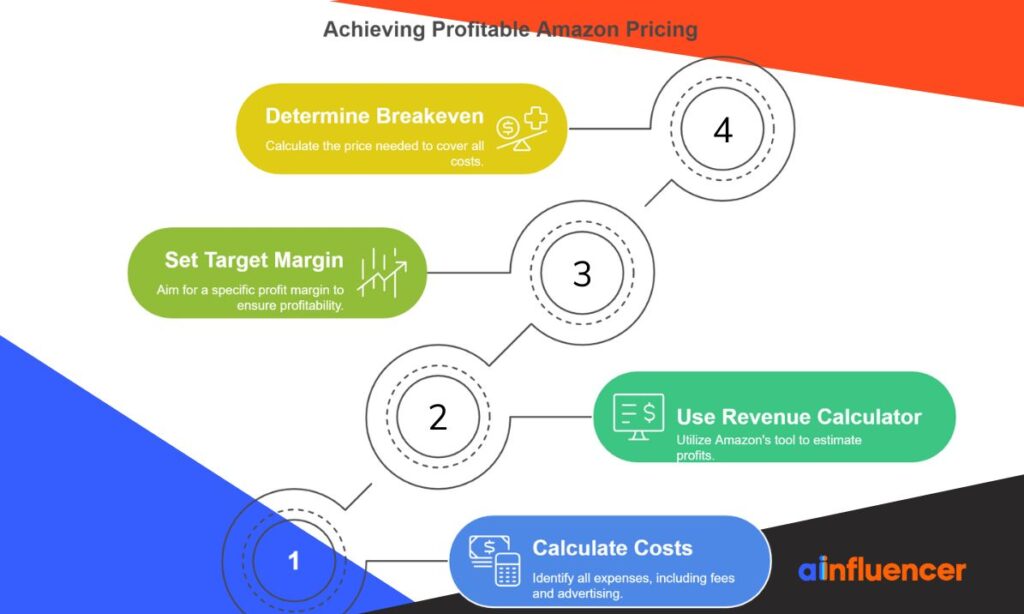
#1 Calculate All Costs Including Fees & Ads
Amazon charges numerous fees that eat into your profits. Referral fees typically range from 8% to 15% of your selling price. FBA fulfillment fees vary based on product dimensions and weight.
Monthly storage fees fluctuate depending on your product category and time of year. Furthermore, you must account for PPC advertising costs, which range from $2.00 to $12.00 per sale.
Don’t forget these often-overlooked expenses on your Amazon pricing strategy:
| Cost Type | Typical Range | Notes |
| Product Cost | Varies | Manufacturing or sourcing cost |
| Referral Fee | 8%–15% | Category-dependent |
| FBA Fulfillment Fee | $3.00–$10.00+ | Based on size & weight |
| Storage Fees | Seasonal | Higher in Q4 |
| PPC Advertising | $2.00–$12.00 per sale | Depends on competition |
| Returns & Refunds | 2%–8% of revenue | Often underestimated |
| Misc. Fees | $0.50–$2.00 per unit | Split shipments, prep, labeling |
Most sellers track their primary costs but miss these hidden fees, dramatically reducing their actual profit margins.
#2 Use Amazon’s Revenue Calculator
Amazon provides tools to estimate your potential profits. The FBA Revenue Calculator helps analyze product profitability before listing on Amazon. This tool breaks down all expenses, fees, and potential profits when using FBA, helping you with your Amazon pricing strategy.
To use the calculator:
- Open the Revenue Calculator at sellercentral.amazon.com/revcal.
- Search for a similar product or enter your product’s dimensions.
- Input your cost of goods and selling price.
- Review the calculated Amazon fees and projected profit.
The calculator shows a side-by-side comparison of fulfillment options, helping you decide between FBA and self-fulfillment based on margins.
This tool is especially valuable when researching new products to sell or considering a switch to FBA.
#3 Set a Target Profit Margin
Industry experts recommend maintaining at least 60% gross margins to stay profitable after Amazon fees. Most Amazon sellers aim for net profit margins between 15% and 25% for their Amazon pricing strategy.
Nevertheless, top performers in categories like Home and Electronics achieve 25%+ net margins.
Profit margins vary significantly by category:
- Electronics and Home: 22-28%.
- Apparel: 10-15%.
- Grocery: 8-12%.
Calculate your net profit margin by subtracting all expenses from revenue, then dividing by revenue and multiplying by 100. Even a $0.30 discrepancy in your calculations can significantly affect margins when selling thousands of units.
#4 Determine Your Breakeven Price
Your breakeven point is where total revenue equals total costs. Before this point, you lose money on every sale. After it, you generate profit. The comprehensive formula for calculating breakeven units is:
Breakeven Units = Fixed Costs ÷ (Selling Price – Variable Cost per Unit)
For Amazon sellers, the minimum breakeven price equals: (Product Cost + Shipping + FBA Fee) ÷ (1 – Referral Fee %)
For example, if your product sells for $34.99 with variable costs of $26.30 per unit and fixed costs of $2,500, you’d need to sell 288 units to break even. Consequently, any sales beyond this point become profitable.
Aim for products that reach breakeven within 90-120 days or 200-400 units sold. Products requiring more than 500 units to break even often indicate margin problems or high fixed costs.
How To Use Dynamic Pricing Tools Effectively
Dynamic pricing tools can boost your Amazon sales compared to static pricing approaches. Similar to Amazon affiliate automation, dynamic pricing tools reduce manual effort while scaling revenue through data-driven decision-making.
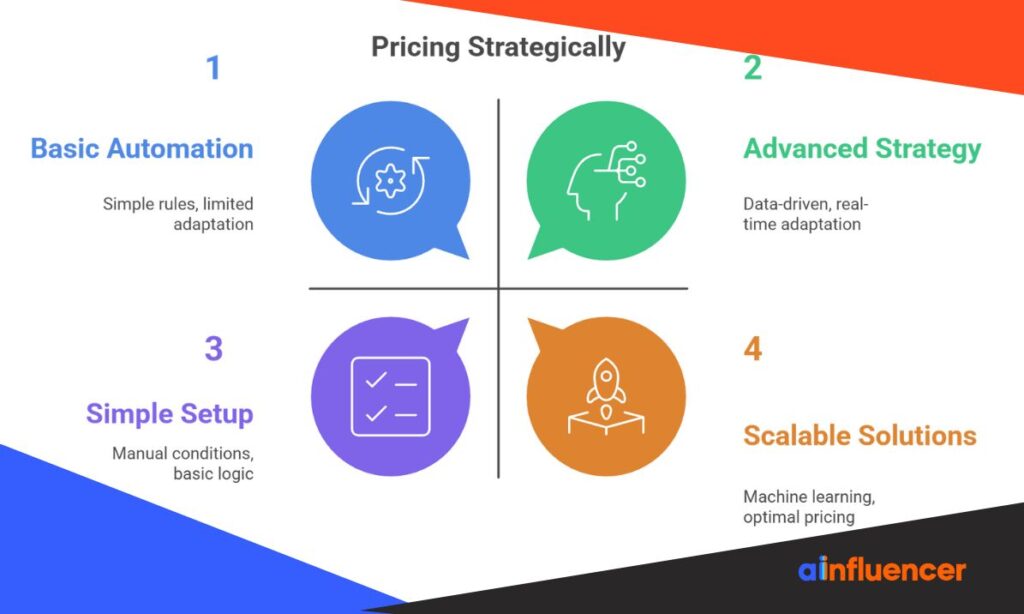
#1 Rule-Based vs Algorithmic Repricing
Rule-based repricing follows specific conditions you set manually. This approach uses simple logic like “price $0.05 below competitors” or “never drop below cost plus 30%”.
Meanwhile, algorithmic repricing employs machine learning to analyze multiple factors, including competitor behavior, Buy Box dynamics, and market trends.
Benefits of algorithmic repricing:
- Avoids human bias through data-driven decisions.
- Increases profitability by finding optimal price points.
- Adapts continuously to evolving market conditions.
- Identifies trends in real-time.
Notably, algorithmic repricing allows you to price higher without losing Buy Box share, as most of the algorithmic sellers set prices above market minimums.
In the table below, you can see the complete differences for each repricing:
| Feature | Rule-Based Repricing | Algorithmic Repricing |
| Setup Complexity | Low | Medium–High |
| Automation Level | Basic | Advanced |
| Market Adaptability | Limited | Real-time |
| Risk of Price Wars | Higher | Lower |
| Margin Optimization | Manual | Data-driven |
| Best For | Small catalogs | Scaling sellers |
#2 Setting Price Floors & Ceilings
Price floors protect your profits by establishing the absolute minimum price for your products. Calculate your floor price using this formula:
(Product Cost + Shipping + FBA Fee) ÷ (1 – Referral Fee %).
Your ceiling price represents the maximum you’ll charge when competition is minimal.
For instance, if your product costs $300 with a target profit of $100 and Amazon’s commission is 15%, your floor price would be $470.59 after including fees. Always consider shipping fees separately from your floor calculations.
#3 Avoiding Over-Aggressive Undercutting
While using Automated repricers as your Amazon pricing strategy, it can sometimes trigger destructive price wars where multiple sellers continually undercut each other. To prevent this, first set intelligent minimum prices that ensure profitability regardless of competition.
Second, consider using algorithmic tools that recognize when racing to the bottom isn’t beneficial.
One effective strategy involves identifying competitors’ bottom prices through careful testing, then pricing just above their threshold.
#4 Best Tools for Amazon Dynamic Pricing Strategy
Amazon’s free Automate Pricing tool offers basic rule-based repricing with competitive, sales-based, and business pricing rules. For more advanced needs, consider these specialized options:
- Ainfluencer Amazon: Beyond pricing, this platform connects you with affiliates and influencers to boost sales, track performance, and automate commissions. Ideal for sellers who want to combine pricing strategy with revenue growth.
- Seller Snap: AI-powered repricing that automatically adjusts prices based on competitors, demand, and Buy Box dynamics. Saves time and helps maintain optimal margins.
- Aura: Advanced algorithmic repricing with real-time market tracking. Improves Buy Box ownership and prevents destructive price wars, suitable for scaling sellers.
By combining dynamic pricing with Ainfluencer, you protect margins while expanding reach and conversions.
Test & Improve Amazon Pricing Strategy Over Time
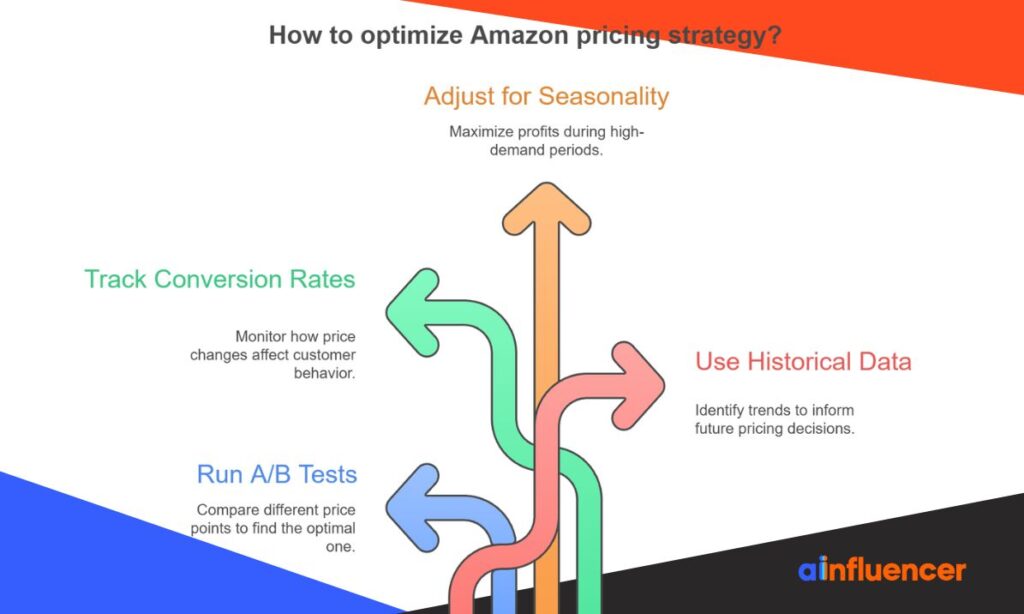
Testing different price points is essential for optimizing your Amazon pricing strategy over time. Regular price testing helps sellers find that sweet spot between maximum profit and competitive positioning.
#1 Run A/B Tests on Price Points
A/B testing price points shows which pricing performs better with actual customers. Sell your product at two different prices for a set time period, primarily to compare results and determine which price performed better.
During testing, focus on one element at a time and run tests for statistically significant periods. Document all test results carefully to track improvements over time.
#2 Track Conversion Rates & Sales Volume
Monitoring conversion rates reveals how price changes affect customer purchasing decisions. Track how price adjustments impact both sales rankings and total revenue.
Your Amazon pricing strategy is almost as important as your product quality in determining conversion rates.
Since customers can distrust heavily discounted products, avoid extreme price reductions that might damage brand perception.
As pricing directly affects conversion rate, it works best when combined with optimizing Amazon listing elements such as titles, images, and bullet points.
#3 Adjust Based on Seasonality & Demand
Seasonal price adjustments maximize profits during different demand cycles. Consider these factors when making seasonal adjustments:
- Market position against competitors.
- Current inventory levels.
- Natural demand cycles.
- Clear profit margin boundaries.
One seller reduced Halloween apparel prices by 20% in early October, resulting in a 147% increase in ad revenue compared to the previous year.
First thing to remember: raising prices during high demand when inventory drops below 30 units can help manage stock while boosting profits.
#4 Use Historical Data to Refine Strategy
Historical pricing data reveals patterns that inform future pricing decisions. Tools like Keepa provide detailed price history charts that help identify seasonal trends 6-12 months in advance.
Most product categories follow predictable pricing cycles. Consumer electronics typically drop 20-30% in January, and outdoor gear spikes in March.
In essence, your pricing strategy shouldn’t remain static; it should evolve with market conditions, seasons, and various other factors.
Before setting new prices, analyze at least 24 months of historical data to identify micro-seasons, those 2-3 week windows where demand spikes create pricing opportunities.
Quarterly pricing reviews ensure your Amazon dynamic pricing strategy stays optimized for long-term success.
Final Words
Your Amazon pricing strategy is a profit lever, not just a number. Sustainable sellers start with accurate cost calculations, factor in all Amazon fees, and protect healthy margins, often targeting 60% gross margins to stay profitable long term.
Instead of racing to the lowest price, they use category-specific pricing, competitor tracking, and ongoing price testing to balance volume and profit.
Dynamic pricing tools make this process scalable. Automated repricing helps you respond to market shifts, win more Buy Box placements, and avoid manual price wars.
Most importantly, pricing isn’t set-and-forget; regular reviews based on demand, seasonality, and competition ensure your prices support both short-term sales and long-term growth.
FAQs
How often should I update my Amazon prices?
Review and adjust prices at least weekly, or more often in competitive categories. Use dynamic repricing tools to automate updates while monitoring sales, inventory, and competitor changes. Frequent adjustments help maintain Buy Box eligibility and optimal margins.
How does repricing interact with Buy Box eligibility?
Pricing is a key factor for Buy Box wins; being competitive without undercutting profits increases your chances. Automated repricers can optimize for Buy Box by analyzing competitor prices, sales velocity, and historical trends in real time.
What is Amazon’s Fair Pricing Policy & how does it affect my listings?
Amazon may suppress listings if prices are unreasonably high or low compared to market value. Ensure your pricing is fair, consistent, and covers costs plus profit, avoiding extreme discounts or inflated prices that could trigger policy enforcement.