The Best Amazon PPC Agencies and Management Services for 2026
The agencies that run Sponsored Products, Brands, and Display profitably — compared by focus, pricing model, and how they treat ACoS versus TACoS.
Amazon PPC is a compounding skill game: campaign architecture, bid strategy, keyword harvesting, and creative testing — repeated weekly, forever. A good PPC agency buys you that compounding without hiring a full-time specialist; a bad one burns budget behind a pretty dashboard.
This guide sits inside our broader roundup of the best Amazon marketing services, zoomed into paid advertising specifically. If you’re still building foundations, start with what Amazon PPC is and how the auction works — the agencies below assume you know why you’re bidding.
We compare six strong options across the spectrum — dedicated PPC shops, full-service agencies with strong ads teams, and software-plus-managed hybrids — then cover pricing models and the five questions that separate operators from report-senders.
What Does an Amazon PPC Agency Do?
Four core workstreams. Account architecture: restructuring campaigns so search terms, match types, and products are isolated enough to control — the foundation most underperforming accounts lack. Bid and keyword strategy: harvesting converting terms, cutting waste, and managing bids against a target, informed by solid Amazon keyword research. Ad-type coverage: Sponsored Products, Sponsored Brands, and Sponsored Display, each with distinct jobs in the funnel. Profit measurement: managing to blended targets — the ACoS vs TACoS distinction — so ad spend grows total sales rather than cannibalizing organic.
Beneath those workstreams sits a weekly discipline most sellers never sustain solo: search-term harvesting and negation on a fixed cadence, placement and dayparting modifiers tuned by segment, and budget reallocation between campaigns as seasonality moves. None of it is glamorous; all of it compounds. When an agency describes its process, listen for cadence words — “weekly negatives,” “biweekly harvest,” “monthly structure review” — because the calendar, not the cleverness, is what you’re actually buying. Ask to see an anonymized change log from a live account: real operators have one, and its rhythm tells you everything.
What you’re paying an agency to run every week
What a good first 90 days looks like
Month one: full audit, campaign restructure, and tracking baseline — expect turbulence as history resets. Month two: harvesting winners into exact-match campaigns, negation waves, bid rules by placement. Month three: profit tuning against your TACoS target and a keep-kill-scale review by product line. Demand the baseline metrics in writing at day zero — without them, “improvement” is unfalsifiable.
The 4 numbers to track
Cut through reporting theater with four numbers:
- TACoS trend. Total ad cost against total sales — the only view that catches organic cannibalization.
- Wasted-spend percentage. Budget on search terms with clicks and no orders; a falling number proves negation cadence is real.
- Blended ACoS by product line. Launch SKUs and profit SKUs need different targets; one account average hides both.
- Organic rank on target terms. The whole point of paid pressure — if ranks don’t move, you’re renting traffic, not building position.
When You Need One — and When You Don’t
Hire an agency when ad spend is meaningful (typically $10K+/month) and performance has plateaued under in-house management, or when nobody on the team can give PPC the weekly hours it demands. Stay in-house — with software — when spend is small or your ACoS is already healthy: our roundup of the best Amazon PPC tools covers automation that handles bid management well below agency cost. And before hiring anyone to “fix ACoS,” read how to lower Amazon ACoS — if an agency’s plan is just “lower bids,” it isn’t a plan.
One more readiness check before signing: your account history. Grant access to a candidate agency and ask for a teardown of the last 90 days — the quality of that free audit (specific, structural, prioritized) predicts the engagement better than any case study.
All Options at a Glance
| Agency | Focus | Best for | Pricing model |
|---|---|---|---|
| Canopy Management | Full account growth, PPC-led | Established brands wanting one partner | Retainer + performance |
| Trivium Group | Amazon ads + account management | Mid-market sellers scaling ad spend | Retainer, quote-driven |
| Ad Advance | Sponsored Ads + DSP | Ads-led growth programs | Retainer/percent of spend |
| Nuanced Media | Amazon ads + marketplace strategy | Brands needing strategy + execution | Retainer, quote-driven |
| Sellozo | Automation + human management | Cost-efficient managed PPC | Software tiers + managed |
| BellaVix | Marketplace ads & growth | Multi-marketplace sellers | Retainer, quote-driven |
6 Best Amazon PPC Agencies (+ How to Choose)
Canopy Management
A prominent full-service Amazon agency whose reputation is built substantially on advertising performance — a fit for brands that want PPC handled inside a broader account-growth engagement rather than as an isolated channel.
- PPC inside full account management
- Creative and listing support in-house
- Performance-aligned pricing components
Trivium Group
An Amazon-only agency with a strong advertising practice, known for hands-on account teams and structured reporting — the specialist profile for sellers whose growth constraint is genuinely ads execution.
- Amazon-dedicated team
- Structured weekly optimization cadence
- Transparent, granular reporting
Ad Advance
A dedicated Amazon ads shop covering the Sponsored suite plus DSP, with data-heavy optimization — a natural shortlist entry when advertising is the engagement’s entire scope and you want depth over breadth.
- Sponsored suite + DSP under one team
- Data-led bid and placement strategy
- Ads-only focus
Nuanced Media
An Amazon-focused agency pairing advertising management with marketplace strategy — useful when your PPC problems are actually catalog, pricing, or listing problems wearing an ads costume.
- Ads plus marketplace strategy
- Catalog and listing coordination
- Amazon-focused practice
Sellozo
A PPC optimization platform with managed-service tiers layered on top: automation handles bid mechanics while humans handle strategy. Typically the most cost-efficient managed route for small and mid-sized accounts.
- Automated bid and campaign optimization
- Managed tiers with human strategists
- Accessible pricing versus pure agencies
BellaVix
A marketplace-focused agency managing both Amazon and Walmart — relevant for sellers running ads across marketplaces who want one team coordinating budgets and learnings between them.
- Amazon + Walmart coverage
- Coordinated cross-marketplace budgets
- Hands-on account management
How Pricing Works
Three models dominate. Flat retainers (commonly $1,500–$5,000+/month by account size) are predictable but reward activity, not outcomes. Percentage of ad spend (often 8–15%) scales with budget — beware the incentive to grow spend rather than profit. Hybrid and performance models tie part of the fee to targets like TACoS or incremental revenue; healthiest alignment, hardest to negotiate. Software-plus-managed hybrids undercut all three for smaller accounts. Whatever the model, cap it against margin math: an agency fee is just another line in your ACoS.
Your three routes, compared
| Route | Cost structure | Best when |
|---|---|---|
| In-house + software | Tool subscription + your hours | Spend under ~$10K/month with healthy ACoS |
| Software + managed tier | Subscription + managed fee | Cost-efficient management for small–mid accounts |
| Dedicated agency | Retainer / % of spend | $10K+/month spend or plateaued performance |
Three negotiation tips
- Cap percent-of-spend fees or blend in a TACoS-linked component to align incentives with profit.
- Write the baseline into the contract: starting ACoS, TACoS, and sales — improvement claims need a denominator.
- 30-day exit after a 90-day trial beats any discount for a 12-month lock-in.
What to Budget for Amazon Ads Management, and What Automation Should Mean
Two questions come up before any shortlist, and both have concrete answers.
What should I budget? Work from the pricing models above rather than a single number. A flat retainer runs roughly $1,500 to $5,000 a month by account size, and a percentage model is commonly 8 to 15 percent of ad spend. The decision rule that matters more than either figure: below about $10K a month in ad spend, software plus your own hours usually wins, because an agency fee on a small budget eats the margin it is supposed to protect. Above that, or when performance has plateaued, a dedicated agency starts to pay for itself. Whatever the model, add the fee to your ACoS math before you sign, since it is just another cost of sale.
What should automation mean? Every Amazon ads management agency now says it uses automation, and the word covers two very different things. Bid automation adjusts bids against rules or a model, many times a day, which no human can match and which you should expect as table stakes. Strategy is the other half: which campaigns exist, how the account is structured, what gets harvested into exact match, when to defend a keyword and when to let it go. That part should have a named person behind it.
The question to put to any agency, in these words: which decisions does your software make on its own, which does a person make, and who do I talk to when the numbers move? An agency that cannot draw that line clearly is selling you a dashboard with a retainer attached.
How to Choose: 5 Criteria
- Ask for their target metric. If the answer is “lower ACoS” without mentioning TACoS or total sales, they optimize screenshots, not profit.
- Inspect a sample account structure. Clean isolation of search terms and products is the tell of real operators.
- Weekly cadence, named humans. Who touches your account, how often, and what changes last week? Vague answers mean automation with a logo.
- Creative capability. Sponsored Brands and Display live or die on creative — ask who makes it and how it’s tested; strong shops coordinate creative with A+ content.
- Exit terms and data ownership. Your campaign history and search-term data must stay in your account, and 30-day exits beat 12-month lock-ins.
4 Mistakes to Avoid When Hiring
- Judging results in week two. Restructures cause deliberate turbulence; honest agencies forecast a 30–60 day stabilization window upfront.
- Ignoring the percent-of-spend incentive. Fees tied to spend reward growing spend — cap it or blend in performance terms.
- No negation cadence. Accounts bleed through unharvested search terms; ask literally when negatives were last added to any account they show you.
- Treating creative as an afterthought. Sponsored Brands and video placements are creative games — media math alone can’t win them.
More Amazon Growth Guides
This article is part of our agency cluster for Amazon sellers. Explore the rest:
- 7 Best Amazon Influencer Marketing Agencies
- 6 Best Amazon FBA Agencies for Full-Service Growth
- 5 Best Amazon Listing Optimization Services
- 6 Best Amazon DSP Agencies
- 7 Best TikTok Shop Affiliate Agencies
- 10 Best Amazon Affiliate Marketing Agencies
Work Out Your Break-Even ACoS Before You Read Anyone’s Case Study
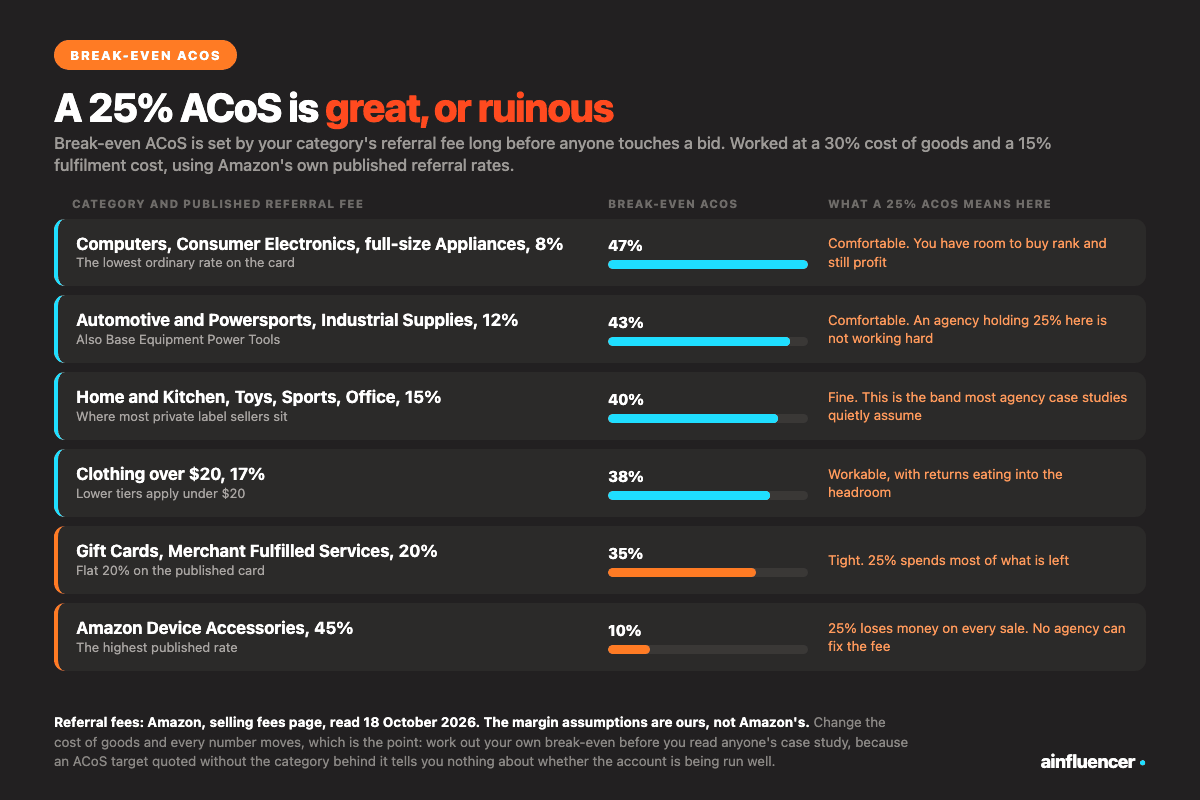
Every agency on a shortlist will quote you an ACoS figure, and the figure is close to meaningless on its own. A 25% ACoS is excellent in one category and loses money on every unit in another, and the thing that decides which is true for you is Amazon’s referral fee, which nobody in the conversation can change.
Work it from the top down. Take 100% of the selling price, remove your cost of goods, remove Amazon’s referral fee for your category, remove fulfilment. What is left is the most you can spend on advertising before a sale stops being worth making. That is your break-even ACoS, and every target you discuss should be read against it.
Run it at a 30% cost of goods and a 15% fulfilment cost, using Amazon’s published rates, and the spread is dramatic. A seller in Computers or Consumer Electronics pays an 8% referral fee and breaks even at roughly 47% ACoS. Home and Kitchen, Toys, Sports and Office all sit at 15% and break even near 40%. Clothing above $20 pays 17% and breaks even around 38%. Amazon Device Accessories pays 45%, and breaks even at about 10%.
Three things follow from that, and they change how you read a pitch:
- An agency reporting 25% ACoS in a 15% fee category is doing ordinary work, not exceptional work. It is well inside break-even and says nothing about skill. Ask what the ACoS was when they took the account over and what it is now
- In a high-fee category, a low ACoS target is not ambition, it is survival. If your break-even is near 10%, the honest conversation is about whether paid search works for your product at all, and an agency that will have that conversation is worth more than one that quotes you a target
- The agency fee belongs inside this calculation. A percentage-of-spend model adds directly to the cost of every sale, so a 10% fee on spend effectively lowers your break-even ACoS. Add it in before you compare two proposals
One refinement worth making once the basics are in place. Break-even ACoS treats every sale as standalone, which is wrong for a product people repurchase. If your category has genuine repeat purchase, the number you can afford on the first sale is higher than this calculation suggests, and that is where TACoS and a lifetime value figure start to matter more than the campaign-level number.
The Reporting Questions That Separate Amazon PPC Agencies
Pricing models and ACoS targets are the easy part of a comparison because every agency answers them. What actually differs between the agencies on any shortlist is what they will show you, what they will let you keep, and what happens when you leave. Five questions, and what a good answer sounds like.
- Do I get access to the search term report, or a summary of it? The search term report is where you see what shoppers actually typed. An agency that hands you a monthly deck instead of access to the account is choosing what you get to know. A good answer is that the account is yours and you have always had access
- Who owns the advertising account? It should be your Seller Central account with the agency as a user, never an agency account running your products. This is the single most expensive thing to get wrong, because an agency-owned account takes all of its history with it when the relationship ends
- What happens to campaign structure and negative keyword lists if I leave? Years of harvested search terms and negatives are the real asset an account builds. Agree in writing that it stays in your account
- Do you report placement-level data? Top of search, rest of search and product pages behave completely differently, and placement modifiers are one of the few genuinely high-leverage controls. An agency that does not report at this level is probably not using it
- How do you tell incremental sales from sales I would have made anyway? This is the question most agencies answer badly, and the honest answer is that it is genuinely hard and requires deliberately turning spend off in controlled ways. An agency that admits the difficulty and describes a method is worth more than one that claims certainty
There is also a cultural signal buried in the answers. Among Amazon’s own Sponsored Products documentation and the reporting it exposes, nothing is hidden from the account owner. So an agency that treats routine account data as something it provides rather than something you already have is telling you how the relationship will feel in month six.
Ask all five in the first call. The answers take ten minutes and they sort a shortlist faster than any case study, because they are about the structure of the arrangement rather than about performance claims nobody can verify from the outside.
FAQs
How much does an Amazon PPC agency cost?
Typical structures: flat retainers from roughly $1,500–$5,000+ monthly by account size, 8–15% of ad spend, or hybrids with performance components. Software-plus-managed services run cheaper for smaller accounts.
Agency or PPC software — which should I choose?
Software handles bid mechanics well at low cost; agencies add strategy, structure, and creative. Under ~$10K/month ad spend, software plus a few strategic hours usually wins; above it, dedicated management typically pays for itself. See the best Amazon PPC tools for the software route.
What’s a good ACoS for my account?
There’s no universal number — it depends on margins, lifecycle stage, and strategy. Launch campaigns tolerate high ACoS to buy rank; mature catalogs manage to blended profitability. The ACoS vs TACoS framing matters more than any benchmark.
Do PPC agencies also run Amazon DSP?
Some do (Ad Advance, for instance); others stick to the Sponsored suite. DSP is a distinct programmatic discipline with its own minimums — see our separate guide to Amazon DSP agencies.
Will restructuring my campaigns hurt current rankings?
Done carelessly, it can — campaign history carries relevance signals. Competent agencies migrate gradually: new structure runs alongside legacy campaigns, budgets shift as the new structure proves itself, and nothing with meaningful history is deleted outright.
Key Takeaways
- A PPC agency buys you compounding weekly optimization — architecture, keywords, bids, creative — without a full-time hire.
- Match the model to spend: software-plus-managed under ~$10K/month, dedicated agencies above it, performance components wherever you can negotiate them.
- Judge every candidate on TACoS thinking, account structure quality, named weekly cadence, creative capability, and clean exit terms.
- Fees are part of your real ACoS — run the margin math before signing.
- Ads capture demand; creator-driven external traffic builds it. The strongest Amazon accounts run both.
Bottom line: PPC management is a weekly discipline priced three ways — buy the model that matches your spend, hold it accountable to TACoS, and remember the fee is part of your real advertising cost. The right partner makes ads a profit engine; the wrong one makes dashboards.
Published on the Ainfluencer Blog. Ainfluencer is an AI-powered influencer marketing marketplace connecting brands with Instagram, TikTok, and YouTube creators for paid collaborations, product gifting, and affiliate deals, with built-in messaging, escrow, and campaign management.