The Best Amazon Affiliate Agencies UK Brands Can Hire in 2026
The agencies and managed services that build Amazon affiliate programs for brands selling on amazon.co.uk, compared by focus, local strength, and pricing model.
Selling on amazon.co.uk and wondering who can actually run your affiliate program, recruit the creators, wire up the tracking, and turn external traffic into attributed sales? This guide compares the strongest Amazon affiliate agency options for brands in the UK, from marketplace-powered managed services to established local specialists.
A quick framing before the list. “Amazon affiliate agency” is a narrower discipline than general affiliate management: attribution runs through Amazon’s own tools, the Brand Referral Bonus reshapes the economics, and the partners that convert best are creators already embedded in Amazon’s ecosystem. Our full guide to the best Amazon affiliate marketing agencies covers the global landscape, and the broader roundup of top affiliate marketing agencies maps the wider industry. This page zooms into what matters for UK-based brands and amazon.co.uk sellers specifically.
Looking to join Amazon Associates yourself? “Amazon affiliate UK” means two different things. If you are a publisher or creator who wants to earn commission by linking to amazon.co.uk, you want the programme itself, and our Amazon Associates programme review covers sign-up, approval and payout, while Amazon affiliate marketing for beginners walks through the first links. This page is for the other side of the market: brands who already sell on amazon.co.uk and want someone to run an affiliate programme for them.
The UK has one of the most mature affiliate industries in the world, because of the ecosystem that grew up around British retail affiliate networks produced a deep bench of specialist agencies. For amazon.co.uk sellers that’s good news: you can hire genuine affiliate craft locally, then layer Amazon-native attribution and creator recruiting on top. Many UK programs also straddle Europe, so pan-European capability is worth screening for from the start.
Why Hire an Amazon Affiliate Agency in the UK?
Running the program yourself means recruiting partners one outreach message at a time, negotiating every commission, tagging every link, and chasing content that never ships. An agency (or managed service) compresses that into a running system. The payoff is bigger than convenience: consistent external traffic is one of the strongest ranking signals on Amazon, and our playbook on driving external traffic to Amazon shows why listings fed by off-Amazon clicks compound in organic search.
For brand-registered sellers there’s a second payoff: agencies tag external traffic with Amazon Attribution so referred sales qualify for the Amazon Brand Referral Bonus, an average of roughly 10% of driven sales credited back to you, which quietly offsets a large share of what you pay partners. A competent agency treats that bonus as part of the program’s P&L from day one, not a footnote.
All Agencies at a Glance
| Agency | Base / coverage | Best for | Pricing model |
|---|---|---|---|
| Ainfluencer | Global (HQ Toronto) | Creator-driven amazon.co.uk programs | Free platform; managed packages |
| Silverbean | Newcastle, UK | Retail & e-commerce programs | Retainer, quote-driven |
| Optimus Performance Marketing | UK | Hands-on retail programs | Retainer, quote-driven |
| ThoughtMix | Lincoln, UK | Launching & scaling programs | Retainer, accessible tiers |
| Genie Goals | UK | Retail brands blending channels | Retainer, quote-driven |
| Navigate Digital | London, UK | Multi-market programs | Retainer, quote-driven |
| Acceleration Partners | Global (US-founded) | Enterprise, multi-market programs | Retainer, quote-driven |
The Best Amazon Affiliate Agencies in the UK
Ainfluencer: Fully Managed Amazon Affiliate Marketing
Ainfluencer runs Amazon affiliate programs on top of a 5M+ creator marketplace with a native Amazon integration: your catalog syncs in, every creator link is tracked and attributed, and its fully managed service handles recruiting, negotiation, content approval, and payouts. For UK brands, the marketplace includes British and international creators ready to push amazon.co.uk listings from day one.
- End-to-end management from recruiting to escrow-protected payouts
- Amazon catalog sync with attributed links and commission tracking
- Creator traffic that qualifies for the Brand Referral Bonus
Silverbean
A well-established UK partnerships agency with deep retail and e-commerce heritage, managing affiliate programs for British brands at home and internationally. For amazon.co.uk sellers, its strength is structured partner recruitment and commercial negotiation across content, loyalty, and creator partners.
- Retail and e-commerce program heritage
- International program management
- Structured partner recruitment
Optimus Performance Marketing
One of the longer-tenured dedicated affiliate agencies in Britain, with hands-on program management and broad publisher relationships built over many years of UK retail affiliate work.
- Veteran UK affiliate team
- Broad publisher relationships
- Hands-on day-to-day management
ThoughtMix
A UK affiliate growth agency known for launching programs from scratch and scaling them for growing brands, an accessible profile for SMB and mid-market amazon.co.uk sellers who need structure without enterprise minimums.
- Program launches from zero
- Growth-stage management
- SMB-friendly engagement sizes
Genie Goals
A retail-focused UK performance agency running affiliate alongside paid channels, useful when your amazon.co.uk affiliate push needs to coordinate with Google and social spend rather than live in a silo.
- Retail specialization
- Affiliate + paid media under one roof
- Channel-coordinated planning
Navigate Digital
A London-based affiliate and performance agency with an international bent, suited to UK brands running programs across several European markets from a single team.
- Multi-market program experience
- London-based senior team
- Media-agnostic performance approach
Acceleration Partners
One of the world’s largest independent partnership agencies, managing full-funnel affiliate programs for enterprise brands across regions and networks. Its London presence makes it the enterprise option for UK brands running global partnership programs.
- Teams across the Americas, Europe, and APAC
- Strategy, recruiting, and compliance at scale
- Deep relationships with major affiliate networks
How Amazon Affiliate Agencies UK Brands Hire Charge
Expect one of three models. Retainers buy dedicated management time and typically start in the low four figures monthly for smaller programs, scaling with scope. Performance models take a percentage of affiliate-driven revenue, which aligns incentives better, but model the math against your margins and Amazon’s fee stack first. Hybrids blend a smaller retainer with a performance component and are the most common structure for mid-sized amazon.co.uk programs. Marketplace-based managed services sit apart: because recruiting happens on an existing creator network instead of manual outreach, their effective cost per activated partner is usually far lower than a traditional agency’s.
In-house, software, or agency?
Three layers get confused constantly, and UK-based sellers waste real money buying the wrong one. In-house means your team recruits and manages partners directly, cheapest on paper, but bandwidth caps most programs at a few dozen partners. Software, the platforms compared in our guide to Amazon affiliate marketing software, provides the tracking, links, and payout rails while you still do the recruiting. Agencies and managed services supply the operators. There’s also the network route: Amazon Associates itself or the Associates alternatives, where affiliates opt in but you control little about who promotes you. Diagnose your bottleneck honestly: if it’s infrastructure, buy software; if it’s hours and relationships, buy the managed layer.
What amazon.co.uk Actually Pays, and Why It Caps Your Offer
Any agency proposal that ignores Amazon’s own rate card is guesswork, because the commission Amazon pays an affiliate on amazon.co.uk is the ceiling your programme has to work under. These are the fixed standard commission income rates published in Amazon’s UK Associates Programme Standard Commission Income Statement, read on 2 October 2026. Amazon does not publish an effective date on that page and revises the table without notice, so confirm it before you sign anything.
| amazon.co.uk category | Fixed commission rate |
|---|---|
| Amazon Fashion Private Brands, Clothing & Accessories, Luxury, Luxury stores beauty, Luxury stores fashion, Shoes, Handbags, Wallets, Watches | 6.0% |
| Amazon Instant Video, Audible Audiobooks, Automotive, Books, Digital Music, Furniture, Handmade, Home, Home Improvement, Jewellery, Kindle Books, Kitchen & Dining, Music, Power & Hand Tools | 5.0% |
| Beauty, Luggage, Personal Care Appliances, Sports & Fitness | 4.0% |
| All other categories | 3.0% |
| Appliances, Fire TV Devices, Mobile Electronics | 2.5% |
| Amazon Fresh, Grocery, Pantry, Video Game Consoles, Video Games | 1.0% |
| Android Apps, Gift Cards, Other Gift Card Brands, Kindle Unlimited, Coach products, Wine | 0.0% |
Read that table next to any pricing conversation. A homeware or furniture brand sits in the 5.0% band and has room to fund a managed programme out of affiliate economics. A grocery or video games seller sits at 1.0%, and no agency retainer survives contact with that number unless the Brand Referral Bonus is doing the heavy lifting instead. Gift cards pay nothing at all, which is why they never belong in an affiliate brief.
Two practical consequences for the UK specifically. First, a creator promoting your amazon.co.uk listing earns the UK rate, not the US one, so briefs copied from a US programme routinely overstate what a British partner will make. Second, because the standard rates are capped this low, serious amazon.co.uk programmes are usually built on top of the rate card rather than out of it: the agency’s job becomes recruiting partners whose volume makes a 3% to 5% category worth working, and tagging the traffic well enough that Amazon’s own incentives apply on top.
The 4-Step Hiring Process
The 4-step process that avoids a locked-in retainer you regret
What a good first 90 days looks like
Whichever partner you pick, hold them to a concrete first quarter. Month one is setup and recruiting: attribution tagging live on amazon.co.uk, commission structure agreed, and a first wave of partners activated, with creators from platforms like TikTok increasingly leading conversion, which is why we track how to find TikTok influencers for Amazon products separately. Month two is content in market: live placements, first attributed clicks, and weekly reporting at partner level. Month three is the verdict: attributed revenue against target, cost per activated partner, and a keep-kill-scale decision on every partner segment. An agency that resists this cadence is selling activity, not outcomes.
The Amazon Affiliate Landscape in the UK
British agencies grew up in a retail-affiliate culture, which shows in their strength with content publishers, loyalty partners, and commercial negotiation. The gap to screen for is Amazon-native mechanics: Attribution tagging and Brand Referral Bonus capture are newer disciplines than classic network management, and not every UK shop has them wired in. If your catalog also sells on amazon.de, prioritize partners with DACH reach. Our guide to Amazon affiliate agencies in Germany maps that side. And for brands splitting inventory across the Atlantic, the US agency landscape is the other half of the picture.
5 Questions to Ask Before You Sign
- How exactly do you track referred sales on amazon.co.uk? The answer must include Amazon Attribution tags, not just network cookies.
- How many creators can you activate in my category, in my market? Ask for numbers and examples, especially for Amazon influencers with storefronts.
- What does month one look like? A credible agency describes recruiting targets, first placements, and a reporting cadence, not a vague “strategy phase.”
- What’s the exit clause? Avoid 12-month lock-ins before a trial period has proven attributed revenue.
- Who owns the partner relationships? If the agency owns them, leaving means restarting from zero. Insist on program ownership staying with your brand.
Why Your Average Order Value Decides Who Will Promote You
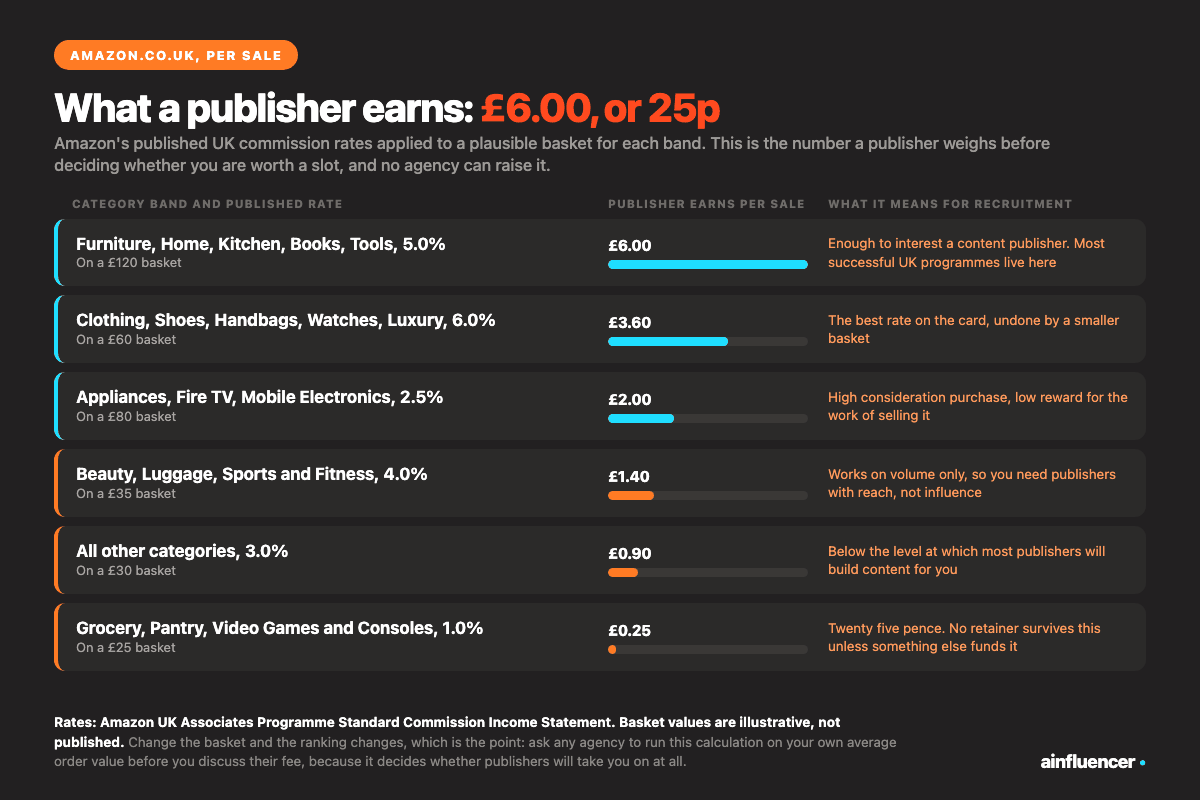
Every shortlist of Amazon affiliate agencies UK brands are shown leads with the rate card, and the rate card is only half the number that matters. A publisher does not earn a percentage, they earn pounds, and the pounds are the rate multiplied by your basket. Two brands on the same 5.0% rate can be completely different propositions to the same reviewer.
Run it through. A furniture or homeware brand with a £120 average order gives a publisher £6.00 a sale. A clothing brand on the better 6.0% rate but a £60 basket gives them £3.60, so the higher rate loses. A beauty brand at 4.0% on a £35 basket gives £1.40. A grocery or video games seller at 1.0% on a £25 basket gives twenty five pence.
That last figure is the one to sit with, because it explains behaviour that otherwise looks like bad luck. A publisher weighing whether to write about your product is pricing their own time, and a piece of content takes the same hours whether it earns six pounds a conversion or twenty five pence. Low basket, low rate brands do not get turned down for being unimpressive. They get turned down because the maths does not work for the other side.
Three practical consequences:
- Ask any agency to run this on your real average order value before you discuss their fee. If they have not, they are selling you recruitment effort into a market that has already priced you
- Bundle and multipack SKUs change the answer more than negotiation does. Raising the basket from £30 to £70 does more for publisher interest than anything an agency can say to a publisher
- Below roughly a pound a conversion, change the publisher type rather than the pitch. Cashback, voucher and loyalty partners work on volume and do not need the per sale figure to justify editorial time. Content publishers do
This is also the honest answer to why some UK programmes never get going despite hiring one of the better Amazon affiliate agencies UK sellers can reach. The programme was never viable at that basket and that rate, and the right response was to fix the offer, not to hire harder.
The Disclosure Law Amazon Affiliate Agencies UK Brands Hire Now Work Under
This is where the UK has moved furthest from the rest of the English speaking market, and where a brief written for a US programme will quietly leave you exposed. Since 6 April 2025 the unfair commercial practices provisions of the Digital Markets, Competition and Consumers Act 2024 have been in force, and they changed who decides and what it costs.
Four things in it bear directly on running an affiliate programme.
- Affiliate commission counts as payment. The CMA’s guidance for brands is explicit that “any form of incentive or reward, including money, commissions, discounts” and gifts of any products is payment. There is no commission-only exemption. If a publisher earns from the link, the content is an ad and has to be labelled as one
- Gifting is caught even when you ask for nothing. The same guidance says that if you send free products you should “include clear instructions that any content posted as a result must be labelled as an ‘Ad'”, and that this applies “even if you don’t ask for anything in return”
- Concealed incentivised reviews are a banned practice. Not a judgement call, not a balancing exercise. The CMA describes behaviour falling under a banned practice as “automatically unfair and illegal”, and it covers reviews that hide having been incentivised, including by a freebie rather than cash
- The responsibility is yours, not only the publisher’s. The CMA tells brands to put the obligation in the contract “whether this is a formal or informal arrangement”, to keep a written policy on creator conduct, to make sure any intermediary such as a marketing or talent agency understands its obligations, and to check content referring to your brand yourself. It also warns that if a creator repeatedly fails to label correctly, “you are at risk if you continue working with them”
What changed most is enforcement. Under the Act the CMA can act directly rather than through a court, deciding itself whether a business has broken the law. The penalty it can impose is “up to 10% of your business’ global turnover or £300,000 (whichever is greater)”, with a further 5% available for breaching directions and a daily penalty on top of that. Cases are published on GOV.UK with the business named, and an appeal runs to the High Court within 60 days.
On labelling itself the CMA is specific and slightly stricter than habit: a label should be “clear, upfront, prominent and timely”, and its recommended wording is “Ad” or “Advert”. A disclosure buried below a fold, trailing a caption, or softened into something vaguer is the failure mode this regime is built to catch.
So add three questions to the shortlist conversation. What is the agency’s written labelling standard, is it in the partner agreement rather than in an email, and what happens the second time a publisher ignores it. An agency that treats UK disclosure as the publisher’s problem is leaving a penalty calculated on your global turnover sitting with you.
FAQs About Amazon Affiliate Agencies in the UK
How much do Amazon affiliate agencies in the UK charge?
Most run retainers (commonly starting in the low four figures monthly), a percentage of affiliate-driven revenue, or a hybrid. Marketplace-based managed services are typically cheaper per activated partner because recruiting happens on an existing creator network rather than through manual outreach.
What commission does amazon.co.uk pay affiliates?
Amazon’s published UK standard rates run from 0% on gift cards and Android apps up to 6.0% on fashion, luxury, shoes and watches, with 5.0% on home, furniture, books and automotive, 4.0% on beauty and sports, 2.5% on appliances and mobile electronics, 1.0% on grocery and video games, and 3.0% for everything else. Amazon revises the table without notice, so treat any figure in an agency proposal as something to verify against the official statement rather than a fixed input.
Should I choose a local UK agency or a global one?
Local partners bring market knowledge and language-native recruiting for amazon.co.uk; global firms bring scale and multi-market coordination. The honest tiebreaker is creator capacity: whoever can activate more relevant partners in your category, wherever they sit, wins. Marketplace-powered services often beat both on that metric.
Can I just run the program in-house instead?
You can. Our guide to Amazon affiliate marketing for beginners covers the mechanics. The ceiling is recruiting bandwidth: in-house teams typically plateau at a few dozen partners, while managed services scale into the hundreds. Many brands start in-house and add the managed layer once recruiting becomes the bottleneck.
Can one agency run my program on both amazon.co.uk and amazon.de?
Yes, and if you sell across Europe you should insist on it. Amazon’s European infrastructure makes multi-market selling straightforward, but partner recruiting is language-specific, so pick an agency (or marketplace service) with genuine DACH creator reach; see our Germany guide for that side of the program.
Key Takeaways
- Amazon affiliate programs on amazon.co.uk need Amazon-native expertise: Attribution tagging, the Brand Referral Bonus, and creator recruiting work differently than generic affiliate marketing.
- UK-based brands can choose between global agencies with local reach, homegrown specialists, and marketplace-powered managed services, each with a different cost structure.
- Vet every option on attribution method, creator capacity in your category, outcome-aligned pricing, and partner-level reporting.
- Run a 60 to 90 day trial with clear KPIs before committing to a long retainer, and keep ownership of partner relationships with your brand.
Published on the Ainfluencer Blog. Ainfluencer is an AI-powered influencer marketing marketplace connecting brands with Instagram, TikTok, and YouTube creators for paid collaborations, product gifting, and affiliate deals, with built-in messaging, escrow, and campaign management.