The Best Amazon DSP Agencies and Managed Partners for 2026
The programmatic partners that run Amazon DSP profitably — audience strategy, creative, and measurement — compared for 2026.
Amazon DSP is the ad product most sellers meet last: programmatic display and video, bought with Amazon’s shopper data, running on and off Amazon. It’s powerful, gated behind spend minimums, and unforgiving of amateur setup — which is exactly why the agency you pick matters more here than in any other Amazon channel.
This guide extends our roundup of the best Amazon marketing services into programmatic. If DSP is new territory, start with our explainer on what Amazon DSP is — the short version: demand-side buying of display, video, and audio inventory using Amazon’s first-party shopper signals, available managed (via Amazon, high minimums) or through agency partners with seat access at lower entry points.
Below: what DSP management involves, when it earns a place in your stack, and six partners worth shortlisting.
What Does an Amazon DSP Agency Do?
Four workstreams. Audience strategy: building in-market, lifestyle, retargeting, and lookalike audiences from Amazon’s shopper data — the targeting depth that separates DSP from Sponsored Display, its self-service cousin. Creative: display and video assets built and rotated against fatigue. Programmatic execution: inventory selection, frequency management, and bid strategy across on-Amazon placements and the open web. Measurement: new-to-brand rates, branded-search lift, and blended return alongside Amazon Attribution data — DSP’s value shows up in the full funnel, and an agency that reports it like Sponsored Products ROAS is measuring the wrong thing.
What sophisticated audience work actually looks like: layered segments, not single lists. In-market shoppers for your category, minus recent purchasers of your brand; viewers of specific competitor detail pages, ramped with tighter frequency caps; past purchasers resurfaced at replenishment intervals for consumables. Each layer gets its own creative message and its own success metric — retargeting closes, prospecting seeds branded search. Ask a candidate agency to sketch this map for your catalog in the sales call; the ones who can, in specifics, are the ones worth shortlisting.
What a programmatic engagement covers
What a good first 90 days looks like
Month one: seat setup, audience architecture, creative production, measurement plan with baselines. Month two: campaigns live — retargeting first for fast signal, prospecting layered in — with frequency tuning weekly. Month three: the full-funnel readout: new-to-brand share, branded-search lift, detail-page-view growth, blended TACoS impact, and a scale recommendation per audience layer. DSP verdicts before day 60 are noise; verdicts without baselines are fiction. Where budgets allow, ask for a simple geo or audience holdout so lift claims rest on a comparison, not a hunch.
The 4 numbers to track
Insist the standard report leads with four numbers:
- New-to-brand share. The percentage of DSP-driven orders from first-time buyers — prospecting’s real scoreboard.
- Branded-search lift. Upper-funnel exposure surfacing as search demand; pair DSP flights with search-volume tracking.
- Effective frequency. Impressions per shopper per window; the governance number that separates presence from pestering.
- Blended TACoS impact. What the whole ad stack costs against total sales while DSP runs — the CFO’s only question.
When You Need One — and When You Don’t
DSP earns its slot when the Sponsored suite is saturated: you’re winning the search terms you can profitably win, and growth now requires reaching shoppers before they search, or recapturing the ones who browsed and left. Practical prerequisites: meaningful ad budget (agency-seat minimums commonly start around $5–10K/month of DSP spend), conversion-ready listings, and existing PPC discipline — DSP amplifies a working account; it doesn’t rescue a broken one. If retargeting is your only goal at small scale, Sponsored Display covers part of the job self-serve.
Creative readiness is the other prerequisite: DSP without purpose-built display and video assets defaults to auto-generated banners that waste premium audiences. If you have no creative pipeline, solve that first — or pick a partner whose production is genuinely in-house. Creator content is an underused source here: authentic video from influencer campaigns consistently outperforms studio banners in programmatic placements, which is one more reason to run the creator and DSP programs as one system.
All Options at a Glance
| Agency | Focus | Best for | Pricing model |
|---|---|---|---|
| Tinuiti | DSP within full commerce media | Enterprise, multi-retailer brands | Retainer/% of spend |
| Podean | Marketplace strategy + DSP | Global Amazon-first brands | Retainer, quote-driven |
| Envision Horizons | DSP + Sponsored suite | Mid-market brands adding programmatic | Retainer, quote-driven |
| Trivium Group | Ads-led growth incl. DSP | Scaling sellers adding DSP | Retainer, quote-driven |
| Ad Advance | Sponsored Ads + DSP | Ads-only engagements | Retainer/% of spend |
| Nuanced Media | DSP within marketplace strategy | Strategy-led engagements | Retainer, quote-driven |
6 Best Amazon DSP Agencies
Tinuiti
The heavyweight of commerce media: one of the largest independent performance agencies, with deep Amazon DSP practice inside a broader retail-media capability spanning multiple platforms — the enterprise default when budgets and stakes are high.
- Deep DSP bench and tooling
- Multi-retailer commerce media view
- Enterprise measurement discipline
Podean
An Amazon-dedicated agency with global market coverage, running DSP inside marketplace-first engagements — a fit for brands whose entire growth thesis runs through Amazon across several countries.
- Amazon-first specialization
- Multi-market coverage
- DSP inside full marketplace strategy
Envision Horizons
An Amazon-focused agency pairing Sponsored-suite management with a DSP practice — the shape most mid-market brands need, where programmatic budgets coordinate with search rather than compete with it.
- Sponsored + DSP coordination
- Mid-market engagement sizes
- Amazon-focused reporting
Trivium Group
An Amazon-only growth agency whose ads practice extends into DSP — convenient for sellers who want one accountable team across the full advertising stack as they graduate into programmatic.
- One team across ads stack
- Hands-on account management
- Structured optimization cadence
Ad Advance
A dedicated Amazon ads shop with DSP seat access and a data-heavy approach — the specialist profile when advertising is the entire scope and you want depth over breadth.
- DSP seat access at accessible minimums
- Data-led audience building
- Ads-only focus
Nuanced Media
An Amazon-focused agency running DSP within wider marketplace strategy work — useful when programmatic decisions need to align with catalog, pricing, and lifecycle plans rather than run standalone.
- Strategy + execution pairing
- DSP coordinated with catalog plans
- Amazon-focused practice
How Pricing Works
Two cost layers stack: media spend (the DSP budget itself — agency-seat entry commonly around $5–10K/month, far below Amazon’s managed-service minimums) and the management fee — typically 10–20% of spend or a flat retainer. Creative production may bill separately; clarify before signing. The economics work when DSP is judged on full-funnel outcomes (new-to-brand share, branded-search lift, blended TACoS impact) over 60–90 day windows — programmatic priced and measured like bottom-funnel search disappoints by design.
Your three routes, compared
| Route | Cost structure | Best when |
|---|---|---|
| Sponsored Display self-serve | Ad spend only | Basic retargeting at small scale |
| Agency DSP seat | ~$5–10K/mo media + 10–20% fee | Full programmatic control at accessible entry |
| Amazon managed service | High minimums (~$50K+) | Enterprise budgets wanting Amazon-direct service |
Three negotiation tips
- Fix the audience-refresh cadence in the contract — segment decay is where set-and-forget programs die.
- Clarify creative costs upfront: in-house production versus billed-out changes the real fee materially.
- Agree the measurement framework at signing: NTB share, search lift, and blended TACoS over 60–90 days — not weekly ROAS.
Where to Find Amazon DSP Partners Beyond This List
Six agencies is a shortlist, not the market. If none of them fits your category, country or budget, there are two other routes, and each one tells you something different.
Amazon’s own partner directory. Amazon Ads runs a public Find a Partner directory of agencies and tool providers working with its ad products. It is the quickest way to build a longlist in a specific market. What a listing does not tell you is how anyone performs: being in the directory means a partner met Amazon’s requirements to be listed, not that it has run a profitable DSP programme for a brand like yours. Use it to source candidates, then put each one through the five criteria below.
Amazon’s managed service. You can also skip agencies entirely and have Amazon’s own team run DSP for you. There is no agency fee, and you get Amazon-direct service, but minimums are high, commonly cited around $50K, and you give up most of the day to day say over audience strategy that an agency seat gives you. For most brands under that threshold the question answers itself.
Whichever route you take, the question to ask first is the same one most sellers forget: who owns the DSP seat, and what happens to your audience data and campaign history if you leave. An agency that cannot answer that plainly is a risk no amount of reporting polish offsets.
How to Choose: 5 Criteria
- Seat access and minimums. Confirm actual DSP seat entry spend and whether it fits your budget with room to test.
- Audience methodology. Ask how they build and refresh segments from shopper signals — canned retargeting-only setups waste DSP’s targeting depth.
- Creative capability. Display and video production, rotation cadence, and fatigue monitoring — in-house or billed out?
- Full-funnel measurement. New-to-brand, search lift, and blended return in the standard report — not last-click ROAS alone.
- Coordination with search. DSP and the Sponsored suite must share learnings and budgets; if your PPC lives elsewhere, see our Amazon PPC agencies guide and decide whether to consolidate.
4 Mistakes to Avoid When Hiring
- Judging DSP on last-click ROAS. Its value lands in new-to-brand share and search lift; bottom-funnel math alone kills good programs early.
- Set-and-forget audiences. Segments decay; refresh cadence should be named in the contract.
- No frequency governance. Uncapped retargeting torches budget and brand goodwill on the same shopper twelve times a day.
- Silos between DSP and search. Prospecting spikes branded search — if the PPC team doesn’t harvest it, the DSP dollars leak into competitors’ ads.
More Amazon Growth Guides
This article is part of our agency cluster for Amazon sellers. Explore the rest:
- 7 Best Amazon Influencer Marketing Agencies
- 6 Best Amazon PPC Agencies
- 6 Best Amazon FBA Agencies for Full-Service Growth
- 5 Best Amazon Listing Optimization Services
- 7 Best TikTok Shop Affiliate Agencies
- 10 Best Amazon Affiliate Marketing Agencies
Amazon DSP Is Now Amazon Ads Agent, and What That Changes
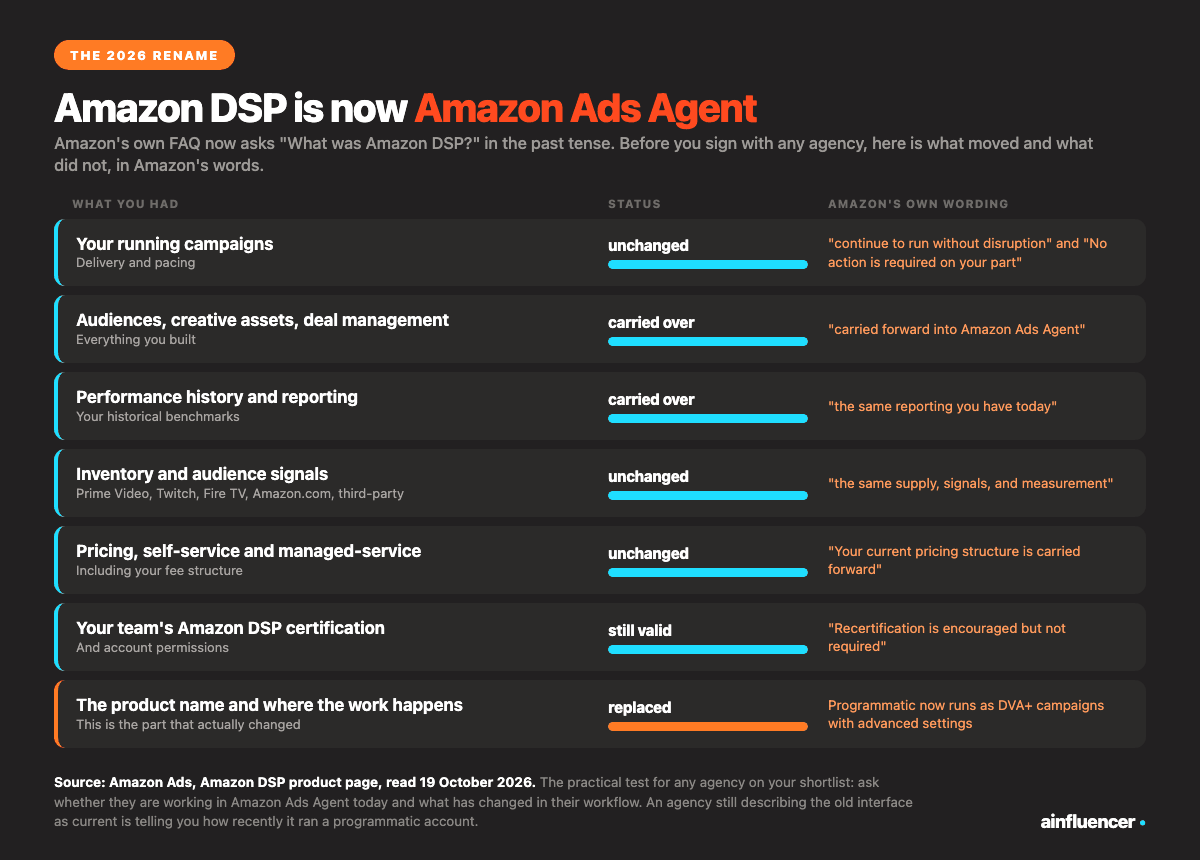
Start here, because it is the most current thing on this page and most comparisons have not caught up with it. On Amazon’s own product page the heading now reads “Amazon DSP is now part of Amazon Ads Agent”, and the FAQ beneath it asks “What was Amazon DSP?” in the past tense.
What that means in practice: the programmatic capabilities you knew as Amazon DSP now live inside Amazon Ads Agent, bought through Display, Video, and Audio campaigns, with the full set of old controls available under advanced settings. Amazon’s stated reason is consolidation, so that programmatic and sponsored ads stop being two tools with two sets of numbers.
The reassuring part, in Amazon’s words rather than anyone’s interpretation:
- Campaigns keep running. They “continue to run without disruption”, and “No action is required on your part to maintain campaign delivery”
- Everything you built comes with you. Campaign settings, audience segments, creative assets, deal management and performance history are “carried forward”
- The buy itself is the same. You access “the same inventory, the same audience signals, and the same reporting”
- Pricing does not move. “Your current pricing structure is carried forward”, including both self-service and managed-service options
- Certifications hold. Existing Amazon DSP certification “remains valid”, and recertification is “encouraged but not required”
So nothing was taken away. What changed is the name, the interface and the route to the controls, and that is enough to matter when you are choosing who runs your money.
Two questions to add to every shortlist call. First, are you working in Amazon Ads Agent today, and what has changed in your workflow? An agency still describing the old console as current is telling you how recently it has actually been inside a programmatic account. Second, how are you handling the shift from managing programmatic and sponsored ads separately, since the whole point of the consolidation is shared signals and shared measurement, and an agency that keeps running them as two unrelated programmes is leaving the new platform’s only real advantage on the table.
Where Amazon DSP Agencies Can Actually Place Your Ads
The thing that makes this channel different from the Sponsored suite is not the bidding technology, it is the inventory. Amazon describes the supply as display, video, audio and streaming TV across its own properties and third-party publishers, and names the exclusive inventory specifically: Prime Video, Twitch, Thursday Night Football, Amazon.com and Fire TV, “along with thousands of premium third-party sites and apps”.
Read that list against your product before you read any agency’s case studies, because the supply splits into three quite different buys:
- Amazon’s own shopping surfaces. Closest to the Sponsored suite in intent and the easiest to attribute, since the shopper is already on Amazon. This is where most of the retargeting lives and where results arrive fastest
- Streaming and living room: Prime Video, Fire TV, Thursday Night Football. Reach and brand building, not click-through. If you judge this inventory on last-click ROAS you will conclude it does not work, because the measurement is the thing that is hard here, not the targeting
- Twitch, audio and third-party sites and apps. The widest reach and the least shopping intent, useful for audience building and for reaching people before they search, which is the stated reason to be on this channel at all
One point worth being blunt about, and it is also a point about creative. These placements are not search results. A banner auto-generated from a product listing will technically run on premium inventory and will waste it, which is why creative readiness belongs in the prerequisites rather than in the nice-to-haves.
The question this gives you for a shortlist is more useful than asking about results. Ask which of those three inventory groups the agency has actually spent in during the last twelve months, and ask how it measured each one differently. An agency that measures streaming the way it measures retargeting is either not running streaming or not measuring it, and either answer tells you something you needed to know before signing.
FAQs
What’s the minimum budget for Amazon DSP?
Through Amazon’s managed service, minimums are high (commonly cited around $50K+). Through agency partners with seat access, entry typically starts around $5–10K/month of media spend plus a management fee of roughly 10–20% or a flat retainer.
Amazon DSP vs Sponsored Display — what’s the difference?
Sponsored Display is the simplified self-service sibling: easy setup, limited control. DSP offers full programmatic control — granular audiences, off-Amazon inventory, video, and frequency management — at the cost of complexity and minimums. Details in our Sponsored Display guide and DSP explainer.
How should DSP performance be measured?
On full-funnel outcomes over 60–90 day windows: new-to-brand share, branded-search and detail-page-view lift, and blended TACoS impact. Judging DSP on last-click ROAS alone systematically undervalues it and leads to premature shutdowns.
Do I need DSP if my PPC is still scaling?
Usually not yet. DSP amplifies accounts that have saturated profitable search demand; it doesn’t fix underbuilt PPC. Graduate to programmatic when incremental search spend stops buying incremental profit.
Can Amazon DSP drive traffic to destinations outside Amazon?
Yes — DSP can land traffic on DTC sites and other off-Amazon destinations while still using Amazon’s audience data for targeting. Most seller-side programs point at listings for attribution cleanliness, but hybrid brands use both routes deliberately, splitting audiences by where each converts best and measuring the two paths separately.
Key Takeaways
- DSP is programmatic buying powered by Amazon’s shopper data — a different discipline from the Sponsored suite, with its own minimums and measurement logic.
- Enter through agency partners (~$5–10K/month media entry) rather than managed-service minimums, with fees of ~10–20% of spend.
- Hire for audience methodology, creative capability, and full-funnel measurement — retargeting-only setups waste the product.
- Sequence matters: saturate profitable search first; DSP amplifies working accounts.
- Coordinate DSP, search, and creator-driven external traffic as one demand system, not three silos.
Bottom line: DSP is a full-funnel amplifier for accounts that have already saturated profitable search. Enter through an agency seat, demand layered audiences and real creative, and judge it on the funnel metrics it actually moves — or don’t run it yet.
Published on the Ainfluencer Blog. Ainfluencer is an AI-powered influencer marketing marketplace connecting brands with Instagram, TikTok, and YouTube creators for paid collaborations, product gifting, and affiliate deals, with built-in messaging, escrow, and campaign management.