Shopify Influencer Marketing
Shopify gives every merchant a free influencer app in Collabs, which is why most stores start there and why most stores stop there. Collabs is genuinely good at one thing, paying commission to creators who already want to work with you. It is weak at the part that decides whether a programme works at all: finding creators who have never heard of your store.
For the store side rather than the creator side, ecommerce skills for Claude Code lists fourteen downloadable Agent Skills for conversion, pricing, email and churn.
This guide is written for a merchant with a store and no programme yet. It covers what Collabs does and does not do, the four ways to find creators when the built in directory runs out, what a first campaign should cost, and how to tell within three weeks whether it is working.
Start with Shopify Collabs, and know its edges
Collabs installs free from the Shopify admin, gives you an application page creators can apply through, generates affiliate links and discount codes, and pays commission automatically out of your Shopify balance. For a store with any existing audience that is a genuinely strong start, and there is no argument for paying for software before you have used it.
| What Collabs does well | Where it stops |
|---|---|
| Affiliate links and codes generated per creator, no setup | Discovery is limited to creators inside Shopify’s own network |
| Commission paid automatically from your Shopify balance | No outreach to creators who have not applied to you |
| A branded application page creators can find you through | No audience authenticity checking, so you vet by eye |
| Gifting workflow tied to your real product catalogue | Reporting is order attributed, so upper funnel work looks like nothing |
| Free, with no monthly fee at any volume | Creators must already be on Shopify’s network to be reachable |
The honest recommendation: install Collabs, run your first five creators through it, and only add anything else when you can name the specific thing it is failing to do. Most stores never need to.
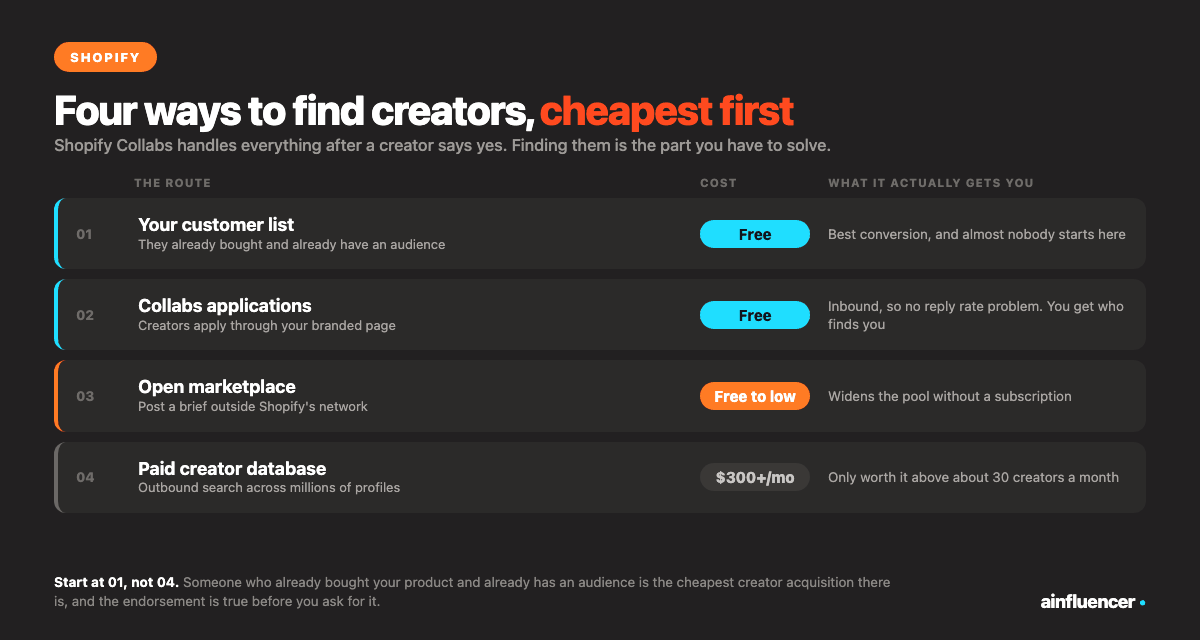
Four ways to find creators, in the order that costs least
1. Your own customer list
Someone who already bought and already has an audience is the cheapest creator acquisition available, and the relationship exists before the pitch. Export your customers, check which ones have a public social handle, and offer those people first. Conversion from this group is consistently better than from a cold database, because the endorsement is true.
This is the single most skipped step in Shopify influencer marketing, and it costs nothing but an afternoon.
2. Collabs applications
Publish the application page, link it in your footer and in post purchase emails, and let creators come to you. Inbound applicants have already decided they want the product, which removes the reply rate problem entirely. The limit is volume: you get the creators who find you, not the ones you want.
3. An open marketplace
Marketplaces outside Shopify’s network widen the pool without a subscription. You post a brief, creators apply, and you choose. Our list of free influencer marketing tools covers the ones that cost nothing, and influencer marketing platforms compares the paid databases if you get to the point of needing outbound reach.
4. A paid creator database
Worth it only when discovery is genuinely the bottleneck, which for most stores is somewhere above thirty creators a month. Below that the subscription costs more than the hours it saves. The full comparison of what these tools do is in affiliate software for Shopify stores for the commission side, and Shopify affiliate marketing agencies if you would rather hand the work over.
Vet before you ship product, not after
Collabs shows you follower counts. It does not tell you whether those followers are real, which is the check that decides whether the campaign was a waste. Auditing one profile by hand takes 15 to 25 minutes, which is why it gets skipped on exactly the campaigns that needed it.
Three checks cover most of the risk: engagement rate measured against the creator’s own size band rather than a global average, the share of followers that look purchased, and whether the audience is in a country you actually ship to. That last one is the commonest expensive mistake in ecommerce influencer marketing. The full walkthrough is in how to audit an influencer profile, and vetting influencers covers reading the result.
What to pay, and in what form
| Structure | When it fits | What it costs you | The catch |
|---|---|---|---|
| Gifting only | Under $60 product, nano and micro creators | Product cost plus shipping | Creators owe you nothing. Expect a third to never post |
| Gift plus commission | The default for most Shopify stores | Product plus 10 to 20% of tracked sales | Only pays the creator if it works, which some will refuse |
| Flat fee | Creators with proven conversion, or a launch date | Cash up front, negotiated per creator | You carry all the risk |
| Flat fee plus commission | Repeat partners you want to keep | Lower fee than flat alone, plus commission | More admin, and worth it above a handful of creators |
Whatever you agree, the range to open from is in influencer rates, and the negotiation itself should stay with a person rather than a template.
Measuring it, and the trap in Shopify’s own numbers
Collabs attributes a sale when someone uses a creator’s link or code. That is clean, auditable and undercounts badly, because a large share of people who discover a product through a creator search the brand name later and buy directly. The number Collabs shows you is a floor, not a measurement.
Two things fix most of it. Give every creator a unique discount code as well as a link, because codes get used when links get lost. And watch direct and branded search traffic in the week after a post goes live, because that is where the uncounted half shows up. The mechanics are in how to track influencer marketing and the numbers worth holding a campaign to are in influencer marketing KPIs.
The three week rule
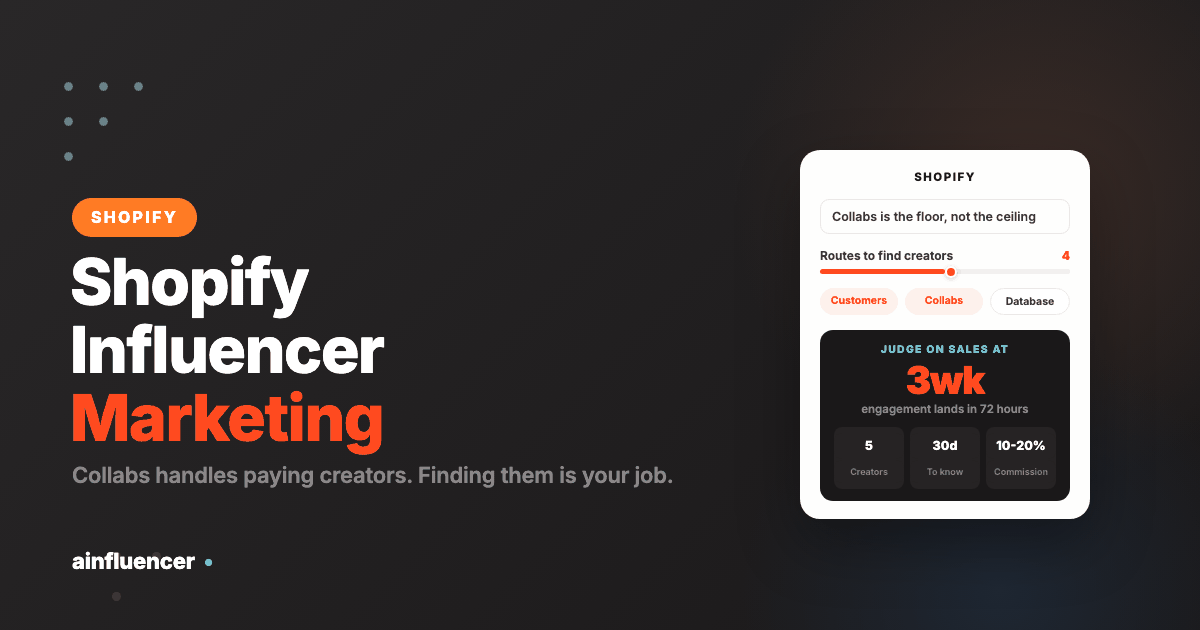
Engagement on a post lands within about 72 hours. Conversion does not. A creator whose post looked quiet can still be your best performer three weeks later, and a creator whose post did huge numbers can convert nothing at all. Judge on sales at three weeks, never on the first day’s likes.
A first thirty days that works
| Week | Do this | Why now |
|---|---|---|
| 1 | Install Collabs, publish the application page, link it in the footer and in post purchase emails | Costs nothing and starts inbound applications running in the background |
| 2 | Export your customer list, find the ones with a public handle, offer those first | Cheapest and best converting creators you will ever get |
| 3 | Ship product to five creators with a unique code each | Five is enough to learn the shape without risking real money |
| 4 | Read the results, keep the two that worked, write down what they had in common | That pattern is your brief for every creator after this |
Creator tiers matter here more than they sound: nano influencers and micro influencers are where ecommerce gifting works hardest, because the product is worth more to them than the fee. The wider programme logic sits in influencer marketing strategy.
Where Shopify stores lose money on this
- Shipping before vetting. Product goes out, then someone notices 40% of the audience is in a country you do not ship to.
- Judging on day one. Likes arrive in 72 hours, sales take three weeks, and stores cut the wrong creators.
- Only counting codes. The link and code number is a floor. Half the effect arrives as direct traffic.
- Ignoring the customer list. The best creators for your store may already be in your orders table.
- Paying flat fees first. Before you know your conversion rate per creator type, a flat fee is a guess with your money.
If gifting is the route you take, product seeding platforms and product gifting platforms cover the tooling, and influencer outreach templates covers the message that gets a reply.
Frequently asked questions
Is Shopify Collabs free?
Yes. Collabs installs free from the Shopify admin with no monthly fee at any volume. You pay the commission you agree with each creator, taken from your Shopify balance, and the product you gift. There is no software cost.
Is Shopify Collabs enough on its own?
For most stores starting out, yes. It handles affiliate links, codes, gifting and commission payment without setup. Where it stops is discovery: it reaches creators inside Shopify’s own network who apply to you, and it does no outreach and no audience authenticity checking. Stores outgrow it at the point finding creators becomes the bottleneck rather than paying them.
How do I find influencers for my Shopify store?
In this order, because it is also the order of cost: your own customer list, which is free and converts best; Collabs applications, which are inbound so reply rates are not a problem; an open marketplace to widen the pool; and a paid creator database only when discovery is genuinely the bottleneck, usually above thirty creators a month.
What commission should a Shopify store pay influencers?
Ten to twenty percent of tracked sales is the common range for gift plus commission, which is the sensible default because Collabs handles the commission half automatically and the structure only pays when it works. Flat fees make sense for creators with proven conversion or for a launch date, but not before you know your own conversion rate per creator type.
How long before influencer marketing works on Shopify?
Engagement lands within about 72 hours, conversion takes roughly three weeks. Judge creators on sales at three weeks rather than on the first day’s likes, because the two frequently disagree. Thirty days and five creators is enough to know whether the channel suits your product.
Does Shopify Collabs track all the sales an influencer drives?
No, and it is important to know that. Collabs attributes a sale when someone uses the creator’s link or code, which is auditable but undercounts, because many people who discover a product through a creator search the brand later and buy directly. Treat the Collabs number as a floor and watch direct and branded search traffic in the week after a post goes live.